Four Flavors of Accounting: Tax, Project, Financial, and Cost Accounting Explained
G
GeoRenus Editorial Team
1,102 views
GeoRenus Editorial Team
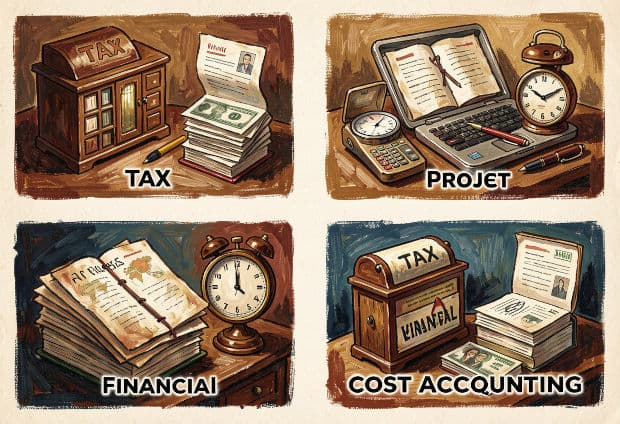
The four flavors of accounting — tax, project, financial, and cost — each serve unique purposes in the business world. Tax accounting focuses on compliance with tax laws and minimizing tax liability. Project accounting tracks the financial performance of individual projects from start to finish. Financial accounting provides a standardized view of a company's overall financial health to external stakeholders. Cost accounting breaks down the actual costs of producing goods or services to help management make informed decisions. Together, these four types give businesses a comprehensive toolkit for managing their finances.
When most people hear the word "accounting," they picture someone hunched over spreadsheets crunching numbers. But accounting is far more diverse than that single image suggests. In reality, accounting comes in several distinct flavors, each serving a different purpose and audience. Think of it like ice cream — vanilla is great, but there's a whole world of flavors out there. In the business world, four major types of accounting dominate the landscape: tax accounting, project accounting, financial accounting, and cost accounting. Understanding each one can give you a much clearer picture of how businesses manage their money.
Tax accounting is probably the type most people are familiar with, even if they don't know the technical term. Every time you file your annual tax return, you're engaging in a basic form of tax accounting. For businesses, however, it gets considerably more complex.
Tax accounting focuses on preparing tax returns and planning for future tax obligations in accordance with tax laws and regulations. Unlike financial accounting, which follows GAAP or IFRS, tax accounting follows the Internal Revenue Code (IRC) in the United States or equivalent tax legislation in other countries.
Let's say you own a retail business called Haq Brothers Trading Co. At the end of the fiscal year, here's what your tax accountant would do:
First, they'd gather all your income records — total sales revenue, interest income, rental income, and any other earnings. Let's say Haq Brothers earned $500,000 in total revenue this year.
Next, they'd identify all allowable deductions: cost of goods sold ($200,000), employee salaries ($100,000), rent ($36,000), utilities ($12,000), depreciation on equipment ($15,000), and business insurance ($8,000). That's $371,000 in total deductions.
Your taxable income would be $500,000 - $371,000 = $129,000. If the corporate tax rate is 25%, Haq Brothers would owe $32,250 in taxes.
But a good tax accountant doesn't stop there. They'd also look for tax credits, carry-forward losses from previous years, and legitimate tax planning strategies to reduce that liability. Maybe Haq Brothers invested $20,000 in qualifying research and development — that could earn a tax credit that further reduces the bill.
Project accounting is a specialized form of accounting that tracks the financial performance of individual projects. It's especially common in industries like construction, consulting, software development, and manufacturing where work is organized around discrete projects rather than continuous operations.
While financial accounting looks at the company as a whole, project accounting zooms in on each project as its own mini-business, tracking its budget, actual costs, revenue, and profitability independently.
Imagine you run a small apparel manufacturing company and you've just landed a contract to produce 10,000 premium hoodies for a retail chain. Here's how project accounting would track this from start to finish:
Step 1 — Budget Planning: Before cutting a single piece of fabric, you'd create a detailed project budget. Raw materials (fabric, zippers, labels): $50,000. Direct labor: $30,000. Machine time and overhead allocation: $10,000. Packaging and shipping: $5,000. Total projected cost: $95,000. The contract price is $150,000, giving you an expected profit margin of about 37%.
Step 2 — Cost Tracking: As the project progresses, your project accountant tracks actual costs against the budget. By the halfway point, you've spent $52,000 on materials (over budget by $2,000 because fabric prices increased) but only $12,000 on labor (under budget because the team worked more efficiently than expected).
Step 3 — Revenue Recognition: Using the percentage-of-completion method, you recognize revenue proportionally as work is completed. If 60% of the hoodies are finished, you'd recognize $90,000 in revenue (60% of $150,000).
Step 4 — Risk Management: The project accountant flags that fabric costs are trending higher than budgeted. Management can now decide whether to negotiate with the supplier, find an alternative material source, or accept the lower margin.
Step 5 — Project Audit and Closeout: Once all 10,000 hoodies are delivered, the project is audited. Final costs came in at $98,000 (slightly over the $95,000 budget), and total revenue was $150,000. The actual profit margin was 34.7% — slightly below the projected 37%, but still healthy.
Financial accounting is the heavyweight champion of the accounting world. It's the type that produces the financial statements — income statement, balance sheet, cash flow statement, and statement of changes in equity — that investors, creditors, regulators, and other external stakeholders rely on to make decisions.
Financial accounting follows standardized frameworks, primarily Generally Accepted Accounting Principles (GAAP) in the United States or International Financial Reporting Standards (IFRS) used in most other countries. These standards ensure that financial statements are comparable, reliable, and transparent.
The income statement (also called the profit and loss statement) shows how much money a company earned and spent over a specific period. Here's a simplified example for a company called GreenLeaf Organics for the year ended December 31, 2025:
Revenue: $1,200,000. Cost of Goods Sold: $720,000. Gross Profit: $480,000. Operating Expenses — Salaries: $150,000, Rent: $48,000, Marketing: $36,000, Depreciation: $24,000, Utilities: $18,000. Total Operating Expenses: $276,000. Operating Income: $204,000. Interest Expense: $12,000. Income Before Tax: $192,000. Tax Expense (25%): $48,000. Net Income: $144,000.
The balance sheet provides a snapshot of what a company owns (assets), owes (liabilities), and the residual value belonging to owners (equity) at a specific point in time. Using the same GreenLeaf Organics example:
Assets — Cash: $85,000, Accounts Receivable: $120,000, Inventory: $95,000, Equipment: $200,000, Less Accumulated Depreciation: ($48,000). Total Assets: $452,000.
Liabilities — Accounts Payable: $65,000, Short-term Loan: $40,000, Long-term Debt: $100,000. Total Liabilities: $205,000.
Equity — Common Stock: $100,000, Retained Earnings: $147,000. Total Equity: $247,000.
Total Liabilities + Equity: $452,000. Notice that this equals Total Assets — the fundamental accounting equation (Assets = Liabilities + Equity) always holds true.
Cost accounting is an internal-facing type of accounting that focuses on capturing and analyzing all costs associated with producing a product or delivering a service. While financial accounting reports to the outside world, cost accounting serves management by providing the detailed cost information needed to make pricing decisions, control expenses, and improve efficiency.
As Peter Drucker once said, "What gets measured gets managed." Cost accounting is all about measuring costs so they can be managed effectively.
Cost accounting categorizes costs in several ways:
Let's look at a cost sheet for a furniture manufacturer producing 500 wooden dining tables in a month:
Direct Materials — Wood: $25,000, Hardware (screws, brackets): $3,000, Finish/Stain: $2,000. Total Direct Materials: $30,000.
Direct Labor — Carpenters (2,000 hours at $20/hr): $40,000, Finishing team (500 hours at $18/hr): $9,000. Total Direct Labor: $49,000.
Manufacturing Overhead — Factory rent: $8,000, Equipment depreciation: $3,000, Utilities: $2,500, Supervisor salary: $5,000, Quality control: $1,500. Total Manufacturing Overhead: $20,000.
Total Production Cost: $99,000. Cost Per Table: $99,000 / 500 = $198 per table.
If the company sells each table for $350, the gross profit per table is $152, giving a gross margin of about 43.4%. This level of detail helps management understand exactly where their money is going and where there might be opportunities to reduce costs.
Each of the four flavors of accounting brings something essential to the table. Tax accounting keeps you on the right side of the law while minimizing your tax burden. Project accounting gives you visibility into individual project performance so you can course-correct before it's too late. Financial accounting provides the standardized reports that the outside world relies on to evaluate your company. And cost accounting gives management the granular cost data needed to make smart operational decisions.
Most successful businesses don't choose just one flavor — they use all four in combination. A manufacturing company, for instance, might use cost accounting to optimize production costs, project accounting to track individual client orders, financial accounting to prepare annual reports for investors, and tax accounting to ensure compliance and minimize tax liability. Understanding these four types of accounting is fundamental to understanding how businesses really work behind the scenes.

Every single day you go to a shop, hand over some notes, and walk away with what you need. The shopkeeper happily accepts those notes without any hesitation. But have you ever stopped and thought — why does that work? What is actually behind those pieces of paper that makes everyone willing to accept them? Why does a 500 taka note say "চাহিবামাত্র ইহার বাহককে দিতে বাধ্য থাকিবে" — meaning the bearer must be paid on demand? Money is so deeply embedded in our daily lives that most of us never question how it actually works. But understanding money — what it really is, how it functions, where it came from, and what different types exist — is the foundation of understanding any economy. At its core, money is simply a medium of exchange that people use to trade goods and services, repay debts, and measure value. It sounds simple. But the story behind it spans thousands of years and several fascinating transformations — from cowrie shells and whale teeth to gold coins, paper notes, and digital deposits.