Analysis
14 articles
B
Business
March 7, 2026
Break-Even Analysis: How to Know When Your Business Starts Making Money
Break-even analysis helps business owners figure out exactly how many units they need to sell before they start turning a profit. By comparing fixed costs, variable costs, and selling price, you can find your break-even point and make smarter decisions about pricing, budgeting, and growth. This guide walks you through the formula, a real-world example, the benefits, limitations, and practical tips to lower your break-even point.

893Read
A
Analysis
March 2, 2026
Business Analysis Tools: A Complete Guide to the Best Tools
Business analysis tools help organizations identify needs, model processes, collaborate effectively, and visualize data for better decision-making. This guide covers the top tools including Jira, Confluence, Trello, Balsamiq, Microsoft Visio, Wrike, Bizagi Modeler, and more, with details on features, pricing, and best use cases.
959Read
A
Analysis
March 2, 2026
MoSCoW Analysis: Definition, Method, and How to Prioritize
MoSCoW Analysis is a prioritization framework that classifies project requirements into Must Have, Should Have, Could Have, and Won't Have categories. Developed by Dai Clegg at Oracle in 1994, it helps teams make clear trade-offs and focus resources on what matters most. The method is widely used in Agile, product management, and business planning.
939Read
A
Analysis
March 2, 2026
SCRS Analysis: Definition, Framework, and How to Apply It
SCRS Analysis is a structured business analysis framework that guides projects through four phases: Strategy, Current State, Requirements, and Solution. It ensures that every project decision aligns with organizational goals while addressing real gaps and delivering actionable solutions.
888Read
A
Analysis
March 2, 2026
VPEC-T Analysis: Definition, Components, and How to Use It
VPEC-T Analysis is a thinking framework developed by Nigel Green and Carl Bate that examines information systems through five lenses: Values, Policies, Events, Content, and Trust. It helps organizations bridge the gap between business needs and IT solutions by capturing multiple stakeholder perspectives and surfacing hidden assumptions that traditional analysis methods often miss.
812Read
A
Analysis
March 2, 2026
STEER Analysis: Definition, Components, and How to Apply It
STEER Analysis is a strategic framework that examines five external macro-environmental factors: Sociocultural, Technological, Economic, Environmental, and Regulatory. It helps businesses identify threats, spot opportunities, and make informed strategic decisions by systematically scanning the forces beyond their direct control.
924Read
A
Analysis
March 2, 2026
MOST Analysis: Definition, Framework, and How to Use It
MOST Analysis is a strategic planning framework that stands for Mission, Objectives, Strategies, and Tactics. It helps organizations ensure internal alignment by creating a clear hierarchy from their overarching purpose down to the specific daily actions taken by teams and individuals. This guide covers the framework's components, a practical Tesla example, and its advantages and limitations.

907Read
A
Analysis
March 1, 2026
CATWOE Analysis: Definition, Framework, and Examples
CATWOE Analysis is a structured problem-framing framework developed by Peter Checkland as part of Soft Systems Methodology. It examines business problems through six lenses: Customers, Actors, Transformation Process, Worldview, Owners, and Environmental Constraints. This comprehensive guide explains each element, provides a real-world ride-sharing example, and explores the advantages and limitations of the framework.

1,033Read
A
Analysis
March 1, 2026
Root Cause Analysis: The Five Whys Method Explained
Root Cause Analysis (RCA) is a systematic problem-solving method that identifies the fundamental cause of an issue rather than just treating its symptoms. The Five Whys technique, originally developed by Sakichi Toyoda and popularized through the Toyota Production System, involves asking "Why?" repeatedly to trace a problem back to its origin. This article explains how to conduct effective root cause analysis, provides real-world examples, and explores why this simple method remains one of the most widely used problem-solving tools across industries.

954Read
B
Business
March 1, 2026
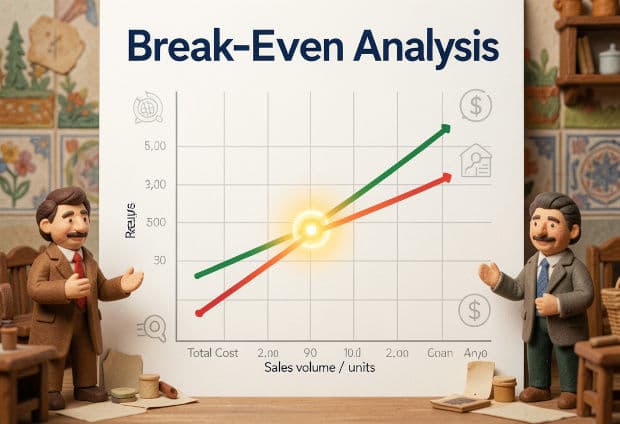
Break-Even Analysis — When Does Your Business Actually Start Making Money?
Before you invest a single dollar in your business, you need to answer one question: how many units must you sell to stop losing money? Break-even analysis gives you that answer. This guide walks through the formulas, three detailed real-world examples (coffee shop, e-commerce, SaaS), 10 data tables, limitations, and proven strategies to reach profitability faster.
998Read
A
Analysis
March 1, 2026
Six Thinking Hats
The Six Thinking Hats is a decision-making framework developed by Edward de Bono in 1985 that separates thinking into six distinct modes — facts (White), emotions (Red), caution (Black), optimism (Yellow), creativity (Green), and process control (Blue). Used by organizations like IBM, NASA, and Prudential Insurance, this parallel thinking method helps teams make better decisions faster by eliminating ego-driven conflict and ensuring every perspective is heard.
731Read
A
Analysis
March 1, 2026
Business Analysis: What It Is, Why It Matters, and How to Do It
Business analysis is the structured practice of identifying organizational needs, evaluating problems, and recommending solutions that deliver measurable value to stakeholders. This article covers the complete business analysis process, from goal identification to plan review, along with seven essential techniques including SWOT, PESTLE, MOST, CATWOE, the 5 Whys, Brainstorming, and Business Process Modeling. Whether you are a beginner or a seasoned professional, these frameworks will help you make smarter, data-driven business decisions.

585Read
A
Analysis
March 1, 2026
PESTLE Analysis in depth
PESTLE Analysis is a strategic framework used to evaluate the six key external factors that influence a business: Political, Economic, Social, Technological, Legal, and Environmental. It helps organizations anticipate changes in the macro-environment, identify opportunities and threats, and make more informed strategic decisions. Widely used in corporate strategy, market entry planning, and investment analysis, PESTLE is a foundational tool for understanding the forces beyond a company's control.

689Read
A
Analysis
May 3, 2025
SWOT Analysis
A ‘SWOT’ analysis is essentially a planning process that helps an organization identify new directions it can pursue while overcoming its challenges. The acronym ‘SWOT’ stands for Strengths, Weaknesses, Opportunities, and Threats. Therefore, a SWOT analysis is an excellent strategy for evaluating these four aspects of any organization.

1,666Read
About Analysis
Analysis is the art of breaking down complex business and economic situations into understandable components. From SWOT and PESTLE frameworks to financial ratio analysis and market research, analytical thinking drives better decision-making. Our analysis articles examine current economic events, business trends, and provide frameworks you can apply to your own situations.
business analysiseconomic analysisSWOT analysisPESTLEmarket analysisfinancial modelingdata analysistrend analysis