Finance
21 articles
F
Finance
April 13, 2026
Financial Leverage: The Final Verdict, Expert Opinions, and Practical Calculator (Part 2)
This is Part 2 of the Financial Leverage debate. Part 1 presented both sides: the case FOR leverage (Soros made $1B in a day, real estate returns of 400%, Apple's $100B debt strategy) and the case AGAINST (Archegos lost $20B in 48 hours, LTCM's Nobel laureates lost $4.6B, the 2008 crisis was entirely a leverage crisis). This concluding part covers what legendary investors actually think (Buffett's hidden $170B insurance float leverage, Soros, Dalio, Munger), a practical Leverage Calculator to assess your own risk, the 2025-2026 global leverage landscape (crypto disasters, AI CapEx debt, high interest rates), practical do's and don'ts, and the Final Verdict: leverage is neither multiplier nor trap -- it is fire. In a kitchen it sustains life, in a forest it destroys.

757Read
F
Finance
April 1, 2026
Financial Leverage: Profit Multiplier or Destruction Trap? -- The Great Debate with Evidence (Part 1)
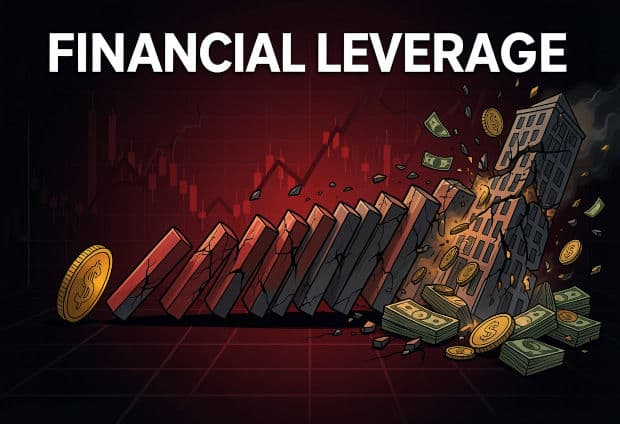
Financial Leverage means using borrowed money to amplify your investment returns. But is it a profit multiplier or a destruction trap? In Part 1 of this two-part debate, we examine both sides with hard evidence. Side 1 argues leverage is a multiplier: George Soros made $1 billion in a single day using leveraged currency bets, US homebuyers with 5:1 leverage earned 400%+ returns, and Apple strategically carries $100B+ in debt despite having $160B+ in cash. Side 2 argues leverage is a trap: Bill Hwang's Archegos lost $20 billion in 48 hours, LTCM's Nobel laureates lost $4.6 billion with 25:1 leverage, and the entire 2008 financial crisis was caused by banks leveraged 30:1. This article presents mathematical proofs for both sides, neutral data analysis, and fair criticism of each argument's weaknesses.
631Read
F
Finance
March 28, 2026
Financial Leverage: What it is, How it works and How to Calculate
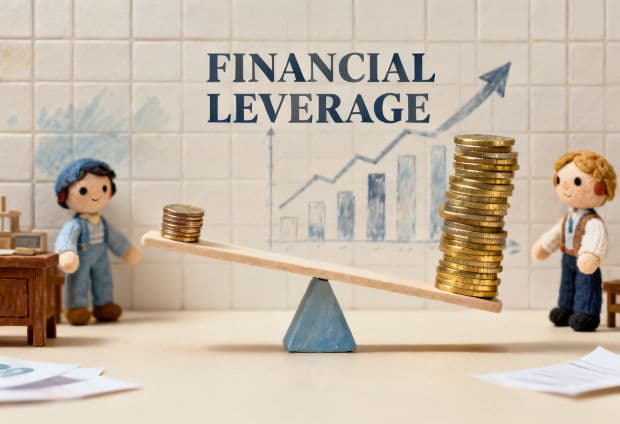
Financial leverage means using borrowed money to amplify your investment returns — putting in 10 lakh of your own and borrowing 40 lakh more to control a 50 lakh asset. When the investment pays off, your returns multiply dramatically. But when things go wrong, your losses multiply just as fast. From home loans and margin trading to corporate bonds and credit cards, leverage is everywhere in modern finance. The 2008 global financial crisis and countless personal bankruptcies share one common thread: too much leverage, too little caution.
660Read
F
Finance
March 12, 2026
Time Value of Money: What It Is, How It Works, and Why It Matters
The Time Value of Money is the fundamental concept that a dollar today is worth more than a dollar in the future due to its earning potential. This guide explains how TVM works, the difference between simple and compound interest, the TVM formula, compounding vs. discounting, real-world applications, and why it is the most important concept in finance.

738Read
F
Finance
March 12, 2026
Valuation of Bonds and Stocks: Methods, Formulas, and How to Determine Fair Value
Valuation is the process of determining what a financial asset is truly worth. This guide explains the key methods for valuing stocks (P/E ratio, P/B ratio, and Dividend Discount Model) and bonds (coupon bond and zero-coupon bond valuation), with formulas, worked examples, and the critical relationship between interest rates and bond prices.

746Read
F
Finance
March 12, 2026
Capital Budgeting: What It Is, How It Works, and Key Techniques Explained
Capital budgeting is the process companies use to evaluate and select long-term investments. This guide covers the core concepts, the four-step process, key evaluation techniques including NPV, IRR, Payback Period, and Profitability Index, and the limitations that financial professionals should be aware of.

710Read
F
Finance
March 12, 2026
Risk vs. Return: Understanding the Trade-Off Every Investor Must Know
Risk and return are the two sides of every investment decision. This guide explains the risk-return trade-off, the eight major types of investment risk, how to measure risk using standard deviation, beta, and Sharpe ratio, different types of returns, and proven strategies for managing risk in your portfolio.

778Read
F
Finance
March 12, 2026
Cost of Capital: What It Is, WACC Formula, and How to Calculate It
The cost of capital is the minimum rate of return a company must earn to satisfy its investors. This guide explains the Weighted Average Cost of Capital (WACC), how to calculate the cost of debt and equity using the CAPM model, the factors that influence cost of capital, and the limitations financial professionals should understand.

724Read
F
Finance
March 12, 2026
Project Financing: How It Works, Key Participants, and Strategies for Success
Project financing is a method of funding large-scale infrastructure projects where the project's own cash flows serve as the primary repayment source. This guide covers the key participants, the three-stage process, advantages like non-recourse lending and risk sharing, how it differs from corporate financing, and the limitations investors and sponsors should understand.
737Read
F
Finance
March 12, 2026
Financial Markets: What They Are, Types, Functions, and How They Work
Financial markets are the platforms where financial assets like stocks, bonds, currencies, and derivatives are traded. This guide covers the eight major types of financial markets, how they work, their key functions in the economy, and the limitations investors should be aware of when participating in these markets.

695Read
F
Finance
March 12, 2026
The Stock Market: A Complete Guide for Investors
The stock market is a marketplace where shares of publicly traded companies are bought and sold. This comprehensive guide explains what the stock market is, how it works, the types of stocks available, how to start investing, and the key advantages and risks every investor should understand before entering the market.

451Read
F
Finance
March 12, 2026
Derivatives: What They Are, Types, How They Work, and How to Invest
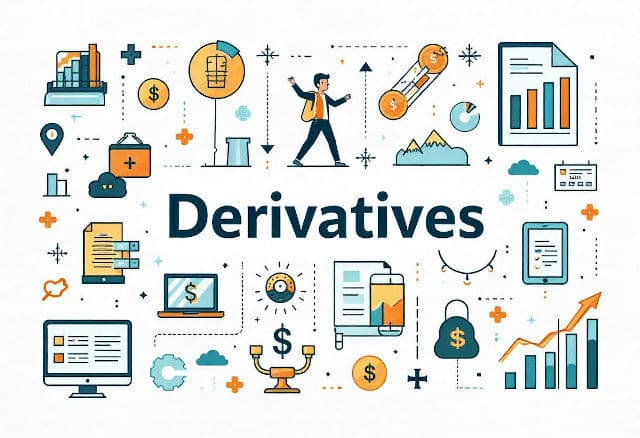
Derivatives are financial contracts whose value is derived from underlying assets like stocks, bonds, commodities, or currencies. This guide explains the four main types of derivatives — options, futures, forwards, and swaps — how they work, who trades them, their advantages and risks, and how beginners can start investing in them.
1,068Read
F
Finance
March 12, 2026
Mutual Funds: What They Are, How They Work, Types, and How to Invest
A mutual fund is a pooled investment vehicle managed by a professional fund manager that invests in a diversified portfolio of stocks, bonds, or other securities. This comprehensive guide explains how mutual funds work, the different types available, their advantages and disadvantages, and how you can start investing in them to build long-term wealth.

458Read
F
Finance
March 10, 2026
Insurance: What It Is, How It Works, and Why You Need It
Insurance is a financial contract that protects individuals and businesses from unexpected financial losses by transferring risk to an insurance company in exchange for regular premium payments. This comprehensive guide covers everything you need to know about insurance, including how it works through risk pooling and underwriting, its rich history dating back to ancient Babylon, the major types of insurance available today such as life, health, auto, and homeowners insurance, key terminology every policyholder should understand, how insurance companies generate revenue, factors that affect your premiums, practical tips for choosing the right policy, common mistakes to avoid, and the exciting future of insurance driven by insurtech, artificial intelligence, and innovative models like usage-based and parametric insurance.

403Read
F
Finance
March 10, 2026
ESOP: How Employee Stock Ownership Plans Work
An Employee Stock Ownership Plan (ESOP) is a tax-qualified retirement benefit that gives employees ownership stakes in the company they work for. Companies create ESOP trusts that hold and allocate shares of stock to eligible workers based on compensation or seniority. With roughly 6,500 active ESOPs covering 14 million participants in the United States, these plans offer significant tax benefits for companies while helping employees build retirement wealth at no direct personal cost. This guide covers how ESOPs work, their history, types, benefits, vesting rules, distribution procedures, and real-world success stories from companies like Publix Super Markets and WinCo Foods.

445Read
F
Finance
March 10, 2026
Financial Institutions: Types, Functions, and Their Role in the Economy
Financial institutions are organizations that handle monetary transactions such as accepting deposits, making loans, facilitating investments, and managing risk. They include commercial banks, investment banks, credit unions, insurance companies, brokerage firms, mutual funds, pension funds, and central banks. These institutions serve as intermediaries between savers and borrowers, playing a critical role in capital allocation, economic growth, and financial stability. Understanding how they work, the risks they face, and how they are regulated is essential for anyone navigating the modern financial landscape.

560Read
F
Finance
March 10, 2026
SWIFT: How the Global Financial Messaging System Works
SWIFT (Society for Worldwide Interbank Financial Telecommunication) is the global messaging network that powers cross-border payments. Connecting over 11,000 financial institutions in 200+ countries, SWIFT does not move money directly but instead carries secure payment instructions between banks. This article explains how SWIFT works, its history since 1973, message types, fees, geopolitical significance including the 2022 Russia sanctions, alternatives like CIPS and Ripple, and the future of global payments through gpi and ISO 20022.
769Read
F
Finance
March 10, 2026
The Roles of Finance: How Money Management Drives Every Part of Our Lives
Finance is the backbone of modern life, guiding how individuals budget and invest, how businesses allocate capital and manage cash flow, and how governments fund public services and manage national debt. From personal savings strategies like the 50/30/20 rule to corporate capital structuring and public fiscal policy, the roles of finance are vast and interconnected. This article explores the three main branches of finance, examines how finance drives decision-making at every level, and highlights the growing impact of fintech, AI, and blockchain on the financial landscape.
396Read
F
Finance
March 10, 2026
The Bond Market: A Comprehensive Guide to Fixed-Income Investing
The bond market is a vast financial marketplace where debt securities are traded. With a global value exceeding $130 trillion, it dwarfs the stock market in size. Bonds work as IOUs: investors lend money to governments, municipalities, or corporations in exchange for regular interest payments and the return of principal at maturity. This guide covers the different types of bonds, how prices and interest rates interact, key metrics like yield and credit ratings, the risks and benefits of bond investing, and practical steps to get started.
396Read
F
Finance
March 10, 2026
The 4% Rule: Your Guide to Sustainable Retirement Withdrawals
The 4% Rule is a retirement guideline that helps working professionals figure out how much money they need in the bank to comfortably sustain their retirement years. The framework is scientifically proven, historically successful, and easy to implement if applied consciously. Four simple steps and a basic calculation create a foundational structure that can help you build your own customized retirement withdrawal plan.

456Read
F
Finance
February 21, 2026
Finance: What It Is, Why You Need It, and How It Works in Real Life
Whether you realize it or not, finance is part of everything you do with money. Every time you decide how to spend your salary, save for something important, take a loan, or invest in something — that is finance in action. At its most basic level, finance is the art and science of managing money. It covers everything from how you personally budget your monthly income to how large corporations decide where to invest billions of taka, and how governments plan national budgets and economic policies. According to financial expert L.J. Gitman, finance is simply the art of money management — and that definition, as straightforward as it sounds, covers an enormous amount of ground. Understanding finance is not just for bankers or economists. It is for anyone who wants to make smarter decisions with their money, build wealth over time, and avoid costly financial mistakes.
1,027Read
About Finance
Finance is the science of managing money. Whether it's personal budgeting, corporate capital allocation, or national fiscal policy, financial knowledge is the foundation of economic freedom. Our articles break down complex financial concepts into practical, actionable knowledge.
financepersonal financecorporate financefinancial planningbudgetingrisk managementwealth managementfinancial literacy