Financial Leverage: What it is, How it works and How to Calculate
G
GeoRenus Editorial Team
643 views
Summary
Financial leverage means using borrowed money to amplify your investment returns — putting in 10 lakh of your own and borrowing 40 lakh more to control a 50 lakh asset. When the investment pays off, your returns multiply dramatically. But when things go wrong, your losses multiply just as fast. From home loans and margin trading to corporate bonds and credit cards, leverage is everywhere in modern finance. The 2008 global financial crisis and countless personal bankruptcies share one common thread: too much leverage, too little caution.
Key Takeaways
- Financial leverage means using borrowed capital to increase the size of an investment — amplifying both potential gains and losses.
- Debt-to-Equity Ratio and Degree of Financial Leverage (DFL) are the two most important metrics to measure how leveraged a company or investment is.
- A 20% gain on a 5:1 leveraged investment can yield 64% ROI — but a 20% loss can wipe out 136% of your own capital.
- Lehman Brothers collapsed in 2008 with a 31:1 leverage ratio, triggering a global financial crisis and the largest bankruptcy in history at $639 billion.
- Keep Interest Coverage Ratio above 3x, always stress-test a 30–50% decline scenario, and never use leverage for consumable purchases.
- Warren Buffett's warning stands: 'Leverage is the only way a smart person can go broke' — respect it before you use it.
What Is Financial Leverage?
Imagine you want to buy a flat worth 50 lakh taka. You have 10 lakh of your own. You borrow the remaining 40 lakh from the bank. Suddenly, with just 10 lakh in hand, you control a 50 lakh asset. That's a 5:1 leverage ratio — and that's financial leverage in a nutshell.
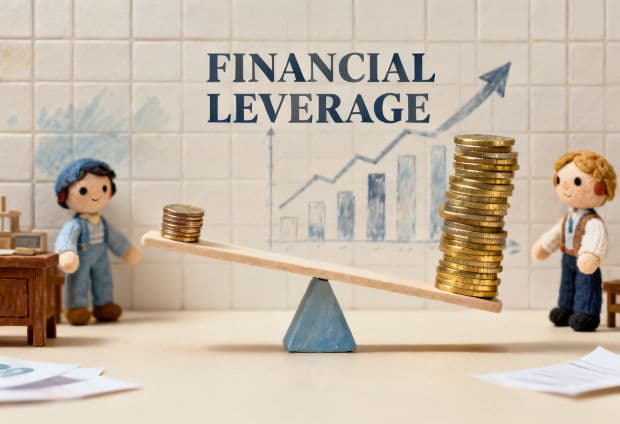
The word "leverage" comes from the physics concept of a lever — a simple tool that lets a small force move a much larger object. In finance, the principle is identical: a small amount of your own capital, amplified by borrowed money, controls a much larger investment.
"Give me a lever long enough and a fulcrum on which to place it, and I shall move the world." — Archimedes
Financial leverage works the same way. With borrowed capital, a modest investment can control enormous assets and generate outsized returns. But here's the catch — a lever works in both directions. Financial leverage amplifies both your gains AND your losses with equal force. That symmetry is the most important thing to understand before you ever borrow a rupee to invest.
How Leverage Works — A Real-World Example
Scenario 1: Investing Without Leverage
You have 10 lakh taka. You invest it directly in a property. One year later, the property appreciates by 20%, rising to 12 lakh. Your profit is 2 lakh taka. ROI = 2L ÷ 10L × 100 = 20%. Clean, simple, no surprises.
Scenario 2: Investing With Leverage (The Good Side)
You take your 10 lakh and borrow an additional 40 lakh from the bank at 9% annual interest. Total investment: 50 lakh. One year later, the property gains 20% and is now worth 60 lakh.
Your profit = 60L (sale) − 50L (purchase price) − 3.6L (9% interest on 40L) = 6.4 lakh taka.
ROI = 6.4L ÷ 10L (your own money) × 100 = 64%. Without leverage: 20%. With leverage: 64%. That's more than 3× the return on the same market movement.
Scenario 3: When Prices Fall (The Brutal Side)
Same setup — but the property drops 20% instead. It's now worth 40 lakh. Loss = 50L (purchase) − 40L (current value) + 3.6L (interest) = 13.6 lakh.
ROI = −13.6L ÷ 10L = −136%. You've lost your entire 10 lakh investment AND owe the bank 3.6 lakh more. Without leverage, a 20% drop would have cost you 2 lakh. With leverage, it wiped you out and left you in debt.
This is the core truth of leverage — it is a multiplier, not a direction. It magnifies whatever the market hands you, good or bad.
Types of Leverage
Operating Leverage
Operating leverage describes how a company's cost structure — specifically the mix of fixed versus variable costs — affects its profitability. A company with high fixed costs (rent, salaries, servers) and low variable costs has high operating leverage.
Think of a software company. Once the product is built, selling one more copy costs almost nothing. If sales rise 10%, profits might jump 50% or more. That's high operating leverage working in your favor. But if sales drop 10%? Losses hit just as hard, because the fixed costs don't budge.
Financial Leverage
Financial leverage is what this article is about — using debt (bank loans, bonds, or other instruments) to increase the total size of an investment beyond what your own equity allows. The interest on that debt is a fixed cost. When business is good, shareholders get amplified returns. When business sours, losses are amplified too.
Combined/Total Leverage
Combined Leverage = Operating Leverage × Financial Leverage. It measures how sensitive earnings per share (EPS) is to a change in sales. A company with both high operating leverage AND high financial leverage is in a precarious position — a small revenue decline can cascade into massive losses on both fronts.
How to Calculate Financial Leverage — Formulas and Examples
Debt-to-Equity Ratio (D/E)
Formula: D/E Ratio = Total Debt ÷ Total Equity
Example: A company has 80 crore in total debt and 40 crore in equity. D/E = 80 ÷ 40 = 2.0. For every 1 taka of its own money, it has borrowed 2 taka.
As a rule of thumb, D/E below 1.0 is generally healthy; above 2.0 is considered risky. But industry context matters — banks and real estate companies routinely carry high D/E ratios, while tech firms typically run lean.
Debt Ratio
Formula: Debt Ratio = Total Debt ÷ Total Assets
Example: Total assets = 120 crore, total debt = 80 crore. Debt Ratio = 80 ÷ 120 = 0.67, or 67%. This means 67% of the company's assets are financed by creditors, not shareholders. The higher this number, the more fragile the balance sheet.
Degree of Financial Leverage (DFL)
Formula: DFL = EBIT ÷ (EBIT − Interest Expense)
EBIT = Earnings Before Interest and Tax — the operating profit before financing costs are deducted.
Example: EBIT = 20 crore, interest expense = 5 crore. DFL = 20 ÷ (20 − 5) = 20 ÷ 15 = 1.33.
This means a 1% change in EBIT produces a 1.33% change in EPS. The higher the DFL, the more sensitive shareholder earnings are to operating swings — leverage is amplifying the volatility.
Interest Coverage Ratio
Formula: Interest Coverage = EBIT ÷ Interest Expense
Example: EBIT = 20 crore, interest = 5 crore. Interest Coverage = 20 ÷ 5 = 4.0×. The company earns four times what it owes in interest — comfortably safe.
The benchmark: above 3× is healthy; below 1.5× is dangerous. Falling below 1.0× means the company cannot even cover its interest payments from operations — a near-certain sign of financial distress.
Equity Multiplier
Formula: Equity Multiplier = Total Assets ÷ Total Equity
Example: Assets = 120 crore, equity = 40 crore. Equity Multiplier = 120 ÷ 40 = 3.0×. For every 1 taka of equity, 3 taka in assets are deployed — the other 2 taka came from debt. This ratio is a key component of DuPont Analysis, which breaks down Return on Equity (ROE) into profitability, efficiency, and leverage.
Where Financial Leverage Is Used
Real Estate
Real estate is the most common and accessible form of financial leverage for everyday people. When you put down a 20% deposit and finance the remaining 80% with a bank mortgage, you are using 5:1 leverage. A 10% rise in property value translates to a 50% return on your down payment — before interest costs.
In Bangladesh, home loan interest rates typically run between 9% and 12% per year. As long as property prices appreciate faster than your borrowing cost, you come out ahead. If appreciation stalls or prices fall, leverage turns against you just as quickly.
Stock Market / Margin Trading
In stock markets, margin trading lets investors borrow from their broker to buy more shares than their own cash allows. You have 1 lakh taka; the broker lends another 1 lakh — you hold 2 lakh worth of shares. That's 2:1 leverage.
Bangladesh Securities and Exchange Commission (BSEC) regulates margin loan ratios. Currently, the maximum permitted margin loan is 1:1 — meaning you can borrow up to the value of your own capital. The 2010 market crash is a permanent reminder of what happens when margin goes unchecked.
Corporate Finance
Companies borrow through bank loans, corporate bonds, and other instruments to fund expansion, acquisitions, and operations. This is textbook financial leverage — using creditors' money to generate returns for shareholders.
According to CFA Institute research, S&P 500 companies average a D/E ratio of approximately 1.5. But the range is enormous — from 0.3 in asset-light tech companies to over 5.0 in capital-intensive industries like utilities and real estate.
Personal Finance
Credit cards, car loans, and personal loans are all forms of personal leverage. When you swipe your credit card for 1 lakh taka worth of purchases without having the cash in the bank, you are leveraged. The critical distinction: productive leverage builds assets (a mortgage on a property that appreciates), while consumptive leverage destroys wealth (a car loan or credit card bill for goods that depreciate the moment you own them).
Pros and Cons of Financial Leverage
The Upside:
1. Amplified returns — as the scenarios above show, leverage can turn a 20% market gain into a 64% personal return. This is why leverage is central to wealth-building strategies worldwide.
2. Tax shield — in many jurisdictions, interest payments on debt are tax-deductible. Borrowing to invest can reduce your taxable income, making the effective cost of debt lower than the stated interest rate.
3. Access to bigger opportunities — if a genuinely profitable opportunity exists but your capital is limited, leverage bridges the gap. Without it, many real estate deals, business expansions, and acquisitions would be impossible.
4. Inflation advantage on long-term debt — if you borrow 50 lakh today at a fixed rate, inflation slowly erodes the real value of that debt over 20 years. You repay in future taka that are worth less than today's taka, while your asset's nominal value has risen.
The Downside:
1. Amplified losses — the same multiplier that creates 64% gains creates −136% losses. Leverage does not care which direction the market moves.
2. Fixed interest payments squeeze cash flow — whether your investment performs well or terribly, the monthly installment arrives on schedule. This pressure can force you to sell at the worst possible time.
3. Bankruptcy risk — if you cannot service your debt, creditors can seize your assets, shut down your business, and permanently damage your credit history and reputation.
4. Margin call and forced liquidation — in stock market margin accounts, if your holdings fall below a threshold, your broker forcibly sells your shares to recover the loan — almost always at the worst possible moment, locking in maximum losses.
Do's and Don'ts
Do:
1. Always calculate the worst case before taking on leverage. If property values or stock prices fall 30–50%, can you still meet your obligations? If the answer is no, reconsider.
2. Keep your Interest Coverage Ratio above 3× at all times. This gives you a meaningful buffer against earnings volatility.
3. Use leverage for long-term, income-producing assets — real estate, business expansion, productive infrastructure. Not for short-term speculation.
4. Maintain an emergency fund covering at least 6 months of debt installments, entirely separate from your investment capital.
5. Factor in interest rate risk. If you are on a floating-rate loan and rates rise significantly, your monthly payments increase — sometimes dramatically. Stress-test your position at 2–3% higher rates.
Don't:
1. Borrow to buy consumables — cars, electronics, vacations, gadgets. These depreciate. Leverage on depreciating assets is a guaranteed way to fall behind.
2. Follow the crowd. "Everyone is doing it" is the most dangerous sentence in finance. Everyone was doing it in 2007 too — right up until they weren't.
3. Let debt payments exceed 40% of your monthly income. Beyond that threshold, any financial shock can tip you into insolvency.
4. Stack debt on debt. Taking a new loan to repay an existing one is the fastest path to a debt spiral. Each layer of leverage compounds your fragility.
Famous Leverage Disasters
1. Lehman Brothers (2008) — The Largest Bankruptcy in History
Lehman Brothers was America's fourth-largest investment bank. By 2008, its leverage ratio had reached 31:1 — meaning 31 dollars of borrowed money for every 1 dollar of its own capital. When the subprime mortgage market collapsed, even a small decline in asset values wiped out their equity entirely. Lehman filed for bankruptcy with $639 billion in debt — the largest bankruptcy filing in history — and its collapse accelerated the 2008 global financial crisis.
2. Long-Term Capital Management — LTCM (1998)
LTCM was a hedge fund run by two Nobel Prize-winning economists and some of Wall Street's brightest minds. Their models were brilliant. Their leverage was reckless — 25:1 at its peak. When Russia defaulted on its debt in 1998, LTCM's highly leveraged positions unraveled catastrophically, losing $4.6 billion in weeks. The Federal Reserve had to orchestrate a $3.6 billion bailout to prevent systemic collapse. Brilliance plus excessive leverage equals disaster.
3. Bangladesh Stock Market Crash (2010)
Between 2009 and 2010, the Dhaka Stock Exchange experienced a massive bubble, fueled in large part by unchecked margin lending. Ordinary people took out bank loans, borrowed from family, and even sold land to buy stocks — all on leverage.
When sentiment shifted, the DSEX index fell nearly 50%. Investors who had used leverage lost not just their investments but their homes, savings, and borrowed funds. The crash became a defining lesson in why margin lending requires strict regulation and personal discipline.
Financial Leverage in Bangladesh
Leverage is deeply woven into Bangladesh's financial landscape — in ways both productive and precarious.
Home Loans:
As property prices in Dhaka have soared — flats ranging from 50 lakh to several crore — most buyers rely on bank financing for 60–80% of the purchase price. This is high leverage by any standard. Interest rates on home loans run between 9–12% annually. If property values stagnate or fall (a trend visible in parts of Dhaka in recent years), these borrowers face significant stress.
Corporate Debt:
According to Bangladesh Bank data, total banking sector loans reached approximately 16.5 lakh crore taka in 2023. A portion of this has funded genuine productive investment. But a non-performing loan ratio of 9.4% signals that a significant share of that leverage did not generate the returns needed to service the debt — borrowed capital that failed to multiply.
Stock Market Margin Lending:
Margin loans remain the most accessible form of leverage for retail investors in Dhaka. BSEC has tightened rules since 2010, limiting margin ratios and improving oversight. But the lesson from the 2010 crash must not be forgotten — when too many investors use margin simultaneously in a rising market, the eventual correction hits leveraged positions with devastating force.
Final Thoughts
Financial leverage is one of the most powerful tools in the investor's kit — and one of the most dangerous. Used wisely, it can accelerate wealth creation, unlock opportunities beyond your immediate capital, and provide genuine tax advantages. Used recklessly, it can eliminate years of savings in days.
"Leverage is the only way a smart person can go broke." — Warren Buffett
The market does not follow your spreadsheet. Prices fall when you least expect it, rates rise when you can least afford it, and liquidity vanishes precisely when you need it most. But your bank installment arrives every single month, without sympathy and without flexibility.
Before you borrow to invest, ask yourself one question: In the absolute worst case — a 40% decline, a rate hike, a job loss — can I still survive this? If the answer is yes, proceed with discipline. If the answer is no, reduce the leverage until it is. The goal is not to maximize returns on the upside. The goal is to still be in the game on the other side of the storm.
Recommended for you
Accounting: The Language of Business
Accounting is like a notebook for a business where all the money-related activities are recorded and tracked. Just like students track their exam scores to understand how they are doing, businesses use accounting to see if they are making a profit or loss. It acts like the financial backbone of a company. Accountants organize these records into different sections to make things easier to understand. To show their performance to shareholders, companies prepare documents called financial statements.
Banking
Banking: What It Is, How Banks Work, and Everything You Need to Know
Money
How Money Works?
Business
Needs, Wants, and Demands

Branding
Branding: How to Make Your Business Stand Out

Business Law
Business Law: What It Is, Why It Matters, and Types You Must Know

E-Commerce
E-Commerce: The Complete Guide to Online Business

Accounting
GAAP: What It Is and Why It Matters in Accounting

Accounting
Four Flavors of Accounting: Tax, Project, Financial, and Cost Accounting Explained
Analysis
PESTLE Analysis in depth