Financial Markets: What They Are, Types, Functions, and How They Work
G
GeoRenus Editorial Team
830 views
GeoRenus Editorial Team
Financial markets are the platforms where financial assets like stocks, bonds, currencies, and derivatives are traded. This guide covers the eight major types of financial markets, how they work, their key functions in the economy, and the limitations investors should be aware of when participating in these markets.
At the heart of every economy lies a system that connects those who have money with those who need it. That system is the financial market. Whether you realize it or not, financial markets affect virtually every aspect of your daily life — from the interest rate on your mortgage to the price of gas at the pump.
A financial market is any marketplace where buyers and sellers trade financial assets such as stocks, bonds, currencies, commodities, and derivatives. These markets serve as the backbone of the global economy, facilitating the flow of capital and enabling businesses to grow, governments to fund public services, and individuals to build wealth.
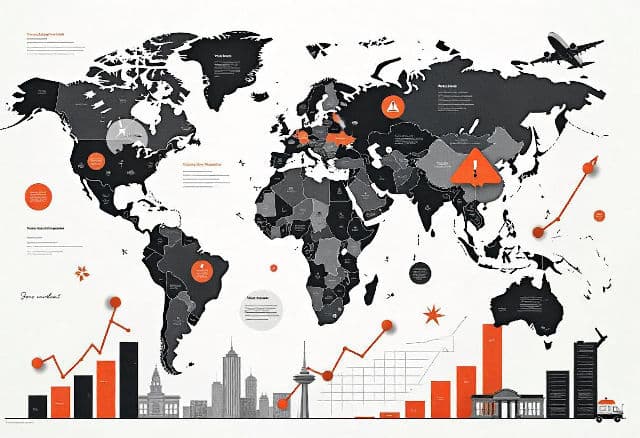
The scale of global financial markets is staggering. According to various estimates, the total value of global financial assets — including stocks, bonds, and other instruments — exceeded $450 trillion in 2024. Understanding how these markets work is essential for anyone looking to participate in the modern economy.
There are many different types of financial markets around the world. Each serves a specific purpose and trades different types of financial instruments. Here are the eight major types:
The stock market is where shares of publicly traded companies are bought and sold. Major stock exchanges include the New York Stock Exchange (NYSE), NASDAQ, London Stock Exchange, and Tokyo Stock Exchange. Investors analyze company fundamentals, earnings reports, and market trends to select stocks with growth potential.
The bond market is where debt securities are issued and traded. When you buy a bond, you are essentially lending money to the issuer (a government or corporation) in exchange for periodic interest payments and the return of your principal at maturity. The global bond market is valued at over $133 trillion, making it even larger than the stock market.
The forex market is the largest financial market in the world, with daily trading volumes exceeding $7.5 trillion. It is where currencies are exchanged — for example, converting US dollars to euros. The forex market operates 24 hours a day, five days a week, and is crucial for international trade and investment.
The cryptocurrency market has emerged as one of the fastest-growing financial markets. It includes digital currencies like Bitcoin, Ethereum, and thousands of altcoins. While highly volatile, the crypto market has attracted millions of investors worldwide. Bitcoin alone reached a market capitalization of over $1 trillion in 2024.
The money market deals in short-term borrowing and lending, typically with maturities of one year or less. Instruments include Treasury bills, commercial paper, and certificates of deposit. The money market is considered one of the safest segments of the financial system and is crucial for maintaining liquidity in the economy.
OTC markets are decentralized markets where financial instruments are traded directly between two parties, without a formal exchange. Many smaller stocks, bonds, and derivatives are traded OTC. While OTC markets offer more flexibility, they also carry higher counterparty risk since there is no exchange acting as a guarantor.
The derivatives market trades financial contracts whose value is derived from underlying assets — stocks, bonds, commodities, or indices. This includes options, futures, forwards, and swaps. Derivatives are used for hedging risk, speculation, and improving portfolio efficiency.
The commodity market deals in raw materials and primary products like gold, silver, oil, natural gas, wheat, and coffee. Commodities can be traded through futures contracts on exchanges like the Chicago Mercantile Exchange or the London Metal Exchange. These markets play a vital role in price discovery for essential goods.
Financial markets work on the basic principle of supply and demand. Various participants — including individual investors, institutional investors, banks, governments, and corporations — come together to buy and sell financial assets.
Financial markets can be divided into two main segments:
Prices in financial markets are determined by multiple factors including a company's financial health, macroeconomic conditions, interest rates, investor sentiment, and geopolitical events. Regulatory bodies like the Securities and Exchange Commission (SEC) in the US and similar organizations worldwide oversee these markets to maintain transparency, prevent fraud, and protect investors.
Financial markets perform several critical functions that are essential for a healthy economy:
Financial markets channel idle savings from households and institutions into productive investments. Without these markets, money would sit in bank accounts earning minimal returns instead of being put to work growing businesses and creating jobs.
Through the interaction of buyers and sellers, financial markets help determine the fair value of financial assets. This price discovery mechanism is essential for the efficient allocation of resources in the economy.
Financial markets provide liquidity, meaning investors can buy or sell assets relatively quickly and easily. This liquidity reduces the risk of being stuck with an investment you cannot sell and encourages more people to invest.
Financial markets are well-organized and transparent. They provide a wealth of financial data — company earnings, economic indicators, market trends — that helps investors make informed decisions. "Markets are the best processors of information we have."
Despite their many benefits, financial markets are not perfect. Here are some key limitations:
Financial markets are the engine of the global economy. They enable the efficient transfer of capital, provide liquidity, facilitate price discovery, and offer opportunities for wealth creation. From the stock market to the forex market, from bonds to cryptocurrencies, these markets touch virtually every aspect of modern life.
However, they also come with risks — volatility, manipulation, and the potential for significant losses. As an investor, the key is to understand how these markets work, diversify your investments, and make decisions based on sound financial knowledge rather than emotion.
As economist Eugene Fama noted, "In an efficient market, prices reflect all available information." While no market is perfectly efficient, understanding financial markets puts you in a much better position to grow and protect your wealth.

In 1944, as the world was still engulfed in the devastation of World War II, the global economy had collapsed and people’s living standards had plummeted. In an effort to stabilize the international economy and address pressing global financial issues, the Allied nations convened a historic summit. Nearly 730 delegates from 44 countries gathered at the Mount Washington Hotel in Bretton Woods, New Hampshire, for the United Nations Monetary and Financial Conference. The outcome of this summit was the landmark Bretton Woods Agreement, which gave birth to the Bretton Woods System.