The 7 P's of Marketing: The Complete Framework Every Business Needs
G
GeoRenus Editorial Team
1,114 views
Summary
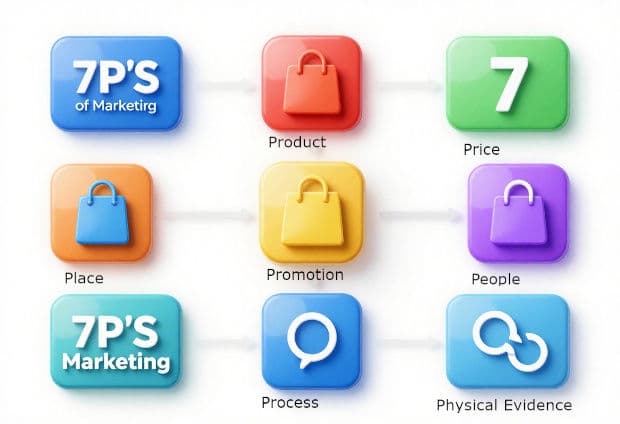
If you have ever wondered why some businesses grow consistently while others struggle despite having good products — the answer is often in their marketing strategy. And one of the most reliable, time-tested frameworks for building a complete marketing strategy is the 7 P's of Marketing. The 7 P's are Product, Price, Place, Promotion, People, Process, and Physical Evidence. Together, these seven elements cover every single aspect of bringing a product or service to market — from how you design it and price it, to how you deliver it and make customers trust it. What makes this framework so powerful is that it does not just focus on selling. It focuses on the entire customer experience — from the moment a customer first hears about your product to the moment they actually use it. Whether you are running a small business in Dhaka or building a national brand, understanding and applying the 7 P's can be the difference between a business that survives and one that truly thrives.
Key Takeaways
- The 7 P's of Marketing — Product, Price, Place, Promotion, People, Process, and Physical Evidence — form a complete framework that covers every major aspect of marketing strategy.
- Both tangible and intangible elements of marketing are given equal importance in the 7 P's framework — making it useful for both product-based businesses and service businesses.
- The framework was originally introduced as 4 P's by E. Jerome McCarthy in 1960. In 1981, Booms and Bitner added 3 more P's to make it applicable to the growing service industry.
- Using the 7 P's framework gives a company significant flexibility — when market conditions change, it is easy to adjust specific elements of the strategy without rebuilding everything from scratch.
- Unlike quick-result tactics like meme marketing or growth hacking, the 7 P's is a long-term strategy — it takes more time to implement but delivers more sustainable and reliable results.
Introduction: Why Marketing Strategy Actually Matters
Let's be honest about something.
A lot of business owners in Bangladesh — especially those just starting out — think marketing means running some Facebook ads or putting up a banner outside the shop. And while those things are part of marketing, they are just a small piece of a much bigger picture.
Real marketing is strategic. It is about making a series of connected decisions — about your product, your pricing, your distribution, your communication, and your customer experience — that all work together to create a compelling reason for people to choose you over everyone else.
The 7 P's framework exists to make sure you are not missing any of those decisions. It is a comprehensive checklist and strategic guide rolled into one. And the reason it has remained popular worldwide for decades — despite newer, flashier marketing concepts coming and going — is because it works. It forces you to think carefully about every part of your business that touches the customer.
A Brief History of the 7 P's
The story of the 7 P's starts in 1949 when Neil Borden first introduced the concept of the "Marketing Mix." He argued that to build a successful marketing program, a marketing manager needs to mix multiple behavioral forces and marketing elements together in the right proportions. However, at that point, no one had defined exactly what those elements were.
That definition came in 1960, when E. Jerome McCarthy published his landmark book "Basic Marketing: A Managerial Approach" and introduced the original 4 P's — Product, Price, Place, and Promotion. These four elements became the foundation of modern marketing thinking and are still relevant today.
However, there was a problem. All four original P's were focused on physical products. They worked well for manufacturing companies selling tangible goods — but when the service industry started booming in the 1980s and 1990s, the framework did not fully apply. A hotel, a bank, or a consulting firm has very different marketing challenges than a company selling soft drinks.
So in 1981, two researchers named Booms and Bitner added three more P's to the mix — People, Process, and Physical Evidence. With these additions, the framework became applicable to service businesses as well, and the 7 P's became the standard marketing framework used by businesses around the world.
The 7 P's Explained in Detail
Let's go through each one carefully — with real, practical examples to make each concept clear.
1. Product
The first P is the most fundamental one. Before you can do anything else in marketing, you need to know exactly what you are offering — and whether it actually solves a problem people have.
Product does not just mean a physical item. It includes services too. Everything about what you are offering falls under this category — the core features and functions, the design, the packaging, the branding, the quality, the variety, and the customization options. But most importantly, it includes your understanding of what the customer actually needs — not just what you want to sell.
This is where market research becomes critical. A product that is built without understanding customer needs is almost always going to struggle — no matter how good the rest of your marketing strategy is. If the product itself does not solve a real problem or fulfill a real desire, no amount of advertising will save it.
Example: Suppose your company wants to launch a new soft drink in the Bangladeshi market. Before you start production, you need to answer some important questions. What is the current market size for soft drinks? Which types of soft drinks are most popular? Is there a type of soft drink that customers want but cannot currently find? What are the prices of existing soft drinks? What specific qualities and features do soft drink lovers want from their drink? Only after you have answers to these questions can you decide what your product should actually look like.
2. Price
Price is not just a number you put on your product. It is a strategic signal — it tells customers what your product is worth, where it sits in the market, and whether it is meant for them or not.
Setting the right price requires you to consider multiple things at the same time. You need to cover your costs — including production, packaging, distribution, and marketing. You need to factor in your target customers' purchasing power — a price that is right for upper-middle-class consumers in Gulshan might be completely wrong for customers in a smaller district town. You need to understand what competitors are charging for similar products. And you need to make sure that your price reflects the quality of your product — customers quickly sense when something is either overpriced or suspiciously cheap.
For new businesses especially, pricing strategy is particularly important. When you are unknown in the market, customers have no prior experience with your product to justify paying a premium. So introductory pricing, discounts, and special offers often play an important role in building your initial customer base.
Example: Going back to our soft drink example — before you set your price, you research what other soft drinks in the same category are selling for. Then you calculate your total production and distribution costs. If you are entering the market for the first time, you might want to price slightly lower than the competition, or offer an introductory discount, to give customers a low-risk reason to try your product. Above all, your price should feel consistent with the quality of what is inside the bottle — customers should feel they are getting good value.
3. Place
A great product at a great price means nothing if customers cannot find it or access it easily. That is what the Place P is all about — making sure your product or service is available in the right locations, through the right channels, at the right time.
Place covers your entire distribution strategy. It includes decisions about which physical locations to sell through, whether to sell online or offline or both, how to manage your supply chain and logistics, and how to make the purchasing experience as frictionless as possible for your customer.
The key question to ask here is — where does my target customer go when they want this type of product? Your product needs to be there, or at least easily accessible from there.
Example: After producing and bottling your soft drink, you need to think carefully about distribution. Where do people in Bangladesh look for soft drinks? Restaurants and food stalls are obvious places — most people who eat out expect soft drinks to be available. Grocery shops and convenience stores in residential areas are another key channel. Parks, sports facilities, and outdoor event venues are also strong options because people get thirsty in those environments. Online delivery platforms are increasingly important too. Your distribution strategy should put your product wherever your target customer naturally goes looking for it.
4. Promotion
There is a well-known saying in business — no one buys what they do not know exists. That is the whole point of promotion. It is about communicating your product's existence, features, benefits, and value to the people most likely to buy it.
Promotion covers a wide range of activities — advertising on TV, radio, or digital platforms, public relations, social media marketing, sales promotions, influencer partnerships, word-of-mouth campaigns, and direct sales efforts. The right mix depends on who your target customer is, where they spend their time, and what kind of messages actually influence their decisions.
One thing to always keep in mind — promotion is not about shouting the loudest. It is about reaching the right people with the right message at the right time. And in Bangladesh's current market, digital and social media channels — particularly Facebook and YouTube — offer incredible reach at relatively low cost, making them essential tools for businesses of almost any size.
Example: Before you start promoting your soft drink, you research how your competitors are advertising. Then you identify where your target customers spend their time — are they mostly on Facebook? Do they watch certain TV channels? Do they follow popular food influencers? Based on this research, you design a promotional strategy that reaches them effectively within your budget. Maybe you start with targeted Facebook ads and some outdoor advertising near popular food spots. The most important thing is that your promotional content is attractive, memorable, and builds confidence in your product.
5. People
This is the P that many businesses — especially smaller ones — overlook. And it is often the one that makes the biggest difference in customer experience.
People refers to everyone involved in delivering your product or service — your employees, your sales team, your customer service staff, and of course your customers themselves. In service industries especially, the quality of human interaction is often what determines whether a customer comes back or never returns.
Well-trained, motivated, and customer-focused employees are an enormous competitive advantage. When your frontline staff treat customers with respect, handle complaints well, and genuinely know the product they are selling — that creates trust and loyalty that no advertisement can replicate.
At the same time, understanding your customers — who they are, what they value, what frustrates them, and what would make them happier — is equally important. Customer feedback is not just a nice thing to collect. It is one of your most valuable business intelligence tools.
Example: Every person working in your soft drink company — from the production team to the delivery drivers to the customer service staff — plays a role in your brand's reputation. If your employees are happy, well-paid, and feel valued, they work harder and take better care of the quality of everything they do. On the customer side, you need to know whether people who try your soft drink actually enjoy it. Are they buying it again? What do they say about it to their friends? This kind of feedback helps you continuously improve.
6. Process
Process refers to the entire system through which your product or service is created and delivered to the customer. It covers every step — from sourcing raw materials to manufacturing, to quality control, to packaging, to delivery, to after-sales service.
Efficient processes reduce costs. Inefficient processes increase them. And when your costs go up, you either have to raise prices — potentially losing customers — or absorb the extra cost as a loss. Neither outcome is good. That is why regularly auditing and optimizing your processes is not just a back-office concern — it is a marketing concern. Because your ability to offer competitive prices and consistent quality depends directly on how well your processes run.
Example: In soft drink production, every batch needs to meet the same quality standard. If the sourcing and mixing process has errors, an entire batch can be ruined — costing you money and potentially damaging your reputation if substandard product reaches customers. Beyond quality control, you also need to watch for waste — are raw materials being used efficiently? Is the distribution process delivering products fresh and on time? These process questions directly affect your product quality and your cost structure.
7. Physical Evidence
The final P is particularly important for service businesses — but it matters for product businesses too. Physical Evidence refers to all the tangible and visible elements that help customers evaluate your business and build trust in it before they have even used your product.
Your office or store environment, your logo, your packaging, your website, your business cards, your delivery vehicles, your staff uniforms, your receipts — all of these are physical evidence. They send signals to customers about who you are, how professional you are, and whether you can be trusted.
In Bangladesh's market, where a significant number of purchasing decisions — especially for new brands — are influenced by the first visual impression, physical evidence carries enormous weight. A professional-looking package, a clean and well-organized shop, or a well-designed website all communicate credibility before a single word is spoken.
Example: For your soft drink, the bottle design, label, color scheme, and brand slogan are all physical evidence. Before a customer even tastes the drink, they are making a judgment based on how it looks. Does the packaging look clean and trustworthy? Does the label communicate quality? Does the bottle feel good to hold? These might seem like small details — but they significantly influence whether someone who has never tried your drink decides to pick it up and give it a chance.
How the 7 P's Work Together
The real power of the 7 P's framework is not in any one P — it is in how all seven work together as an integrated system.
A great product at the wrong price will not sell. A well-priced product in the wrong place will not be found. A product available everywhere but promoted poorly will be overlooked. Great promotion for a poorly made product will generate one-time sales and lasting negative word-of-mouth. Excellent products and marketing but terrible customer service will lose customers to competitors. Inefficient processes will eat into your profits. And poor physical evidence will undermine trust before customers even engage with you.
Every P reinforces every other P. When all seven are aligned and working together effectively — that is when a marketing strategy truly performs.
The Bottom Line
The 7 P's of Marketing is not a trendy new concept. It has been around for decades — and it has survived because it works. It works for multinational corporations and it works for small businesses in Bangladesh. It works for physical product companies and it works for service providers. It works in traditional markets and it works in digital markets.
What makes it so enduringly useful is its completeness. It does not let you forget anything important. It makes you think about every dimension of how you bring your product or service to market and how customers experience it.
If you are starting a new business, use the 7 P's as your planning framework from day one. If you are running an existing business that is not growing as fast as you want, go through each P systematically and identify which ones need attention. The answer to why your business is underperforming is almost always hiding somewhere in those seven letters.
Recommended for you
Accounting: The Language of Business
Accounting is like a notebook for a business where all the money-related activities are recorded and tracked. Just like students track their exam scores to understand how they are doing, businesses use accounting to see if they are making a profit or loss. It acts like the financial backbone of a company. Accountants organize these records into different sections to make things easier to understand. To show their performance to shareholders, companies prepare documents called financial statements.
Banking
Banking: What It Is, How Banks Work, and Everything You Need to Know

Investment
Investment: What It Is, Types, and Real Life Examples
Accounting
Assets, Liabilities, and Equity: The Building Blocks of Finance
Accounting
Auditing: Definition, Types, Principles, and How It Works
Accounting
Financial Accounting: Principles, Purpose, and How It Works

Accounting
Tax Compliance and Reporting: Everything You Need to Know

Accounting
Taxation for Individuals and Businesses: A Complete Overview

Agreement
North American Free Trade Agreement (NAFTA)

Agreement
Basel Accords