Machiavellian Marketing Framework (MMF): How Power Philosophy Wins Markets
G
GeoRenus Editorial Team
649 views
Summary
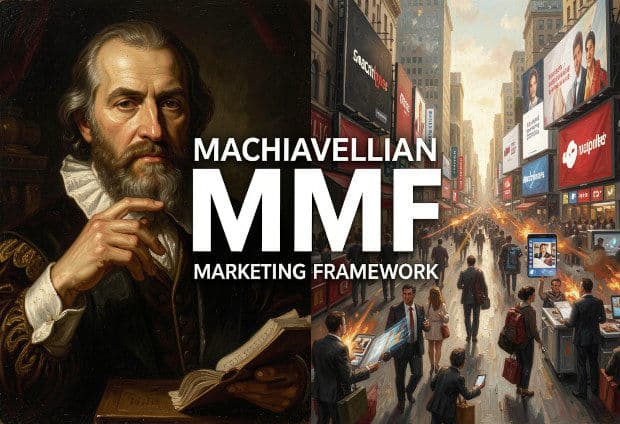
In 1513, Niccolò Machiavelli wrote a short book about power that still makes politicians nervous. Five centuries later, the world's biggest brands are quietly using the same principles to dominate markets. The Machiavellian Marketing Framework (MMF) translates Machiavelli's raw power philosophy — fear and love, narrative control, strategic alliances, and ironclad lock-in — into a modern marketing playbook. Apple, Nike, and Amazon didn't build their empires by accident. They built them the Machiavellian way.
Key Takeaways
- MMF applies Machiavelli's 500-year-old power principles — fear, love, narrative, alliances, and lock-in — to modern brand strategy.
- Emotionally connected customers are 25–100% more valuable than merely satisfied ones, per Harvard Business Review research.
- Tesla spent just $6M on ads in 2023 vs Toyota's $1.5B, yet commands a higher brand value — proof that narrative control beats ad spend.
- Apple's ecosystem lock-in delivers a 92% customer retention rate, the highest in the industry, according to Bain & Company.
- Strong brand positioning drives 20% more revenue growth than weak brands, per McKinsey & Company research.
- MMF is a mindset, not a manipulation manual — ethical application builds lasting dominance; unethical use destroys brands.
Who Was Machiavelli and What Is MMF?
It's 1513. A disgraced Florentine diplomat named Niccolò Machiavelli has just been thrown out of office, tortured briefly, and exiled to his farm outside Florence. With nothing left to lose, he sits down and writes a slim, dangerous little book — 'The Prince.'
The book wasn't about being nice. It was about winning. Machiavelli laid out, with brutal clarity, how rulers gain power, hold onto it, and crush the competition. He didn't moralize. He observed. And what he observed was that the most successful rulers used a mix of fear, love, strategic deception, and ironclad alliances — whatever it took.
"It is better to be feared than loved, if you cannot be both." — Niccolò Machiavelli, The Prince
So what does a 16th-century Italian political philosopher have to do with your brand strategy? Quite a lot, it turns out.
The Machiavellian Marketing Framework (MMF) is the strategic playbook that translates Machiavelli's power principles into modern marketing. Fear and love, narrative control, strategic alliances, seizing opportunity, locking in customers, and managing perception — these aren't just political tactics. They are the exact levers that Apple, Nike, Amazon, and the world's most dominant brands pull every single day.
These brands may not hang a portrait of Machiavelli in their boardrooms. But study their moves closely, and you'll find his fingerprints everywhere.
The Six Pillars of MMF — Power Principles for Marketing
Pillar 1: Fear & Love Strategy
Machiavelli's most famous insight was deceptively simple: to control people, bind them with love or bind them with fear. In marketing, both levers are always on the table — and the best brands use both.
The Love Strategy:
When a brand makes you feel something — belonging, aspiration, identity — it has deployed the love strategy. Apple is the textbook master. Apple customers don't just own a phone. They belong to a tribe. They see themselves as creative, forward-thinking, and a little bit rebellious. That emotional identity is worth far more to Apple than any product spec.
Harvard Business Review research found that emotionally connected customers are 25% to 100% more valuable than merely satisfied customers. They buy more, they stick around longer, and they tell their friends. Love is not a soft metric — it's the hardest one to compete against.
The Fear Strategy:
FOMO — Fear of Missing Out — is one of the oldest tricks in the marketing handbook, and it still works beautifully. 'Only 3 left in stock.' 'This offer expires in 2 hours.' 'Your neighbors are already saving money on energy — are you?' These messages don't sell products. They sell urgency.
Insurance companies have built entire industries on fear. 'What happens to your family if you're not around?' is a sentence that has sold more policies than any product feature ever could. Cybersecurity firms do the same thing: 'Is your data really safe?' is worth billions of dollars in annual revenue.
The trick is balance. Pure fear without love makes customers anxious and resentful. Pure love without any urgency makes them comfortable — and comfortable customers don't act. The most effective brands layer both.
Pillar 2: Narrative Control — Whoever Controls the Story Wins
Machiavelli wrote that people judge by appearances more than by reality. In marketing, this principle is everything.
"Everyone sees what you appear to be; few really know what you are." — Niccolò Machiavelli, The Prince
Narrative control means that you — not your competitors, not the press, not a random Twitter thread — define what your brand stands for. You decide the story people tell about you. And the brand that controls its narrative controls its market.
Tesla — A $6 Million Lesson in Narrative Power:
Tesla spent roughly $6 million on advertising in 2023. Toyota spent approximately $1.5 billion in the same year, according to Statista. Yet Tesla's brand value has surpassed Toyota's by most measures. How?
Elon Musk is himself a media channel. His posts on X (formerly Twitter) reach hundreds of millions of people instantly, with zero media buy. Every Tesla launch, every product announcement, every controversy gets amplified through Musk's personal narrative. No PR agency, no rival brand, no critical journalist can hijack that story — because Musk tells it first, loudest, and most directly.
That is Machiavellian narrative control at its most audacious. You don't need the biggest ad budget. You need to own the microphone.
Pillar 3: Strategic Alliances & Enemies
Machiavelli was clear on alliances: never try to fight alone when you can fight with allies. But he added a subtler insight — sometimes having a visible enemy is more valuable than any alliance, because an enemy gives you definition. You know who you are because you know who you're against.
Creating an Enemy — Apple vs. PC:
Apple's 'I'm a Mac, I'm a PC' ad campaign is one of the most Machiavellian marketing moves in history. Apple didn't just advertise its product — it created a villain. The PC: boring, corporate, crash-prone, stuck in the past. The Mac: cool, creative, effortless. By defining its enemy, Apple simultaneously defined itself. Customers didn't just buy a computer. They picked a side.
Building an Alliance — Spotify and Samsung:
Spotify struck a deal to be pre-installed on Samsung devices as the default music app. Spotify gained access to hundreds of millions of Samsung users with zero acquisition cost. Samsung gained the credibility of the world's most popular music streaming service as part of its out-of-box experience. Both sides won — which is exactly how Machiavelli said good alliances should work.
Pillar 4: Seizing Opportunity (Virtù & Fortuna)
Machiavelli introduced two concepts that every strategist should tattoo on their wrist: Virtù and Fortuna. Fortuna is fortune — the market shift, the crisis, the unexpected opening that fate drops in your lap. Virtù is the skill, courage, and preparation to actually seize that moment when it arrives.
Machiavelli believed Fortuna controls about half of what happens to you. The other half is yours — if you have the Virtù to act.
Zoom — A Master Class in Virtù Meeting Fortuna:
Zoom Video Communications was founded in 2011. For most of the next decade, it was a solid but obscure enterprise tool. Then, in early 2020, Fortuna arrived in the form of a global pandemic. The entire world suddenly needed to work, study, and connect from home.
Zoom had the Virtù to move fast. They rapidly scaled servers, removed the 40-minute limit for educational accounts, and made onboarding friction-free. The result: daily active users went from 10 million in December 2019 to 300 million by April 2020 — a 30x increase in three months.
Their competitors had the same Fortuna. They didn't have the same Virtù. That's the difference.
Pillar 5: The Fortress of Dominance — Switching Cost & Lock-in
Machiavelli warned that conquest is only half the battle. The harder challenge is keeping what you've won. His advice: build fortresses. Create systems so entrenched that even a willing enemy has difficulty dislodging you.
In marketing, this is the Switching Cost Strategy. Make it so costly — in time, money, data loss, or habit disruption — for a customer to leave that staying is simply the easier choice.
Apple Ecosystem — The Greatest Fortress in Consumer Tech:
You buy an iPhone. Then you add AirPods because they pair instantly and nothing else connects quite as smoothly. Then a MacBook because iCloud keeps everything in sync across devices. Then an Apple Watch because it needs an iPhone to unlock its full features. You're now deep inside Apple's walled garden.
Want to switch to Android? You lose your iMessage history. Your AirPods still work, but lose half their features. Your Watch becomes a paperweight. Your photos need migrating. Your app purchases don't transfer. The switching cost isn't just financial — it's psychological and logistical.
Bain & Company research puts Apple's customer retention rate at 92% — the highest of any major consumer electronics company. That number isn't built on product quality alone. It's built on a fortress.
Pillar 6: Image Management — Perception Is Reality
"A prince need not have all good qualities, but must appear to have them." — Niccolò Machiavelli, The Prince
This is perhaps Machiavelli's most uncomfortable truth — and the most powerful one for marketers. Customers don't buy what your product is. They buy what they believe your product is. Perception is the product.
Starbucks — Selling an Experience, Not a Coffee:
Is Starbucks coffee the best in the world? Most serious coffee people would say no. A cup at a local specialty roaster is frequently better. But Starbucks has built an image so powerful — warm, familiar, upscale-but-accessible — that millions of people pay $4 to $5 for a drink they could get elsewhere for $1.
What Starbucks actually sells is an experience: the feeling of a 'third place' between home and office, the comfort of knowing exactly what you're getting in any city in the world, the small luxury of a personalized cup with your name on it. That image commands a price premium that no amount of coffee quality could justify on its own.
Manage your image, and you manage your price. That's the Machiavellian calculus.
Real-World Examples — How Top Brands Use MMF
Apple — The Most Machiavellian Brand of Our Time
Walk through the six pillars of MMF and you'll find Apple at every single one. This is not a coincidence — it's a strategy executed with extraordinary consistency across decades.
Love strategy: The 'Think Different' campaign told customers they weren't just buying a computer — they were joining the ranks of Einstein, Gandhi, and Picasso. Apple users feel creative and distinct by association.
Enemy creation: PC was 'boring.' Android was 'fragmented' and 'cheap.' Apple positioned every competitor as the uncool alternative, giving customers an identity to rebel against.
Lock-in: The ecosystem is so deeply integrated that switching away from Apple is less a decision and more a small personal crisis.
Narrative control: Apple's product launches are meticulously choreographed media events — more religious ceremony than press conference. Every word, every slide, every demo is controlled. No surprises. No off-message moments.
According to Statista, Apple's brand value reached $880 billion in 2023 — the highest of any company on Earth. That is what five decades of Machiavellian marketing looks like.
Nike — The Empire of Emotion
Nike doesn't sell shoes. Nike sells the belief that you can be an athlete — that greatness is accessible, that the only thing standing between you and your best self is whether you just do it.
'Just Do It' is three words. It launched in 1988. It still runs the brand today. That's narrative control so strong it outlasts decades of campaigns, CEOs, and cultural shifts.
Nike's athlete partnerships aren't endorsements — they're mythology-building. Michael Jordan, LeBron James, Serena Williams, Cristiano Ronaldo. These aren't spokespeople. They are living proof of the Nike narrative. When you wear the swoosh, you wear a piece of that mythology.
In 2018, Nike made one of the most Machiavellian marketing calls in recent memory. They signed Colin Kaepernick — the NFL quarterback who had kneeled during the national anthem to protest racial injustice — as the face of a major campaign. The backlash was immediate and loud. Some customers burned their Nike shoes on camera.
Nike didn't flinch. The campaign ran. And Nike's online sales jumped 31% in the days immediately following the launch. By creating a deliberate enemy (conservative America), Nike cemented its alliance with a younger, progressive, and deeply loyal customer base. That's Virtù.
Amazon — Dominance Through Fear
Amazon's Machiavellian genius is different from Apple's or Nike's. Amazon doesn't primarily use fear on its customers — it uses fear on its competitors and suppliers. And it does so with a clinical efficiency that Machiavelli himself might have admired.
Here's how the Amazon Marketplace play works: Independent sellers pay to list products on Amazon's platform. Amazon collects data on every sale — which products sell, at what price, to which customers, in which regions. When a product becomes a proven bestseller, Amazon studies that data and launches its own competing version under the 'Amazon Basics' label — cheaper, promoted by the platform, and impossible for the original seller to out-rank in search results.
In Machiavellian terms: learn from your allies, then defeat them with their own intelligence.
The Wall Street Journal's investigation found that Amazon used third-party seller data to develop its own competing products. The European Union launched an antitrust investigation into this practice in 2020. Amazon's dominance is so entrenched that even after the scrutiny, sellers stay — because leaving Amazon means leaving the largest marketplace in the world.
How to Apply MMF — Step by Step
MMF isn't just for billion-dollar companies. The principles scale. Here's a practical five-step framework for applying MMF to any brand, at any size.
Step 1: Identify Your Enemy
Every powerful brand has something to push against. That enemy doesn't have to be a competitor — it can be an old way of doing things, a widespread frustration, or a cultural problem. A healthy food brand's enemy might be 'junk food culture.' A fintech startup's enemy might be 'the predatory banking system.' Define what you're against, and you immediately clarify what you're for. Customers rally around opposition.
Step 2: Build Your Narrative
What you sell is secondary. What story you tell is primary. Why does your brand exist? What does a customer become when they use your product? What values does your brand represent? Your narrative should be specific enough to mean something and broad enough to grow with you. Write it down. Make sure every piece of content, every campaign, every customer interaction reinforces it.
Step 3: Balance Fear and Love
Lead with love — build emotional connection, community, and identity over the long term. Layer in fear — FOMO, scarcity, urgency — for short-term conversion moments. A flash sale is fear. A loyalty program is love. A 'limited edition' product is fear with a love wrapper. Use them together deliberately, and never let fear overwhelm the relationship you're building.
Step 4: Create Lock-in Through Value
The key word is 'through value.' Lock-in by delivering genuine value — loyalty points that customers actually use, subscription models that save them time or money, ecosystems that make their lives meaningfully easier. Customers who stay because leaving is inconvenient will leave the moment something better comes along. Customers who stay because your product genuinely improves their life are the ones who become advocates.
Step 5: Stay Ready for Opportunity
Fortuna will knock. Markets shift, crises emerge, technologies disrupt. Your job is to be ready with Virtù — the preparation, the resources, and the decision-making speed to act when the window opens. Keep some capacity in reserve. Watch your market obsessively. When the moment comes, move faster than anyone expects.
Do's and Don'ts of MMF
Do:
1. Understand your customers' deepest emotions — not just their preferences, but their fears, aspirations, and sense of identity. Build your brand at the intersection of those emotions.
2. Watch your competitors relentlessly. Their weaknesses are your opportunities. Their unserved customer segments are your market.
3. Control your narrative proactively. Be first with your story. Don't let competitors, critics, or media define you. Show up on social media, in press, in community — before anyone else shapes the conversation.
4. Create switching costs through genuine value. Make your product so good, so integrated into your customer's life, that leaving feels like a loss — not because you've trapped them, but because you've made yourself essential.
5. Think in decades, not quarters. Machiavellian dominance is built slowly and deliberately. The brands that last are the ones that invest in long-term loyalty rather than short-term conversion.
Don't:
1. Deceive your customers. Machiavellian does not mean dishonest. Manipulation and deception destroy trust the moment they're discovered — and in the age of social media, they are always discovered.
2. Manufacture fake FOMO. If the 'limited time offer' runs every week, customers will notice. If the 'only 3 left' message appears on a product that's always in stock, you've lost credibility that takes years to rebuild.
3. Attack competitors personally or disrespectfully. Defining an enemy is powerful — mocking, insulting, or obsessing over a competitor makes your brand look small. Let the contrast speak for itself.
4. Cross ethical lines. Short-term Machiavellian tactics that exploit vulnerable customers, spread misinformation, or violate privacy may produce a spike in revenue — and a collapse in reputation that no marketing budget can fix.
Pros and Cons of MMF
Pros:
1. Strong market positioning: MMF forces you to define a clear, differentiated brand identity. In crowded markets, clarity wins. Customers know who you are, what you stand for, and why you're different.
2. Deep customer loyalty: When customers are emotionally connected to your brand — when they see themselves in it — they don't comparison-shop. They advocate. They recruit friends. They forgive mistakes.
3. Premium pricing power: A brand with a powerful narrative and genuine lock-in can charge more than competitors for equivalent products. Customers pay for identity, belonging, and convenience — not just features.
4. Revenue growth advantage: McKinsey & Company research shows that companies with strong brand positioning grow revenue 20% faster than companies with weak brands. Brand isn't a soft asset. It's a compounding financial one.
Cons:
1. Ethical risk: The line between strategic positioning and manipulative deception is real, and crossing it has real consequences. Brands that deploy MMF irresponsibly tend to attract regulatory scrutiny, media backlash, and customer revolt.
2. FOMO fatigue: Overuse the fear lever and customers become desensitized — or worse, annoyed. Amazon sends so many 'lightning deal' alerts that many shoppers have tuned them out entirely. Urgency only works when it's genuinely rare.
3. Not universal: MMF works best in consumer markets where emotion and identity drive purchase decisions. In B2B markets built on relationships, contracts, and technical evaluation, heavy Machiavellian tactics can actually damage trust and credibility.
4. Requires real investment: Narrative control, ecosystem development, and quality lock-in aren't free. Smaller brands need to be selective about which pillars they invest in, rather than trying to execute all six at once.
MMF in Emerging Markets — Practical Insights
MMF isn't a Western luxury. It plays out in emerging markets just as powerfully — sometimes more so, because the competitive dynamics are faster and the brand relationships are still being formed.
bKash — When a Brand Becomes a Verb:
The ultimate form of narrative control is when your brand name becomes the generic word for what you do. In Bangladesh, people don't 'transfer money' — they 'bKash it.' The brand has embedded itself so deeply into daily language and habit that competitors are fighting a verb. That's lock-in at the cultural level, and it's worth more than any advertising campaign.
Daraz — Engineering FOMO at Scale:
Daraz's 11.11 and 12.12 mega-sales are textbook Machiavellian fear strategy. 'Today only.' 'Countdown ends in 3 hours.' 'Only 5 left.' The entire event is engineered to make inaction feel costly. And it works — Daraz's single-day sales figures on 11.11 dwarf any regular shopping day. MMF's fear lever doesn't need a Silicon Valley zip code to operate. It works in Dhaka just as well as in Cupertino.
The insight for emerging market brands: you don't need Apple's budget or Amazon's data to apply MMF. You need clarity about which pillar matters most in your market — and then the discipline to execute it consistently.
Final Thoughts
Five hundred years is a long time for any idea to stay relevant. Machiavelli's power principles have survived the Renaissance, the Industrial Revolution, the Information Age, and the algorithm era. They survive because human psychology doesn't change as fast as technology does. People still want to belong to something. They still fear missing out. They still follow compelling stories. They still resist change when change is costly.
The Machiavellian Marketing Framework isn't a set of tactics you bolt onto your existing strategy. It's a way of reading markets — seeing competitive dynamics as power relationships, customer psychology as emotional architecture, and brand building as a long game of positioning and dominance.
And here's the critical distinction: Machiavellian doesn't mean unethical. Apple's lock-in works because the products are genuinely excellent. Nike's emotional connection works because the 'Just Do It' message is genuinely inspiring. bKash became a verb because it genuinely made financial transactions easier for millions of people. The Machiavellian insight is that being good isn't enough — you have to be strategically good. You have to structure your goodness so that it compounds into lasting advantage.
"A prince must be a fox to recognize traps and a lion to frighten off wolves." — Niccolò Machiavelli, The Prince
In marketing, the fox reads the market — spots the opportunities, understands the psychology, anticipates the moves. The lion executes — with boldness, with consistency, and with the willingness to take calculated risks that smaller brands won't. Be both. That's how markets are won — and kept.
Recommended for you

Red Ocean and Blue Ocean Strategy: Fight the Competition or Make It Irrelevant — The Complete Guide
Red Ocean strategy means competing in an existing market where rivals fight over the same customers. Blue Ocean strategy means creating an entirely new, uncontested market where competition is irrelevant. W. Chan Kim and Renee Mauborgne's 2005 bestseller introduced the Four Actions Framework — Eliminate, Reduce, Raise, Create — to achieve Value Innovation. Netflix, Apple, Tesla, and Bangladesh's bKash are among the most celebrated Blue Ocean success stories.
Books
The $100 Startup

Branding
Branding: How to Make Your Business Stand Out

E-Commerce
E-Commerce: The Complete Guide to Online Business

Finance
Finance: What It Is, Why You Need It, and How It Works in Real Life
Marketing
The 7 P's of Marketing: The Complete Framework Every Business Needs

Organization
What Is the International Monetary Fund (IMF)?

Startup
What Is a Startup? The Ultimate Guide You Need to Read

Accounting
Accrual Accounting: How It Works, Types, and Why It Matters

Accounting
Audit Planning and Risk Assessment: A Complete Guide

Related Tools
Readiness Assessment
ProAm I Ready for Business (Pro)?
Impact Analysis
ProBusiness Impact Analyzer Pro
Financial Analysis
EssentialBusiness Financial Health Checker
Digital Marketing
NewAdSense - Google Calculator
Market Analysis
ComprehensiveMarket Readiness 360 Analyzer
Business Discovery
Popular