STP Marketing -- The Complete Guide to Segmentation, Targeting, and Positioning
G
GeoRenus Editorial Team
1,306 views
Summary
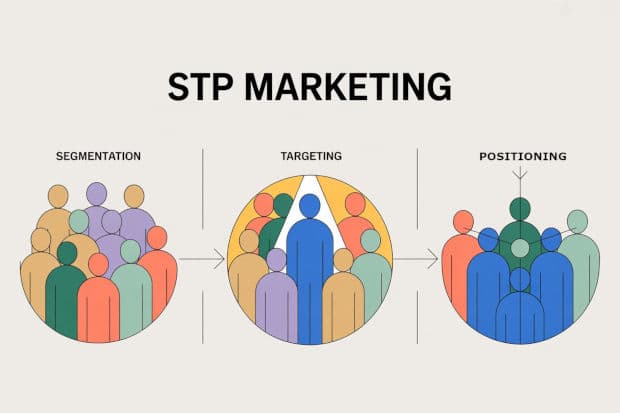
STP (Segmentation, Targeting, Positioning) is the foundational strategic marketing framework popularized by Philip Kotler. Segmentation means dividing a broad market into smaller groups based on demographics, geography, psychographics, and behavior. Targeting means choosing which segment to serve. Positioning means creating a distinct place for your brand in that segment's mind. According to Bain & Company (2025), businesses that follow STP strategy are approximately 25% more profitable than those that don't. This guide covers all three steps in depth with real-world examples from Nike, Spotify, and Coca-Cola, industry data, a step-by-step implementation process, and common mistakes to avoid.
Key Takeaways
- STP stands for Segmentation, Targeting, and Positioning -- the foundational strategic marketing framework developed by Philip Kotler.
- Segmentation divides a broad market into distinct groups using demographic, geographic, psychographic, and behavioral criteria.
- Targeting selects which segment(s) to serve based on size, growth, competition, accessibility, and strategic fit.
- Positioning creates a distinct, valued place for your brand in the minds of your target segment.
- Bain & Company (2025): businesses using STP strategy are approximately 25% more profitable than undifferentiated competitors.
- Campaign Monitor (2025): segmented campaigns drive up to 760% more revenue than non-segmented campaigns.
- McKinsey (2025): well-positioned brands command a 20-25% price premium over undifferentiated rivals.
- The three targeting strategies are undifferentiated (mass), differentiated (multi-segment), and concentrated (niche).
- The positioning statement template: 'For [segment] who [need], [brand] is the [category] that [benefit] because [proof].'
- The six most common STP mistakes: targeting everyone, demographics-only segmentation, founder bias, copying competitors, set-and-forget positioning, and gut over data.
How One Soft Drink Changed the Way the World Markets Products
It was 1982. Coca-Cola had dominated the soft drink market for nearly a century with a single formula and a single message. But something was shifting. Americans were jogging, counting calories, and reading nutrition labels. A segment of health-conscious consumers was emerging -- and they were not buying regular Coke.
Coca-Cola's response was not to tweak the original recipe or run a new ad campaign for the same audience. According to published Coca-Cola case studies and marketing history, the company made a strategic move: it identified a specific consumer segment, chose to target that segment deliberately, and positioned an entirely new brand -- Diet Coke -- to occupy a distinct place in that group's mind.
That is STP marketing in action. Segmentation. Targeting. Positioning. Three words. One of the most powerful frameworks in the history of business strategy.
Diet Coke became one of the fastest-growing beverage launches in U.S. history. Within two years it was the second best-selling soft drink in America.
Per Coca-Cola's annual reports, the company today manages over 200 brands globally -- each one designed for a different market segment. That is not an accident. That is STP strategy applied at scale, across generations, across geographies.
"The art of marketing is the art of brand building. If you are not a brand, you are a commodity." -- Philip Kotler
Philip Kotler, widely regarded as the father of modern marketing, has written and taught that STP sits at the heart of all effective marketing strategy. His textbook Marketing Management has been used in business schools worldwide for over five decades.
Bain & Company (2025) found that businesses that apply STP strategy consistently are approximately 25% more profitable than those using mass-market, undifferentiated approaches.
If you are a business owner, a marketing manager, a startup founder, or a student trying to understand how real strategy works -- this guide is for you. We will walk through every layer of STP marketing: what it means, why it works, how to apply it step by step, and the mistakes that cause it to fail.
By the end of this guide, you will be able to take any product or service and build a complete STP strategy around it. You will have the frameworks, the data, the real-world examples, and the implementation roadmap. Let us get into it.
What Is STP Marketing? The Framework Explained
STP stands for Segmentation, Targeting, and Positioning. It is a three-step strategic marketing process that helps businesses stop wasting money on broad, unfocused campaigns and start directing their resources toward the customers most likely to respond, buy, and stay loyal.
S -- Segmentation: Divide the total market into distinct groups of customers with shared characteristics.
T -- Targeting: Evaluate each segment and select the one(s) where your brand can compete and win.
P -- Positioning: Design a message and identity that occupies a unique, desirable place in the minds of your chosen segment.
The framework was popularized by Philip Kotler in the 1960s and formalized in his seminal textbook Marketing Management, first published in 1967. It built on earlier work by Wendell Smith, who introduced the concept of market segmentation in 1956. Over the following decades, STP became the standard foundation for marketing strategy taught in MBA programs worldwide.
Before STP, most companies used what marketers now call 'spray and pray' marketing -- broadcast the same message to the widest possible audience and hope enough of them respond. It was expensive, wasteful, and increasingly ineffective as markets became more competitive and consumers more sophisticated.
STP was the antidote. Instead of talking to everyone, you find your people, go to them specifically, and speak their language directly. The result is higher relevance, higher conversion, and stronger brand loyalty.
STP does not operate in isolation. It sits between market research (which informs segmentation) and the marketing mix (which executes positioning). Without STP, your 4Ps -- product, price, place, promotion -- have no strategic anchor. With STP, every decision has a clear rationale tied to your target customer.
| Component | Core Question | Key Output |
| Segmentation | Who is in the market? | Defined customer groups with shared traits |
| Targeting | Which segment should we serve? | Selected priority segment(s) |
| Positioning | How should we be perceived? | Positioning statement and brand identity |
Note: STP is a planning framework, not a one-time exercise. Markets shift, competitors enter, and consumer preferences evolve. Revisit your STP strategy at least once per year.
Now that you understand the big picture, let us go deep into each of the three steps -- starting with the one most businesses get wrong first: Segmentation.
Segmentation -- How to Divide a Market into Meaningful Groups
Segmentation is the process of dividing a broad market into smaller, more homogeneous groups of consumers who share similar needs, behaviors, or characteristics. The goal is not to create random categories -- it is to find clusters of customers who will respond similarly to a marketing message or offering.
There are four primary bases of segmentation used in modern marketing. Each provides a different lens through which to view your market. Most sophisticated marketers use a combination of all four.
Demographic Segmentation
Demographic segmentation divides markets by measurable population statistics: age, gender, income, education, occupation, family size, and life stage. It is the most commonly used and easiest to measure form of segmentation.
Example: Rolex does not sell to everyone who wants a watch. According to Bain's Global Luxury Study, Rolex targets high-income adults (typically $200,000+ annual income) who associate luxury goods with personal achievement and social status. Every product decision, from price point to distribution channel, reflects that demographic targeting.
Demographic segmentation works well when purchasing behavior is actually correlated with demographic factors. It fails when marketers assume demographics explain motivation -- which they often do not. A 45-year-old doctor and a 45-year-old teacher share demographic traits but may have entirely different preferences.
Geographic Segmentation
Geographic segmentation divides markets by physical location: country, region, city size, climate, population density. It is especially powerful for global brands that must adapt to local preferences.
Example: McDonald's is the classic case. Per the company's annual reports and investor presentations, McDonald's operates with a 'think global, act local' strategy. In India, where beef consumption is culturally restricted, the McAloo Tikki (potato patty burger) is a top seller. In Japan, seasonal sakura-themed desserts drive traffic. In the Middle East, all menus are halal-certified. Same brand, different geographic positioning.
Psychographic Segmentation
Psychographic segmentation goes deeper than demographics to understand values, lifestyles, attitudes, personality traits, and social class. This is where the 'why behind the buy' lives.
Example: Tesla's market positioning, according to multiple published brand strategy analyses, is built on psychographic targeting. Tesla buyers are not just people who want an electric vehicle -- they are tech-forward individuals who see themselves as environmentally conscious status-seekers. Tesla's marketing does not lead with miles-per-charge or charging infrastructure. It leads with performance, innovation, and identity.
Behavioral Segmentation
Behavioral segmentation divides customers by their actions: purchase frequency, brand loyalty, benefits sought, usage rate, and occasion. This is often the most directly actionable form of segmentation for digital marketers.
Example: Netflix, per publicly available information about its recommendation and content strategy, segments users by viewing behavior -- not just demographics. Heavy bingers, casual weekend watchers, documentary enthusiasts, and podcast-style content consumers each receive different recommendation experiences. This behavioral segmentation drives the personalization engine that Netflix credits for reducing churn.
5 Criteria for a Good Segment (Kotler's Framework)
Philip Kotler identified five criteria that a segment must meet to be worth targeting. A segment that fails even one of these tests is likely not a viable target.
Measurable: You can quantify the size and purchasing power of the segment.
Accessible: You can reach the segment through your available marketing and distribution channels.
Substantial: The segment is large enough and profitable enough to justify investment.
Differentiable: The segment responds differently from other segments to your offer or message.
Actionable: You can actually design and execute programs to serve this segment.
| Segmentation Type | Basis | Best For | Example Brand |
| Demographic | Age, income, gender | Mass-market consumer goods | Rolex |
| Geographic | Location, climate, culture | Global/regional brands | McDonald's |
| Psychographic | Values, lifestyle, personality | Premium and lifestyle brands | Tesla |
| Behavioral | Usage, loyalty, benefits | Digital and subscription brands | Netflix |
Note: Most powerful segmentation combines at least two bases. A 'psychographic-behavioral' hybrid -- values + actions -- often produces the sharpest, most actionable customer profiles.
Segmentation is discovery work. Once you know your distinct customer groups, the next challenge is deciding which one to go after -- and that is where targeting comes in.
Targeting -- Choosing the Segment Where You Can Actually Win
Segmentation gives you a map of the market. Targeting is the decision about which territory to claim. This is one of the most consequential choices a business makes -- and one of the most frequently underdisciplined. Many companies try to serve too many segments and end up serving none of them well.
There are three core targeting strategies, each appropriate for different market conditions, resource levels, and competitive situations.
Strategy 1: Undifferentiated (Mass) Marketing
Undifferentiated targeting means treating the entire market as a single audience with one unified message. This strategy works when consumer needs are broadly similar, the product has universal appeal, and cost efficiency from scale is a significant competitive advantage.
Example: Coca-Cola Classic is one of the last great examples of undifferentiated mass marketing. The core brand -- red can, same formula since 1985's New Coke reversal -- is marketed with broadly universal themes like happiness, sharing, and refreshment. The audience is essentially everyone who consumes soft drinks.
Undifferentiated marketing is increasingly difficult to sustain as markets fragment, competition intensifies, and digital channels enable hyper-personalization. It works for commodity categories or brands with overwhelming market power.
Strategy 2: Differentiated (Multi-Segment) Marketing
Differentiated targeting means serving multiple segments simultaneously with distinct offerings and messages tailored to each. This strategy captures more total market revenue but requires more resources and organizational complexity.
Example: Toyota Motor Corporation provides a textbook example. Per Toyota's annual reports and investor materials, the company targets multiple distinct income and lifestyle segments: the Toyota brand targets value-conscious mainstream buyers, Lexus targets premium-income professionals seeking luxury and refinement, and (in its earlier U.S. history) Scion targeted young urban buyers seeking individuality and affordable customization. Three segments, three distinct brand identities, one parent company.
Strategy 3: Concentrated (Niche) Marketing
Concentrated targeting means focusing all resources on a single, very specific segment and dominating it completely. This is the strategy of choice for companies with limited budgets or those entering markets dominated by larger players.
Example: Rolls-Royce, per widely published brand strategy analyses, targets ultra-high-net-worth individuals -- typically those with investable assets exceeding $30 million. The company makes no attempt to appeal to aspirational middle-class buyers or even upper-middle-class professionals. Every design, distribution, and communication decision reflects a single, narrow segment. This extreme focus commands prices exceeding $300,000 per vehicle.
How to Evaluate and Choose a Segment
Once you have mapped your segments, evaluate each one against five criteria before making a final targeting decision:
Segment Size: Is the segment large enough to generate meaningful revenue at your price point?
Growth Rate: Is the segment expanding or contracting? A growing segment forgives early mistakes; a shrinking one punishes them.
Competitive Intensity: How many well-resourced competitors are already serving this segment? Entering a crowded space requires significant differentiation.
Accessibility: Can you reach this segment through your available channels, budget, and partnerships?
Strategic Fit: Does this segment align with your brand's core competencies, mission, and long-term vision?
| Strategy | Segments Served | Investment Required | Best For |
| Undifferentiated | Entire market | Low (one message) | Universal products, commodity categories |
| Differentiated | Multiple segments | High (multiple campaigns) | Companies with scale and resources |
| Concentrated | One segment | Moderate (single focus) | Startups, niche experts, premium brands |
Note: There is no universally correct targeting strategy. The right choice depends on your resources, your competitive landscape, and the structural characteristics of your market.
You have segmented the market and selected your target. Now comes the piece that lives in the consumer's mind long after the marketing campaign ends: Positioning.
Positioning -- How to Own a Specific Place in Your Customer's Mind
Positioning is the act of designing your company's offer and image so that it occupies a distinctive and valued place in the minds of your target customers. It is not about what you do to a product -- it is about what you do to the minds of your audience.
That definition comes directly from Positioning: The Battle for Your Mind by Al Ries and Jack Trout, first published in 1981 and still considered essential reading. Ries and Trout argued that the marketplace is no longer a battle of products -- it is a battle of perceptions. Whoever owns the strongest mental position wins, regardless of objective product quality.
The Positioning Statement Template
A positioning statement is an internal strategic tool -- not an advertising slogan -- that defines exactly who you are targeting, what need you address, and why you are the best answer to that need. The classic template:
"For [target segment] who [have a specific need or problem], [brand name] is the [category or frame of reference] that [delivers this key benefit] because [reason to believe or proof point]."
Nike example: "For athletes and fitness-motivated individuals aged 18 to 34 who push their physical limits, Nike is the performance sportswear brand that inspires achievement because it is trusted by the world's greatest athletes and backed by decades of sports science innovation."
A good positioning statement is specific enough to guide every creative, product, and pricing decision -- yet broad enough to allow for campaign variation and product evolution over time.
5 Positioning Strategies
1. Attribute Positioning: Owning a specific product feature or characteristic. The clearest example is Volvo. Per multiple published brand analyses, Volvo has owned 'safety' as its core positioning attribute for over 40 years. Every design decision, every engineering announcement, every advertisement reinforces that single attribute.
2. Benefit Positioning: Focusing on the outcome or benefit the customer receives. Colgate's positioning around cavity prevention ('Fewer cavities' / 'Protects against cavities') is a benefit position -- not a product feature, but a customer result.
3. Use or Application Positioning: Associating the brand with a specific use occasion. Gatorade positioned itself as the drink for sports performance and recovery -- not for casual hydration. This usage positioning created a distinct category that excluded casual beverage competitors.
4. Competitive Positioning: Positioning directly against a specific competitor. 7-Up's famous 'UnCola' campaign is the classic example -- not defining what 7-Up is, but defining what it is not (not a cola, not Coke or Pepsi). This positioning strategy works when the competitor is dominant and universally recognized.
5. Price-Quality Positioning: Owning a value tier in the consumer's mind. Walmart's 'Everyday Low Prices' (per Walmart's published brand strategy) positions the brand as the default destination for cost-conscious shoppers. At the other end, brands like Hermès position on extreme quality and exclusivity.
The Perceptual Map
A perceptual map is a visual tool used to understand how your brand is positioned relative to competitors on two key dimensions that matter to your target segment. Common axes include: price vs. quality, traditional vs. innovative, serious vs. playful, or functional vs. aspirational.
Building a perceptual map reveals gaps -- underserved positions in the market where customer needs exist but no current brand is meeting them well. Those gaps are positioning opportunities. They are where new brands are built and where incumbents launch successful sub-brands.
| Strategy | Core Idea | Classic Brand Example |
| Attribute | Own a key product feature | Volvo (safety) |
| Benefit | Own a customer outcome | Colgate (cavity prevention) |
| Use/Occasion | Own a specific moment or activity | Gatorade (sports performance) |
| Competitive | Define yourself against a rival | 7-Up (the UnCola) |
| Price-Quality | Own a value tier | Walmart (everyday low prices) |
Note: Your positioning should be consistent across every touchpoint -- your website, packaging, sales scripts, social media, and customer service language. Inconsistency erodes brand trust faster than any competitor can.
Theory is only useful when applied. Let us look at how three world-class brands have executed STP strategy to build some of the most recognized and profitable brands in existence.
STP in the Real World -- Nike, Spotify, and Dollar Shave Club
The best way to understand a strategic framework is to see it in action. The following three case studies draw on publicly available information from annual reports, investor presentations, acquisition documents, and published brand analyses. Each one illustrates a distinct application of STP strategy.
Nike -- Segmenting a $51 Billion Ecosystem
Nike is not a single brand targeting a single customer. Per Nike's annual reports and investor presentations, the company has built a portfolio of segments, each with its own identity and messaging architecture.
Segmentation: Nike segments its market along three primary lines -- serious competitive athletes, fitness-motivated casual exercisers, and lifestyle/fashion consumers who wear athletic gear for cultural expression rather than performance.
Targeting: Nike's core target has historically been the aspirational athlete -- men and women aged 18 to 34 who are fitness-conscious, competitive, and motivated by personal achievement. This segment drives the premium positioning that allows Nike to charge higher prices than commodity athletic wear.
Positioning: "Just Do It." Three words that capture a philosophy of relentless self-improvement, elimination of excuses, and athletic aspiration. Nike does not sell shoes -- it sells the belief that you are capable of more. This aspirational positioning has made Nike the most valuable sports brand on earth, per Brand Finance's annual Global 500 rankings.
Nike's sponsorship strategy -- paying elite athletes like Serena Williams, LeBron James, and Cristiano Ronaldo to represent the brand -- serves the positioning strategy directly. It associates Nike with the peak of athletic achievement, reinforcing the aspiration of its core segment.
Spotify -- Personalizing Music for 600 Million Users
Spotify's STP strategy is a masterclass in behavioral segmentation and personalized positioning at massive scale.
Segmentation: Per Spotify's investor presentations and published product strategy, the company segments its user base into casual music listeners, dedicated music enthusiasts, podcast-first consumers, and creator/artist communities.
Targeting: Spotify's primary commercial target is digital-native users aged 18 to 34 who consume media across multiple platforms, are comfortable with algorithmic recommendations, and value discovery over fixed library ownership.
Positioning: "Music for Everyone." Spotify's positioning is built on radical personalization -- the idea that the platform adapts to you rather than requiring you to adapt to it. Features like Discover Weekly, Wrapped, and AI DJ are all executions of this positioning. No two users experience Spotify identically, which creates an emotional ownership of the product.
Spotify's freemium model is itself a targeting tool -- it allows a massive free tier to build habitual usage (behavioral segmentation) before converting the most engaged users to premium subscriptions.
Dollar Shave Club -- Disrupting P&G with Niche Targeting
Dollar Shave Club's story is one of the most cited examples of concentrated STP strategy successfully disrupting an entrenched incumbent.
Segmentation: Per Unilever's acquisition documents (Unilever acquired Dollar Shave Club for $1 billion in 2016) and publicly available analysis, the men's grooming market was segmented into premium razor buyers (Gillette Fusion Pro-Glide at $15-20 per refill pack), value seekers, and a growing segment of millennial men frustrated with what they perceived as 'razor inflation' -- paying a premium for incremental blade innovations they did not value.
Targeting: Dollar Shave Club targeted millennial men specifically -- digital-first consumers comfortable with subscription e-commerce, skeptical of corporate marketing, and motivated by both price and attitude.
Positioning: "A great shave for a few bucks a month." The launch video -- produced for roughly $4,500 and viewed over 25 million times on YouTube -- was the positioning strategy itself. It was irreverent, direct, anti-corporate, and spoke the exact language of the target segment. It positioned Dollar Shave Club not just as a cheaper razor, but as a smarter, more honest alternative to the mainstream.
| Brand | Primary Segment | Targeting Strategy | Core Positioning |
| Nike | Fitness-conscious 18-34 | Differentiated (multi-segment) | Aspirational achievement ('Just Do It') |
| Spotify | Digital-native 18-34 | Differentiated (behavioral) | Radical personalization ('Music for Everyone') |
| Dollar Shave Club | Millennial men vs. overpriced razors | Concentrated (niche) | Honest value ('Great shave, few bucks') |
Note: Each of these brands started with a clear, single segment. Nike began in running. Spotify began in music streaming. Dollar Shave Club began in men's razors. Focus at launch is not a limitation -- it is a strategic advantage.
These stories are compelling. But strategy needs to be grounded in data, not just narratives. Let us look at the research that explains why STP consistently outperforms undifferentiated marketing.
The Research Is Clear -- Why STP Outperforms Mass Marketing
If you need to justify an investment in STP strategy to a leadership team, a board, or a client, the data is on your side. Multiple independent research firms have quantified the performance advantage of segmented, targeted, and positioned marketing over undifferentiated alternatives.
The following statistics come from published 2025 research reports and should be referenced with their original source documents when cited in business contexts:
| Source | Finding | Year |
| Bain & Company | Businesses applying STP strategy are ~25% more profitable than undifferentiated peers | 2025 |
| HubSpot State of Marketing Report | Segmented email campaigns generate 200%+ higher marketing ROI than non-segmented campaigns | 2025 |
| Salesforce State of the Connected Customer | Brands using personalization (a key output of STP) see 56% higher customer engagement | 2025 |
| Campaign Monitor | Segmented email campaigns drive up to 760% more revenue than non-segmented campaigns | 2025 |
| McKinsey & Company | Well-positioned brands can command a 20-25% price premium over undifferentiated competitors | 2025 |
| Epsilon Research | 80% of consumers say they are more likely to purchase from brands that deliver personalized experiences | 2025 |
Note: These statistics reflect averages across industries. Actual results vary by sector, competitive intensity, and quality of implementation. Use them as directional benchmarks, not guarantees.
What explains these results? The mechanism is straightforward: when you segment accurately, your message is more relevant. When your message is more relevant, attention rates go up. When attention rates go up, engagement increases. When engagement increases, conversion rates rise. When conversion rates rise, customer acquisition costs fall. When acquisition costs fall, margins expand.
The compounding effect of relevance -- driven by STP -- is what the data is measuring. A customer who feels genuinely understood by a brand is not just more likely to buy once. They are more likely to buy repeatedly, recommend the brand to others, and resist competitive offers even at lower prices.
McKinsey's finding on price premium is particularly important. A 20-25% price advantage over competitors is the difference between a commodity business and a brand business. Positioning creates that gap. It is not built into the product -- it is built into the mind of the consumer.
STP strategy also reduces wasted marketing spend. When you know exactly who you are targeting, you stop paying to reach audiences who will never buy from you. In digital advertising, this translates directly into lower cost-per-click, higher quality scores, and better return on ad spend.
For startups and small businesses with limited budgets, this resource concentration is often the difference between sustainable growth and burning out. You cannot out-spend a larger competitor. You can out-focus them.
Now let us move from understanding why STP works to the practical question of how to actually do it in your own organization.
How to Implement STP Marketing -- A Step-by-Step Guide
Knowing the theory of STP is one thing. Executing it inside a real organization with real budget constraints, competing priorities, and incomplete data is another. Here is a practical implementation guide built around six sequential steps.
Step 1: Conduct Market Research
Before you can segment a market, you need to understand it. This means gathering both quantitative and qualitative data about your current and potential customers.
Quantitative sources: customer surveys, web analytics, purchase data, CRM records, industry reports, government census data. Qualitative sources: customer interviews, focus groups, social listening, review analysis, sales team debriefs.
Minimum viable research for a startup: 25-30 in-depth customer interviews plus analysis of any available behavioral data. For larger organizations, add quantitative validation through surveys with statistically significant sample sizes.
Step 2: Segment the Market
Using your research data, identify distinct groups of customers with meaningfully different needs, behaviors, or characteristics. Plot them out. Name each segment with a brief label that captures its defining characteristic (e.g., 'price-sensitive pragmatists,' 'status-driven professionals,' 'eco-conscious minimalists').
Test each segment against Kotler's five criteria: Measurable, Accessible, Substantial, Differentiable, and Actionable. Eliminate segments that fail two or more criteria.
Step 3: Evaluate Each Segment
Score each remaining segment against the five targeting criteria: size, growth rate, competitive intensity, accessibility, and strategic fit. Use a simple 1-5 scoring matrix if you want a structured approach.
Be honest about competitive intensity. A large, growing segment already dominated by well-funded, well-positioned competitors is not an attractive target unless you have a significant and sustainable differentiation advantage.
Step 4: Select Your Target Segment(s)
Choose the segment(s) where you can create the most value and capture the most value. For most early-stage companies, that means concentrating on a single primary segment before expanding. For established companies with resources, a multi-segment approach may be viable.
Document your targeting decision and its rationale explicitly. This creates organizational alignment and prevents later scope creep -- the tendency to gradually expand targeting until the original focus is lost.
Step 5: Write Your Positioning Statement
Use the positioning statement template: 'For [target segment] who [need], [brand] is the [category] that [benefit] because [proof].' Write multiple drafts. Test drafts with actual members of your target segment. A good positioning statement resonates immediately with the people it describes.
Once finalized, your positioning statement should be shared with every team in the organization -- not just marketing. Product, sales, customer service, and even finance should understand what you stand for and who you stand for it with.
Step 6: Align Your Marketing Mix (4Ps) with Your Positioning
Your positioning statement is only strategy until it is reflected in your actual marketing mix:
Product: Does your product's design, features, and quality level match the expectations of your target segment and reinforce your positioning?
Price: Does your price point signal the right value tier to your target segment? Premium positioning requires premium (or at least non-commodity) pricing.
Place: Are your distribution channels the ones your target segment actually uses? A luxury brand selling through discount retailers destroys positioning.
Promotion: Does your advertising, content, social media, and messaging speak the language of your target segment and reinforce your positioning consistently?
| Step | Action | Key Output |
| 1. Market Research | Gather qualitative + quantitative data | Rich customer understanding |
| 2. Segmentation | Group customers by shared characteristics | Named, defined segments |
| 3. Evaluate Segments | Score against 5 criteria | Ranked segment priority list |
| 4. Select Target | Choose segment(s) to serve | Official targeting decision |
| 5. Positioning Statement | Write and test positioning | Approved positioning statement |
| 6. Align 4Ps | Adjust product, price, place, promotion | Consistent marketing mix |
Note: Implementation is never perfectly linear. You may discover new segments during step 2 that change your research priorities, or your positioning statement may reveal product gaps that require development work before launch.
Knowing what to do is valuable. Knowing what not to do is equally critical. Let us cover both in the next section.
STP Marketing -- What to Do and What to Avoid
Experienced marketers accumulate hard-won rules about what works and what derails STP strategy. Here are the most important ones:
Do's
Do use real customer data, not assumptions. Segment your market based on actual research -- interviews, surveys, behavioral data. Assumptions about who your customer is are often wrong, especially in early-stage companies.
Do test your segments before fully committing. Run small campaigns to two or three candidate segments before choosing your primary target. Let data inform the decision, not just intuition.
Do pick a segment where you can win, not just where you want to play. Attractive markets with heavy incumbent competition are often poor choices for undercapitalized entrants. Find the segment where your strengths create a genuine advantage.
Do write your positioning statement down and share it organizationally. Positioning that lives only in the CMO's head is not positioning -- it is a thought. Formalize it, distribute it, and hold the organization accountable to it.
Do align every touchpoint with your positioning. Consistency across product, price, channel, and messaging is what builds a strong mental position over time. Inconsistency destroys it.
Do revisit your STP annually. Markets shift. Competitors enter. Consumer preferences evolve. A positioning that was accurate in 2022 may be irrelevant or incorrect in 2025.
Do start focused and expand later. Every major brand started with a single segment. Amazon started with books. Facebook started with Harvard students. Nail one segment before expanding to others.
Don'ts
Do not try to target everyone. "Everyone is my customer" is not a targeting strategy -- it is the absence of one. It leads to generic messaging that resonates with no one deeply enough to drive action.
Do not rely on demographics alone. Demographics tell you who your customer is on paper. Psychographics and behavioral data tell you why they buy, what they value, and how to reach them. Use all four segmentation bases.
Do not let founder bias drive targeting. Founders often assume their target customer looks like themselves. This is especially dangerous in consumer markets where the actual buyer may have very different characteristics.
Do not copy your competitor's positioning. If your competitor owns 'safe and reliable,' and you position on the same attribute, you will always be the follower. Find unoccupied territory that your target segment values.
Do not treat STP as a one-time launch exercise. Positioning decay is real. Without ongoing reinforcement and periodic re-evaluation, your brand's mental position erodes as competitors and market shifts dilute it.
Do not write positioning for internal comfort. Positioning statements that make leadership feel good but do not resonate with actual customers are strategic theater. Test your statement with real target-segment members.
Do not over-segment to the point of impracticality. If your 'segments' are so narrow that you cannot actually build scalable marketing programs to reach them, you have over-segmented. Segments need to be substantial and accessible to be useful.
Advantages and Limitations of STP Marketing
STP is a powerful framework -- but like every strategic tool, it has both genuine strengths and real limitations. Understanding both helps you apply it more wisely.
Advantages of STP Marketing
Focused resource allocation: By targeting specific segments rather than broadcasting broadly, you concentrate your marketing budget where it is most likely to generate returns. This is particularly valuable for organizations with limited resources.
Better return on investment: Relevance drives conversion. A message designed specifically for your target segment's needs and language will outperform a generic message across almost every measurable metric -- click rates, conversion rates, customer lifetime value.
Clearer, more compelling messaging: When you know exactly who you are talking to, you can speak their language, address their specific concerns, and make promises that are meaningful to them. Generic messaging tries to be relevant to everyone and ends up being compelling to no one.
Sustainable competitive advantage: A strong positioning creates a mental barrier against competitors. When your brand owns a valuable attribute or benefit in your target segment's mind, a competitor cannot easily displace you without making a major investment in repositioning.
Stronger customer loyalty: Customers who feel genuinely understood by a brand are more loyal, more forgiving of occasional mistakes, and more likely to act as advocates. STP creates the understanding that generates this emotional connection.
Limitations of STP Marketing
Over-segmentation risk: Dividing a market into too many small segments can result in targeting groups so narrow that scalable marketing programs are not feasible. Profitability suffers when segments are too small to justify the investment required to serve them.
Data requirements: Good segmentation requires substantial, high-quality data. Many smaller organizations lack the research budgets, data infrastructure, or analytical capabilities to segment accurately. Poor data produces misleading segments.
Market shift vulnerability: A positioning that is precisely calibrated to current market conditions may become outdated as consumer preferences shift, new technologies emerge, or demographic trends change. Brands that do not evolve their STP strategy can find themselves positioned for a segment that has moved on.
Implementation complexity: Executing STP well across a large organization requires alignment across product, marketing, sales, customer service, and sometimes operations. Without that alignment, the positioning strategy exists only on paper.
| Dimension | Advantage | Limitation |
| Resources | Focused spending = less waste | Data research requires upfront investment |
| Messaging | Relevant and resonant communications | Risk of alienating non-target audiences |
| Competition | Strong position deters easy copying | Well-funded rivals can reposition against you |
| Loyalty | Understood customers stay longer | Narrow targeting limits total addressable market |
| Time | Clear direction speeds decisions | Market changes require periodic re-evaluation |
Note: The limitations of STP are not arguments against using it -- they are arguments for implementing it thoughtfully, with good data, organizational alignment, and a commitment to revisiting the strategy regularly.
Even with a solid understanding of the framework, marketers make predictable mistakes in applying it. Let us address the six most common ones directly.
6 Common STP Mistakes (And How to Avoid Them)
Most STP failures are not failures of the framework -- they are failures of application. The following six mistakes appear repeatedly across industries, company sizes, and market types.
Mistake 1: "Everyone Is My Market"
This is the most common mistake, and it is almost always found in early-stage companies. Founders, understandably optimistic about their product's appeal, resist narrowing their target audience because they fear excluding potential revenue.
The reality is the opposite: by trying to appeal to everyone, you appeal to no one powerfully enough to drive action. Mass-market positioning requires mass-market resources -- the kind that startups and most mid-sized businesses do not have. Focused, specific targeting is the small player's most powerful weapon.
Mistake 2: Segmenting Only on Demographics
Age and income data are easy to obtain, which makes demographic segmentation tempting. But demographics rarely explain purchase motivation. Two consumers with identical demographic profiles can have entirely different buying behaviors, values, and brand affinities.
Layer psychographic and behavioral data onto your demographic base. Understanding why your target segment buys -- not just who they are on a spreadsheet -- is what separates effective segmentation from statistical categorization.
Mistake 3: Letting Founder Bias Drive Targeting
Founders bring enormous passion and domain knowledge to their businesses. They also bring their own demographics, preferences, and blind spots. When the founding team builds a target customer profile that mirrors themselves without validation data, they create a segment that may not exist at the scale needed to sustain the business.
The solution is direct customer research. Talk to 30-50 people in your hypothesized target segment before finalizing your STP. Let their words, not your assumptions, define the segment.
Mistake 4: Copying a Competitor's Positioning
When a competitor's positioning appears to be working, the temptation is to adopt similar language, imagery, and claims. This is one of the most expensive marketing mistakes a company can make.
Copied positioning reinforces the original brand owner's position, not yours. If your competitor owns 'the most trusted' and you claim the same attribute, consumers who already associate trust with your competitor will simply see you as a less-established imitator. Find unoccupied territory that your target segment values and that you can credibly deliver.
Mistake 5: Set-It-and-Forget-It Positioning
Many companies invest in STP at launch and then never revisit it. Over five to ten years, markets shift dramatically. The segment you originally targeted may have changed its preferences, grown, shrunk, or been displaced by a new segment. Competitors have adjusted their positioning. New technologies have created new channels and new customer behaviors.
Treat your STP strategy as a living document. Review it annually. Survey your target segment to verify that your positioning still resonates. Conduct competitive audits to check that your mental position remains distinct and valuable.
Mistake 6: Prioritizing Gut Instinct Over Data
Experienced marketers and senior executives often have well-developed intuitions about customers and markets. Those intuitions are valuable -- but they are not a substitute for research. Markets are too complex and consumer behavior too counterintuitive for intuition alone to reliably guide targeting and positioning decisions.
The most effective marketers combine data with judgment. They let research surface unexpected insights and challenge assumptions, then apply experience and creativity to interpret and act on those insights. Neither data alone nor gut alone is sufficient.
| Mistake | Root Cause | Prevention |
| Everyone is our market | Fear of limiting opportunity | Pick one primary segment and commit |
| Demographics-only segmentation | Easy data availability | Add psychographic + behavioral layers |
| Founder bias in targeting | Proximity bias | Validate with direct customer research |
| Copying competitor positioning | Shortcut thinking | Map white space on perceptual map |
| Set-and-forget positioning | Launch focus, no maintenance | Annual STP review process |
| Gut over data | Overconfidence in experience | Research-first, then apply judgment |
Note: Avoiding these six mistakes does not require unlimited budget or perfect data. It requires intellectual honesty, a willingness to test assumptions, and a commitment to customer understanding over organizational comfort.
You now have the complete STP toolkit. Let us close with the most important step of all: actually starting.
Your STP Strategy Starts This Week
STP marketing is not a complex academic theory. It is a practical decision-making framework that answers three fundamental questions every business must answer to grow: Who is in this market? Which of them should we serve? How should we be seen by the people we choose to serve?
Philip Kotler, whose 50-plus years of research and teaching have shaped marketing education globally, wrote in Marketing Management that these three questions -- segmentation, targeting, and positioning -- are the foundation upon which all successful marketing strategy is built. The companies that answer them clearly and consistently outperform those that do not.
"The most important thing is to forecast where customers are moving, and to be in front of them." -- Philip Kotler
Bain & Company (2025) puts a number on it: 25% more profitable. Not 25% more marketing impressions. Not 25% more brand awareness. More profitable. That is the business case for STP in one data point.
The three real-world examples in this guide -- Coca-Cola's Diet Coke launch, Nike's aspirational athlete positioning, Dollar Shave Club's niche disruption -- all began with someone asking and honestly answering the same three questions. The frameworks are the same. The execution is specific to each market and each organization.
Here is the action step: pick one product or service in your portfolio. This week, map out a basic STP strategy for it. Identify three to five potential segments using the four segmentation bases. Evaluate them against Kotler's five criteria. Score them on the five targeting dimensions. Draft a positioning statement using the template.
You do not need a full market research budget to start. You need 30 honest customer conversations, your existing data, and the discipline to write down what you find. The framework does the rest.
One final principle to hold onto: "Trying to be everything to everyone means being nothing to anyone." This is not a marketing slogan. It is the central lesson of 60 years of strategic marketing research. The brands that endure are the ones that chose a specific group of people, committed to serving them exceptionally well, and built a mental position that no competitor could easily dislodge.
STP is how you do that. Not in theory -- in practice, this week, with your actual product, your actual customers, and your actual market. Start the segmentation. Make the targeting decision. Write the positioning statement. Then align everything -- product, price, channel, message -- to deliver on it consistently.
Sources referenced throughout this guide: Philip Kotler, Marketing Management (16th edition); Al Ries & Jack Trout, Positioning: The Battle for Your Mind; Bain & Company Global Strategy Report 2025; HubSpot State of Marketing Report 2025; Salesforce State of the Connected Customer 2025; Campaign Monitor Email Marketing Benchmarks 2025; McKinsey & Company Marketing Strategy Report 2025; Epsilon Consumer Personalization Research 2025; Nike Annual Report 2024; Spotify Investor Presentation 2024; Coca-Cola Annual Report 2024.
Recommended for you

Red Ocean and Blue Ocean Strategy: Fight the Competition or Make It Irrelevant — The Complete Guide
Red Ocean strategy means competing in an existing market where rivals fight over the same customers. Blue Ocean strategy means creating an entirely new, uncontested market where competition is irrelevant. W. Chan Kim and Renee Mauborgne's 2005 bestseller introduced the Four Actions Framework — Eliminate, Reduce, Raise, Create — to achieve Value Innovation. Netflix, Apple, Tesla, and Bangladesh's bKash are among the most celebrated Blue Ocean success stories.
Books
The $100 Startup

Branding
Branding: How to Make Your Business Stand Out

E-Commerce
E-Commerce: The Complete Guide to Online Business
Finance
Finance: What It Is, Why You Need It, and How It Works in Real Life

Marketing
The 7 P's of Marketing: The Complete Framework Every Business Needs
Organization
What Is the International Monetary Fund (IMF)?

Startup
What Is a Startup? The Ultimate Guide You Need to Read

Accounting
Accrual Accounting: How It Works, Types, and Why It Matters

Accounting
Audit Planning and Risk Assessment: A Complete Guide