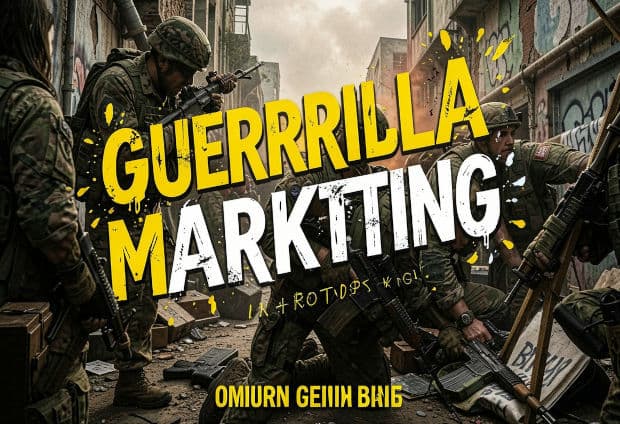
Guerrilla Marketing: The Art of Creating Massive Impact on a Tiny Budget
G
GeoRenus Editorial Team
660 views
Summary
Guerrilla marketing is an unconventional, low-cost marketing strategy that uses creativity, surprise, and bold ideas to leave a lasting impression — instead of relying on big advertising budgets. Coined by Jay Conrad Levinson in 1984, the approach has been adopted by brands from tiny startups to giants like Coca-Cola, Nike, and IKEA. From a coffee-cup manhole cover in New York City to Red Bull's space jump, guerrilla marketing proves one thing: you don't need a massive budget to make a massive impact.
Key Takeaways
- Guerrilla marketing uses creative, unconventional tactics to grab attention at a fraction of traditional advertising costs.
- Jay Conrad Levinson coined the term in 1984; his book sold over 21 million copies in 63 languages.
- Six core types: Ambient, Ambush, Stealth, Viral, Street, and Experiential marketing.
- HubSpot research shows guerrilla campaigns generate up to 15x more social media engagement than traditional ads.
- Key risks include legal exposure, public backlash, and difficulty measuring ROI — plan carefully before executing.
- Emerging market brands like Pathao and foodpanda have used guerrilla tactics effectively with minimal spend.
What Is Guerrilla Marketing?
Picture this: you're walking to work on a Tuesday morning in New York City. Nothing unusual — until you glance down and notice a manhole cover that looks exactly like a giant coffee cup, with real steam curling out of it. For a split second, your brain short-circuits. You stop, pull out your phone, and take a photo. By the time you reach the office, you've already posted it online.
You just experienced guerrilla marketing.
Guerrilla marketing is an unconventional, low-cost, creativity-driven marketing strategy that creates surprise, emotion, or wonder in places where people least expect advertising. Instead of buying attention with a big budget, it earns attention with a big idea.
The word "guerrilla" comes from warfare. Guerrilla soldiers are small, irregular forces that defeat much larger armies by using unconventional, surprise-based tactics instead of direct confrontation. In marketing, the same principle applies — a small brand with a clever idea can outmaneuver a corporate giant with a hundred-million-dollar ad budget.
The secret weapon is not money. It is creativity, timing, and the element of surprise.
The History and Origins of Guerrilla Marketing
In 1984, American marketing expert Jay Conrad Levinson published a book simply titled Guerrilla Marketing. It was written for small business owners who had no advertising budget but still needed to compete and survive in a crowded market.
Levinson's core argument was refreshingly simple: you don't need money to market effectively. What you need is time, energy, and imagination. He laid out practical, creative tactics that any business — from a one-person bakery to a local repair shop — could execute without breaking the bank.
The book became a phenomenon. It has sold over 21 million copies and been translated into 63 languages, making it one of the best-selling marketing books in history.
What started as a survival guide for small businesses eventually caught the attention of the world's biggest brands. Today, Coca-Cola, Nike, and IKEA regularly run guerrilla campaigns — not because they lack budget, but because guerrilla marketing does something paid advertising cannot: it creates a genuine human moment that people want to share.
Social media turbo-charged guerrilla marketing's power. A stunt witnessed by 200 people on a street corner in 2005 would stay local. The same stunt today gets filmed, shared on Instagram and TikTok, and reaches millions of people within hours — for free.
Six Types of Guerrilla Marketing
Ambient Marketing
Ambient marketing blends advertising seamlessly into the surrounding environment, so cleverly that people almost don't realize it's an ad — until they do, and then they can't stop thinking about it.
The classic example: Folgers Coffee, New York City
New York City manholes constantly emit steam from underground pipes. Folgers placed oversized coffee cup stickers on those manhole covers, making it look like a giant cup of hot coffee was steaming right there on the sidewalk. Cost? Nearly zero. Result? Millions of New Yorkers saw it, photographed it, and talked about it.
Ambush Marketing
Ambush marketing means hijacking someone else's event or moment to promote your own brand — without paying a cent to be an official sponsor. It is bold, aggressive, and, when done right, breathtakingly effective.
The standout example: Beats by Dre at the 2012 London Olympics
Samsung paid a fortune to be the official audio sponsor of the 2012 Olympics. But Beats by Dre quietly shipped free headphones to athletes before the games began. Athletes showed up on camera wearing Beats — not Samsung. Samsung got the official title. Beats got the screen time. It was one of the most talked-about marketing moves of the year.
Stealth Marketing
Stealth marketing is advertising that doesn't look like advertising. An influencer "casually" using a product in their daily content, or an actor mentioning a brand in a conversation — without the audience knowing it was paid for.
This is arguably the most controversial type of guerrilla marketing. If an audience discovers they were being sold to without knowing it, brand trust can collapse overnight. For this reason, many countries — including the US, UK, and EU nations — now legally require influencers to label paid content with disclosures like "Ad" or "Paid Partnership."
Viral Marketing
Viral marketing is about creating content so compelling, funny, emotional, or shareable that people spread it themselves — turning every viewer into a free distributor. It is the digital equivalent of word-of-mouth, scaled to millions.
The iconic example: ALS Ice Bucket Challenge, 2014
The ALS Association launched a deceptively simple challenge: pour a bucket of ice water over your head, film it, nominate three friends. In just 8 weeks, 17 million people participated and $115 million was raised. The campaign cost almost nothing to launch, but generated hundreds of millions of dollars worth of earned media. It remains one of the most successful viral campaigns ever.
Street Marketing
Street marketing takes the brand directly to where people live their daily lives — sidewalks, metro stations, parks, markets. It often involves pop-up installations, live performances, interactive experiences, or visual spectacles.
The memorable example: IKEA in the Paris Metro
IKEA furnished an entire Paris metro station with their sofas, beds, bookshelves, and lamps — turning a commuter platform into a cozy living room. Tired commuters waiting for their train found themselves sinking into a comfortable couch, surrounded by warm lighting. They laughed, took photos, and shared the experience online. IKEA got a flood of free publicity, and thousands of people walked away thinking about redecorating their homes.
Experiential Marketing
Experiential marketing doesn't just show you a product — it pulls you into an experience with it. The logic is powerful: people remember what they feel far longer than what they see or hear.
The benchmark example: Coca-Cola Happiness Machine
Coca-Cola installed a vending machine at a university that dispensed not just Coke, but flowers, pizzas, and oversized sandwiches. The video of people's reactions earned over 9 million views on YouTube. People weren't just buying a soft drink — they were living a moment of surprise and joy. That emotional connection is worth far more than any banner ad.
How to Execute Guerrilla Marketing — Step by Step
Step 1: Define Your Goal
What do you actually want to achieve? Brand awareness? App downloads? Product launch buzz? Foot traffic to a store? Be specific. Without a clear goal, your creative energy will scatter in every direction and land nowhere.
Step 2: Know Your Audience Deeply
Where does your target audience spend their time? What do they care about? What makes them laugh, stop, or pull out their phone? A guerrilla campaign aimed at college students looks completely different from one aimed at working parents. Understand your audience before you design your stunt.
Step 3: Create a Surprise-Driven Idea
This is the hard part — and the most important. The idea must break pattern. People are conditioned to ignore advertising; your job is to create something so unexpected that their brains can't filter it out. The best guerrilla ideas are simple, visual, and shareable. Ask yourself: would someone stop, take a photo, and send it to a friend?
Step 4: Plan Your Budget and Resources
Guerrilla marketing is low-cost, not zero-cost. You may need materials, permits, staff, or equipment. Plan realistically. The beauty of guerrilla marketing is that $500 of creative materials can outperform a $50,000 billboard — but only if the idea is sharp enough.
Step 5: Set Up Social Media Capture
The real leverage in guerrilla marketing is online amplification. A live stunt might reach 300 people. A video of that stunt can reach 3 million. Have a filming crew ready, create a campaign hashtag, and seed the content on your own channels immediately after the activation. Think of the live event as the launch pad, not the destination.
Step 6: Check Legal and Ethical Issues
Before you do anything in a public space, check whether you need a permit. If you're planning an ambush campaign around a competitor's event, consult a lawyer. Skipping this step is how a creative idea turns into a lawsuit or a PR disaster.
Do's and Don'ts
Do:
1. Lead with creativity — a strong idea is your most valuable asset, not your budget.
2. Respect local culture and context — what delights an audience in one city can deeply offend an audience in another.
3. Design every activation to be shareable — if it's not photo-worthy or video-worthy, rethink it.
4. Target emotion — surprise, laughter, wonder, and inspiration are the emotions most likely to trigger sharing.
5. Measure your results — track views, shares, website visits, app downloads, and sales lift so you know what worked.
Don't:
1. Frighten or alarm people — in 2007, a Cartoon Network guerrilla campaign in Boston placed LED devices around the city that were mistaken for bombs. The city went into lockdown. It cost the network $2 million in fines and destroyed the campaign entirely.
2. Use misleading or false information — if your stunt involves a claim, it must be true. Regulatory bodies take a dim view of deceptive marketing.
3. Act without permits in public spaces — "it'll be quick" is how brands end up with fines or forced shutdowns mid-activation.
4. Touch sensitive topics — religion, politics, tragedy, or grief are almost never appropriate themes for guerrilla stunts.
5. Insult or mock competitors directly — it almost always backfires and makes your brand look petty, not clever.
Pros and Cons
Pros:
1. Low cost, high impact — a fraction of a traditional advertising budget can generate the same or greater reach if the idea is strong enough.
2. Viral potential — HubSpot research shows that creative guerrilla campaigns generate up to 15x more social media engagement than conventional digital advertising.
3. Lasting memory — a surprising, emotionally resonant experience sticks in the mind far longer than a TV spot or banner ad.
4. High trust — Nielsen research found that 92% of consumers trust personal recommendations and experiential interactions more than traditional advertising. Guerrilla marketing, at its best, feels personal.
5. Ideal for small businesses — with the right idea, a small brand can compete with — and sometimes beat — companies with far larger marketing budgets.
Cons:
1. Uncertainty — not every campaign will go viral. Some will be ignored; others will actively flop. There is no formula that guarantees success.
2. Legal risk — unauthorized activity in public spaces can result in fines, legal action, or forced removal.
3. Backlash risk — a misjudged stunt can blow up in your face on social media, causing reputational damage that is hard to repair.
4. Hard to measure ROI — unlike paid digital ads with trackable clicks and conversions, guerrilla campaigns make attribution difficult.
5. Higher risk for established brands — a startup with nothing to lose can afford to be bold and weird. A brand with decades of brand equity has more to lose if a guerrilla stunt goes wrong.
Famous Guerrilla Marketing Campaigns
1. Red Bull Stratos — Jump from Space (2012)
Red Bull sponsored Austrian skydiver Felix Baumgartner to jump from a helium balloon 128,000 feet above the Earth — the edge of space. The live stream attracted 8 million concurrent viewers on YouTube, breaking the platform's record at the time. Red Bull didn't just sell an energy drink that day — it cemented its identity as the brand of human limits and extraordinary ambition.
2. Burger King — Whopper Detour (2018)
Burger King ran a promotion where customers who got within 600 feet of a McDonald's location could unlock a Whopper for just 1 cent through the Burger King app. They used their biggest competitor's locations as the trigger for their own promotion. Brilliant — and infuriating for McDonald's.
Result: 1.5 million app downloads in just 9 days, and the campaign won a Grand Prix at the Cannes Lions International Festival of Creativity.
3. UNICEF — Dirty Water Vending Machine
UNICEF placed a vending machine in New York City that sold bottles of "dirty water" — labeled with diseases like cholera, typhoid, and malaria — for $1 each. The stunt was designed to confront comfortable New Yorkers with the reality that millions of people around the world drink contaminated water every day. Donations could be made directly at the machine. It was guerrilla marketing as activism — unforgettable and deeply human.
4. Spotify Wrapped — Turning Data into Content
Every December, Spotify releases each user's personalized listening stats — top artists, top songs, total minutes — in a beautifully designed visual card. Users share it everywhere without being asked. Spotify spends virtually nothing on the promotion, and every year it dominates social media for days. It is perhaps the most elegant example of turning product data into a self-sustaining marketing engine.
Guerrilla Marketing in Emerging Markets
Guerrilla marketing is not just a Western phenomenon. In emerging markets, where advertising budgets are tighter and digital penetration is rapidly growing, guerrilla tactics are becoming increasingly powerful.
Pathao — Campus Guerrilla in Dhaka
In its early days, ride-sharing app Pathao went directly onto university campuses across Dhaka, handing out free ride coupons and talking to students face to face. No TV spots, no billboards — just direct street-level engagement with the exact audience they needed. It was textbook Street Marketing, and it helped Pathao build a loyal user base from the ground up.
foodpanda — Flash Sales and Rolling Ads
foodpanda Bangladesh has used social media flash sales and viral challenges to build buzz at minimal cost. But perhaps their most underrated guerrilla asset is their bright pink delivery bags — every delivery rider on Dhaka's streets is a living, moving billboard, putting the brand in front of thousands of eyes daily without a single rupee in media spend.
Opportunity for Small Businesses
For small and medium businesses in Dhaka, Chittagong, or any dense urban market, guerrilla marketing represents a genuine equalizer. Creative street activations, viral Facebook and Instagram content, and surprise pop-up experiences can generate the kind of word-of-mouth that would cost a fortune through traditional advertising. The barrier to entry is not money — it is imagination.
Final Thoughts
Guerrilla marketing teaches a fundamental truth about business: success is not proportional to budget. The brands and businesses that win — whether they are Fortune 500 companies or first-year startups — are the ones that find smarter, more human ways to connect with people.
That said, guerrilla marketing is not a magic wand. Not every stunt will go viral. Not every idea will land. The approach requires courage, creativity, careful planning, and a willingness to accept that some campaigns will fail. The key is to learn fast, iterate, and keep showing up with bold ideas.
"The smaller your budget, the bigger your ideas need to be." — Jay Conrad Levinson
For small and medium businesses in particular, guerrilla marketing is not just an option — it is one of the most powerful tools available. In a world where attention is the scarcest resource, the brands that earn it through creativity will always outperform the ones that simply buy it.
Recommended for you

Red Ocean and Blue Ocean Strategy: Fight the Competition or Make It Irrelevant — The Complete Guide
Red Ocean strategy means competing in an existing market where rivals fight over the same customers. Blue Ocean strategy means creating an entirely new, uncontested market where competition is irrelevant. W. Chan Kim and Renee Mauborgne's 2005 bestseller introduced the Four Actions Framework — Eliminate, Reduce, Raise, Create — to achieve Value Innovation. Netflix, Apple, Tesla, and Bangladesh's bKash are among the most celebrated Blue Ocean success stories.
Books
The $100 Startup
Branding
Branding: How to Make Your Business Stand Out
E-Commerce
E-Commerce: The Complete Guide to Online Business
Finance
Finance: What It Is, Why You Need It, and How It Works in Real Life
Marketing
The 7 P's of Marketing: The Complete Framework Every Business Needs
Organization
What Is the International Monetary Fund (IMF)?
Startup
What Is a Startup? The Ultimate Guide You Need to Read
Accounting
Accrual Accounting: How It Works, Types, and Why It Matters

Accounting
Audit Planning and Risk Assessment: A Complete Guide