Ponzi Scheme: The Investment Fraud That Has Been Fooling People for Over 100 Years
G
GeoRenus Editorial Team
961 views
Summary
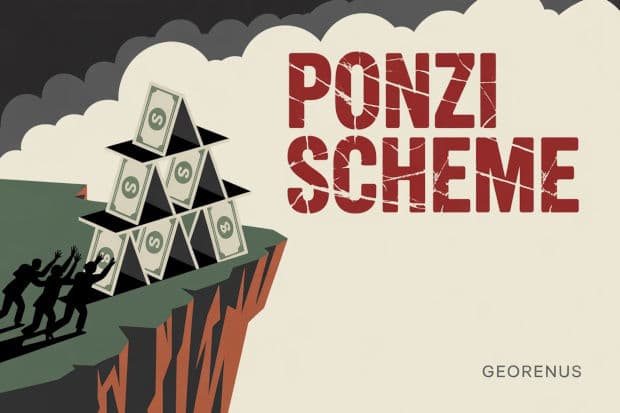
A Ponzi scheme is one of the oldest and most dangerous investment frauds in the world — and the scary part is, it is still happening today. In simple terms, it is a fake investment opportunity where a person or company promises you very high returns on your money in a very short time. But here is the truth — there is no real business, no real profit, and no real investment happening behind the scenes. The money you put in does not go into any legitimate fund. Instead, your money is used to pay the "profits" of earlier investors, while the people running the scheme quietly pocket the rest. Eventually the whole thing collapses, and most people lose everything they invested.
Key Takeaways
- A Ponzi scheme is an investment scam where people are lured with promises of very high returns in a very short period of time.
- There is no legitimate source of profit in a Ponzi scheme. Money from new investors is used to pay returns to earlier investors, while the operators keep the rest for themselves.
- Once new investments stop coming in, the entire scheme collapses — and that is when the fraud becomes visible to everyone.
- The rate of return offered in a Ponzi scheme is always suspiciously higher than what any legitimate investment can offer — and that is your biggest warning sign.
- If you try to withdraw your money from a Ponzi scheme, the operators will always find vague and unclear reasons to delay or block your withdrawal.
- Financial statements in a Ponzi scheme are heavily manipulated and falsified to hide what is really happening with investors' money.
Introduction -- The Night Bernie Madoff Destroyed Thousands of Lives
December 2008. New York City. The financial world was already in freefall -- Lehman Brothers had collapsed, stock markets were imploding, and panic was spreading from Wall Street to Main Street.
But in a luxury apartment on the Upper East Side, something far more personal was unraveling. Bernard L. Madoff, one of Wall Street's most respected figures, called his two sons into a room. He told them the truth he had been hiding for decades.
There were no real investments. There were no real returns. There was nothing. Just a massive lie -- new investors' money being used to pay old investors, round after round, year after year, for nearly half a century.
Per published SEC investigation and US DOJ court documents: Madoff had orchestrated a $65 billion Ponzi scheme -- the largest investment fraud in American history, and arguably the largest in the history of the world.
Thousands of families lost their life savings. Charities that had trusted Madoff with their endowments were shuttered overnight. Elderly retirees who had invested their entire nest eggs were left with nothing. Some could not cope with the devastation.
In 2009, Bernard Madoff was sentenced to 150 years in federal prison. He died there in April 2021 at the age of 82.
This is not fiction. This is a documented, court-verified catastrophe. And the mechanism behind it -- the financial con that brought down this empire -- is called a Ponzi scheme.
This guide will show you exactly how Ponzi schemes work, the 8 warning signs the SEC and FINRA say you should never ignore, the most famous cases in history, how they differ from pyramid schemes, and -- most importantly -- how to protect yourself and the people you love.
"If an investment sounds too good to be true, it almost certainly is." -- A principle repeated across every SEC and FINRA investor protection publication ever written.
This guide is not just a theoretical overview. It is a practical field manual. By the end, you will know how to recognize the mechanics of a Ponzi scheme from a distance -- before it is too late to protect yourself or someone you care about.
What Is a Ponzi Scheme -- Charles Ponzi, 1920, and the Birth of a Con
The year is 1919. A small office in Boston, Massachusetts. A sharp-dressed Italian immigrant named Charles Ponzi has a pitch that sounds almost magical.
His claim: he had discovered a way to profit from international postal reply coupons -- buy them cheap in Europe, redeem them at higher face value in the United States. He promised investors 50% returns in 90 days. Some accounts suggest he even offered 100% in 180 days.
People lined up to give him money. The first investors received their promised returns -- right on schedule, exactly as advertised. Word spread through Boston's immigrant communities like wildfire. Newspapers wrote glowing profiles. More people came. More money poured in.
But here was the secret Charles Ponzi was keeping: there were almost no postal coupons. There was no actual investment strategy. There was no real business at all.
He was simply taking money from new investors and handing it to earlier investors as their so-called 'profit.' As long as new money kept flowing in, the illusion held. The moment it stopped, everything would collapse.
Per published historical records: in just 8 months, Charles Ponzi collected approximately $20 million from roughly 40,000 investors -- equivalent to well over $280 million in today's money. He was arrested in August 1920.
The Definition
A Ponzi scheme is a fraudulent investment operation in which returns paid to existing investors are funded entirely by money collected from new investors -- not by any actual business activity, trading, or investment generating real profit.
The scheme is named after Charles Ponzi, though similar frauds had existed before him. What made his version so notorious was its scale, speed, and audacity.
How the Mechanics Work -- Step by Step
Step 1: The operator promises extraordinary returns -- far above anything legitimately available in the market.
Step 2: Early investors deposit money, drawn in by the promise.
Step 3: The operator uses money from a second wave of investors to pay the first group their promised 'returns.'
Step 4: Satisfied early investors -- who genuinely believe they've made a profit -- tell their friends, family, and colleagues. More investors arrive.
Step 5: Each new round of investors funds the returns for the previous round. The operator skims cash for personal use along the way.
Step 6: Eventually, the flow of new money slows. Redemption requests pile up. The math breaks down. The scheme collapses.
| Stage | What Investors See | What Is Actually Happening |
| 1 - The Promise | An exciting, exclusive opportunity with guaranteed high returns | The operator is building a false credibility facade |
| 2 - First Wave In | Easy sign-up, confident operator, professional appearance | Money is pooled with no real investment made |
| 3 - First Payouts | Early investors receive exactly what was promised -- on time | New investors' deposits are being handed to early investors as 'profit' |
| 4 - Word Spreads | Trusted friends confirm they made money -- social proof at work | The operator needs exponentially more new money each round |
| 5 - Peak Expansion | Hundreds or thousands of investors, a thriving 'business' | The math is already broken -- collapse is inevitable |
| 6 - Slowdown | A few investors try to withdraw; delays and excuses appear | The operator is desperately scrambling for new capital |
| 7 - Collapse | Panic withdrawals, operator disappears or is arrested | Most investors lose everything -- only the earliest may have profited |
Note: The Ponzi scheme is named after Charles Ponzi, but the underlying fraud mechanism predates him. What he did was scale it -- and get caught spectacularly.
Here is the essential truth about a Ponzi scheme: it is not a business. It is a clock that is always running out of time. It works brilliantly -- until it does not. And when it stops, the damage is total.
The mathematics are unforgiving: to keep paying a 50% annual return to 1,000 investors, the operator needs 1,500 new investors the following year. To pay those 1,500, they need 2,250. The exponential growth required is never sustainable -- the question is only how many years before the numbers become impossible.
How It Works -- The 6-Phase Lifecycle of a Ponzi Scheme
Every Ponzi scheme in history -- from Charles Ponzi in 1920 to Bernie Madoff in 2008 -- follows the same predictable lifecycle. Understanding these phases is your best defense.
Phase 1 -- The Hook: Extraordinary Returns
Operators typically promise returns that are completely detached from market reality. Monthly returns of 10-30%, or annual returns exceeding 100%, are common lures.
For context: Warren Buffett, widely regarded as the greatest investor of the modern era, has averaged roughly 20% annual returns over six decades -- an astonishing record built on genuine business analysis. Anyone claiming they can consistently beat that by 5x or 10x is either lying or delusional.
Phase 2 -- The Proof: Early Investors Are Paid
This is the most psychologically dangerous phase. The first investors actually receive their promised returns -- because there is still fresh money coming in from the second wave of investors.
These early winners become the scheme's most powerful marketing tool. They are not lying when they tell people they made money. They genuinely did -- for now. Their honest testimonials create social proof that draws in the next wave.
Phase 3 -- The Spread: Word of Mouth Amplifies
Satisfied early investors tell their networks. The operator may also cultivate an air of exclusivity -- making it feel like a privilege to be invited into this opportunity. FOMO kicks in. The scheme grows.
Phase 4 -- The Peak: Thousands of Investors, Enormous Sums
At this stage, the operator is managing a complex balancing act: paying enough existing investors to keep them satisfied, skimming personal profits, and continuously recruiting new money.
The mathematics, however, are working against the operator with every passing day. Each payout round requires more new money than the last, because the pool of 'owed returns' keeps growing exponentially.
Phase 5 -- The Strain: New Money Dries Up
Eventually, market conditions shift, or there are simply no more easily accessible new investors. Some existing investors start asking for their money back. The operator begins stalling -- offering excuses, delays, and new incentives to keep money locked in.
Phase 6 -- The Collapse: The Inevitable End
The operator can no longer pay redemptions. Either they disappear with whatever cash remains, or investigators catch up with them, or -- as in Madoff's case -- they confess. Investors are left with claims against an empty account.
| Phase | Typical Duration | Investor Sentiment | Mathematical Reality |
| 1 - Launch | First weeks to months | Skeptical but curious | Operator building false credibility |
| 2 - First Returns | 3 to 12 months in | Excited, convinced, grateful | Later investors' money funding early payouts |
| 3 - Spread | Year 1 to Year 3 | Enthusiastic, recruiting friends | Exponential money gap widening silently |
| 4 - Peak | Year 3 to Year 5+ | Total faith, fully invested | Collapse is now only a matter of timing |
| 5 - Strain | Final months | Mildly uneasy, some asking questions | Operator in full panic mode |
| 6 - Collapse | Sudden | Shock, rage, devastation | Nothing left -- most investors lose everything |
The tragic irony: most investors do not realize what has happened until they are in Phase 5 or 6. By then, the damage cannot be undone.
Madoff's scheme is the most vivid illustration of this lifecycle stretched to its extreme: Phase 4 lasted for decades, because his legitimate brokerage provided cover, his client base was private and elite, and the SEC failed to act on repeated red-flag reports. Most Ponzi schemes collapse within 3-5 years. Madoff's ran for roughly 50.
"Every Ponzi scheme eventually collapses. The only question is how big it gets before it does." -- A principle consistently emphasized in SEC investor education materials.
8 Warning Signs of a Ponzi Scheme -- Per SEC and FINRA Published Guidance
The U.S. Securities and Exchange Commission (SEC) and the Financial Industry Regulatory Authority (FINRA) have published extensive investor protection materials identifying the most reliable warning signs of Ponzi schemes. Here are the 8 you should memorize.
Warning Sign 1 -- Unrealistically High Returns
The best-performing mutual funds in the world average 15-20% annually in strong years. If someone promises you 50%, 100%, or 'guaranteed 10% per month' -- that is not investing. That is fraud.
The rule of thumb: the higher and more guaranteed the promised return, the more suspicious you should be. Legitimate returns come with risk. No risk means no real investment.
Warning Sign 2 -- Consistent Returns Regardless of Market Conditions
Real investments move with market forces. When stock markets crash -- as they did in 2001, 2008, and 2020 -- genuine portfolios lose value. Ponzi operators claim their strategy 'works in any market.'
This is a massive red flag. No legitimate investment strategy consistently beats market downturns. If the numbers never go down, something is being hidden.
Warning Sign 3 -- Unregistered or Unlicensed Operators
Per published SEC warnings: every legitimate investment firm and advisor must be registered with the relevant regulatory authority. In the U.S., that means SEC and/or FINRA. In Bangladesh, that means BSEC (Bangladesh Securities and Exchange Commission). No registration means no legal accountability.
Warning Sign 4 -- Secretive or Overly Complex Strategies
'Our proprietary algorithm is too complex to explain.' 'We use a special arbitrage strategy we can't disclose for competitive reasons.' Legitimate investment managers can always explain, in plain language, where your money is going and how it is being used.
Deliberate opacity is not sophistication. It is concealment.
Warning Sign 5 -- Difficulties Withdrawing Money
In any legitimate investment vehicle, you should be able to access your money within a reasonable timeframe -- even if there are fees or penalties for early withdrawal. Ponzi operators routinely stall withdrawal requests with excuses: 'processing delays,' 'reinvestment lock-in periods,' 'market conditions.'
Warning Sign 6 -- Pressure to Recruit New Investors
'Bring your friends and we will give you a bonus.' If an investment opportunity incentivizes you to recruit new participants, that is a fundamental sign that the operation depends on new money -- not real returns -- to function.
Warning Sign 7 -- Absence of Proper Documentation
No registered prospectus. No audited financial statements. No third-party custodian for your assets. No official company registration. Legitimate investments come with paperwork -- and that paperwork can be independently verified.
Warning Sign 8 -- Manufactured Exclusivity
'This opportunity is only for our inner circle.' 'We can only take a few more investors.' This artificial scarcity is a calculated psychological tactic to suppress your skepticism and accelerate your decision-making. Do not let it work.
| Warning Sign | What Legitimate Investments Look Like | What Ponzi Schemes Look Like |
| Returns | Market-linked, 5-20% annually with variability | Guaranteed 50-100%+ annually or 10%+ per month |
| Consistency | Returns fluctuate with market conditions | Steady, consistent returns regardless of conditions |
| Registration | Registered with SEC, FINRA, BSEC, or equivalent | Unregistered, or registration cannot be verified |
| Strategy | Transparent, explainable investment thesis | Secret, proprietary, too complex to explain |
| Liquidity | Withdrawals processed within standard timeframes | Delays, excuses, or locked-in periods on withdrawals |
| Documentation | Prospectus, audited financials, custodian statements | No proper paperwork or third-party verification |
| Recruitment | No pressure to bring in new investors | Bonuses or pressure to recruit new participants |
| Access | Open to qualified investors, clearly marketed | Invitation-only, exclusive, limited availability |
Note: Per published SEC Ponzi Scheme Investor Alerts -- the more of these warning signs you observe in a single opportunity, the more certain you should be that something is wrong. Three or more is a near-certain red flag.
One or two warning signs might occasionally appear in legitimate but poorly structured investments. Three or more together -- especially guaranteed high returns combined with unregistered operators and withdrawal difficulties -- is almost never coincidence.
A critical habit to develop: before giving anyone your money, spend 15 minutes on your national securities regulator's website verifying registration. For U.S. investors, SEC.gov and FINRA BrokerCheck are free and take minutes. For Bangladeshi investors, BSEC's database is publicly accessible. This one step alone filters out the vast majority of fraudulent operators.
Famous Ponzi Schemes in History -- From Charles Ponzi to Bernie Madoff
History has given us no shortage of Ponzi schemes. They have appeared in every era, every country, and across every demographic. Here are the most significant cases, grounded in published court documents and regulatory enforcement records.
Charles Ponzi -- The Original (1919-1920), United States
Per published historical records: Charles Ponzi launched his scheme in Boston in 1919, promising investors 50% returns in 90 days through international postal reply coupon arbitrage.
In reality, he never purchased meaningful quantities of postal coupons. The 'returns' paid to early investors came entirely from new investors' deposits.
In just 8 months, he collected approximately $20 million -- equivalent to over $280 million today. He was arrested in August 1920 and ultimately served several years in federal prison.
After his release and eventual deportation to Italy, Ponzi attempted similar schemes in Florida real estate and Brazil. He died in poverty in Rio de Janeiro in 1949. His name became a permanent entry in the dictionary of financial fraud.
Bernie Madoff -- The Largest in History (approximately 1960-2008), United States
Per published SEC investigation and US Department of Justice court documents: Bernard L. Madoff Investment Securities LLC operated a Ponzi scheme totaling approximately $65 billion -- the largest investment fraud in recorded history.
What made Madoff uniquely devastating was his extraordinary credibility. He was a former chairman of NASDAQ. His firm had a legitimate market-making operation that was genuinely profitable. He cultivated an elite, exclusive client list -- major banks, universities, charities, and wealthy individuals trusted him completely.
The fraud ran for decades -- possibly as far back as the 1960s, though the precise start date remains disputed in legal proceedings. The 2008 financial crisis forced the collapse: clients needed liquidity and began withdrawing. Madoff could not cover the redemptions.
He confessed to his sons, who reported him to federal authorities. The SEC -- embarrassingly -- had received warnings about Madoff's operation years earlier but failed to act decisively.
In June 2009, Madoff was sentenced to 150 years in federal prison. He died in prison on April 14, 2021.
Allen Stanford -- The Caribbean Banker (2009), United States/Antigua
Per published SEC enforcement actions: Allen Stanford operated a $7 billion Ponzi scheme through Stanford International Bank, based in Antigua.
Stanford promised investors unusually high returns on certificates of deposit (CDs) -- a typically conservative instrument. Approximately 20,000 investors across 113 countries were defrauded.
Per published US DOJ court documents, Stanford was sentenced to 110 years in federal prison in 2012.
Destiny Group -- Bangladesh
Per published court case records: Destiny Group operated a large-scale multi-level marketing and Ponzi-like scheme in Bangladesh.
The operation collected funds from hundreds of thousands of members under the guise of various investment products and programs. Subsequent investigations revealed significant financial misappropriation. Legal proceedings resulted in criminal charges against its leadership.
| Scheme | Country | Period | Scale (Per Published Records) | Legal Outcome |
| Charles Ponzi | United States | 1919-1920 | ~$20 million (~$280M today) | Prison; later deported |
| Bernie Madoff | United States | ~1960-2008 | ~$65 billion (per SEC) | 150 years federal prison; died 2021 |
| Allen Stanford | United States / Antigua | 2000-2009 | ~$7 billion (per SEC) | 110 years federal prison |
| Destiny Group | Bangladesh | 2000s | Hundreds of thousands of members affected | Criminal charges; ongoing legal proceedings |
Note: All figures are sourced from published SEC enforcement actions, US DOJ court documents, and published historical and court records. Individual figures may vary across sources.
Notice the common thread across every single case: the operator was trusted, respected, and appeared entirely credible. Charles Ponzi wore fine suits. Bernie Madoff was a NASDAQ chairman. Allen Stanford was a prominent banker. Credibility is not protection -- it is the weapon.
And notice what brought each one down: not clever investigators, not sophisticated financial forensics, but simple arithmetic. In Madoff's case, the 2008 financial crisis forced liquidity needs that exposed the hollow core. In Stanford's case, the SEC eventually dug deeper. In Ponzi's case, a single investigative journalist ran the numbers on the postal coupons and found they did not add up. The math always wins in the end.
Ponzi Scheme vs. Pyramid Scheme -- What Is the Difference?
These two terms are often used interchangeably in casual conversation -- but they describe distinct fraud structures. Both are illegal. Both inevitably collapse. Understanding the difference helps you identify which type of scheme you might be looking at.
The Ponzi Scheme -- Structure and Mechanics
A Ponzi scheme has a single central operator who manages everything. Investors simply hand over money and wait for returns. They typically do not know each other and have no obligation to recruit anyone. The operator handles all recruitment. The claimed source of returns is always some form of investment or trading activity.
The Pyramid Scheme -- Structure and Mechanics
In a pyramid scheme, every participant is required to recruit new members. A portion of the money paid by new recruits flows upward to earlier members. The structure grows geometrically -- hence the pyramid shape. The actual 'product' or 'investment' is often nominal or nonexistent.
| Feature | Ponzi Scheme | Pyramid Scheme |
| Core structure | One central operator controls everything | Multi-level network; every member recruits |
| Recruitment obligation | Operator recruits; investors are passive | Every participant must bring in new members |
| Claimed income source | Investment returns, trading profits | Recruitment fees, sales commissions on new tiers |
| What triggers collapse | New investment money dries up | Impossible to keep recruiting new members geometrically |
| Investor's role | Passive -- deposit money and wait | Active -- must constantly recruit to earn |
| Key examples | Madoff, Charles Ponzi, Stanford | Many MLM-style 'business opportunities' |
| Legal status | Completely illegal in virtually all jurisdictions | Completely illegal in virtually all jurisdictions |
| Product or service | Usually none -- pure financial fraud | Often a nominal product to maintain legal cover |
The simplest way to distinguish them: in a Ponzi, you give money and wait. In a pyramid, you give money and then have to hustle to bring in more people. Both end the same way -- in collapse, with most participants losing everything.
"Both schemes share one inescapable mathematical truth: they require more money coming in than going out. That equation always breaks." -- Principle cited consistently in SEC educational materials.
There is also a hybrid known as a 'Ponzi-pyramid' -- where participants both invest money and are encouraged to recruit others. This combination is especially common in developing markets and online 'investment clubs.'
Psychology -- Why Intelligent People Still Fall for Ponzi Schemes
Here is the question that haunts every Ponzi scheme aftermath: how could such smart, educated, successful people fall for something that, in hindsight, seems so obvious?
The uncomfortable answer: because Ponzi operators are not just financial criminals. They are psychologists. They systematically exploit specific, well-documented cognitive biases that all human beings share.
Reason 1 -- Greed and the Dream of Fast Wealth
The desire to become wealthy faster than patience normally allows is not a character flaw -- it is deeply human. Ponzi operators understand this perfectly. When someone says 'monthly 20% returns guaranteed,' the rational part of your brain may flash a warning -- but the emotional part starts calculating the lifestyle that kind of money could buy.
Published behavioral research on Prospect Theory -- developed by Nobel Prize laureates Daniel Kahneman and Amos Tversky -- shows that humans are disproportionately drawn to potential gains, often at the expense of careful risk assessment.
Reason 2 -- Social Proof: The Power of Trusted Testimony
'My neighbor invested and made 40% in three months. I saw his statement. He is not the type to lie.' This kind of trusted social proof is extraordinarily persuasive -- and it is exactly what Ponzi operators engineer.
The brutal twist: the neighbor is not lying. He did receive those returns -- funded by your money and the money of everyone else who invested after him. Social proof in a Ponzi scheme is real, specific, and completely misleading.
Reason 3 -- Authority Bias: Trusting the Impressive
Madoff was a former NASDAQ chairman with a legitimate Wall Street firm. Stanford was knighted by the government of Antigua. Charles Ponzi wore a diamond stickpin and carried a gold cane. We are psychologically wired to trust signals of status, credibility, and authority.
The dangerous conclusion: impressive credentials and social standing are no substitute for independent due diligence. They are, in fact, precisely what sophisticated fraudsters cultivate.
Reason 4 -- FOMO: Fear of Missing Out
'This offer closes at the end of the month.' 'We can only accept three more investors at this level.' Artificial scarcity and time pressure are deliberate psychological techniques designed to short-circuit careful thinking. FOMO compels action before analysis.
Reason 5 -- Certainty Bias: The Irresistible Appeal of 'Guaranteed'
Real investments carry uncertainty. Ponzi schemes offer certainty -- 'guaranteed returns,' 'capital protection,' 'no-risk profit.' For investors who are risk-averse, the false promise of certainty overrides the obvious warning that no real investment can deliver it.
| Psychological Trigger | How Operators Exploit It | How to Counter It |
| Greed / Fast-wealth fantasy | Promise returns 5x-10x above market reality | Anchor expectations to actual market benchmarks |
| Social proof | Engineer early winners whose honest testimonials recruit the next wave | Verify claims independently -- do not rely on anecdotes |
| Authority bias | Cultivate impressive titles, offices, and social connections | Check registration records, not resumes or appearances |
| FOMO | Manufactured scarcity: 'limited spots,' 'closing soon' | Treat urgency as a red flag, not a reason to rush |
| Certainty bias | Promise 'guaranteed' returns to attract risk-averse investors | Understand that any real 'guarantee' is mathematically impossible |
Note: Published behavioral economics research consistently shows that cognitive biases operate below conscious awareness. Being aware of them is not foolproof protection -- but it significantly raises your defenses.
Among Madoff's victims were Nobel-Prize-winning economists, prominent lawyers, sophisticated hedge fund managers, and veteran Wall Street professionals. Intelligence does not immunize you. Awareness and process do.
The practical takeaway: slow down. A real investment opportunity does not require you to decide today, recruit your friends, or trust a complex strategy you cannot understand. Anything that bypasses your natural skepticism is designed to bypass your natural skepticism.
Legal Framework -- How Governments Fight Ponzi Schemes
Ponzi schemes are serious criminal offenses in virtually every jurisdiction on earth. Understanding the legal framework helps you know what protections exist -- and what your options are if you have been victimized.
United States -- Federal Legal Framework
Per published SEC and US DOJ information: operating a Ponzi scheme typically triggers multiple simultaneous federal charges, including securities fraud, wire fraud, mail fraud, and money laundering.
Each federal fraud count carries a maximum sentence of up to 20 years. Because operators typically commit hundreds or thousands of individual fraudulent transactions, sentences can be stacked -- which is how Bernie Madoff received a 150-year sentence.
The SEC investigates and brings civil enforcement actions. The FBI and DOJ handle the criminal prosecution. The court typically appoints a Receiver to recover and distribute whatever assets remain to victims -- though recoveries are rarely complete.
Bangladesh -- Legal Framework
The Bangladesh Securities and Exchange Ordinance 1969 and subsequent securities legislation prohibits unauthorized collection of investment funds from the public. BSEC (Bangladesh Securities and Exchange Commission) registration is legally mandatory for any entity soliciting public investment.
Criminal penalties include imprisonment and substantial financial fines. The severity of punishment scales with the scale of the fraud and the number of victims.
| Legal Dimension | United States | Bangladesh |
| Primary legislation | Securities Exchange Act 1934; Wire Fraud Act; Mail Fraud Act | Securities and Exchange Ordinance 1969; subsequent BSEC regulations |
| Primary regulator | SEC (civil enforcement) | BSEC |
| Criminal prosecution | FBI and US Department of Justice | Police and relevant prosecutorial authorities |
| Maximum criminal penalty | Up to 20 years per count (counts may be stacked) | Imprisonment and fines scaled to offense severity |
| Asset recovery | Court-appointed Receiver; SIPC for brokerage accounts | Court-ordered asset seizure and distribution |
| Victim compensation | Partial recovery via Receiver liquidation; rare full recovery | Via court process; recovery rates vary significantly |
Note: Legal information is based on published regulatory sources as of the knowledge cutoff. Laws change. For current legal advice, consult a qualified attorney or your national securities regulator.
Critical point for anyone who has been victimized: report immediately to the relevant regulator (SEC in the U.S., BSEC in Bangladesh) and law enforcement. The earlier a scheme is reported, the greater the chance of recovering any remaining assets before they are dissipated.
How to Protect Yourself -- 7 Things to Do and 7 Things to Never Do
Prevention is the only fully reliable protection against a Ponzi scheme. By the time a scheme collapses, recovery options are limited and uncertain. Here is a concrete, actionable framework.
7 Things You Should Always Do
1. Verify registration before investing: In the U.S., check SEC.gov and FINRA BrokerCheck. In Bangladesh, check BSEC's registered entity database. No registration means no legal protection.
2. Compare promised returns to market reality: The best-performing legitimate investments return 15-20% annually in good years. Anything significantly higher demands a very clear, independently verifiable explanation.
3. Demand proper documentation: Ask for the registered prospectus, audited financial statements signed by a reputable accounting firm, and the name of the third-party custodian holding your assets.
4. Get independent advice: Before committing significant capital, consult a financial advisor who has absolutely no connection to -- and no commission from -- the investment opportunity you are evaluating.
5. Take your time: Any legitimate investment opportunity will still exist tomorrow, next week, and next month. If someone tells you you must decide right now, walk away.
6. Discuss major decisions with trusted people: Before committing large sums, talk to a financially literate family member or trusted colleague who is not involved in the opportunity.
7. Report suspicions immediately: If you believe you have encountered a Ponzi scheme, report it to the SEC (tips.sec.gov), FINRA, BSEC, or your national securities regulator. Early reports save other victims.
7 Things You Should Never Do
1. Never invest on word of mouth alone: Even your closest, most trusted friend can be an unwitting participant in a Ponzi scheme. Affection is not due diligence.
2. Never believe in 'guaranteed returns': No legitimate investment can guarantee returns. The word 'guaranteed' in an investment context is almost always a signal of fraud.
3. Never invest under pressure or urgency: 'Last chance' and 'limited spots' are sales tactics designed to prevent you from thinking clearly. Manufactured urgency is a major red flag.
4. Never rely solely on others' success stories: Early investors in every Ponzi scheme genuinely made money. Their experience tells you nothing about your outcome.
5. Never put all your capital in one place: Diversification is not just an investment strategy -- it is a fraud defense. Even if one investment fails completely, the rest of your portfolio survives.
6. Never recruit friends without doing your own independent due diligence first: If the investment turns out to be fraudulent, you have not just lost your own money -- you have damaged relationships you cannot replace.
7. Never stay silent if you suspect you are a victim: Shame and embarrassment are powerful inhibitors. But early reporting is your best chance of recovering anything -- and it protects others who have not yet invested.
What People Think They Are Getting -- And What Actually Happens
Ponzi schemes succeed because they align perfectly with human aspirations -- the dream of financial security, fast wealth, and passive income. Understanding the gap between the perception investors hold and the reality they face is crucial.
The Perception Versus the Reality
| What Investors Believe | What Actually Happens |
| I will earn high guaranteed returns | Most investors lose their entire principal; only the earliest participants may profit |
| My money is being carefully invested | Money is pooled and used to pay earlier investors -- no real investment occurs |
| This trusted person would not deceive me | Trust and credibility are the operator's primary tools -- not evidence of legitimacy |
| My neighbor made money, so will I | Early investors genuinely profit; later investors almost always lose everything |
| If it collapses, the government will recover my money | Recovered assets are typically a fraction of what was invested; many victims receive very little |
| I will exit before it collapses | The collapse is sudden and unpredictable -- Madoff's victims had no warning |
| The investment is registered and legal | Many operators maintain a thin veneer of legitimacy to delay detection |
The Real Cost to Real People
In the Madoff case: Per published post-collapse accounts and court filings, thousands of families lost their entire retirement savings. Charities that had entrusted him with their endowments were forced to shut down. Some individuals who lost everything took their own lives.
In the original Charles Ponzi case: Per published historical accounts, ordinary working-class families in Boston lost their life savings. Several banks were forced to close as a direct result of the collapse.
A Ponzi scheme does not merely destroy money. It destroys retirement security, family stability, charitable missions, and psychological wellbeing. The trauma of being deceived by someone you trusted is not purely financial.
| Category of Harm | Description |
| Financial | Total or near-total loss of invested principal |
| Psychological | Trauma from betrayal, depression, anxiety, loss of confidence in financial institutions |
| Social | Damaged relationships with family and friends who were also recruited or who recommended the investment |
| Planning and security | Retirement plans, education funds, home purchases -- all derailed indefinitely |
| Legal exposure | Those who recruited others may face civil liability claims from the people they brought in |
Note: A Ponzi scheme has no legitimate benefits for investors. It is purely extractive -- designed to enrich the operator at the expense of every other participant.
Ponzi Schemes by the Numbers -- The Scale of the Problem
Abstract warnings about fraud become far more concrete when you look at the data. The numbers tell a stark story about just how widespread and devastating Ponzi schemes have been.
| Statistic | Source | What It Means |
| $65 billion | Per published SEC investigation, Madoff case | The scale of the largest single Ponzi scheme in recorded history |
| $7 billion | Per published SEC enforcement (Stanford case) | The scale of the second-largest U.S. Ponzi scheme prosecuted by the SEC |
| ~$20 million | Per published historical records (Ponzi 1920) | The original Ponzi scheme -- equivalent to over $280 million today |
| 150 years | Per US DOJ published Madoff sentencing records | The prison sentence handed to Bernie Madoff in 2009 |
| 110 years | Per US DOJ published Stanford sentencing records | The prison sentence handed to Allen Stanford in 2012 |
| 37,000+ | Per published Madoff case claim figures | Approximate number of investor accounts defrauded in the Madoff scheme |
| $10 billion+ | Per published SEC estimates of annual U.S. losses | Approximate annual losses to Ponzi and investment fraud schemes in the U.S. alone |
Putting the Returns in Perspective
One of the most useful defenses against Ponzi schemes is a clear mental benchmark for what legitimate investment returns actually look like.
| Investment Type | Typical Legitimate Annual Return | What Ponzi Schemes Typically Promise |
| Bank savings account (United States) | 0.5-5% depending on rate environment | 10-20% per month (120-240% annualized) |
| Bank fixed deposit (Bangladesh) | 5-8% annually | 50-100%+ annually or monthly returns of 10%+ |
| Top-performing mutual funds (historical) | 15-20% in strong years, lower in weak years | Consistent 30-50%+ annually regardless of market |
| Warren Buffett / Berkshire Hathaway | ~20% average annual return over 6 decades | Any promise claiming to beat this consistently is extraordinary at minimum |
| U.S. S&P 500 (long-term historical average) | ~10% annually | Ponzi promises are typically 5x to 20x this benchmark |
The digital era has created new channels for Ponzi fraud. WhatsApp investment groups, Facebook 'forex trading communities,' and 'crypto investment bots' promising guaranteed daily returns are among the fastest-growing vectors for Ponzi-style fraud globally.
Note: All statistics are from published sources as noted. Figures may vary slightly across different publications of the same cases.
The core takeaway from all these numbers: no legitimate investment can consistently deliver what Ponzi schemes promise. If the returns sound extraordinary, they almost certainly are -- and not in a good way.
The digital era has dramatically accelerated the spread of investment fraud. A fraudster in 2024 can reach millions of potential victims through social media in a matter of days -- at a cost that would have been unimaginable for Charles Ponzi in 1919. The mechanics remain identical. Only the distribution channel has changed.
Per published FTC (Federal Trade Commission) reports: investment fraud reports have risen sharply in the digital era, with social media and cryptocurrency emerging as primary vectors for new Ponzi-style operations globally.
Conclusion -- Back to That December Night in 2008
Think back to Bernie Madoff in that New York apartment in December 2008. The confession. The phone calls to his sons. The end of a 50-year lie.
Madoff was not some obscure con artist operating out of a boiler room. He was a pillar of Wall Street society -- a former NASDAQ chairman, a philanthropist, a man whose firm had operated legitimately for years alongside the fraud. He had been investigated by the SEC and cleared. Banks trusted him. Universities trusted him. Nobel Prize winners trusted him.
And yet, per published SEC investigation and US DOJ court documents: $65 billion in investor money was gone -- used, for decades, to fund the fiction of returns that never existed.
The families who lost everything did not lose it because they were naive or foolish. They lost it because they trusted an extraordinarily sophisticated liar who understood exactly how to exploit the most powerful human instincts: the desire for security, the trust in authority, and the dream of financial freedom.
The same scheme -- with different names, different faces, and different technologies -- is running right now, somewhere in the world. It may be disguised as a cryptocurrency investment platform. It may be a 'forex trading bot' promising daily returns. It may be a real estate fund with implausibly consistent performance.
But underneath whatever new packaging surrounds it, the mechanics are exactly what Charles Ponzi used in 1919 and exactly what Bernie Madoff used for five decades: new money paying old promises. No real investment. No real return. Just borrowed time.
Every Ponzi scheme in history has collapsed. Every single one. The only variables are scale and timing.
What you can do -- starting today -- is simple.
Verify registration before investing. Match promised returns against real market benchmarks. Demand documentation. Take time. Ask questions.
And if something feels wrong -- if the returns are too perfect, if the strategy is too secret, if the urgency feels too manufactured -- trust that instinct.
"If an investment sounds too good to be true, it almost certainly is." The most powerful sentence in investor protection. Memorize it.
Your money is the product of your work, your time, and your sacrifice. It deserves to be protected by knowledge, by skepticism, and by the discipline to walk away from anything that does not pass a clear-eyed test.
Remember the 8 warning signs. Verify registration through BSEC, SEC, or FINRA before committing a single dollar. And never let anyone -- no matter how credible, how trusted, or how impressive -- skip the step of showing you the paperwork.
One final thought: Charles Ponzi died penniless in Rio de Janeiro in 1949. Bernie Madoff died in federal prison in 2021. Allen Stanford remains incarcerated. In every documented case in history, the Ponzi operator ultimately lost far more than their victims -- not just money, but freedom, family, and legacy.
The short-term thrill of the con is always overwhelmed by the long-term catastrophe of the collapse. For operators and victims alike, the math always settles the account.
Protect yourself. Verify before you invest. And when it sounds too good to be true -- it is.
Recommended for you
From Barter to Bitcoin: The Evolution of Money
Since the dawn of human civilization, people have engaged in trade through barter. However, around 5,000 years ago, humans gradually abandoned the barter system and began using metallic coins. These coins were made from copper, silver, and gold. Around 1260 AD, the first paper currency was introduced in China and eventually spread throughout the world. In the 1930s, the first credit cards were issued by commercial establishments, and by the 1950s, banks began issuing them as well.
Business
Needs, Wants, and Demands

Business Models
Sharing Economy Model: How Businesses Make Money Without Owning Anything
Accounting
Business Accounting: What It Is and How It Works

Accounting
Tax Rebate: Definition, Types, and How to Claim One

Agreement
World Trade Organization (WTO) Agreements

Agreement
Teesta Water Sharing Treaty

Analysis
PESTLE Analysis in depth

Analysis
Business Analysis: What It Is, Why It Matters, and How to Do It

Banking
The History of Banking: From Ancient Times to the Digital Age