E-Commerce: The Complete Guide to Online Business
G
GeoRenus Editorial Team
990 views
Summary
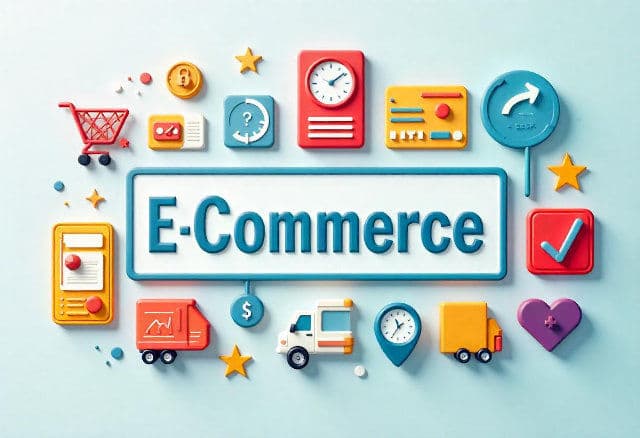
Not too long ago, if you wanted to buy something, you had to physically go to a shop, find what you needed, pay for it, and carry it home. Today, millions of people around the world buy everything — from groceries to electronics to clothing — without leaving their sofa. That shift happened because of e-commerce. E-commerce, short for electronic commerce, is simply the buying and selling of products and services over the internet using electronic devices. What started as a small experiment in the early 1980s has grown into one of the largest and most powerful industries in the world. In 2020 alone, global e-commerce sales reached $4.28 trillion. And the growth is nowhere near stopping.
Key Takeaways
- The world's first e-commerce company, Boston Computer Exchange, launched in 1982 — long before Amazon, eBay, or Alibaba existed.
- The concept of e-commerce was first formally defined in 1984 by Dr. Robert Jacobson, Principal Consultant of the Utility and Commerce Committee of the California State Assembly.
- There are six main types of e-commerce business models — B2C, B2B, C2C, C2B, B2G, and C2G — each serving a completely different type of transaction between different groups of people.
- According to Statista, e-commerce revenue in the United States alone between 2017 and 2020 was $431.6 billion, and it is expected to exceed $600 billion by 2025.
- Bangladesh's e-commerce market was valued at approximately 65,966 crore taka in 2022 and is projected to reach 1.5 lakh crore taka by 2026 — making it one of the most exciting growth markets in South Asia.
- Despite its enormous potential, e-commerce still faces serious challenges around customer trust, data privacy, fraud, and product quality — especially in Bangladesh.
What Is E-Commerce?
Let's make this very simple.
Have you ever ordered food through an app? Bought a product on Daraz? Paid a bill through bKash? Booked a bus ticket online? Every single one of those transactions — that is e-commerce.
E-commerce, also known as electronic commerce or internet commerce, refers to any transaction where goods or services are bought or sold using the internet and electronic devices. The device could be your smartphone, your laptop, or even a smart TV. The platform could be a website, a mobile app, or a social media marketplace. As long as the transaction happens digitally — it is e-commerce.
What makes e-commerce so powerful is that it removes almost every traditional barrier to buying and selling. Distance does not matter anymore. A small business owner in Sylhet can sell handmade products to a customer in Dhaka or even someone in London — without ever setting up a physical shop. A customer in Chittagong can compare prices from ten different sellers and make a purchase in two minutes without stepping outside.
Modern e-commerce is powered by a combination of technologies — smartphones, electronic fund transfers, supply chain management systems, online payment gateways, and inventory management software. All of these moving parts work together to make the experience fast, convenient, and reliable.
The History of E-Commerce
When most people think about e-commerce, Amazon, Alibaba, and eBay come to mind immediately. But the truth is, e-commerce existed well before any of those companies were founded.
The story begins in 1982, when Boston Computer Exchange became the world's first e-commerce company. They created an online marketplace specifically for buying and selling used computers — a genuinely revolutionary idea for that era.
Two years later, in 1984, Dr. Robert Jacobson of the California State Assembly formally defined the concept of electronic commerce for the first time, giving it a clear academic and legal identity.
In 1992, a startup called Book Stacks launched an online bookstore — which is still operating today as Books.com. Then in 1994, Jeff Bezos started Amazon from a garage in Washington. Like Book Stacks, Amazon initially sold only books online. But over the following decades, Amazon expanded relentlessly — and today it is the largest e-commerce company in the entire world.
Just one year after Amazon launched, in 1995, eBay started its journey under the name AuctionWeb in California. And four years after that, in 1999, Alibaba was founded in China, eventually becoming the world's largest wholesale online marketplace.
From these early pioneers, the industry exploded. Today, there are estimated to be around 20 million e-commerce websites of various sizes operating globally — and new ones are being created every single day.
Types of E-Commerce Business Models
Not all e-commerce businesses work the same way. Depending on who is selling to whom, e-commerce can be categorized into six main types. Understanding these models is essential for anyone thinking about starting an online business.
Business to Consumer (B2C)
This is the most common and familiar type of e-commerce. It happens when a business sells products or services directly to individual customers. Every time you buy something from Amazon, Daraz, or any online shop — that is B2C in action. The business is on one side, the consumer is on the other, and the transaction happens between them.
Business to Business (B2B)
In B2B e-commerce, one business sells to another business rather than to individual consumers. These transactions are typically done in large volumes — bulk orders rather than single purchases. Alibaba is the world's most prominent example of a B2B e-commerce platform, where manufacturers, wholesalers, and retailers trade with each other at scale.
Consumer to Consumer (C2C)
In C2C e-commerce, individual consumers buy and sell directly with each other — with the e-commerce platform acting as a trusted middleman that facilitates the transaction. In Bangladesh, Bikroy.com is a great local example. People list their used or new products on the platform, and other people buy them. The platform itself does not own the products — it just creates the space where the transaction can happen safely.
Consumer to Business (C2B)
This model is a reversal of the traditional B2C setup. Here, an individual person sells a product or service to a business. The most relatable example in today's world is freelancing platforms like Fiverr and Freelancer.com — where individual professionals offer their skills and services to companies that need them. A graphic designer in Dhaka can sell a logo design to a company in Germany through this model.
Business to Government (B2G)
In B2G e-commerce, businesses provide products or services directly to government bodies or public administrations. This includes things like e-government platforms, social security systems, and legal service providers that work with government agencies digitally.
Consumer to Government (C2G)
C2G is similar to B2G, but instead of a business, it is an individual person providing services to a government entity. Examples include individual consultancy services, freelance audit work, or any other professional service that a private individual might provide to a government organization through a digital platform.
The Growth of E-Commerce
E-commerce did not become a dominant industry overnight. It earned its position gradually — by consistently proving to customers that online shopping is convenient, affordable, and reliable.
The COVID-19 pandemic dramatically accelerated this growth. When physical stores closed and people were confined to their homes, online shopping became not just a preference but a necessity. Millions of people who had never bought anything online before suddenly became regular e-commerce customers. And importantly — research suggests that most of those people have continued shopping online even after the pandemic ended. The behavioral shift was permanent.
The numbers back this up decisively. According to Statista, total global e-commerce sales reached $4.28 trillion in 2020. In the United States alone, e-commerce revenue between 2017 and 2020 was $431.6 billion — and projections suggest it will exceed $600 billion by 2025.
This explosive growth has forced even the largest traditional retailers to move online. At the same time, it has opened enormous doors for small and medium businesses, who can now reach national and even international customers without the massive overhead costs of physical retail.
The e-commerce boom has also created millions of new jobs — in delivery logistics, digital marketing, customer service, web development, content creation, and supply chain management.
E-Commerce in Bangladesh
Bangladesh's e-commerce story is relatively young but growing at a remarkable pace.
The real foundation was laid in 2009 when Bangladesh Bank approved online payment systems, followed by the approval of debit and credit card payments for online transactions in 2013. These two regulatory steps made digital commerce practically possible for ordinary people in the country.
The e-Commerce Association of Bangladesh (e-CAB) serves as the trade body for the industry, overseeing and supporting its development. According to e-CAB, more than 1,900 e-commerce businesses of various sizes have registered as members — ranging from small entrepreneurs to large platforms.
The financial scale of Bangladesh's e-commerce market is striking. According to Research and Markets, the market size in 2022 was approximately 65,966 crore taka. By 2026, it is projected to reach 1.5 lakh crore taka — more than double in just four years. That is an extraordinary growth trajectory and a massive signal for entrepreneurs and investors alike.
However, Bangladesh's e-commerce industry also faces serious challenges that cannot be ignored. Customer complaints about delayed deliveries, wrong products being sent, and outright fraud are unfortunately common. Building and maintaining customer trust remains the single biggest challenge for the industry going forward. For Bangladesh's e-commerce sector to reach its full potential, these trust and quality issues must be addressed systematically.
Advantages of E-Commerce
The reason e-commerce has grown so quickly is straightforward — it genuinely solves real problems for both businesses and customers.
Businesses can now reach their exact target customers far more easily and at much lower cost than traditional retail allows. A local business in Bangladesh is no longer limited to local customers — with a good e-commerce setup, the entire country — or even the world — becomes your market.
For customers, the convenience is transformative. You can browse hundreds of options, compare prices, read reviews, and complete a purchase within minutes — all from wherever you are. The product is then delivered directly to your door, saving you time, transportation costs, and effort.
Operating costs for businesses are also dramatically lower in e-commerce compared to physical retail. No rent for a shop, no utility bills for a large premises, no need for a large in-store staff. These savings can be passed on to customers through lower prices, making e-commerce competitive on price as well as convenience.
Marketing is also significantly more cost-effective in e-commerce. Digital marketing tools allow businesses to reach precisely the right customers with the right message at a fraction of the cost of traditional advertising.
Limitations of E-Commerce
Despite all its advantages, e-commerce has genuine limitations that have prevented some customers from fully embracing it — and that the industry needs to continue working on.
Communication between buyers and sellers is often limited and impersonal. When something goes wrong with an order, resolving it can be frustrating and time-consuming compared to simply walking back into a physical shop.
Data privacy and security remain serious ongoing concerns. Many e-commerce websites do not have strong enough encryption systems to protect customers' financial and personal information during transactions.
Customers cannot physically examine a product before purchasing it. A fabric, a piece of furniture, or a piece of jewelry looks different in a photo than it does in real life — and this gap between expectation and reality leads to disappointment and returns.
In Bangladesh specifically, fraud complaints are unfortunately common — sellers taking payment and not delivering, sending wrong products, or disappearing entirely. These issues damage customer confidence not just in individual sellers but in the entire e-commerce ecosystem.
Major E-Commerce Companies You Should Know
Amazon
What started as an online bookstore from a garage in Washington in 1994 has grown into the world's largest multinational technology company. Founded by Jeff Bezos, Amazon now dominates not just e-commerce but also cloud computing through AWS, digital streaming through Prime Video, and artificial intelligence. Amazon's relentless focus on customer experience has made it the benchmark that every other e-commerce company measures itself against.
Alibaba
If Amazon is the king of e-commerce in the West, Alibaba holds that position in the East. Founded in 1999 by Jack Ma, who literally ran the operation from his apartment in the early days with his team eating, working, and sleeping in the same space, Alibaba became the world's largest wholesale online marketplace. It now operates multiple major platforms including AliExpress, AliPay, and Taobao, and is currently the third largest e-commerce company in the world.
eBay
eBay started in 1995 in California under the name Auction Web — a platform where anyone could auction their items to the highest bidder. Over time, customers started referring to it by its parent company's name "eBay" so naturally that the brand eventually adopted it officially. eBay is one of the survivors of the dot-com bubble and remains a significant global marketplace today.
Flipkart
Founded in 2007 by two IIT graduates, Sachin Bansal and Binny Bansal, Flipkart started as an online bookstore modeled after Amazon. Over the years it grew into India's most prominent e-commerce platform. In May 2018, Walmart acquired Flipkart — and currently holds approximately 81% of its shares. Flipkart remains one of the dominant e-commerce forces in the South Asian market.
Daraz
Daraz is the e-commerce platform most directly relevant to Bangladesh. Operating across Bangladesh, Pakistan, Sri Lanka, Nepal, and Myanmar, Daraz has built a strong presence across South Asia in a relatively short period of time. In May 2018, Alibaba Group acquired the entire Daraz Group — bringing the financial muscle and technological expertise of one of the world's largest e-commerce conglomerates behind it. In Bangladesh, Daraz recently acquired the popular food delivery service Hungrynaki, signaling its ambition to expand beyond product retail into a broader digital commerce ecosystem.
The Bottom Line
E-commerce has fundamentally changed how businesses operate and how people shop — and this transformation is still very much in progress. Technologies like artificial intelligence, blockchain, and advanced logistics are continuing to push the industry forward in ways that will make the shopping experience even faster, safer, and more personalized.
In Bangladesh, the opportunity is enormous. With a young, digitally active population, rapidly growing smartphone penetration, and a projected market size of 1.5 lakh crore taka by 2026, the conditions for e-commerce growth are genuinely exciting.
But the foundation of any successful e-commerce business — here or anywhere in the world — remains the same. It is customer trust. The businesses and the industry as a whole that figure out how to consistently deliver on their promises, protect customer data, and resolve problems quickly will be the ones that build lasting success in this space.
The future of commerce is digital. And in Bangladesh, that future is arriving faster than most people realize.
Recommended for you

SWOT Analysis
A ‘SWOT’ analysis is essentially a planning process that helps an organization identify new directions it can pursue while overcoming its challenges. The acronym ‘SWOT’ stands for Strengths, Weaknesses, Opportunities, and Threats. Therefore, a SWOT analysis is an excellent strategy for evaluating these four aspects of any organization.
Branding
Branding: How to Make Your Business Stand Out

GeoPolitics
The U.S.-China Rivalry: What It Means for the World's Economy, Technology, and Military Balance
Startup
What Is a Startup? The Ultimate Guide You Need to Read

Startup
How to Calculate Startup Valuation: Methods, Tools, and Examples
Accounting
Gross Profit: Definition, Formula, and Why It Matters
Accounting
Accounting for Startups: A Complete Guide to Getting It Right

Accounting
Audit Planning and Risk Assessment: A Complete Guide
Agreement
Teesta Water Sharing Treaty

Agreement
North American Free Trade Agreement (NAFTA)