Investing vs Saving: What's the Difference and Which Should You Do?
G
GeoRenus Editorial Team
366 views
GeoRenus Editorial Team
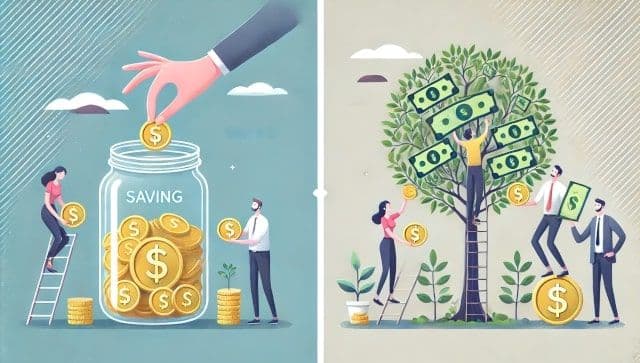
Saving and investing are both essential for financial health, but they serve different purposes. Saving means setting aside money in safe, low-return accounts for short-term needs and emergencies. Investing means putting money into assets like stocks and real estate for higher long-term returns, with the trade-off of risk. The ideal strategy combines both: save 3-6 months of expenses for emergencies, then invest the rest toward long-term goals like retirement.
Building a secure financial future requires two essential skills: saving and investing. Most people know they should do both, but many aren't clear on the difference — or when to prioritize one over the other.
Should you keep your money safe in a savings account, or put it to work in the stock market? The answer depends on your financial goals, risk tolerance, and timeline. Let's break down both approaches so you can make an informed decision.
Saving means setting aside money for future use in a safe, easily accessible place. Typically, this means putting money into a savings account, fixed deposit, or money market account at a bank.
The primary goal of saving is capital preservation — making sure your money is safe and available when you need it. Savings accounts offer low but guaranteed interest (usually 1-4% annually) and are typically insured by government programs like the FDIC in the U.S., which protects deposits up to $250,000.
People save for many reasons: emergency funds, upcoming purchases (a car, a vacation, a wedding), short-term goals, or simply as a financial cushion for unexpected expenses.
Suppose you want to buy a laptop costing $1,000 in 6 months. Your best strategy is to save — put money aside each month in a safe account where it can't lose value. You wouldn't invest this money in stocks because the market could drop 20% in those 6 months, leaving you short of your goal.
Saving is ideal when you need the money within 1-3 years and can't afford to lose any of it.
Investing means putting your money to work with the expectation of generating returns that outpace inflation and grow your wealth over time. When you invest, you buy assets — stocks, bonds, real estate, mutual funds, or other instruments — that have the potential to increase in value.
Unlike saving, investing involves risk. Your investment can go up or down in value. However, historically, investments like stocks have returned an average of 8-10% annually over the long term — significantly more than any savings account.
People invest to achieve long-term financial goals: retirement, children's education, building generational wealth, or achieving financial independence.
Suppose you have $100,000 and you want to grow it for retirement in 20 years. If you keep it in a savings account earning 2%, after 20 years you'd have about $148,595.
But if you invest it in a diversified stock portfolio earning an average of 8% annually, after 20 years you'd have approximately $466,096 — more than three times as much. The additional $200,000 is also your investment — the total combines your original money plus all returns.
This massive difference demonstrates why investing is essential for long-term wealth building. But remember: this comes with risk. In any given year, the stock market could drop 20-30% or more.
There's no universal answer — the right choice depends on your personal situation. But here are clear guidelines:
A practical approach: save 3-6 months of expenses as an emergency fund first, then start investing everything above that. As you age and approach retirement, gradually shift more toward saving and lower-risk investments.
The smartest financial strategy isn't choosing between saving and investing — it's doing both simultaneously. A common rule of thumb is to allocate 3 to 6 times your monthly expenses in savings for emergencies, then invest the rest toward long-term goals.
As your income grows, increase both your savings cushion and your investment contributions. The younger you start investing, the more time compound interest has to work — and the results can be extraordinary.
Warren Buffett started investing at age 11. He's said he wishes he had started even earlier. The message is clear: "The best time to invest was yesterday. The second best time is today."
Saving and investing are both critical components of a healthy financial life. Saving provides safety, liquidity, and peace of mind. Investing provides growth, wealth building, and protection against inflation. You need both.
The key is understanding when to use each tool. Save for short-term needs and emergencies. Invest for long-term goals and wealth accumulation. Start as early as possible, be consistent, and let time and compound interest do the heavy lifting. Your future self will thank you.

Since the dawn of human civilization, people have engaged in trade through barter. However, around 5,000 years ago, humans gradually abandoned the barter system and began using metallic coins. These coins were made from copper, silver, and gold. Around 1260 AD, the first paper currency was introduced in China and eventually spread throughout the world. In the 1930s, the first credit cards were issued by commercial establishments, and by the 1950s, banks began issuing them as well.