Sharing Economy Model: How Businesses Make Money Without Owning Anything
G
GeoRenus Editorial Team
1,245 views
Summary
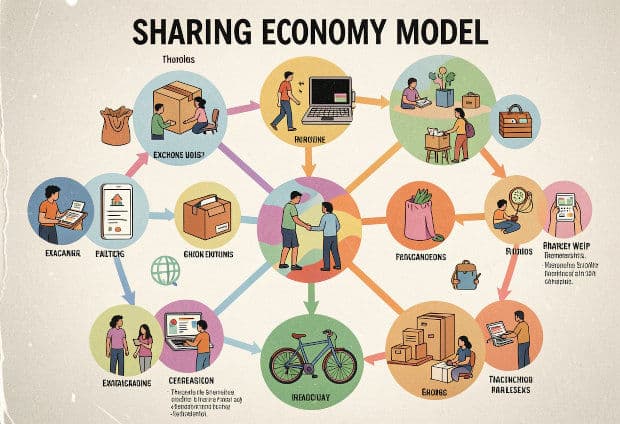
The sharing economy is a peer-to-peer business model where the main company acts as a middleman — connecting people who have something to offer with people who need it. The company itself does not own the product or service being exchanged. Instead, it uses technology to bring two sides together: the service provider and the service receiver. Pathao in Bangladesh, Uber globally, and Airbnb worldwide are all perfect real-world examples of this model in action. Simply put, the sharing economy turns unused assets into income-generating opportunities — for everyone involved.
Key Takeaways
- The sharing economy is a peer-to-peer business model where the main company works as a middleman between service providers and service receivers.
- eBay was the first company to introduce the sharing economy model back in 1995, built around the idea that anyone can buy or sell anything on a single platform.
- To succeed with this model, the most important first step is identifying a real, everyday problem that your product or service can solve.
- Customer trust and safety are the biggest challenges for sharing economy businesses — because the platform is open to everyone, maintaining consistent quality and security is extremely difficult.
- The sharing economy turns idle or underused assets into income — making it a win-win for both the person who has the asset and the person who needs it temporarily.
- Uncertainty of income is a major downside for service providers in this model, since earnings depend entirely on customer demand and are never guaranteed.
What Is the Sharing Economy Model?
Let's start with something familiar.
Almost everyone in Bangladesh has used Pathao at least once — whether it's for a bike ride across the city or food delivery to your door. But have you ever thought about how Pathao actually works as a business? They do not own a single bike or motorbike. They do not employ the riders directly. Yet they are one of the most successful service platforms in the country.
This is exactly what the sharing economy model is all about.
In simple terms, the sharing economy is a peer-to-peer business model where the company in the middle connects two types of people — those who have something to offer and those who need it. The company does not own the product or service itself. It just creates the bridge between the two sides, using technology and a smart platform strategy.
The concept is not new. Back in 1995, eBay introduced this idea to the world through its reselling and trading marketplace — where anyone could buy or sell anything. The success of eBay then inspired countless other companies to adopt the same model, and today it has become one of the most powerful and widely used business frameworks in the world.
How Does the Sharing Economy Actually Work?
At its core, the sharing economy works around one simple observation — some people have valuable assets or skills that are sitting idle, while other people need exactly those things temporarily rather than permanently.
Think about it this way. You own a car but you only use it for a few hours a day. The rest of the time it just sits in the parking lot doing nothing. On the other side, there are hundreds of people in your city who need a reliable and affordable ride right now but do not want to buy a car of their own. The sharing economy model connects these two groups — and both sides benefit.
The person with the car earns extra income from an asset they already own. The person who needs the ride gets an affordable and convenient service without having to buy a car. And the platform sitting in the middle — the company — earns a commission from every transaction.
One important thing to understand is that in this model, service providers have a lot of freedom. They are not traditional employees. They can work whenever they want, offer their service whenever they choose, and stop whenever they feel like it. There are no rigid rules or fixed schedules. This flexibility is actually one of the biggest reasons why so many people are drawn to become service providers on these platforms.
How to Succeed With the Sharing Economy Model
Running a sharing economy business sounds simple on the surface, but making it actually work takes careful planning. Here are the key things you need to get right.
Find the Right Product or Service
The very first thing you need to do is identify a real problem that your product or service can solve. Not a small or occasional problem — but something that affects a large number of people on a regular basis.
You have to study your target market deeply. Who are your potential customers? What is their lifestyle? What are their daily frustrations? And equally important — who will provide the service on the other end? Both sides of the equation need to be thought through carefully.
Your service also needs to be unique enough to stand out, good enough to beat competitors in quality, and sustainable enough to generate long-term revenue. A clever idea that solves a real problem but cannot generate consistent income is not a viable business.
Make Safety and Security Your Top Priority
This is where most sharing economy businesses either win or lose.
Because your platform is open to everyone — any person can sign up as a service provider — maintaining consistent quality and safety is genuinely hard. A customer who has a bad experience with one provider does not just blame that provider. They blame your entire platform. And once trust is broken, it is very hard to earn it back.
To build a trustworthy platform, you must verify the identity and background of every service provider. You also need to verify the assets they are using — whether that is a vehicle, a property, equipment, or anything else. Payment systems also need to be smooth, secure, and hassle-free. Any friction in the payment process creates frustration and drives customers away.
Risks You Need to Be Aware Of
The sharing economy model has enormous potential, but it also carries some real risks that every founder should think about carefully before jumping in.
Trust and Security Challenges
Fraud and customer safety complaints have followed sharing economy companies around the world. When your platform has thousands or even millions of service providers, you simply cannot monitor everyone at the same time. Some providers will behave unprofessionally. Some might even try to take advantage of customers.
The hardest part is that a single bad incident can damage your entire brand's reputation — even if 99% of your providers are doing a great job. Building a platform that customers feel genuinely safe using, consistently, is one of the most difficult things in this business.
Dependency on Both Sides
Your business depends entirely on two groups of people showing up — providers and customers. If one side drops off, the whole thing breaks down.
Providers, in particular, face income uncertainty because their earnings are entirely demand-driven. When business is slow, they earn less. And because you cannot guarantee them a fixed income, many providers remain hesitant to rely on your platform as their primary source of livelihood.
On the customer side, loyalty is fragile. People will switch to a competitor the moment they offer a better price or a more convenient experience. Building a loyal customer base in this model is much harder than in traditional businesses.
Other Practical Challenges
Not everyone has access to the internet or feels comfortable using apps. This automatically cuts out a large segment of potential customers, especially in smaller cities or rural areas in countries like Bangladesh. Many people also simply prefer traditional service methods and are reluctant to try something new.
Tax compliance and regulatory requirements are also an ongoing headache for sharing economy businesses. Governments around the world are still figuring out how to regulate these platforms, and companies often find themselves navigating unclear or shifting legal frameworks.
Advantages of the Sharing Economy Model
Despite the challenges, the sharing economy model has some genuinely powerful advantages that make it attractive for entrepreneurs.
According to OECD data, around 6.9% of the world's population is unemployed. For people who want to work on their own terms without being tied to a traditional job, sharing economy platforms offer an attractive opportunity. They can work whenever they want, earn according to their effort, and maintain personal freedom. This makes it relatively easy for platforms to attract a large number of service providers without much difficulty.
The model also makes brilliant use of underutilized assets. When something that was previously sitting idle — a car, a parking spot, a spare room, a skill — suddenly starts generating income, it creates value from nothing. This is the fundamental genius of the sharing economy, and it is why companies built on this model can scale extremely quickly with relatively low capital.
Disadvantages of the Sharing Economy Model
The disadvantages are equally real and should not be ignored.
Fraud, customer privacy breaches, and inconsistent service quality are the most common complaints against sharing economy platforms. When a scandal or a safety incident makes headlines, it affects not just one company but the entire model's reputation.
Service providers themselves are often vulnerable too. They do not receive the benefits that traditional employees get — no pension, no maternity leave, no sick leave, no bonus. Their income fluctuates month to month with no safety net. This creates frustration among providers, which eventually affects the quality of service that customers receive.
And the dependency on internet access means a large portion of the population simply cannot participate — either as providers or as customers. This is a particularly significant limitation in developing markets.
Real World Examples
Udemy
Founded in 2010, Udemy is an online education marketplace that perfectly demonstrates the sharing economy model applied to knowledge and skills. Instructors from around the world create courses on topics they are experts in — from programming and digital marketing to guitar playing and yoga. Learners from any corner of the world then purchase those courses and study at their own pace.
As of February 2021, Udemy had over 40 million registered students, 70,000 instructors, and around 155,000 courses on its platform. Instructors earn money from course sales, and Udemy takes a percentage of each sale as its commission. Both sides win — and Udemy wins in the middle.
Uber
Uber is perhaps the most famous example of the sharing economy model in the world. Founded in 2009 as Uber Cab, the company now operates across 785 cities in 63 countries.
Here is the remarkable part — Uber does not own a single car. Yet by 2018, it had already generated $11.27 billion in revenue. How? By connecting approximately 30 million drivers with around 75 million riders through a simple mobile app.
Riders do not have to struggle to find transport. Drivers earn income from their existing vehicles on their own schedule. And Uber takes a commission from every trip. Traditional taxi services simply cannot compete with this level of convenience and affordability.
ParqEx
Founded in 2014, ParqEx is a smart parking platform based in Chicago that solves one of urban life's most frustrating daily problems — finding a parking spot.
In busy cities, parking is scarce and expensive. But at the same time, many private parking spaces sit completely empty for most of the day. ParqEx connects these two groups — people who need parking and people who have unused parking spaces — through a simple app.
Parking space owners earn income from their idle property. Drivers find parking more easily and often at a lower cost than traditional parking lots. And ParqEx earns its commission from every booking. A simple, elegant solution to a very real problem — powered entirely by the sharing economy model.
The Bottom Line
The sharing economy model has fundamentally changed the way we think about ownership, services, and income. You do not need to own a hotel to run an accommodation business. You do not need to own cars to run a transport company. You do not need a classroom to teach thousands of students.
What you do need is a clear understanding of a real problem, a smart platform to connect two groups of people, and an unwavering commitment to safety and trust.
For entrepreneurs in Bangladesh and beyond, the sharing economy model represents one of the most powerful and scalable business frameworks available today. The key is not just to copy what Uber or Airbnb did — but to find the specific unsolved problem in your own market and build the bridge that connects the people who have the solution with the people who need it.
- https://en.wikipedia.org/wiki/Sharing_economy https://businessca.net/what-are-the-advantages-or-disadvantages-of-sharing-economy
- https://www.moneycrashers.com/sharing-economy/
- https://medium.com/keycafe/the-history-of-the-sharing-economy-b139e55cdf47
- https://www.smf.org.uk/what-are-pros-and-cons-of-the-sharing-economy/
- http://www.parqex.com/wants-sharing-economy/ https://venturebeat.com/2014/11/10/sharing-economy-series-how-udemy-ramped-up-without-paid-advertising/
Recommended for you
From Barter to Bitcoin: The Evolution of Money
Since the dawn of human civilization, people have engaged in trade through barter. However, around 5,000 years ago, humans gradually abandoned the barter system and began using metallic coins. These coins were made from copper, silver, and gold. Around 1260 AD, the first paper currency was introduced in China and eventually spread throughout the world. In the 1930s, the first credit cards were issued by commercial establishments, and by the 1950s, banks began issuing them as well.
Business
Needs, Wants, and Demands

Business Models
Sharing Economy Model: How Businesses Make Money Without Owning Anything
Accounting
Business Accounting: What It Is and How It Works

Accounting
Tax Rebate: Definition, Types, and How to Claim One

Agreement
World Trade Organization (WTO) Agreements

Agreement
Teesta Water Sharing Treaty

Analysis
PESTLE Analysis in depth

Analysis
Business Analysis: What It Is, Why It Matters, and How to Do It

Banking
The History of Banking: From Ancient Times to the Digital Age