Velocity of Money: What It Means, How It Works, and Why It Matters with Examples
G
GeoRenus Editorial Team
367 views
Summary
The velocity of money measures how quickly money circulates through an economy, calculated by dividing GDP by the money supply. A higher velocity indicates a healthy, active economy where money changes hands frequently, while a lower velocity suggests people are saving more and spending less. Factors like money supply, consumer confidence, digital payment systems, and credit availability all influence velocity. Central banks and policymakers closely monitor this indicator to shape monetary and fiscal policy decisions.
Key Takeaways
- Velocity of money measures how frequently a unit of currency is used to purchase goods and services within a specific time period.
- The formula is V = GDP / Money Supply (M1 or M2), providing a snapshot of economic activity relative to available money.
- High velocity signals a strong, active economy with robust consumer spending, while low velocity often indicates economic slowdown or uncertainty.
- Key factors influencing velocity include money supply changes, consumer preferences, payment system efficiency, and credit availability.
- Central banks use velocity of money alongside GDP, inflation, and unemployment data to shape monetary policy decisions.
Understanding the Velocity of Money
Every day, we make countless transactions — buying groceries, paying rent, grabbing coffee. Each time money changes hands, it keeps the economic engine running. But have you ever wondered just how fast money moves through an economy? Or how many people that single bill in your wallet has passed through before reaching you?
These seemingly complex questions have a surprisingly simple answer in economics. It’s called the Velocity of Money, and it’s one of the most important indicators economists and policymakers use to gauge the health of an economy. Let’s break it down in plain terms.
What Is the Velocity of Money?
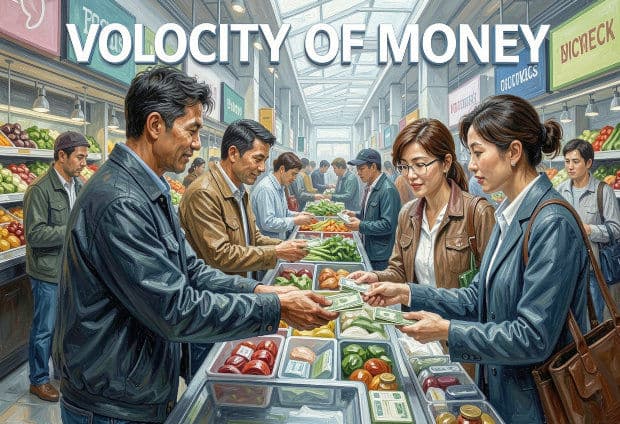
The velocity of money measures how quickly money circulates through an economy. In other words, it tells us how many times a single unit of currency — say, one dollar — is used to purchase goods or services within a specific period of time.
Think of it this way: if a $100 bill is used to buy groceries, then the grocery store uses that same $100 to pay a supplier, and the supplier uses it to pay wages — that $100 has changed hands three times. The velocity of money captures exactly this kind of movement.
A high velocity means money is being spent and re-spent quickly, which typically signals a healthy, active economy. A low velocity means people and businesses are holding onto their cash — often a sign of economic uncertainty or contraction.
How Does the Velocity of Money Work?
The velocity of money reveals how much economic activity is being generated by the money supply. Economists and investors watch this metric closely to understand the current state of the economy.
When velocity is high, it means each unit of currency is doing a lot of work — being exchanged frequently for goods and services. This usually happens in developed and growing economies where consumer confidence is high and people are willing to spend.
On the other hand, when velocity drops, it suggests people are saving more and spending less. This can happen during recessions, financial crises, or times of economic uncertainty. During the 2008 financial crisis, for example, the velocity of money in the United States dropped sharply as consumers and businesses pulled back on spending.
However, a declining velocity isn’t always a cause for panic. It can temporarily slow down for many reasons. That’s why economists don’t use velocity of money as a standalone indicator — they look at it alongside other metrics like GDP growth, unemployment rate, and inflation.
Interestingly, the velocity of money can also increase due to hyperinflation. When prices are rising rapidly, people rush to spend their money before it loses more value — which ironically pushes velocity even higher. But this kind of high velocity is definitely not a good sign.
A Simple Example of Velocity of Money
Let’s make this concept crystal clear with a practical example.
Imagine a tiny economy with just two people: Person A (a car dealer) and Person B (a house builder). Both start with $100 each.
- Person B buys a car from Person A for $100. Now Person A has $200.
- Person A then buys a house from Person B for $200. Now Person B has $200.
- Person B buys another car from Person A for $100.
After these three transactions, both are back to $100 each. But the total value of transactions — the GDP of this tiny economy — was:
GDP = $100 + $200 + $100 = $400
The money supply was just $200 (total cash in the economy). So:
Velocity = GDP / Money Supply = $400 / $200 = 2
This means each dollar was used twice on average during this period. Simple, right?
The Formula for Velocity of Money
The most widely used formula for calculating the velocity of money is:
V = GDP / M
Where:
- V = Velocity of Money
- GDP = Gross Domestic Product (total value of goods and services produced)
- M = Money Supply (typically M1 or M2)
Some countries use GNP (Gross National Product) instead of GDP. GDP measures the total value of goods and services produced within a country, while GNP also includes income earned by citizens abroad and excludes income earned by foreigners domestically.
As for money supply, there are two common measures:
- M1: All physical cash in circulation + money in checking and savings accounts + traveler’s checks
- M2: Everything in M1 + mutual funds, fixed deposits, and other near-money instruments
For example, if the GDP of the United States in a given year is $25 trillion and the M2 money supply is $21 trillion, the velocity would be approximately 1.19. This means each dollar was used about 1.19 times during the year to buy final goods and services.
Factors That Influence the Velocity of Money
Several factors can push the velocity of money higher or lower. Let’s look at the most important ones:
1. Money Supply
When the central bank increases the money supply, more money flows into the economy. If people spend this extra money, velocity increases. However, if they simply save it — as often happens during recessions — velocity may actually fall despite the larger money supply. This is why printing more money doesn’t automatically boost economic activity.
2. Consumer Preferences
How people choose to use their money plays a big role. When consumers prefer saving over spending, the velocity of money drops. When consumer confidence is high and people are eager to buy, velocity picks up. Cultural attitudes toward saving and spending also matter.
3. Payment Systems
The easier and faster it is to make payments, the higher the velocity of money. The rise of digital payment systems — mobile wallets, UPI, credit cards, online banking — has made transactions almost instantaneous. Money naturally circulates faster when you can buy something with a single tap on your phone.
4. Credit Availability
When banks make it easy to borrow — through lower interest rates, easier loan approvals, and more credit card options — people tend to spend more. This borrowed money enters the economy and increases velocity. When monetary policy tightens and borrowing becomes expensive, people cut back and velocity slows.
Why Does the Velocity of Money Matter?
The velocity of money is not just an academic concept — it has real-world implications for monetary policy and economic planning.
Central banks and governments closely monitor this metric to make important decisions:
- If velocity is falling, the central bank might lower interest rates or increase money supply to stimulate spending.
- If velocity is rising too fast alongside inflation, policymakers might tighten monetary policy to cool things down.
- During the COVID-19 pandemic, governments injected massive stimulus into economies, but velocity actually dropped because people saved rather than spent due to lockdowns and uncertainty.
As the famous economist Milton Friedman emphasized, understanding the relationship between money supply and velocity is key to understanding inflation and economic growth.
The Bottom Line
The velocity of money is a powerful yet often overlooked economic indicator. It tells us not just how much money exists in an economy, but how actively that money is being used. A healthy velocity suggests a vibrant, functioning economy where money flows freely between consumers, businesses, and institutions.
Understanding this concept helps you see the bigger picture — why printing more money doesn’t always solve problems, why recessions can persist even when there’s plenty of cash in the system, and why consumer confidence matters so much for economic recovery.
Whether you’re an investor, a student of economics, or simply someone curious about how money works, the velocity of money is one metric that deserves your attention.
Recommended for you
From Barter to Bitcoin: The Evolution of Money
Since the dawn of human civilization, people have engaged in trade through barter. However, around 5,000 years ago, humans gradually abandoned the barter system and began using metallic coins. These coins were made from copper, silver, and gold. Around 1260 AD, the first paper currency was introduced in China and eventually spread throughout the world. In the 1930s, the first credit cards were issued by commercial establishments, and by the 1950s, banks began issuing them as well.
Books
The $100 Startup
Business Law
Business Law: What It Is, Why It Matters, and Types You Must Know

Business Models
Sharing Economy Model: How Businesses Make Money Without Owning Anything
Organization
What Is the International Monetary Fund (IMF)?

Sales
What Is Sales and How Does It Work?
Startup
What Is a Startup? The Ultimate Guide You Need to Read

Accounting
Assets, Liabilities, and Equity: The Building Blocks of Finance
Accounting
GAAP: What It Is and Why It Matters in Accounting

Accounting
Audit Planning and Risk Assessment: A Complete Guide