Income Statement, Balance Sheet and Cash Flow
G
GeoRenus Editorial Team
1,075 views
GeoRenus Editorial Team
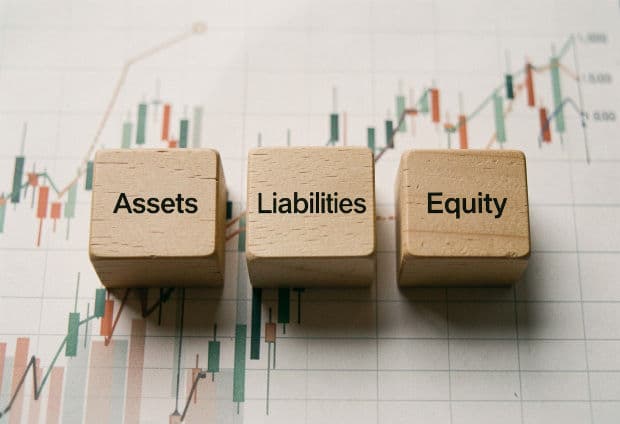
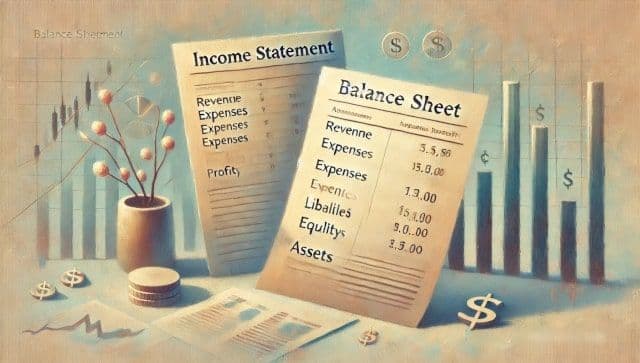
The three core financial statements every business relies on are the income statement, balance sheet, and cash flow statement. The income statement tracks revenue and expenses over a specific period to show whether a company made a profit or loss. The balance sheet provides a snapshot of what a company owns (assets), what it owes (liabilities), and what belongs to shareholders (equity) at a single point in time. The cash flow statement tracks actual money coming in and going out, broken down into operating, investing, and financing activities — because profit on paper does not always mean cash in the bank.
Imagine you run a small bakery. Every morning you buy flour, sugar, and butter. Every evening you count the cash in the register. At the end of the month, you sit down and ask yourself three simple questions: Did I make money? What do I own and owe right now? And where did all the cash actually go?
Those three questions are exactly what the three core financial statements answer — the income statement, the balance sheet, and the cash flow statement. Whether you're managing a neighborhood bakery or analyzing a Fortune 500 company, these documents tell the complete financial story of any business.
Warren Buffett once put it this way: "Accounting is the language of business." And financial statements are the sentences written in that language. If you can read them, you can understand almost any company on the planet.
In this guide, we'll break down each statement in plain English, walk through real numbers, and show you how they connect to give you the full picture. No accounting degree required.
The income statement — also called the profit and loss statement (P&L) — answers one fundamental question: did the company make money or lose money over a specific period? That period could be a month, a quarter, or a full year.
Think of it like your bakery's monthly scorecard. You add up everything you earned, subtract everything you spent, and the number at the bottom tells you whether you came out ahead or fell behind. The income statement has four main components: revenue, expenses, gains, and losses.
Revenue is the money a company earns from its core business operations — selling products or providing services. It sits at the very top of the income statement, which is why people call it the "top line."
For Apple, revenue comes from selling iPhones, MacBooks, and services like iCloud. For a law firm, it's the fees charged to clients. For our bakery, it's every loaf of bread and croissant sold over the counter.
Revenue can be broken down further:
Here's an important distinction: revenue is recognized when it's earned, not necessarily when cash is received. If your bakery delivers $5,000 worth of wedding cakes in March but the clients pay in April, the revenue is recorded in March. This is called accrual accounting, and it's the standard for most businesses.
Expenses are the costs a company incurs during its normal business operations to generate revenue. They're subtracted from revenue to determine profit. The major categories include:
Let's say our bakery has these monthly expenses: $3,000 in ingredients (COGS), $2,500 in employee salaries, $1,200 in rent, $300 in utilities, and $200 in insurance. That's $7,200 in total monthly expenses. Every dollar of expense eats directly into profit.
Gains are increases in the company's financial position from activities outside of its core operations. They're the pleasant surprises on the income statement.
Common examples include:
Gains are reported separately from revenue because they don't come from the company's core business. Investors pay close attention to this distinction because a company that relies heavily on gains rather than revenue may not have a sustainable business model.
Losses are the opposite of gains — they represent decreases in the company's financial position from non-core activities. Importantly, losses are different from expenses. Expenses are planned and necessary costs of running the business. Losses are typically unexpected or non-recurring.
Examples of losses include:
Peter Lynch, the legendary mutual fund manager, once noted: "Know what you own, and know why you own it." Understanding the difference between operating expenses and non-recurring losses helps you know exactly what's happening inside a business.
Let's build a simplified annual income statement for our bakery, Sweet Rise:
Now subtract operating expenses:
Operating Income: $126,000 - $60,400 = $65,600
Now add gains and subtract losses:
Income Before Tax: $65,600 + $1,500 - $2,000 - $3,600 = $61,500
Assuming a 25% tax rate: Tax = $15,375
Net Income (the bottom line): $61,500 - $15,375 = $46,125
That $46,125 is what the bakery actually earned after all costs, gains, losses, and taxes. This is the famous "bottom line" — the single most important number investors and business owners look at on the income statement.
While the income statement covers a period of time (like a full year), the balance sheet is a snapshot taken at a single moment. It answers: what does the company own, what does it owe, and what's left over for the owners? Think of it as a photograph of the business's financial health on one specific date — say, December 31, 2024.
The balance sheet is built on the most fundamental equation in all of accounting:
Assets = Liabilities + Stockholders' Equity
This equation must always balance — hence the name "balance sheet." Every dollar a company has (assets) was either borrowed (liabilities) or invested by owners (equity). There are no exceptions.
Assets are resources that have economic value and can generate future benefits. They're divided into two categories:
Current Assets — expected to be converted to cash or used within one year:
Non-Current Assets — long-term resources that provide value for more than one year:
For our bakery, current assets might include $12,000 in cash, $3,000 in accounts receivable (from a catering order), and $5,000 in ingredient inventory. Non-current assets might include a $40,000 commercial oven and $25,000 in leasehold improvements.
Liabilities are the company's obligations — debts and other amounts it must pay. Like assets, they're classified by time horizon:
Current Liabilities — due within one year:
Long-Term Liabilities — due beyond one year:
Equity is what's left after you subtract liabilities from assets. It represents the owners' claim on the business. The main components are:
Here's something that trips up many beginners. The balance sheet reports assets at their book value — which is historical cost minus accumulated depreciation. But the actual market value of those assets could be very different.
Suppose our bakery bought its commercial oven for $40,000 five years ago. With annual depreciation of $4,000, the book value is now $20,000. But if similar ovens sell for $28,000 on the used market, the market value exceeds the book value by $8,000. The balance sheet only shows the $20,000 figure.
This matters enormously for investors. As of 2024, Apple's book value was roughly $74 billion, but its market capitalization exceeded $3 trillion — a staggering 40x difference. That gap reflects intangible value like brand strength, ecosystem lock-in, and future earnings potential that the balance sheet simply cannot capture.
Here's what our bakery's balance sheet might look like on December 31:
Assets:
Liabilities:
Stockholders' Equity:
Verification: $65,000 (Assets) = $28,000 (Liabilities) + $37,000 (Equity). It balances perfectly. If it doesn't, something is wrong — and that's actually the beauty of double-entry bookkeeping. The math always serves as a built-in error check.
Here's a truth that surprises many people: a company can be profitable on its income statement and still run out of cash. How? Because the income statement uses accrual accounting — it records revenue when earned and expenses when incurred, regardless of when cash actually changes hands.
The cash flow statement fixes this blind spot. It tracks the actual movement of cash into and out of the business during a specific period. As the old business saying goes: "Revenue is vanity, profit is sanity, but cash is king."
The cash flow statement is divided into three sections, each covering a different type of activity.
This section shows cash generated or used by the company's core business operations. It starts with net income from the income statement and then makes adjustments for non-cash items and changes in working capital.
Key adjustments include:
For Sweet Rise Bakery, operating cash flow might look like this:
Notice that operating cash flow ($47,625) is different from net income ($46,125). This gap exists because of non-cash charges and timing differences in when cash is collected and paid.
This section covers cash spent on or received from long-term assets. It tells you whether the company is investing in its future growth or selling off its assets.
Common investing activities include:
For our bakery:
A negative number in investing activities is usually a good sign — it means the company is spending money on assets that will generate future revenue. A company that consistently shows positive investing cash flow might be liquidating assets, which could be a red flag.
The financing section shows how a company raises and returns capital. It covers transactions between the company and its owners and creditors.
Common financing activities include:
For the bakery:
Now let's combine all three sections for Sweet Rise Bakery:
If the bakery started the year with $12,000 in cash, its ending cash balance would be $25,125. But wait — the income statement showed net income of $46,125, while the actual net cash increase was only $13,125. Where did the difference go?
The answer: the owner took out $24,000 in drawings, $6,000 went to loan repayment, $8,000 went to a new refrigerator, while depreciation add-back and working capital changes made up the rest. This is precisely why the cash flow statement exists — profit and cash are not the same thing.
The income statement, balance sheet, and cash flow statement are not three separate stories — they're three chapters of the same book. Here's how they connect:
No single financial statement tells the whole story. A company might show impressive revenue growth on its income statement while quietly drowning in debt on its balance sheet. Another might report modest profits while generating massive operating cash flow. You need all three to see the complete picture.
As Charlie Munger wisely observed: "It is remarkable how much long-term advantage people like us have gotten by trying to be consistently not stupid, instead of trying to be very intelligent." When it comes to financial statements, simply understanding these three documents and how they interact puts you ahead of the vast majority of people making financial decisions. You don't need to be a CPA — you just need to read the numbers, ask the right questions, and let the statements tell you what's really going on inside a business.

Needs are what we lack or feel deprived of for survival or sustenance. These needs can be physical, mental, or social. Wants are the desires people express to fulfill their needs. These wants are often influenced by an individual's surroundings and many other factors. Demands occur when people have the purchasing power to satisfy their wants.