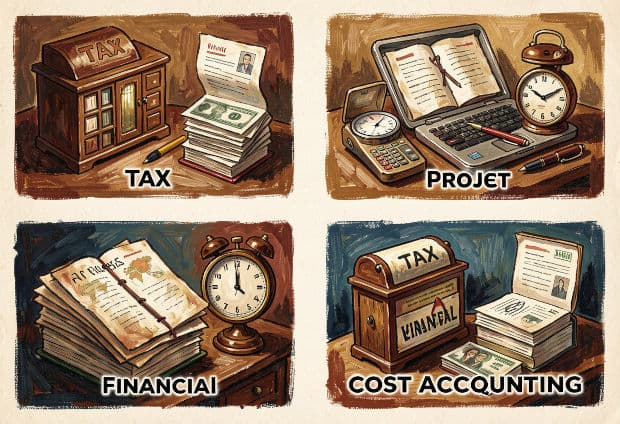
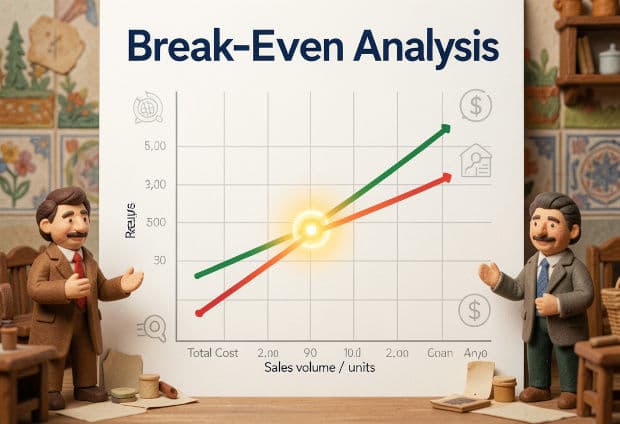
Break-Even Analysis — When Does Your Business Actually Start Making Money?
G
GeoRenus Editorial Team
1,082 views
Summary
Before you invest a single dollar in your business, you need to answer one question: how many units must you sell to stop losing money? Break-even analysis gives you that answer. This guide walks through the formulas, three detailed real-world examples (coffee shop, e-commerce, SaaS), 10 data tables, limitations, and proven strategies to reach profitability faster.
Key Takeaways
- Break-even point (BEP) is where Total Revenue equals Total Costs — no profit, no loss. Everything above BEP is profit.
- Three building blocks: Fixed Costs (constant regardless of volume), Variable Costs (change with volume), and Contribution Margin (Selling Price minus Variable Cost per unit).
- BEP Formula in Units: Fixed Costs divided by Contribution Margin per Unit. BEP in Revenue: Fixed Costs divided by Contribution Margin Ratio.
- Margin of Safety shows how much sales can fall before losses begin — higher is better. Formula: (Actual Sales minus BEP Sales) divided by Actual Sales.
- Coffee shop example: $4,700 fixed costs, $3.50 CM per cup, BEP = 1,343 cups/month (45 cups/day) — very achievable for a decent location.
- E-commerce t-shirt example: $2,904 fixed costs, $12.26 CM per shirt, BEP = 237 shirts/month. Ad dependency makes this model fragile without organic traffic.
- SaaS startup: 91.4% contribution margin ratio — the highest of any business model, which is why investors love SaaS. BEP = 717 users, but post-BEP growth is explosive.
- Five strategies to lower your BEP: reduce fixed costs, reduce variable costs, increase selling price, improve product mix, and increase marketing efficiency.
- Key limitations: assumes constant price, ignores market demand and competition, assumes linear costs, is a static snapshot that requires regular updating.
- Always include your own salary, hidden costs (returns, fees, taxes), and run sensitivity analyses to test how cost changes affect your break-even point.
Introduction — The Number Every Entrepreneur Must Know
In 2007, a young woman named Sara Blakely had exactly $5,000 in savings and a big idea. Before she spent a single dollar building her shapewear company, she sat down at her kitchen table with a calculator and figured out one critical number: how many units she needed to sell just to cover her costs. That number gave her the confidence to quit her day job, cold-call factories, and pitch her product to department stores. Today, Spanx is worth over $1.2 billion and Sara Blakely became the world's youngest self-made female billionaire.
That one number was her break-even point. And it changed everything.
Now contrast that with the darker side of entrepreneurship. Every year, thousands of businesses launch with passion, a great product idea, and absolutely zero understanding of when — or whether — they will actually make money. They spend their savings, take on debt, hire staff, and sign leases. Then the money runs out.
CB Insights found that 38% of startups fail because they "ran out of cash." Many of them never calculated their break-even point. They had no idea how many customers they needed, how much revenue was enough, or how long they could survive at their current burn rate.
Harvard Business School research suggests that approximately 82% of businesses that fail cite "cash flow problems" as a primary cause. But here's the uncomfortable truth: cash flow problems don't appear overnight. They build slowly, predictably — and they're almost always visible in advance if you know what to look for.
Break-even analysis is the FIRST financial calculation any entrepreneur should do — before writing the business plan, before designing the logo, before building the website. It costs nothing but a few minutes of honest math. Yet a shocking number of entrepreneurs skip it entirely.
The U.S. Small Business Administration (SBA) estimates that only 40% of small businesses have a documented financial plan. That means 6 out of 10 business owners are essentially flying blind.
In this guide, you will learn everything you need to know about break-even analysis: the core concepts, the formulas, three detailed real-world examples spanning a coffee shop, an e-commerce business, and a SaaS startup, plus data tables, honest limitations, and proven strategies to reach profitability faster.
Whether you are an aspiring entrepreneur evaluating a business idea, a small business owner trying to price your products correctly, or a student learning financial planning, this guide will give you a clear, practical, numbers-backed understanding of one of the most important tools in business finance.
But what exactly IS a break-even point, and why do investors, bankers, and experienced entrepreneurs obsess over it? Let's start from the beginning.
What Is Break-Even Analysis?
At its core, the break-even point (BEP) is the exact moment when your total revenue equals your total costs. You're not making a profit. You're not losing money. You're at zero — the break-even point. Everything you sell above that point is profit. Everything below it is a loss.
Break-even analysis is the process of finding that point, understanding what drives it, and planning strategically around it. It answers three essential questions: How much do I need to sell to stop losing money? Is my pricing model actually viable? And how long can I survive before I need to start making money?
"What gets measured, gets managed." — Peter Drucker, father of modern management
Drucker's famous quote applies perfectly here. You cannot manage your path to profitability if you don't know where profitability begins. Break-even analysis gives you that measurement — that target — so you can manage toward it deliberately rather than hoping for the best.
To understand break-even analysis, you need to understand three fundamental building blocks: fixed costs, variable costs, and contribution margin. Master these three concepts and the entire framework becomes intuitive.
Fixed Costs — The Bills That Never Sleep
Fixed costs are expenses that remain constant regardless of how much you produce or sell. Whether you sell 10 units or 10,000 units this month, your fixed costs stay the same. They are the financial obligations you have simply by being in business.
Common fixed costs include: monthly rent or mortgage payments, salaried employee wages, business insurance premiums, loan repayments, equipment lease payments, software subscriptions, business licenses and permits, and depreciation on owned equipment.
The most important thing to understand about fixed costs: even if you sell ZERO units this month, these costs still hit your bank account. The landlord still wants rent. The insurance company still wants its premium. Your salaried staff still expect their paychecks.
Consider a SaaS company in its early days: they're paying $5,000 per month for cloud servers (AWS), $8,000 for two junior developers, and $2,000 for a shared office space. That's $15,000 per month in fixed costs — even if they have zero customers. Every month they operate without reaching break-even, $15,000 is flowing out the door.
Fixed costs create urgency. They are the ticking clock that every entrepreneur hears in the background. And understanding them precisely is step one of any serious break-even analysis.
Variable Costs — The Costs That Scale With You
Variable costs are the opposite of fixed costs. They change in direct proportion to your production or sales volume. Sell more, pay more. Sell nothing, pay nothing (in theory). Variable costs are always calculated on a per-unit basis.
Common variable costs include: raw materials, packaging materials, shipping and delivery fees, payment processing fees (usually a percentage of revenue), sales commissions, manufacturing labor paid per piece, and costs of goods sold (COGS) in retail.
Example: An e-commerce business selling handmade soaps. Each bar requires $1.20 in ingredients, $0.80 in packaging, $4.50 in shipping, and $0.45 in payment processing fees — totaling $6.95 in variable costs per unit sold. Sell 100 bars, spend $695 in variable costs. Sell 500 bars, spend $3,475.
Variable costs are important because they directly affect your profit margin on each sale. If your variable costs are too high relative to your selling price, you may be working harder just to lose more money. Every additional unit sold could actually increase your losses if the math is wrong.
This is why understanding your variable cost per unit is non-negotiable before you set any price or make any sales projection.
Contribution Margin — The Hero of the Story
Here's where it gets interesting. Once you know your selling price and your variable cost per unit, you can calculate something called the contribution margin — and this single number is arguably the most important metric in break-even analysis.
Contribution Margin = Selling Price per Unit − Variable Cost per Unit
The contribution margin tells you exactly how much each unit sold 'contributes' toward covering your fixed costs. Think of it like filling a bucket. Your fixed costs are the size of the bucket. Each unit sold pours in an amount equal to the contribution margin. The moment the bucket is full — all fixed costs are covered — you've hit break-even.
Every unit sold AFTER break-even is different: the entire contribution margin becomes pure profit. Fixed costs are already paid for. So from break-even forward, each additional sale directly adds to your bottom line.
Example: A small business sells handmade soy candles for $25 each. Variable cost per candle (wax, wick, fragrance, jar, label, shipping) is $8. Contribution margin = $25 - $8 = $17 per candle. Each candle sold puts $17 toward covering fixed costs. Once fixed costs are covered, each candle puts $17 directly into profit.
This is powerful information. It means you can calculate exactly how many candles you need to sell. No guessing, no hoping — just math.
Contribution Margin Ratio — Thinking in Percentages
CM Ratio = Contribution Margin / Selling Price × 100
The contribution margin ratio expresses your contribution margin as a percentage of the selling price. It tells you what fraction of every dollar of revenue goes toward covering fixed costs and eventually profit.
In the candle example: CM = $17, Price = $25 → CM Ratio = 68%. This means for every $1 in candle sales, $0.68 is available to cover fixed costs and profit, while $0.32 goes to variable costs.
The CM ratio is especially useful when you have multiple products with different prices, or when you run a service business where 'units' are hard to define. Instead of thinking in units, you think in revenue dollars — and the CM ratio tells you how efficient each revenue dollar is.
High CM ratio = capital-efficient business. Low CM ratio = you're working hard for thin margins and need high volume to survive. Understanding your CM ratio helps you compare products, evaluate pricing, and identify which parts of your business deserve the most attention.
| Feature | Fixed Costs | Variable Costs |
| Definition | Constant regardless of output | Change directly with output volume |
| Changes with volume? | No — stays the same | Yes — rises and falls with sales |
| Manufacturing examples | Factory rent, machinery lease, manager salary | Raw materials, direct labor per unit, packaging |
| Service business examples | Office rent, staff salaries, software licenses | Freelancer fees per project, transaction fees |
| E-commerce examples | Platform fees, ads budget, warehouse rent | Product cost, shipping, payment processing per order |
| Impact when sales = 0 | Still owed in full | Zero or near zero |
| Behavior over time | Can change (e.g., rent increase) but are 'step' changes | Continuously proportional to volume |
Note: This table provides general classifications. In practice, some costs may be semi-variable (e.g., utility bills have a fixed base plus a variable component). Always analyze your specific cost structure carefully.
Now you know the three ingredients of break-even analysis. So how do you actually combine them into a number? Let's learn the formulas — they're simpler than you might think.
The Break-Even Formulas — Step by Step
The math behind break-even analysis is refreshingly straightforward. You don't need a finance degree or a complex spreadsheet. You need four numbers: your total fixed costs, your selling price per unit, your variable cost per unit, and optionally your target profit. From those four numbers, you can calculate everything that matters.
Let's walk through each formula carefully, with clear examples so the logic is unmistakable.
Formula 1: Break-Even Point in Units
BEP (Units) = Fixed Costs ÷ Contribution Margin per Unit
This is the most fundamental break-even formula. It tells you exactly how many units you need to sell in a given period (usually a month) to cover all your costs — fixed and variable — with nothing left over as profit or loss.
Simple example: You run a small bakery. Fixed costs are $3,000/month. You sell artisan bread loaves at $12 each, and variable cost per loaf (flour, yeast, butter, packaging, electricity for baking) is $4. Contribution margin = $12 - $4 = $8 per loaf.
BEP = $3,000 / $8 = 375 loaves per month — or about 12-13 loaves per day (based on a 30-day month). If you sell 375 loaves, you break even. Sell 376, you make $8 profit. Sell 374, you lose $8. Simple and precise.
Formula 2: Break-Even Point in Revenue (Dollars)
BEP (Revenue) = Fixed Costs ÷ Contribution Margin Ratio
Sometimes you don't think in units — you think in dollars. Service businesses, restaurants, and multi-product retailers often find it more natural to set revenue targets rather than unit targets. That's where the revenue-based BEP formula is invaluable.
Using the bakery example: CM Ratio = $8 / $12 = 66.7%. BEP (Revenue) = $3,000 / 0.667 = $4,498/month. This means the bakery needs to generate $4,498 in monthly revenue to break even — regardless of the product mix, as long as the average CM ratio stays at 66.7%.
This formula is also useful for setting monthly sales targets for your team. 'We need $4,500 in sales this month to cover costs' is a tangible goal everyone can rally around.
Formula 3: Break-Even Point with Target Profit
Units for Target Profit = (Fixed Costs + Target Profit) ÷ Contribution Margin per Unit
Here's the real-world version of break-even analysis. Because just breaking even isn't actually a business success — it's a survival threshold. You want profit. This formula tells you exactly how many units to sell to achieve a specific profit target.
Example: You want to earn a $5,000 monthly profit from your bakery. Fixed costs remain $3,000, CM = $8/loaf. Required units = ($3,000 + $5,000) / $8 = 1,000 loaves per month — about 33 loaves per day. Now you have a real sales goal that funds not just your costs but your livelihood.
This formula is particularly powerful for salary planning. If you want to pay yourself $4,000/month, that $4,000 becomes part of your 'target profit' (or you can add it to fixed costs if it's a set salary). Either way, the formula gives you a concrete production and sales target.
Margin of Safety — How Much Room Do You Have?
Margin of Safety (Units) = Actual Sales − Break-Even Sales
Margin of Safety (%) = (Actual Sales − BEP Sales) ÷ Actual Sales × 100
The margin of safety tells you how much your sales can drop before you start losing money. It's a resilience metric — a buffer between your current performance and financial danger.
Example: Your bakery currently sells 600 loaves/month. BEP is 375 loaves. Margin of Safety = 600 - 375 = 225 loaves, or (225/600) × 100 = 37.5%. Your sales can fall by 37.5% before you hit a loss. That's a reasonably comfortable cushion.
A higher margin of safety means a more resilient business. Businesses with a low margin of safety (under 15%) are in a precarious position — a minor disruption, a slow month, or a competitor's price war can push them into losses quickly. Investors and lenders love seeing a healthy margin of safety because it signals business stability.
| Formula | Equation | What It Tells You | Best Used For |
| BEP in Units | Fixed Costs ÷ CM per Unit | How many units to sell to cover all costs | Product businesses, manufacturing, retail |
| BEP in Revenue | Fixed Costs ÷ CM Ratio | How much revenue needed to cover all costs | Service businesses, multi-product companies |
| BEP with Target Profit | (Fixed Costs + Target Profit) ÷ CM per Unit | Units needed to achieve a specific profit goal | Goal-setting, salary planning, investor pitches |
| CM Ratio | CM per Unit ÷ Selling Price × 100 | Percentage of each revenue dollar that covers costs | Comparing products, revenue efficiency analysis |
| Margin of Safety | (Actual Sales − BEP Sales) ÷ Actual Sales × 100 | How much sales can fall before losses begin | Risk assessment, resilience planning |
Note: These formulas assume a single product or a consistent product mix. For businesses with multiple products at different price points, a weighted average contribution margin should be calculated. Always revisit these calculations when your costs or prices change significantly.
With the formulas firmly in hand, the best way to solidify this knowledge is through real examples. Let's walk through three very different businesses and apply every formula we've learned. Starting with everyone's favorite: the coffee shop.
Example 1: The Coffee Shop
Let's meet Maya. She's been a barista for five years, and she's finally ready to open her own coffee shop. She's found a 600-square-foot space in a busy neighborhood, negotiated a lease, and is now trying to figure out if her business can actually work. Let's run the numbers together.
Step 1: Identify Fixed Costs
Monthly rent: $2,500. Part-time employee wage: $1,200. Equipment lease (espresso machine, grinder): $300. Business insurance: $200. Utilities (electricity, water, internet): $400. POS system and payment software: $100. Total monthly fixed costs: $4,700.
These costs are owed every single month regardless of how many coffees Maya sells. Even if she's sick and closes for a week, $4,700 is due at the end of the month.
Step 2: Calculate Variable Cost Per Cup
Coffee beans (per cup): $0.50. Milk and dairy: $0.30. Cup, lid, sleeve: $0.15. Napkin and stirrer: $0.05. Total variable cost per cup: $1.00.
This is the direct cost Maya incurs for each cup she makes and sells. If a customer orders and then cancels, Maya doesn't incur this cost. It scales perfectly with volume.
Step 3: Calculate Contribution Margin
Average selling price per cup: $4.50 (blended average of drip coffee at $3, lattes at $5, specialty drinks at $6).
Contribution Margin = $4.50 − $1.00 = $3.50 per cup. Every cup Maya sells puts $3.50 toward covering her $4,700 in monthly fixed costs.
Step 4: Calculate Break-Even Point
BEP (Units) = $4,700 / $3.50 = 1,343 cups per month.
Divided across 30 days: 1,343 / 30 = approximately 45 cups per day.
BEP (Revenue) = 1,343 cups × $4.50 = $6,044 per month.
Is 45 cups per day realistic? Absolutely. In fact, it's quite conservative. The Specialty Coffee Association (SCA) reports that the average U.S. coffee shop sells approximately 230 cups per day. Even a below-average location doing 80 cups per day would easily exceed Maya's break-even.
Step 5: Margin of Safety
If Maya sells 80 cups/day → 2,400 cups/month.
Margin of Safety = (2,400 − 1,343) / 2,400 × 100 = 44%. Maya's sales could drop by nearly half before she starts losing money. That's a very healthy buffer.
Step 6: Target Profit Calculation
Maya wants to pay herself $3,000 per month. How many cups does she need to sell?
Required cups = ($4,700 + $3,000) / $3.50 = 2,200 cups per month = 73 cups per day. Entirely achievable for a reasonably located coffee shop — especially once she builds a regular morning customer base.
| Item | Amount | Category | Notes |
| Rent | $2,500/month | Fixed Cost | 600 sq ft neighborhood location |
| Part-time employee | $1,200/month | Fixed Cost | 20 hrs/week at ~$15/hr |
| Equipment lease | $300/month | Fixed Cost | Espresso machine + grinder |
| Business insurance | $200/month | Fixed Cost | General liability + property |
| Utilities | $400/month | Fixed Cost | Electricity, water, internet |
| POS system | $100/month | Fixed Cost | Square or similar platform |
| Total Fixed Costs | $4,700/month | Fixed Cost | |
| Coffee beans | $0.50/cup | Variable Cost | Specialty-grade arabica |
| Milk/dairy | $0.30/cup | Variable Cost | Blended average (some drinks use more) |
| Cup + lid + sleeve | $0.15/cup | Variable Cost | Eco-friendly compostable |
| Napkin + stirrer | $0.05/cup | Variable Cost | |
| Total Variable Cost | $1.00/cup | Variable Cost | |
| Average Selling Price | $4.50/cup | Revenue | Blended average across menu |
| Contribution Margin | $3.50/cup | CM | $4.50 - $1.00 |
| BEP (Units) | 1,343 cups/month | Break-Even | 45 cups/day (÷30 days) |
| BEP (Revenue) | $6,044/month | Break-Even | 1,343 × $4.50 |
| Margin of Safety @ 80 cups/day | 44% | Safety Buffer | Healthy resilience |
| Cups needed for $3,000 profit | 2,200 cups/month | Target Profit | 73 cups/day |
Note: These figures use simplified averages. Real-world costs vary by location, supplier pricing, and season. Maya should also account for waste (unsold pastries, spilled coffee) and slow days. Consider adding a 10-15% buffer to all variable cost estimates.
Maya's coffee shop is a great illustration of how even a modest neighborhood cafe can have a very achievable break-even point. The key insight: a low variable cost combined with a reasonable price creates a solid contribution margin. Next, let's look at an entirely different model — online retail.
Example 2: E-Commerce T-Shirt Business
Alex runs a print-on-demand e-commerce business selling graphic t-shirts through a Shopify store. He designs the shirts himself, uses a third-party printer, and sells directly to consumers online. His model is digital-first — no physical store, no inventory risk. Let's examine whether his business math works.
Step 1: Fixed Costs
Shopify subscription: $39/month. Custom domain: $15/month ($180/year ÷ 12). Facebook and Instagram advertising: $2,000/month. Freelance graphic designer (retainer): $500/month. Storage and warehouse (small unit): $300/month. Accounting software: $50/month. Total fixed costs: $2,904/month.
Notice that Alex's biggest fixed cost is his advertising budget — $2,000 out of $2,904 total. This is common in e-commerce. Digital marketing is often the single largest overhead expense, and it's essentially fixed because cutting it dramatically would kill traffic and sales.
Step 2: Variable Costs Per Shirt
Blank t-shirt (wholesale): $5.00. Printing cost: $3.00. Packaging (bag + tissue + sticker): $1.50. Shipping to customer: $4.00. Payment processing (3% on $28): $0.84. Returns reserve (5% of shirts returned, cost $1.40 avg): $1.40. Total variable cost per shirt: $15.74.
The returns reserve is a cost that many new e-commerce entrepreneurs forget to include. If 5% of your orders get returned and each return costs you $1.40 in restocking/reshipping, that's a real cost that must be factored into your analysis. Ignoring it will make your break-even look more favorable than it really is.
Step 3: Contribution Margin
Selling price: $28.00. Variable cost: $15.74.
Contribution Margin = $28.00 − $15.74 = $12.26 per shirt.
CM Ratio = $12.26 / $28.00 = 43.8%. For every dollar in shirt revenue, $0.44 goes toward covering fixed costs and profit. That's a reasonable margin for e-commerce, though not outstanding.
Step 4: Break-Even Calculations
BEP (Units) = $2,904 / $12.26 = 237 shirts per month — approximately 8 shirts per day.
BEP (Revenue) = $2,904 / 0.438 = $6,630 per month.
Eight shirts per day sounds very achievable — but let's think about this more carefully. Alex is spending $2,000/month on ads. If his average cost per acquisition (CPA) is $8 per customer (fairly competitive for apparel on Facebook), he needs approximately 250 customers from ads alone just to cover costs. That's actually tight.
This is why organic traffic, SEO, email lists, and repeat customers are so important in e-commerce. Over-reliance on paid ads means your break-even is fragile — the moment ad costs rise (and Facebook CPC has risen significantly over the years), the math breaks down.
Step 5: Target Profit
Alex wants $2,000/month profit. Required shirts = ($2,904 + $2,000) / $12.26 = 400 shirts per month — about 13 shirts per day. Achievable with consistent ad performance and a growing organic audience.
| Item | Amount | Type |
| Shopify subscription | $39/month | Fixed |
| Custom domain | $15/month | Fixed |
| Facebook/Instagram ads | $2,000/month | Fixed |
| Freelance designer retainer | $500/month | Fixed |
| Storage/warehouse | $300/month | Fixed |
| Accounting software | $50/month | Fixed |
| Total Fixed Costs | $2,904/month | Fixed |
| Blank t-shirt (wholesale) | $5.00/shirt | Variable |
| Printing | $3.00/shirt | Variable |
| Packaging | $1.50/shirt | Variable |
| Shipping to customer | $4.00/shirt | Variable |
| Payment processing (3%) | $0.84/shirt | Variable |
| Returns reserve (5%) | $1.40/shirt | Variable |
| Total Variable Cost | $15.74/shirt | Variable |
| Selling Price | $28.00/shirt | Revenue |
| Contribution Margin | $12.26/shirt | CM |
| CM Ratio | 43.8% | CM Ratio |
| BEP (Units) | 237 shirts/month | Break-Even |
| BEP (Revenue) | $6,630/month | Break-Even |
| Shirts for $2,000 profit | 400 shirts/month | Target Profit |
Note: E-commerce businesses face particularly volatile variable costs. Shipping rates, ad costs, and platform fees can change with little notice. Alex should recalculate his break-even point quarterly or whenever a major cost component changes by more than 10%.
The t-shirt example highlights an important lesson: an e-commerce business can have a relatively low unit count for break-even but still be precarious if it depends too heavily on expensive paid traffic. Diversification of customer acquisition channels is critical. Now let's look at the most modern business model of all — software.
Example 3: SaaS Startup
Meet Jordan and Sam. They're two developers who built a project management SaaS tool for freelancers. They've launched their product and are charging $29/month per user. Their business model is fundamentally different from a coffee shop or t-shirt store — and understanding WHY makes SaaS so attractive to investors.
Fixed Costs
Developer salaries (2 co-founders at $6,000 each): $12,000/month. AWS/cloud infrastructure: $1,500/month. Shared office space: $2,000/month. Marketing and content creation: $3,000/month. Tools and subscriptions (Slack, Notion, analytics, etc.): $500/month. Total fixed costs: $19,000/month.
Variable Costs Per User Per Month
Server scaling cost per additional user: $0.50. Payment processing (Stripe at ~3.1%): $0.90. Customer support time allocation: $1.00. Email/notifications (SendGrid): $0.10. Total variable cost per user: $2.50/month.
Notice something remarkable: the variable cost per user is only $2.50 on a $29 subscription. This is the magic of software economics. Once code is written, it essentially replicates itself for free. Adding a thousand new users doesn't require hiring a thousand new employees or buying a thousand new machines.
Contribution Margin — The Power of Software
CM = $29.00 − $2.50 = $26.50 per user per month.
CM Ratio = $26.50 / $29.00 = 91.4% — this is why venture capitalists love SaaS businesses. For every dollar of subscription revenue, over 90 cents is available to cover fixed costs and generate profit.
Compare this to our earlier examples: the coffee shop had a CM ratio of roughly 78%, and the t-shirt e-commerce had 43.8%. SaaS at 91.4% is in a completely different league. This is why a profitable SaaS company with 5,000 users can generate enormous profits while a coffee shop with 5,000 customers per month is still fighting for margin.
Break-Even Calculations
BEP = $19,000 / $26.50 = 717 paying users.
BEP (Revenue) = 717 × $29 = $20,793/month.
Getting 717 paying users is genuinely challenging for a new SaaS startup. The average B2B SaaS startup takes 12-18 months to reach this milestone. But here's the crucial difference from other businesses: once Jordan and Sam hit 717 users, each new user they add generates $26.50/month in near-pure profit. At 1,000 users, they're generating roughly $7,500/month in profit. At 2,000 users, nearly $27,000/month. The business scales without proportionally scaling its costs.
"SaaS is the best business model ever invented." — Marc Andreessen, venture capitalist and co-founder of Netscape
This scalability is what makes the SaaS model so powerful — and why the break-even journey, though longer, is worth the wait. Once you cross break-even in a high-CM-ratio business, the profit acceleration is dramatic.
| Item | Amount | Notes |
| Developer salaries (2) | $12,000/month | Co-founders drawing market-rate salaries |
| AWS/cloud servers | $1,500/month | Scales somewhat but mostly fixed at this size |
| Office space | $2,000/month | Shared coworking space |
| Marketing/content | $3,000/month | SEO, blog, social media |
| Tools & subscriptions | $500/month | Slack, analytics, CRM, etc. |
| Total Fixed Costs | $19,000/month | |
| Server scaling per user | $0.50/user/month | Variable portion of AWS |
| Payment processing | $0.90/user/month | Stripe 3.1% of $29 |
| Customer support time | $1.00/user/month | Allocated cost of support hours |
| Email/notifications | $0.10/user/month | SendGrid per-email cost |
| Total Variable Cost | $2.50/user/month | |
| Subscription Price | $29/user/month | |
| Contribution Margin | $26.50/user/month | 91.4% CM ratio |
| BEP (Users) | 717 paying users | Monthly subscribers |
| BEP (Revenue) | $20,793/month | 717 × $29 |
| Typical time to BEP | 12-18 months | Industry average for early-stage SaaS |
Note: SaaS variable costs can be misleading because infrastructure costs don't always scale linearly. At very high user volumes, new server tiers may require step-cost investments. Additionally, customer success and support costs tend to grow faster than modeled here. Update your variable cost model as you scale.
| Metric | Coffee Shop | T-Shirt E-Commerce | SaaS Startup |
| Monthly Fixed Costs | $4,700 | $2,904 | $19,000 |
| Variable Cost/Unit | $1.00/cup | $15.74/shirt | $2.50/user/month |
| Selling Price | $4.50/cup | $28.00/shirt | $29.00/user/month |
| Contribution Margin | $3.50/cup | $12.26/shirt | $26.50/user/month |
| CM Ratio | 77.8% | 43.8% | 91.4% |
| BEP (Units) | 1,343 cups/month | 237 shirts/month | 717 users |
| BEP (Revenue) | $6,044/month | $6,630/month | $20,793/month |
| Time to Break-Even (typical) | 3-6 months | 2-6 months | 12-18 months |
| Scalability | Limited (physical space) | Moderate (inventory/fulfillment) | High (software scales cheaply) |
Note: This comparison uses simplified models for illustrative purposes. Real businesses face more complex cost structures, seasonal variation, and market-specific factors. The time-to-break-even estimates are industry averages and can vary significantly based on execution, location, and market conditions.
Three very different businesses. Three very different break-even profiles. What matters is not which model is 'better' in the abstract — it's understanding YOUR model deeply enough to know exactly what you need to do to reach profitability. Now let's talk about why break-even analysis matters beyond just the math.
Why Break-Even Analysis Matters — 6 Critical Use Cases
Break-even analysis isn't just a textbook exercise. It has real, practical applications at every stage of a business — from the initial idea to expansion decisions years down the road. Here are the six most important use cases, each with concrete examples.
1. The Go/No-Go Decision Before You Start
Before you invest a single dollar — before you sign a lease, buy inventory, or build a website — calculate your break-even point. This analysis tells you whether your business idea is financially viable given the market you're entering.
If your break-even calculation shows you need to sell 500 wedding cakes per month, but your city only has 200 weddings per year, the math is telling you something important. The business, as currently structured, cannot work in that market. You need to either dramatically reduce costs, raise prices, or serve a larger market.
Many entrepreneurs skip this analysis because they're emotionally committed to their idea. Don't. A 10-minute calculation before launch is worth infinitely more than a painful failure after investing your savings.
2. Pricing Strategy — Finding the Optimal Price
Break-even analysis is one of the most powerful tools for pricing decisions. By running multiple scenarios at different price points, you can find the optimal price that balances volume and margin.
Example: A product with $50,000/month fixed costs and $15 variable cost per unit. At $20/unit, CM = $5, BEP = 10,000 units. At $25/unit, CM = $10, BEP = 5,000 units. At $30/unit, CM = $15, BEP = 3,334 units. If your market research suggests you can realistically sell 4,000-6,000 units per month, the $25 price point might be optimal — achievable break-even without pricing yourself out of the market.
Price is not just about covering costs. Break-even analysis lets you model the trade-off between price and volume explicitly, with real numbers. This is how professional pricing decisions are made.
3. Investor and Lender Confidence
Walk into any investor meeting or bank loan interview without knowing your break-even point, and you will lose credibility instantly. Investors and bankers view break-even analysis as a basic requirement — a signal that you understand your own business.
Y Combinator, one of the world's top startup accelerators, requires applicants to demonstrate a clear understanding of their unit economics — which is essentially break-even analysis at the unit level. The question 'when do you break even?' comes up in nearly every investor pitch meeting.
A clear, well-supported break-even analysis says: 'I understand my cost structure. I know my unit economics. I have a realistic plan to reach profitability.' That's exactly what investors and lenders need to hear before writing a check.
4. Cost Control and Sensitivity Analysis
Once you have a break-even calculation, you can run sensitivity analyses — 'what if' scenarios that test how changes in costs or prices affect your BEP.
What happens to break-even if your supplier raises raw material costs by 15%? What if your landlord raises rent by 20% at lease renewal? What if you hire one additional full-time employee? By running these scenarios in advance, you can prepare contingency plans rather than being blindsided.
Example: If a rent increase from $2,500 to $3,000/month raises your monthly fixed costs by $500, your BEP in the coffee shop example rises from 1,343 to 1,486 cups — about 5 extra cups per day. That's a manageable adjustment. But if you're already operating at a thin margin of safety, that same increase might be devastating.
5. New Product or Product Line Decisions
Thinking of adding a new product to your lineup? Calculate the break-even point for it separately before launching. New products bring new variable costs and may require additional marketing investment (new fixed costs). The product might look attractive in isolation but drag down your overall profitability if the contribution margin is low.
Experienced product managers and business owners calculate a BEP for every new product launch — and they don't proceed unless the BEP is achievable given realistic market demand.
6. Expansion Decisions — Opening a Second Location
Expansion is exciting. It's also one of the most common ways successful small businesses destroy themselves. Expanding too fast, without understanding the break-even implications, is a recipe for disaster.
Before opening a second location, calculate its standalone break-even point. Does it have higher rent? Different foot traffic? Different labor costs? A second location may have a significantly higher BEP than your first — and if you've been subsidizing it with your first location's profits without realizing it, the whole structure can collapse.
Rule of thumb from experienced multi-location operators: your second location should be able to reach break-even independently, without relying on the first. If it can't, you're not expanding — you're diluting.
| Scenario | What BEP Tells You | Example Decision |
| New business launch | Whether the business model is viable given realistic volume | Proceed, pivot, or abandon the idea |
| New product launch | Whether the product contributes positively to overall profitability | Launch, re-price, or redesign the product |
| Price change | How price changes affect required sales volume | Choose optimal price point for the market |
| Cost increase | How a cost change affects break-even and margin of safety | Absorb, pass on, or offset through efficiency |
| Expansion decision | Whether a new location/channel can stand on its own | Expand now, wait, or restructure costs first |
| Investor pitch | Your understanding of unit economics and path to profit | Build investor confidence, negotiate better terms |
| Loan application | Your ability to service debt with a clear profitability timeline | Qualify for better loan terms and rates |
Note: Break-even analysis is a decision-support tool, not a decision-making tool. Use it alongside market research, competitor analysis, and customer validation. The best financial analysis in the world doesn't compensate for a product no one wants.
Break-even analysis is clearly powerful — but no tool is perfect. Like any model, it has real limitations that every serious user must understand. Knowing the limitations doesn't make the tool less useful; it makes you a smarter user of it.
Limitations — What Break-Even Analysis Cannot Tell You
Break-even analysis is an enormously useful tool, but it's a simplified model of a complex reality. Using it naively — plugging in numbers and trusting the output without questioning the assumptions — can lead to dangerously overconfident conclusions. Here are eight critical limitations every business person should know.
1. Assumes a Constant Selling Price
The basic break-even formula assumes you sell every unit at the same price. In reality, businesses constantly deal with discounts, promotional pricing, seasonal sales, bulk deal negotiations, and price segmentation. A clothing retailer selling at full price in September and at 40% discount in January has a wildly different effective selling price over the year.
2. Assumes All Units Produced Are Sold
Break-even analysis typically ignores unsold inventory, waste, spoilage, and returns. A bakery that bakes 400 items but sells only 320 (with 80 going stale) has effectively higher variable costs per sold unit than the model suggests. Your real contribution margin might be significantly lower than calculated.
3. Ignores Market Demand
This is perhaps the most dangerous limitation. Break-even analysis tells you what you need to sell — it says nothing about what the market will buy. You may calculate that you need 2,000 customers per month to break even, but if only 800 people in your market want your product, the BEP is mathematically correct but practically irrelevant.
4. Ignores Competition
A competitor can enter your market and undercut your prices, steal your customers, or force you to spend more on marketing — all of which change your cost structure and revenue projections dramatically. Break-even analysis is a static model; real markets are dynamic and competitive.
5. Assumes Linear Cost Behavior
The model assumes variable costs are perfectly proportional to volume. In reality, bulk purchasing discounts, economies of scale, learning curve effects, and capacity constraints make costs non-linear. At 100 units per month you might pay $5 per unit; at 1,000 units per month, a bulk discount might bring that to $3.50. Your real BEP at high volumes is lower than the simple model suggests — but you had to survive long enough to get there.
6. Ignores Time Value of Money
Breaking even in 3 months versus breaking even in 3 years are very different financial outcomes, but basic break-even analysis treats them identically. $10,000 lost over 3 months is very different from $10,000 lost over 3 years in terms of present value, opportunity cost, and cash flow pressure. For longer-horizon projects, discounted cash flow analysis should complement break-even analysis.
7. Single-Product Simplification
Most businesses sell multiple products at different prices with different contribution margins. The basic BEP formula assumes one product. For multi-product businesses, you need to calculate a weighted average contribution margin based on your product mix — and that mix changes over time, making the calculation more complex and less stable.
8. Static Snapshot
Perhaps most fundamentally, break-even analysis gives you a snapshot of your cost structure at a specific moment in time. Costs change. Supplier prices fluctuate. Wages increase. Insurance premiums adjust. A break-even analysis done today may be inaccurate in six months. This is why regular recalculation — at minimum quarterly — is essential.
| Limitation | Real-World Impact | How to Compensate |
| Constant price assumption | Promotions and discounts lower effective revenue per unit | Use average realized price from historical data |
| All units sold assumption | Waste, returns, and unsold inventory inflate real costs | Add a returns/waste factor to variable costs |
| Ignores market demand | BEP may be unachievable given market size | Combine with market size research (TAM/SAM) |
| Ignores competition | Competitive pricing pressure can erode margins | Include competitive scenario in sensitivity analysis |
| Linear cost assumption | Bulk discounts change variable cost at scale | Model cost at different volume tiers |
| Ignores time value of money | Long BEP timelines understate true cost of capital | Use NPV/DCF for long-horizon projects |
| Single product simplification | Product mix shifts change effective CM ratio | Calculate weighted average CM by product |
| Static snapshot | Costs change over time, making BEP calculations stale | Recalculate at minimum quarterly |
Note: Acknowledging limitations doesn't diminish the value of break-even analysis — it makes you a more sophisticated practitioner. The goal is not to find a perfect model, but to use an imperfect model wisely, with appropriate judgment layered on top.
"All models are wrong, but some are useful." — George Box, statistician
The limitations are real, but they're manageable if you approach break-even analysis with clear-eyed pragmatism. More importantly, once you understand what drives your break-even point, you can actively work to move it in the right direction — and that's where the real strategic work begins.
How to Lower Your Break-Even Point — 5 Proven Strategies
Knowing your break-even point is useful. Actively lowering it is powerful. A lower break-even point means you reach profitability sooner, you're more resilient in downturns, and you have more room to invest in growth. Here are five battle-tested strategies to reduce your BEP.
1. Reduce Fixed Costs — Cut the Overhead
Fixed costs are the denominator killer. They are owed every month regardless of performance, and they set your baseline requirement before you earn a single dollar of profit. Every dollar you shave off fixed costs lowers your BEP directly.
Concrete tactics: Negotiate rent aggressively — especially in a post-pandemic commercial real estate market, landlords often have room to negotiate. Use coworking spaces or remote-first models to eliminate or reduce office costs. Outsource non-core functions (bookkeeping, HR, IT support) instead of hiring full-time. Use open-source software or free tiers of tools wherever possible. Audit every subscription quarterly and cut anything not delivering clear value.
Basecamp (now 37signals) is a legendary example. They run a $100M+ business with fewer than 60 employees by obsessing over keeping fixed costs lean. Their philosophy: every dollar of overhead is a dollar that raises your break-even. Treat it like a tax.
2. Reduce Variable Costs — Get Leaner on Every Unit
Reducing variable costs directly improves your contribution margin, which lowers your BEP. Even small improvements compound dramatically at scale.
Tactics: Negotiate volume discounts with key suppliers — even before you have the volume, you can often get better pricing by committing to minimums. Optimize your production or fulfillment process to reduce waste and time. Explore alternative materials or suppliers that offer comparable quality at lower cost. Automate repetitive tasks to reduce labor costs per unit. Improve returns and damage rates to reduce the waste portion of your variable cost estimate.
A 10% reduction in variable costs has a larger impact on BEP than most entrepreneurs realize. In the coffee shop example, reducing variable cost from $1.00 to $0.90 per cup improves CM from $3.50 to $3.60 and lowers BEP from 1,343 cups to 1,306 cups — saving 37 cups (about 1.2 cups per day) of required sales.
3. Increase Your Selling Price — Charge What You're Worth
Raising prices is the highest-leverage action in break-even management. A price increase directly and immediately improves your contribution margin without requiring any operational change. Yet many entrepreneurs are terrified to raise prices, fearing they'll lose customers.
The key is adding tangible or perceived value that justifies a higher price: superior packaging, stronger branding, better customer service, warranties and guarantees, exclusive access, or premium positioning. Customers pay premium prices for products that make them feel good about the purchase.
Consider Apple: an iPhone costs approximately $490 in components and manufacturing. Apple sells it for $999 — a contribution margin of roughly 51% on hardware alone, before software and services. They justify that premium through brand identity, ecosystem integration, software quality, and perceived status. You don't have to be Apple. But you can learn from their pricing philosophy: price what you're worth, then build the product and brand to justify it.
4. Improve Your Product Mix — Sell More of What Pays
If you sell multiple products, not all of them contribute equally to covering your fixed costs. Products with higher contribution margins 'fill the bucket' faster. Strategically pushing customers toward your higher-CM products lowers your effective break-even.
This is cross-selling and upselling in practice. McDonald's is a masterclass in product mix optimization. Their burgers have relatively thin margins — but drinks and fries have extremely high contribution margins. That's why every McDonald's employee is trained to ask 'Would you like fries with that?' It's not a nicety. It's a break-even strategy.
Audit your product catalog. Identify your highest-margin items. Then ask: How can I make those items more prominent, more appealing, and easier to buy? A modest shift in product mix toward higher-CM items can dramatically lower your effective break-even point.
5. Increase Volume Through Marketing Efficiency
While the first four strategies focus on the BEP calculation itself, this strategy focuses on reaching BEP faster through smarter customer acquisition. Lower customer acquisition cost (CAC) means you generate more revenue per marketing dollar, which gets you to break-even sooner.
Tactics: Invest in SEO and content marketing — it costs more upfront but has near-zero marginal cost per customer acquired at scale. Build an email list and nurture existing customers; retention is 5-7 times cheaper than acquisition. Improve your conversion rate through better copywriting, UX, and social proof. Implement referral programs that turn existing customers into a free sales force.
For a SaaS company, reducing CAC from $150 to $100 per customer means each marketing dollar goes 50% further toward reaching the 717-user break-even threshold. Over 717 users, that's a savings of $35,850 in marketing spend — money that can be reinvested in product development or simply kept as profit.
| Strategy | Method | Impact on BEP | Risk Level | Real Example |
| Reduce Fixed Costs | Negotiate rent, remote work, outsourcing, free tools | Direct reduction — every $1 saved = lower BEP | Low | Basecamp: $100M+ with ~60 employees |
| Reduce Variable Costs | Bulk discounts, process optimization, waste reduction | Improves CM, lowers required unit sales | Low-Medium | Toyota: lean manufacturing reduces waste |
| Increase Selling Price | Add value, premium branding, better service | Dramatically improves CM per unit | Medium | Apple: $999 iPhone on $490 cost base |
| Improve Product Mix | Upsell, cross-sell, promote high-CM products | Raises effective CM ratio across product line | Low | McDonald's 'Would you like fries?' strategy |
| Marketing Efficiency | SEO, referrals, email, better conversion rates | Reaches BEP faster with less capital burned | Low-Medium | HubSpot: inbound marketing model |
Note: These strategies are not mutually exclusive — the most effective approach combines all five simultaneously. Even a 5% improvement across each lever can compound to a 20-30% reduction in your break-even point, dramatically improving business viability and investor attractiveness.
Lowering your break-even point isn't just financial optimization — it's survival strategy. The faster you reach profitability, the more options you have: reinvest in growth, pay yourself more, build reserves, or simply breathe easier. Now let's make sure you implement break-even analysis correctly.
The Do's and Don'ts of Break-Even Analysis
Break-even analysis is simple in concept but easy to do badly. The following do's and don'ts are distilled from the mistakes that trip up even experienced business people — and the habits that separate rigorous financial thinkers from wishful thinkers.
The Do's
DO calculate BEP before investing money. The time to find out that your business model is unviable is before you sign a lease or buy inventory — not after. A 15-minute analysis can save you years of financial pain.
DO include ALL costs — including the hidden ones. Returns and refunds. Payment processing fees (they add up). Credit card fees. Your own salary or opportunity cost. Taxes on profits. Seasonal inventory write-offs. Business owners routinely underestimate their true costs by 15-25% by forgetting these items.
DO recalculate regularly. At minimum quarterly. More frequently during periods of rapid change (new hires, price changes, new supplier contracts, expansion). Your BEP from 12 months ago is almost certainly wrong today.
DO run sensitivity analyses. Calculate BEP under multiple scenarios: base case, optimistic (+15% revenue), pessimistic (-15% revenue), cost increase (+10% costs), price decrease (-10% price). Knowing how BEP behaves under different conditions is far more valuable than a single-point estimate.
DO use BEP alongside other tools. Break-even analysis works best when combined with market size research, competitor analysis, customer discovery interviews, and cash flow projections. It's one instrument in an orchestra — powerful, but not the whole show.
DO track actual performance vs BEP monthly. Create a simple dashboard: current month sales vs BEP. Margin of safety this month vs last month. This transforms break-even from a one-time calculation into an ongoing management tool.
DO calculate separate BEP for each product line or location. Blended BEPs hide important information. A product with a negative contribution margin can be invisible in a blended analysis — but it's actively destroying your profitability.
The Don'ts
DON'T rely ONLY on break-even analysis. It's one tool, not the whole toolbox. It tells you nothing about cash flow timing, growth trajectory, competitive response, or customer satisfaction. Use it as one input into a larger decision-making framework.
DON'T forget to include your own salary. This is the number one mistake among solo entrepreneurs and small business owners. If you're working 50 hours/week in your business and not paying yourself, you're not 'breaking even' — you're working for free. Your time has market value. Include it.
DON'T use wishful thinking in your numbers. It is psychologically tempting to use optimistic cost estimates and aggressive sales projections. Resist this. Use conservative estimates for costs and realistic (not best-case) estimates for sales. If the business works with conservative numbers, it definitely works. If it only works with optimistic numbers, be very careful.
DON'T ignore seasonal variations. A beach resort, a tax preparation service, and an ice cream shop all have wildly different monthly revenue profiles. Calculating a single monthly BEP and treating it as constant misses entirely the reality that some months will easily exceed BEP while others may fall far short. Calculate BEP by season or quarter for cyclical businesses.
DON'T assume fixed costs are truly fixed forever. Rent increases at lease renewal. Insurance premiums adjust annually. Software subscriptions add tiers. Utilities fluctuate. Fixed costs creep upward over time — often faster than you expect. Build in a 3-5% annual escalation on fixed costs when doing multi-year planning.
DON'T treat break-even analysis as a one-time calculation. The entrepreneurs who use break-even analysis most effectively treat it as a living document — updated continuously, referred to regularly, and refined as the business evolves. Think of it as your financial vital sign, not a one-time health check.
DON'T compare BEP across different industries without context. A software company with a $500,000 monthly BEP is not less healthy than a food truck with a $3,000 BEP. BEP is meaningful in the context of the business model, market size, and growth trajectory — not as an absolute number.
Advantages and Disadvantages of Break-Even Analysis
Like all analytical frameworks, break-even analysis has genuine strengths and real weaknesses. Being clear-eyed about both helps you deploy the tool effectively and avoid over-reliance on its outputs.
Advantages
Simple to calculate — no advanced degree required. You need four numbers and basic arithmetic. Any entrepreneur, regardless of financial background, can run a break-even analysis in under 15 minutes with a calculator or spreadsheet.
Provides clear, actionable sales targets. Instead of a vague goal of 'sell more,' break-even analysis gives you a precise number: sell 237 shirts this month to cover costs. That's measurable, trackable, and motivating.
Essential for pricing decisions. No other tool more directly connects your pricing to your survival threshold. Break-even analysis ensures you never set a price below the level needed to sustain your business long-term.
Builds investor and lender confidence. Demonstrating that you understand your cost structure, your contribution margin, and your path to profitability is a prerequisite for serious funding conversations.
Helps prioritize cost control efforts. When you know exactly how each cost element contributes to your BEP, you know where to focus reduction efforts for maximum impact.
Applicable to any business size. From a street food vendor calculating how many meals they need to sell to a Fortune 500 division manager evaluating a new product line — the framework works at every scale.
Enables quick go/no-go decisions for new products and expansions. Instead of lengthy planning processes, a break-even calculation can quickly screen out ideas that are financially unviable before significant resources are invested.
Disadvantages
Over-simplified model of business reality. The assumptions (constant price, perfect sales, linear costs) rarely hold perfectly in practice. The model is an approximation, not a precise prediction.
Ignores market demand and competitive dynamics. The model tells you what you need to sell, not what you CAN sell. Market forces, competitive pressure, and customer behavior are entirely outside the model's scope.
Assumes linear cost-revenue relationships. Real businesses experience economies of scale, volume discounts, capacity constraints, and step-cost increases — none of which are captured in the basic model.
Difficult to apply accurately for multi-product businesses. Weighted average contribution margins require assumptions about product mix that may not hold over time, making multi-product BEP calculations less reliable.
Doesn't account for time value of money or cash flow timing. Breaking even in revenue terms doesn't mean you have cash in the bank. Customers paying 60-day invoices while your bills are due in 30 days is a cash flow problem invisible to basic break-even analysis.
Can create false confidence if inputs are inaccurate. Garbage in, garbage out. An entrepreneur who underestimates costs and overestimates prices will calculate a deceptively low, achievable-looking BEP — and be blindsided when reality diverges.
| Aspect | Advantage | Disadvantage |
| Complexity | Simple to calculate and understand | Over-simplified; misses real-world nuances |
| Actionability | Gives clear, measurable sales targets | Target may be unachievable given market demand |
| Pricing | Ensures minimum viable price is understood | Doesn't optimize price for market positioning |
| Investor relations | Demonstrates financial literacy and planning | Alone is insufficient for serious due diligence |
| Cost management | Highlights highest-impact cost areas | Doesn't address cash flow timing issues |
| Scalability | Works for any business size | Less accurate for complex, multi-product businesses |
| Decision speed | Enables fast go/no-go decisions | May create false confidence with poor inputs |
| Time horizon | Good for short-term planning | Doesn't account for time value of money |
Note: Understanding both advantages and disadvantages positions you to use break-even analysis as a powerful but appropriately bounded tool. Pair it with cash flow forecasting, market research, and scenario planning for a complete financial decision-making framework.
Conclusion — Calculate Your Break-Even Point Today
We've covered a lot of ground in this guide. From the foundational concepts of fixed costs, variable costs, and contribution margin, through three detailed real-world examples, nine data tables, eight limitations, and five proven strategies to lower your break-even — you now have everything you need to apply this framework to your own business or idea.
Let's bring it back to the beginning. Sara Blakely sat down with $5,000 and a calculator. She figured out her break-even point. She knew exactly how many units she needed to sell to prove the concept was viable. That clarity gave her the confidence to act decisively — and the rest is billion-dollar history.
Break-even analysis is the FIRST financial calculation every business owner should do. It takes 10 minutes with a piece of paper and basic arithmetic. There is no excuse — and no cost — for skipping it.
Even a rough estimate is infinitely better than no estimate. If your numbers are imprecise, you can still get directional clarity: Is break-even achievable with realistic sales? Is it so high that the market can't support it? Is one cost category dominating and deserving attention? These questions — answerable even with rough estimates — are what matter most at the early stages.
"In God we trust. All others must bring data." — W. Edwards Deming, management pioneer
Data is what separates entrepreneurs who build sustainable businesses from those who rely on hope and hustle alone. Break-even analysis is one of the simplest, most powerful pieces of data you can generate about your own business.
Here's your action plan — do this right now. Grab a piece of paper. In Column 1, list every fixed cost you have or expect to have monthly. Add them up. In Column 2, list every variable cost per unit. Add them up. Write down your selling price. Calculate your contribution margin (Price - Variable Cost). Divide your total fixed costs by your contribution margin. That number — your break-even point — might be the most important number in your entire business.
Once you have it, ask yourself: Is that number achievable? How long will it realistically take me to get there? What would happen if my costs went up 10%? What's my margin of safety if I'm already operating? Can I lower this number by 20% with a few strategic changes?
The question isn't whether you CAN afford to do break-even analysis. The question is whether you can afford NOT to.
Sara Blakely could afford not to — she had $5,000 and one shot. So she chose data over hope. You can make the same choice, regardless of the size of your business or the scale of your ambitions. The math is simple. The clarity it provides is priceless.
Recommended for you

The Bretton Woods Agreement: A Turning Point in Global Economic History
In 1944, as the world was still engulfed in the devastation of World War II, the global economy had collapsed and people’s living standards had plummeted. In an effort to stabilize the international economy and address pressing global financial issues, the Allied nations convened a historic summit. Nearly 730 delegates from 44 countries gathered at the Mount Washington Hotel in Bretton Woods, New Hampshire, for the United Nations Monetary and Financial Conference. The outcome of this summit was the landmark Bretton Woods Agreement, which gave birth to the Bretton Woods System.
Money
Money: What It Is, How It Works, and Its Complete History
Branding
Branding: How to Make Your Business Stand Out

E-Commerce
E-Commerce: The Complete Guide to Online Business
Marketing
The 7 P's of Marketing: The Complete Framework Every Business Needs
Startup
What Is a Startup? The Ultimate Guide You Need to Read

Accounting
Gross Profit: Definition, Formula, and Why It Matters
Accounting
GAAP: What It Is and Why It Matters in Accounting

Accounting
Business Accounting: What It Is and How It Works

Accounting
Four Flavors of Accounting: Tax, Project, Financial, and Cost Accounting Explained