The Sykes-Picot Agreement: The Secret Deal That Reshaped the Middle East Forever
G
GeoRenus Editorial Team
624 views
Summary
In 1916, during the height of World War I, Britain and France secretly carved up the Arab lands of the Ottoman Empire between themselves. Two diplomats — Sir Mark Sykes and François Georges-Picot — drew straight lines on a map that became the borders of modern Iraq, Syria, Lebanon, Jordan, and Palestine. This deal betrayed earlier promises of Arab independence and planted the seeds of a century of conflict, instability, and deep mistrust of Western powers across the Middle East.
Key Takeaways
- In 1916, Britain and France secretly divided the Arab territories of the Ottoman Empire in what became known as the Sykes-Picot Agreement.
- The deal directly violated Britain's earlier promise of Arab independence made through the Hussein-McMahon Correspondence of 1915.
- In November 1917, Bolshevik revolutionaries exposed the secret treaty, triggering outrage across the Arab world.
- The agreement's boundaries — largely straight lines ignoring ethnic and religious realities — shaped the borders of Iraq, Syria, Lebanon, and Jordan.
- The same year the deal was exposed, the Balfour Declaration promised a Jewish homeland in Palestine, creating a third contradictory commitment for the same land.
- In 2014, ISIS declared it was erasing the Sykes-Picot borders — proof that this 100-year-old agreement still drives conflict today.
What Is the Sykes-Picot Agreement?
Open a map of the Middle East and look at the border between Iraq and Syria. It's almost perfectly straight. The same goes for the line between Jordan and Saudi Arabia — ruler-straight, cutting across the desert with zero regard for geography, rivers, or the people living there.
There's a reason for that. Those lines weren't drawn by the people of the Middle East. They were drawn by two European diplomats sitting thousands of miles away, laying a ruler across a map and carving up land they had never lived on.
Those two men were Sir Mark Sykes of Britain and François Georges-Picot of France. In 1916, right in the middle of World War I, they struck a secret deal to divide the Arab territories of the collapsing Ottoman Empire between their two countries.
That deal is the Sykes-Picot Agreement — formally known as the Asia Minor Agreement. It is one of the most consequential and controversial diplomatic deals in modern history. And its effects? You can still see them in every headline coming out of Syria, Iraq, Palestine, and Lebanon today.
The Context — Why This Secret Deal Happened
The Ottoman Empire's Decline
The Ottoman Empire had ruled the Arab world for nearly 600 years by the time World War I broke out in 1914. At its peak, it controlled an enormous stretch of land — from the Arabian Peninsula and Mesopotamia (modern Iraq) to Syria, Palestine, and deep into Anatolia.
But by the late 19th century, the empire was crumbling. European powers had a nickname for it: "The Sick Man of Europe." Internal revolts, military defeats, and economic weakness had hollowed it out.
When the Ottomans sided with Germany at the start of WWI, Britain and France saw their opportunity. Britain had a massive strategic interest in the region — the Suez Canal, opened in 1869, was its lifeline to India and the rest of the empire. France had deep cultural and commercial ties to the Levant, particularly Syria and Lebanon, going back centuries.
Both powers had been quietly planning for the empire's collapse. The war just made it urgent.
The Arab Revolt and Britain's Promise
Here's where things get morally complicated — and historically important.
In 1915, Britain made a secret promise to Sharif Hussein ibn Ali, the ruler of Mecca. Through letters exchanged between Hussein and Sir Henry McMahon, Britain's High Commissioner in Egypt — the famous Hussein-McMahon Correspondence — Britain pledged that if the Arabs rose up against the Ottomans, they would get their own independent Arab state after the war.
"The districts of Mersin and Alexandretta and portions of Syria... cannot be said to be purely Arab" — Sir Henry McMahon, 1915, carefully hedging Britain's promise while still encouraging the Arab Revolt
Trusting that promise, Sharif Hussein launched the Arab Revolt in June 1916. Thousands of Arab fighters took up arms against the Ottomans. The famous British intelligence officer T.E. Lawrence — "Lawrence of Arabia" — fought alongside them in the desert, helping coordinate guerrilla attacks on Ottoman supply lines.
What those Arab fighters didn't know was this: at the very same moment they were bleeding for Britain's cause, Britain and France were secretly negotiating a deal to divide up that same Arab land between themselves. That betrayal is the heart of the Sykes-Picot story.
The Secret Negotiations — Sykes and Picot
On the British side sat Sir Mark Sykes — a Conservative MP from Yorkshire and a self-styled Middle East expert who had traveled the region but, critics would later argue, understood it only superficially. On the French side was François Georges-Picot — a French diplomat who had served as consul-general in Beirut and was known for his strong belief in French imperial rights in the Levant.
The two men negotiated for several months through late 1915 and early 1916. Russia (then under Tsar Nicholas II) was also brought into the deal — promised a share of Ottoman territory including Constantinople and the Turkish Straits, in exchange for its agreement to the Anglo-French carve-up.
The agreement was finalized on May 16, 1916 — just weeks before the Arab Revolt officially began. The timing is staggering.
What the Agreement Actually Said — Who Got What
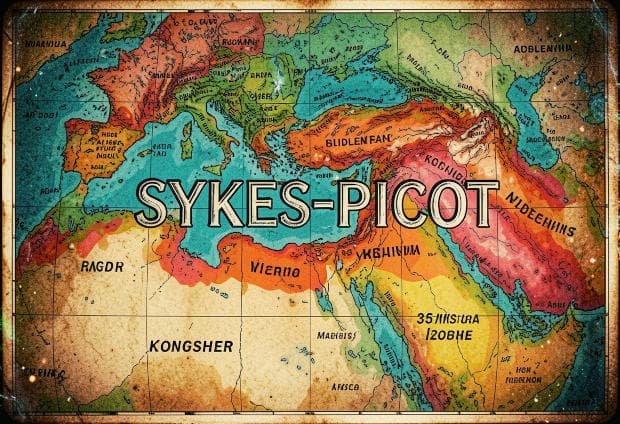
The Sykes-Picot Agreement divided the Ottoman Arab territories into five zones — color-coded on the original map:
Blue Zone — Britain's Direct Control:
Southern Iraq, from Baghdad down to Basra. This region sat on top of massive oil reserves that Britain's Royal Navy — which had recently switched from coal to oil — desperately needed.
Red Zone — France's Direct Control:
The Lebanese coast and a portion of southeastern Turkey (the Cilicia region). France had long coveted this Mediterranean coastline.
Zone B — Britain's Sphere of Influence:
Modern-day Jordan and much of northern Iraq, including the oil-rich Mosul region. Britain would have indirect control here — supporting local Arab rulers while maintaining strategic dominance.
Zone A — France's Sphere of Influence:
Inland Syria, including Damascus, Aleppo, and the rest of the Syrian interior. France would control the local Arab governments in this zone.
International Zone — Palestine:
Jerusalem and the surrounding area were to be placed under international administration — a nod to the fact that the holy city mattered to Christians, Muslims, and Jews alike, and no single power could claim it without controversy.
Historian James Barr, in his book 'A Line in the Sand', describes the moment Sykes drew the boundary on the map: he pointed to a spot and declared he wanted a line from the 'e' in Acre to the 'k' in Kirkuk. That single gesture — a line from Acre to Kirkuk — determined the fate of millions of people across generations.
The Secret Exposed — The Bolshevik Revolution Reveals Everything
The secret held for about a year. Then came the Russian Revolution of November 1917. The Bolsheviks overthrew the Tsar, seized power, and immediately published all of the Tsar's secret treaties — including Sykes-Picot — to embarrass the Western imperial powers.
The text was translated into Turkish and handed to the Ottoman government, who made sure it spread throughout the Arab world. The reaction was explosive. Sharif Hussein and his allies suddenly understood the full picture: Britain had promised them independence with one hand while secretly promising their land to France with the other.
The sense of betrayal was profound and permanent. Arab leaders who had staked their lives and their people on British promises felt humiliated and deceived. That wound — the gap between what the West promised and what it delivered — would shape Arab politics for the next century.
And that wasn't the only bombshell of 1917. On November 2, 1917 — the same month the Bolsheviks exposed Sykes-Picot — British Foreign Secretary Arthur Balfour wrote a letter to the leader of the British Jewish community:
"His Majesty's Government view with favour the establishment in Palestine of a national home for the Jewish people..." — The Balfour Declaration, November 2, 1917
Think about what this meant. The same land — Palestine — had now been promised three different things to three different groups. Arabs were told it would be part of their independent state (Hussein-McMahon, 1915). Britain and France had secretly planned to divide it between them (Sykes-Picot, 1916). And now Jews were promised a national homeland there (Balfour Declaration, 1917). These three contradictory commitments, all made within two years, set up a conflict that has never been resolved.
Implementation — The Mandate System and Artificial States
When World War I ended, the Ottoman Empire collapsed completely. The League of Nations was established in 1920, and a new system was introduced: the Mandate system. Britain and France were appointed as 'mandatory powers' — essentially caretaker administrators — over the former Ottoman territories. In practice, it was Sykes-Picot made official.
Iraq — Three Nations Forced Into One Country
Britain took control of three very different Ottoman provinces and merged them into a single new country called Iraq. Mosul in the north was home to Kurdish and Sunni Arab populations. Baghdad in the center was ethnically and religiously mixed. Basra in the south was predominantly Shia Arab.
These three communities had little in common — different languages, customs, religious practices, and no shared national identity. Britain's solution? Import a king from somewhere else. They brought in Faisal, a prince from the Hejaz region (modern Saudi Arabia) who had led the Arab Revolt, and crowned him King of Iraq. He was a foreigner ruling a country that had been invented just years before.
The results played out over decades: chronic sectarian conflict, the brutal dictatorship of Saddam Hussein (who held the artificial state together through repression), the 2003 US invasion that shattered the authoritarian lid, and the subsequent civil war that gave birth to ISIS.
Syria and Lebanon — Under French Control
France took control of the Syrian region and immediately made a fateful decision: it separated Lebanon from Syria, creating a new country. The reason was strategic — Lebanon had a large Maronite Christian population that France had cultivated as an ally for centuries.
But Lebanon wasn't only Christian. It contained a complex mix of Sunni Muslims, Shia Muslims, Druze, Greek Orthodox Christians, and more — all now crammed into a tiny country with an artificially engineered political system designed to balance their competing interests. That system buckled under the pressure, eventually igniting the Lebanese Civil War that raged from 1975 to 1990, killing approximately 150,000 people.
Palestine and Transjordan
Britain received the Palestine Mandate — and immediately faced its own contradictions. The land had been promised to both Arabs (for independence) and Jews (for a national home). Jewish immigration to Palestine increased steadily through the 1920s and 1930s, fueling growing tensions with the Arab population.
Britain also sliced off the eastern portion of Palestine — the land east of the Jordan River — and created a new entity called Transjordan. They installed Abdullah, another son of Sharif Hussein, as its ruler. That territory became the modern Kingdom of Jordan.
On the western side of the Jordan River, the conflict escalated until Britain simply handed the problem to the newly created United Nations. In 1948, Israel declared independence. The Arab-Israeli War followed immediately. Approximately 700,000 Palestinian Arabs were displaced — an event the Palestinians call the Nakba, or 'the Catastrophe.' That conflict has never ended.
Long-Term Impact — A Century of Instability
The damage from Sykes-Picot wasn't just about borders on a map. It reshaped the entire political culture of the Middle East in ways that are still playing out today.
1. Ethnic and Sectarian Conflict
The artificial borders split the same people across multiple countries and forced different peoples into the same country. The most dramatic example: the Kurds — one of the largest ethnic groups in the world without their own state — were divided across four countries: Turkey, Iraq, Syria, and Iran. About 30 to 40 million Kurds live as minorities in countries that have often repressed their identity.
2. The Rise of Dictatorships
Artificial states need strong men to hold them together. When a country has no genuine national identity — when people identify more with their tribe, sect, or ethnic group than with the nation-state — democratic politics become nearly impossible. That's how you get the Assad family ruling Syria for over 50 years, and Saddam Hussein ruling Iraq through fear and violence. Both were products of the dysfunctional state structures Sykes-Picot created.
3. Oil Politics
The secret negotiations over Mosul's oil fields were fierce — Britain and France both wanted them badly. Historian David Fromkin, in his landmark book 'A Peace to End All Peace', argues that resource competition — especially oil — was a hidden driver of how the region was divided. The struggle over Middle Eastern oil has shaped global politics ever since.
4. The Israel-Palestine Conflict
The three contradictory promises made in 1915-1917 — Arab independence, Anglo-French division, and a Jewish homeland — created a problem with no clean solution. The conflict between Israelis and Palestinians, with all its complexity and suffering, has roots that trace directly back to this period of imperial promise-making and betrayal.
5. Deep Distrust of Western Powers
Ask people in the Arab world why they are skeptical of Western intentions in the Middle East, and somewhere in the answer you will find Sykes-Picot. The gap between what Britain and France promised (independence, self-determination) and what they delivered (colonialism, artificial borders, broken promises) left a scar that has shaped every interaction between the West and the Arab world since.
Why Sykes-Picot Still Matters Today
In 2014, when ISIS swept across a massive swath of Iraq and Syria, its fighters tore up their passports and bulldozed border crossing posts. Their propaganda declared: "We are erasing the Sykes-Picot borders." Whether you find ISIS's ideology repugnant or not, that declaration resonated because it tapped into something real — the idea that those borders were always illegitimate impositions.
The Syrian Civil War, which began in 2011 and has killed hundreds of thousands of people, is partly a story about a state whose internal contradictions — Alawite minority ruling a Sunni majority in a country whose borders were drawn by outsiders — finally exploded. Kurdish fighters in northern Syria have carved out an autonomous region that functions almost like a state of its own, a direct challenge to the Sykes-Picot map.
Iraq's Kurdish region similarly operates with significant independence. The Kurds have their own parliament, their own military (the Peshmerga), and their own foreign policy relationships. The dream of an independent Kurdistan — denied by Sykes-Picot — keeps reasserting itself.
And it's not just the Middle East. Libya, Yemen, Sudan — countries whose borders were drawn by European colonial powers without regard for the people living there — face similar crises of legitimacy and governance.
Historian Eugene Rogan, in his acclaimed book 'The Fall of the Ottomans', puts it plainly: Sykes-Picot wasn't just a treaty — it was a mindset. European powers genuinely believed they had the right, even the duty, to determine the fate of other peoples. The same logic that produced the Berlin Conference of 1884-85 — when European powers divided Africa over brandy and cigars — produced Sykes-Picot a generation later.
"The British and French statesmen of 1916 could not have imagined... that the lines they drew would prove so enduring and so combustible." — Eugene Rogan, 'The Fall of the Ottomans'
Final Thoughts
The Sykes-Picot Agreement was just a few pages of diplomatic text, negotiated in secret, signed quietly, and initially hidden from the world. But those few pages changed the lives of hundreds of millions of people.
The ruler-straight lines on that 1916 map divided nations, separated families, and created states that were dysfunctional from their very first day — because they were built on a contradiction. They gave political borders to people who shared no political community.
Three contradictory promises were made for the same land in just two years: Arab independence (1915), Anglo-French division (1916), and a Jewish homeland (1917). All three were made by the same power — Britain — and all three could not possibly be honored simultaneously.
More than 100 years later, the shadows are still visible. In the rubble of Syrian cities. In the sectarian fault lines of Iraqi politics. In the endless, unresolved tragedy of Palestine. In Lebanon's cycle of crises. These are not ancient hatreds or civilizational inevitabilities. They are the downstream consequences of specific decisions made by specific people in 1916.
The lesson history offers is uncomfortable but clear: when outside powers decide other people's destinies — drawing their borders, installing their rulers, making promises they never intend to keep — the consequences last for generations. The Middle East is still living inside the map that Sykes and Picot drew. And until its peoples can truly determine their own futures, that map will keep shaping their present.
Recommended for you
Accounting: The Language of Business
Accounting is like a notebook for a business where all the money-related activities are recorded and tracked. Just like students track their exam scores to understand how they are doing, businesses use accounting to see if they are making a profit or loss. It acts like the financial backbone of a company. Accountants organize these records into different sections to make things easier to understand. To show their performance to shareholders, companies prepare documents called financial statements.
Banking
Banking: What It Is, How Banks Work, and Everything You Need to Know
Money
How Money Works?
Business
What is Equity? A Comprehensive Guide to Ownership, Value, and ROE

Crime and Fraud
Ponzi Scheme: The Investment Fraud That Has Been Fooling People for Over 100 Years
Organization
What Is the International Monetary Fund (IMF)?
Sales
What Is Sales and How Does It Work?
Accounting
GAAP: What It Is and Why It Matters in Accounting

Accounting
Accrual Accounting: How It Works, Types, and Why It Matters

Agreement
General Agreement on Tariffs and Trade (GATT)