What Do Banks Really Do — Store Your Money or Create New Money? The Truth About Modern Banking
G
GeoRenus Editorial Team
713 views
Summary
Most people think banks are giant vaults that safely hold deposits and lend them out. The Bank of England said otherwise in 2014: commercial banks create money out of thin air every time they approve a loan. Your 1,000 taka deposit is not sitting in a vault — it has already been lent out many times over. This article unpacks the seven real functions of a bank, explains how fractional reserve banking and the money multiplier work, examines why banks cannot create unlimited money, and gives you a clear snapshot of Bangladesh's banking sector — so you can be a smarter, more informed customer.
Key Takeaways
- 1. Banks are not vaults — they are money factories. The Bank of England (2014) confirmed: commercial banks create new deposits (money) when they make loans. They do not lend out existing deposits from other savers.
- 2. About 97% of money in the UK and roughly 78% of money in Bangladesh is bank-created. Only 22% of the money supply consists of central-bank-printed notes and coins — the rest was born from loans.
- 3. Fractional Reserve Banking means banks keep only a fraction of deposits as reserves (CRR 4% + SLR 13% = 17% in Bangladesh) and lend the rest, producing a Money Multiplier of approximately 5.9x.
- 4. Banks have seven core functions: money creation, deposit taking, lending, payment system operations, foreign exchange, investment and trading, and risk management.
- 5. Bangladesh's banking sector at a glance: 61 scheduled banks, total assets ~22 lakh crore taka, total loans ~16.5 lakh crore, NPL ratio 9.4% (1,55,395 crore taka) — three times the international benchmark of 3%.
- 6. As a customer, know this: your bank deposit is a loan you gave to the bank, not money it is guarding for you. Deposit insurance in Bangladesh covers a maximum of only 2 lakh taka per account.
Introduction: Everything You Think You Know About Banks Might Be Wrong
Ask 100 people what a bank does. Ninety-nine of them will say something like: 'It keeps my money safe and lends it to other people.' That answer feels logical. It is also wrong — fundamentally, completely wrong.
In 2014, the Bank of England published a landmark paper in its Quarterly Bulletin and stated plainly: 'Commercial banks create money, in the form of bank deposits, by making new loans.' Banks do not take your deposit and hand it to a borrower. They create brand-new money with a couple of accounting entries.
Think about that for a moment. Your 1,000 taka sitting in a savings account is not physically in a vault. The bank has already lent most of it out. If every single depositor walked in today and demanded their money back at the same time, the bank would collapse. That is not a glitch in the system — that is how the system is designed to work.
In this article we will cover: what banks actually do, how new money is created with every approved loan, why banks cannot go on creating money forever, how they make their profits, and what you as a Bangladeshi bank customer absolutely need to know.
Chapter 1: Banks — Intermediary or Money Creator?
The Textbook Model — Banks as Intermediaries
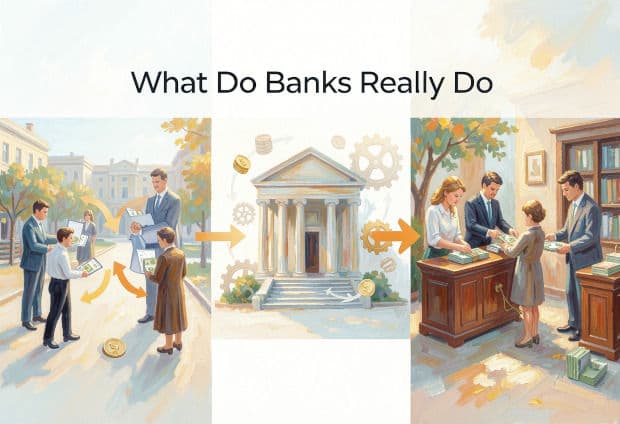
Open any economics textbook and you will find the same diagram: savers deposit money, the bank collects those deposits, and then lends them out to borrowers. The bank earns a spread between the interest it pays depositors and the interest it charges borrowers. Simple, clean, logical.
Think of it like a pipe: savings flow in one end, loans flow out the other. The pipe does not create anything — it just moves money from people who have it to people who need it.
The Reality — Banks as Money Creators
Bank of England (2014): 'Whenever a bank makes a loan, it simultaneously creates a matching deposit in the borrower's bank account, thereby creating new money.'
When a bank approves your loan, no existing deposit is touched. The bank simply makes two accounting entries: on the asset side, it records a new loan receivable; on the liability side, it credits your account with the loan amount. Two keystrokes — new money exists. No saver was inconvenienced. No vault was opened.
Real-world example: You take out a 50-lakh-taka home loan. The bank did not pull that money from another customer's account. It wrote '50 lakh owed to us' on one line and '50 lakh in your account' on the next. At that instant, 50 lakh taka that did not exist before was added to the economy.
Why This Matters
In the UK: Bank of England data shows 97% of money in circulation is bank-created.
In Bangladesh: Bangladesh Bank data indicates roughly 78% of the money supply is bank-created. Only 22% consists of central-bank-printed notes and coins.
This means the total amount of money in the economy rises when banks lend more and shrinks when loans are repaid. A credit crunch is literally a money crunch. Understanding this one fact changes how you read every financial headline.
| Aspect | Textbook Model | Reality | Confirmed By |
| What banks do | Collect deposits, then lend them out | Create new deposits (money) by approving loans | Bank of England (2014) |
| Source of loan funds | Savings from depositors | Two accounting entries by the bank | IMF, BIS |
| Bank's role | Financial intermediary | Money creator | Positive Money UK |
| Effect of a new loan | Money moves from saver to borrower | Brand-new money is created | Federal Reserve |
| Effect of repaying a loan | Money returns to the bank | Money is destroyed | Bank of England |
Chapter 2: Seven Real Functions of a Bank
1. Money Creation
The most important — and least discussed — function of a commercial bank.
Every new loan creates new money. Every loan repayment destroys money. The total money supply in any economy essentially equals the total stock of outstanding loans. When banks lend aggressively, money expands, investment grows, and jobs are created. When lending contracts, money supply shrinks and recession can follow.
2. Deposit Taking
Yes, banks take deposits — but not in order to fund loans. Deposits are a liability on the bank's balance sheet. Banks pay interest on deposits because they need liquidity: they must be able to hand back cash whenever you ask for it.
In plain English: your bank deposit is a loan you have made to the bank. You are the bank's creditor. The bank owes you money — not the other way around.
3. Lending
Home loans, business loans, personal loans, credit cards — this is where the actual money creation happens.
Bangladesh picture: total outstanding loans stand at approximately 16.5 lakh crore taka (2023). The industrial sector absorbs the largest share, followed by services and agriculture.
4. Payment System Operations
Cheque clearing, RTGS (Real Time Gross Settlement), NPSB (National Payment Switch Bangladesh), BEFTN (Bangladesh Electronic Funds Transfer Network), ATM networks, debit and credit cards — banks are the plumbing of the entire economy. Every digital payment you make flows through bank infrastructure.
Every day in Bangladesh: billions of taka settle through RTGS in seconds, keeping commerce moving.
5. Foreign Exchange
Opening Letters of Credit (LC) for importers, processing inward remittances, and trading in foreign currencies — banks run the entire chain.
Bangladesh numbers: over $21.6 billion in remittances arrives through banking channels each year, and $55 billion in RMG exports is processed through bank LCs.
6. Investment and Trading
Government treasury bills and bonds, corporate securities, and forex trading all pass through bank dealing desks, generating significant non-interest income. Bangladeshi banks hold large positions in government T-bills, which also serve as their SLR buffer.
7. Risk Management
Banking is fundamentally the business of taking on risk — and charging for it.
Credit Risk: will the borrower repay?
Market Risk: will interest rate or currency movements erode portfolio value?
Operational Risk: system failures, fraud, and cyberattacks.
The Basel III framework sets international standards for managing all three categories. Bangladesh Bank has adopted these guidelines and requires all scheduled banks to comply.
Chapter 3: How Banks Create Money — Step by Step
Step 1: You Apply for a Loan
Say you want a 50-lakh-taka home loan.
The bank will assess: your income and employment history, your CIB (Credit Information Bureau) report showing past borrowing behaviour, the collateral you can offer (usually the property deed), and your debt-to-income ratio.
Step 2: The Bank Approves the Loan
At this exact moment, no money moves from anywhere to anywhere.
The bank makes two entries on its balance sheet:
Asset: Loan receivable from you — 50 lakh taka.
Liability: Deposit credited to your account — 50 lakh taka.
Result: 50 lakh taka has been created from nothing. New money has entered the economy.
Step 3: You Spend the Money
You transfer the 50 lakh to the property seller. The seller deposits it at their bank. That bank now has a new deposit — and can use it as a base to issue further loans. The multiplier effect has begun.
Step 4: The Seller Deposits the Funds
Principal repayment: both the bank's asset and your liability shrink by the same amount. Money is destroyed — it leaves the economy.
Interest payment: this is the bank's income. It stays in the system and is not destroyed.
Step 5: The Multiplier Effect Kicks In
Every new loan creates money, every repayment of principal destroys it. The total money supply at any point equals the stock of outstanding loan principal minus repaid principal. If this cycle stalls — if businesses stop borrowing — the economy slows down.
| Step | What Happens | Balance Sheet Effect | Money Supply Effect |
| Application | Bank assesses creditworthiness | No change | No change |
| Approval | Two accounting entries made | Asset +50L, Liability +50L | +50 lakh (new money created) |
| You spend | You pay the property seller | Deposit transferred | Unchanged (new deposit formed) |
| Multiplier | Seller's bank issues further loans | Another bank's assets grow | More new money created |
| Repay interest | Interest payment | Bank income rises | Unchanged |
| Repay principal | Principal payment | Asset and Liability both shrink | Minus repaid amount (money destroyed) |
Chapter 4: Fractional Reserve Banking
What It Is and Why It Exists
Banks keep only a fraction of deposits in reserve and lend the rest. This is fractional reserve banking — the foundation of how modern banking works.
Bangladesh's current reserve requirements:
CRR (Cash Reserve Ratio): 4% — must be held as cash at Bangladesh Bank.
SLR (Statutory Liquidity Ratio): 13% — must be held in liquid assets such as government bonds.
Total effective reserve: 17%. So for every 100 taka in deposits, the bank can lend out a maximum of 83 taka.
The Money Multiplier
Formula: Money Multiplier = 1 / Reserve Ratio
If Reserve Ratio = 10%: Multiplier = 10. An initial 1,000 taka deposit can theoretically become 10,000 taka circulating in the system.
In Bangladesh: with an effective reserve ratio of ~17%, the multiplier is approximately 5.9x. A 1,000 taka deposit can theoretically support ~5,900 taka of total money.
In practice the multiplier is lower than the theoretical maximum, because not everyone borrows to the limit, loan demand is naturally constrained, and banks voluntarily hold excess reserves as a safety buffer.
Why the System Usually Works
Because not everyone withdraws their money at the same time. On a typical day, only 5-10% of customers make withdrawals. The entire fractional reserve system rests on this statistical probability — and it works beautifully, right up until it does not.
But what if everyone shows up at once? You get a bank run, and the bank collapses.
Bank Runs — When the System Breaks Down
Historical examples:
The Great Depression, 1929: 9,000 US banks failed. Millions of ordinary savers lost everything overnight.
Northern Rock, 2007 (UK): The first British bank run in 150 years. Customers queued around the block to withdraw funds after news of liquidity problems spread.
Silicon Valley Bank, 2023 (USA): Social media panic triggered $42 billion in withdrawals in just 48 hours. The bank collapsed before regulators could intervene.
Bangladesh: No large-scale public bank run has occurred, but several banks have experienced liquidity stress. Bangladesh Bank has stepped in each time with emergency support.
| Reserve Ratio | Money Multiplier | 1,000 Taka Becomes | Country Example |
| 10% | 10x | 10,000 taka | USA (historical) |
| 17% | 5.9x | 5,900 taka | Bangladesh (current) |
| 20% | 5x | 5,000 taka | India (approximate) |
| 100% | 1x | 1,000 taka | Full reserve (theoretical) |
Chapter 5: Why Banks Cannot Create Unlimited Money
CAR — Capital Adequacy Ratio
Basel III minimum: 10.5%. Bangladesh Bank's requirement: a minimum of 12.5%.
CAR measures how much of a bank's own capital backs its risk-weighted assets (RWA). The more loans a bank makes, the higher its RWA, and the more capital it needs. Once capital is exhausted, lending must stop — full stop.
Simple analogy: CAR is the bank's personal savings buffer. If it drops too low, the bank is one bad shock away from insolvency.
CRR and SLR
Bangladesh Bank's mandatory requirements: 4% CRR held as cash at the central bank plus 13% SLR in liquid assets = a combined 17% of deposits that cannot be lent out.
These two requirements serve dual purposes: they ensure banks always have enough liquidity to meet day-to-day withdrawals, and they prevent runaway money creation. Bangladesh Bank adjusts CRR and SLR rates as a monetary policy tool to expand or contract the money supply.
Loan Demand
A bank cannot force anyone to borrow. If businesses and households do not want loans, no new money gets created — regardless of how low interest rates are.
Japan's experience: Since the 1990s, the Bank of Japan has held interest rates near 0%, yet loan demand stayed chronically weak. When people are uncertain about the future, they do not borrow — even at zero cost.
Central Bank Controls
Bangladesh Bank's toolkit:
Repo Rate: raising it increases the cost of funds for banks, which reduces lending and contracts the money supply.
Reverse Repo Rate: banks park surplus funds at the central bank and earn a return, reducing the incentive to lend.
Moral Suasion: Bangladesh Bank can issue guidance encouraging or discouraging lending to specific sectors.
Non-Performing Loans
Bangladesh NPL (2023): 1,55,395 crore taka — 9.4% of total loans.
Non-performing loans destroy bank capital. Less capital means a lower CAR. A lower CAR means less lending capacity. This creates a vicious cycle: rising NPLs erode capital, which forces banks to cut lending, which slows the economy, which causes even more defaults.
| Constraint | How It Limits Lending | Current Level in Bangladesh | Effect |
| CAR | Capital must back risk-weighted assets | Minimum 12.5% | Low capital = no new loans |
| CRR | 4% of deposits held at central bank | 4% | Preserves liquidity |
| SLR | 13% of deposits in liquid assets | 13% | Mandatory government bond purchases |
| Loan Demand | Cannot lend if no one wants to borrow | Moderate growth | Affects GDP growth |
| NPL | Erodes capital, shrinks lending capacity | 9.4% (1,55,395 crore) | Credit contraction and higher rates |
Chapter 6: How Banks Make Profit
Net Interest Margin
The primary engine of bank profitability.
Banks pay depositors: 4-6% (savings accounts, FDRs).
Banks charge borrowers: 9-13% (home loans, business loans).
The spread: 3-7% = the bank's gross profit on the interest book.
Bangladesh average NIM: approximately 3-4%. This spread is the core business model.
Fees and Commissions
Account maintenance fees, ATM fees, card fees, LC charges, and remittance commissions are collectively the second-largest revenue stream.
For large banks, fee-based income can account for 20-30% of total revenue — and unlike interest income, it carries almost no credit risk.
Trading Income
Banks buy and sell government treasury bills and bonds, profiting from price movements. They also earn the bid-ask spread on foreign currency transactions. Bangladeshi banks typically hold significant T-bill positions that double as their SLR assets.
Investment Income
Dividends and capital gains from holdings in treasury bills, corporate bonds, and equity stakes contribute to the bottom line.
| Revenue Source | Approx. Amount (Crore BDT, 2023) | % of Total | Trend |
| Net Interest Income | ~35,000 crore | ~60% | Stable |
| Fees and Commissions | ~12,000 crore | ~20% | Rising (digital) |
| Trading and Investment Income | ~8,000 crore | ~14% | Volatile |
| Other Income | ~4,000 crore | ~6% | Stable |
Chapter 7: Do's and Don'ts as a Bank Customer
Do:
1. Understand that your deposit is a loan to the bank: the bank owes you that money. You are the creditor, not a protected beneficiary.
2. Check your bank's financial health: look at the CAR (12.5%+ is good), NPL ratio (below 5% is healthy), and NIM. Annual reports are available on the Bangladesh Bank website.
3. Diversify across banks: do not keep all your savings in one institution.
4. Know your deposit insurance limit: Bangladesh's Deposit Insurance Scheme covers a maximum of only 2 lakh taka per depositor. Anything above that is uninsured in the event of a bank failure.
5. Read loan agreements carefully: check whether your rate is fixed or floating, ask for the full amortization schedule showing how much of each EMI is principal versus interest, and find out the pre-payment penalty.
6. Review your CIB report regularly: you can obtain your credit report from Bangladesh Bank's Credit Information Bureau. Dispute any errors — a wrong entry can block you from getting a loan.
Don't:
1. Think of the bank as a vault: your money is not sitting there waiting for you — it is circulating as loans throughout the economy.
2. Keep all savings in one bank: amounts above 2 lakh taka per bank are not covered by deposit insurance.
3. Take a loan without understanding the rate structure: a floating rate means your EMI can increase if Bangladesh Bank raises the repo rate.
4. Ignore the amortization schedule: in the early years of a loan, most of each payment goes toward interest, not principal. Ask for this breakdown before you sign.
5. Assume the government will always bail out banks: private banks have no guaranteed government backstop. Due diligence is your responsibility.
Chapter 8: Bangladesh Banking Sector in Numbers
The Numbers at a Glance
Total scheduled banks: 61 (6 state-owned commercial, 3 specialised, 43 private commercial, 9 foreign branches).
Additional specialised banks: 5 more covering agriculture, industry, housing, and expatriate welfare.
Total assets: approximately 22 lakh crore taka.
Total deposits: approximately 16 lakh crore taka.
Total loans: approximately 16.5 lakh crore taka.
Non-performing loans (NPL): 1,55,395 crore taka = 9.4% of total loans — three times the international benchmark of 3%.
State-owned bank NPL: above 20% — the worst performers in the sector.
Problems
Sky-high NPLs: politically directed lending and weak corporate governance have allowed defaults to spiral far beyond acceptable levels.
Repeated recapitalisation: state-owned banks have needed taxpayer-funded bailouts worth tens of thousands of crore taka over the past decade — and the cycle continues.
Governance failures at state banks: politically appointed boards, lack of independent risk oversight, and inadequate accountability structures persist.
Interest rate pressure: government-mandated interest rate caps have squeezed bank NIMs and distorted credit allocation.
Opportunities
Digital banking revolution: bKash alone has over 21 crore registered accounts. Combined with Nagad and Rocket, mobile financial services have brought banking within reach of tens of millions of previously unbanked Bangladeshis.
Growing middle class: rising household incomes are fuelling demand for mortgages, consumer loans, and investment products.
Financial inclusion push: the number of bank accounts is growing rapidly, expanding the deposit base and the addressable market for all banking products.
| Indicator | Value | International Benchmark | Source |
| Total Assets | ~22 lakh crore taka | Not comparable | Bangladesh Bank 2023 |
| Total Loans | ~16.5 lakh crore taka | Not comparable | Bangladesh Bank 2023 |
| NPL Ratio | 9.4% | <3% (healthy) | Bangladesh Bank 2023 |
| State-Owned Bank NPL | 20%+ | <3% | Bangladesh Bank |
| Average CAR | ~13% | >12.5% (BD), >10.5% (Basel) | Bangladesh Bank |
| Mobile Banking Accounts | 21 crore+ (bKash) | Among highest in developing world | bKash 2023 |
| Bank Branches | ~12,000+ | Not comparable | Bangladesh Bank |
Final Thoughts
Banks are money factories, not money vaults.
Every loan approval conjures new money into existence. Every principal repayment wipes it away. The 78% of Bangladesh's money supply that was not printed by the central bank was born from someone's debt — a home loan, a business credit line, a personal loan. Understanding this is not a technicality; it is the master key to understanding how the entire financial system operates.
As a customer, this knowledge makes you sharper. You will read loan offers differently, evaluate banks more critically, and make smarter decisions about where to keep your savings. For a deeper dive into the mechanics of debt-based money creation, see our article 'Money From Debt: The Hidden Truth of the Modern Financial System.'
'Banking is a very good business if you don't do anything dumb.' — Warren Buffett
Remember: a bank can be your best financial ally or your most expensive mistake — the difference is how well you understand the game you are playing.
Recommended for you

The Bretton Woods Agreement: A Turning Point in Global Economic History
In 1944, as the world was still engulfed in the devastation of World War II, the global economy had collapsed and people’s living standards had plummeted. In an effort to stabilize the international economy and address pressing global financial issues, the Allied nations convened a historic summit. Nearly 730 delegates from 44 countries gathered at the Mount Washington Hotel in Bretton Woods, New Hampshire, for the United Nations Monetary and Financial Conference. The outcome of this summit was the landmark Bretton Woods Agreement, which gave birth to the Bretton Woods System.
Money
How Money Works?

Business
What is Equity? A Comprehensive Guide to Ownership, Value, and ROE

Business Models
Sharing Economy Model: How Businesses Make Money Without Owning Anything
E-Commerce
E-Commerce: The Complete Guide to Online Business

Economics
Economics: What It Is, Why It Matters, and How It Shapes Our Lives

Investment
Investment: What It Is, Types, and Real Life Examples

Sales
What Is Sales and How Does It Work?

Accounting
Accounting for Startups: A Complete Guide to Getting It Right

Accounting
Accrual Accounting: How It Works, Types, and Why It Matters