M0, M1, and M2 — The Numbers That Reveal the True Face of Any Economy
G
GeoRenus Editorial Team
1,123 views
GeoRenus Editorial Team
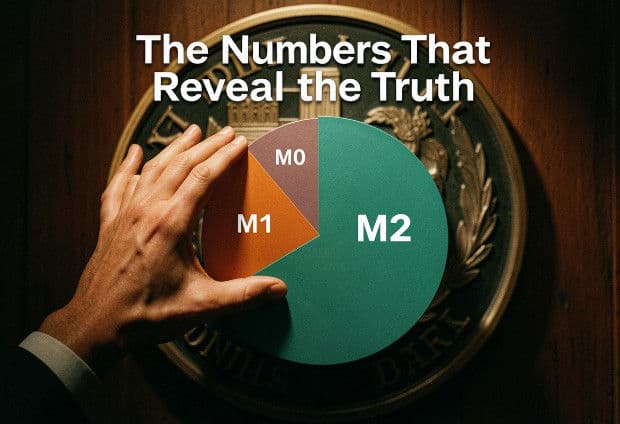
M0, M1, and M2 are three layers of money supply that reveal how much 'real' money exists in an economy versus how much has been created by banks through lending. M0 is physical currency printed by the central bank — the only 'real' money. As M1 and M2 grow larger relative to M0, it means banks have created more debt-based money. In advanced economies, bank-created money is 89-97% of the total. Bangladesh's M2/M0 ratio of 4.45x and M2/GDP ratio of just 34% tell a story of both underdevelopment and fragility, worsened by high non-performing loans.
If you asked someone how much money exists in Bangladesh, they'd probably say "whatever Bangladesh Bank has printed." But that answer would be wrong.
In modern economies, measuring "how much money exists" is far more complex than counting physical notes. Money exists in layers — central bank-printed currency is one layer, checking account balances are another, savings deposits are yet another.
Economists label these layers M0, M1, and M2. Together, these three numbers reveal exactly how much "real" money an economy has versus how much is bank-created, debt-based money. Understanding them changes how you see the entire financial system.
M0, also called Base Money, Monetary Base, or High-Powered Money, is the foundation of the entire monetary system.
What M0 includes:
M0 = Physical notes and coins in public circulation + Commercial bank reserves held at the central bank
This is the only money directly created and backed by the central bank's authority. Nobody created it through lending. The central bank manufactured it — either by printing physical notes or by crediting reserves digitally.
Why is it called 'High-Powered'?
Because one unit of M0 can generate several times its value through the money multiplier effect. When M0 increases, total money in the system increases. When it shrinks, the whole system contracts.
Bangladesh's M0 (Bangladesh Bank data):
| Year | M0 (Crore BDT) | Growth |
| 2019 | 2,31,456 | — |
| 2020 | 2,78,932 | +20.5% |
| 2021 | 3,18,456 | +14.2% |
| 2022 | 3,56,789 | +12.0% |
| 2023 | 3,82,345 | +7.2% |
Note: These figures are approximate, based on Bangladesh Bank published data. Actual numbers may vary slightly. For the latest data, refer to Bangladesh Bank's Monetary Policy Statement and Monthly Economic Trends reports.
Notice how M0 growth has been decelerating — from 20.5% in 2020 down to 7.2% in 2023. This reflects tightening monetary policy as Bangladesh Bank tried to combat inflation.
M1 is the most liquid form of money — everything you can spend immediately. It's also called Narrow Money.
What M1 includes:
M1 = M0 (notes and coins in public hands) + Demand deposits (checking account balances) + Other checkable deposits
Your checking account balance is money the bank created — the government didn't print it. When you check your balance and see 50,000 taka, that number exists because the bank made an entry in its system. This is the first layer where bank-created money appears.
What the M1/M0 gap tells us:
Bank-created M1 money = M1 minus M0 (notes and coins portion). This difference reveals how much money banks have created through demand deposits alone.
Bangladesh's M1:
| Year | M1 (Crore BDT) | M1/M0 Ratio |
| 2019 | 3,45,678 | 1.49x |
| 2020 | 4,12,345 | 1.48x |
| 2021 | 4,89,765 | 1.54x |
| 2022 | 5,34,567 | 1.50x |
| 2023 | 5,78,900 | 1.51x |
Note: These figures are approximate, based on Bangladesh Bank published data. Actual numbers may vary slightly. For the latest data, refer to Bangladesh Bank's Monetary Policy Statement and Monthly Economic Trends reports.
The ratio tells us that for every 1 taka of "real" base money, there's about 1.5 taka in M1. That extra 0.5 taka was created by banks through checking accounts alone.
M2 is the most important indicator. Most central banks base their monetary policy decisions on M2 data.
What M2 includes:
M2 = M1 + Savings deposits + Short-term time deposits + Money market funds (in some countries)
M2 tells you the total amount of money circulating in the entire banking system. And the M2/M0 ratio reveals exactly how aggressively banks have been creating money.
Bangladesh's M2:
| Year | M2 (Crore BDT) | M2/M0 Ratio | Growth |
| 2019 | 12,34,567 | 5.34x | — |
| 2020 | 13,89,456 | 4.98x | +12.5% |
| 2021 | 15,23,678 | 4.78x | +9.7% |
| 2022 | 16,45,345 | 4.61x | +7.9% |
| 2023 | 17,00,000 | 4.45x | +3.3% |
Note: These figures are approximate, based on Bangladesh Bank published data. Actual numbers may vary slightly. For the latest data, refer to Bangladesh Bank's Monetary Policy Statement and Monthly Economic Trends reports.
In 2023, Bangladesh's M2/M0 ratio was 4.45. That means for every 1 taka printed by Bangladesh Bank, the total system contains 4.45 taka. The remaining 3.45 taka was created by banks through lending. In percentage terms: approximately 77.5% of all money in Bangladesh is bank-created. Only 22.5% is printed by the central bank.
2023 data (IMF and respective central banks):
| Country | M0 (Billion USD) | M2 (Billion USD) | M2/M0 | Bank-Created Money (%) |
| United States | 2,200 | 20,800 | 9.45x | 89.4% |
| China | 4,800 | 53,900 | 11.23x | 91.1% |
| Eurozone | 1,900 | 16,300 | 8.58x | 88.4% |
| Japan | 1,050 | 9,800 | 9.33x | 89.3% |
| United Kingdom | 110 | 3,200 | 29.09x | 96.6% |
| India | 520 | 2,800 | 5.38x | 81.4% |
| Bangladesh | 35 | 155 | 4.43x | 77.4% |
Note: These comparative figures are approximate, sourced from the IMF and respective central banks. Definitions of M0 and M2 vary slightly across countries, so direct comparisons are not perfectly precise.
The UK's ratio of 29x is extraordinarily high because London is a global financial center and the banking sector dwarfs the domestic economy. China's ratio of 11x reflects the government's aggressive use of bank lending to drive massive infrastructure investment. Bangladesh's ratio of 4.43x is low compared to developed nations — but that's not necessarily good news. It signals an underdeveloped banking system where high non-performing loans are limiting credit flow.
There's a direct mathematical relationship between M2 growth and inflation.
The formula: Inflation ≈ M2 Growth Rate − GDP Growth Rate
If M2 grows at 15% per year but GDP grows only 6%, the excess 9% of money supply chases the same amount of goods — pushing prices up.
Bangladesh's track record:
| Year | M2 Growth | GDP Growth | Theoretical Inflation | Actual Inflation |
| 2019 | 10.4% | 8.2% | 2.2% | 5.5% |
| 2020 | 12.5% | 3.5% | 9.0% | 5.6% |
| 2021 | 9.7% | 6.9% | 2.8% | 5.6% |
| 2022 | 7.9% | 7.1% | 0.8% | 7.7% |
| 2023 | 3.3% | 5.8% | — | 9.9% |
Note: These figures are approximate, based on Bangladesh Bank published data. Actual numbers may vary slightly. For the latest data, refer to Bangladesh Bank's Monetary Policy Statement and Monthly Economic Trends reports.
Notice the 2023 anomaly: M2 growth was low but inflation was the highest. Why? Because the excess money created during 2020-2021 hit prices with a delay. This is called the Lagged Effect — monetary expansion takes 12-18 months to fully show up in consumer prices.
Global M2 growth comparison (2015-2023 average, IMF data):
| Country | Avg M2 Growth | Avg GDP Growth | Avg Inflation |
| USA | 7.2% | 2.3% | 3.1% |
| China | 9.8% | 6.4% | 2.3% |
| Eurozone | 5.3% | 1.5% | 2.4% |
| Japan | 3.4% | 0.9% | 0.8% |
| India | 10.3% | 6.1% | 5.5% |
| Bangladesh | 12.1% | 6.8% | 6.3% |
Note: These comparative figures are approximate, sourced from the IMF and respective central banks. Definitions of M0 and M2 vary slightly across countries, so direct comparisons are not perfectly precise.
Japan is the most restrained — low M2 growth, low inflation. It has been fighting deflation for decades. China is the most aggressive — highest M2 growth, but high GDP growth absorbs it. Bangladesh is under pressure — high M2 growth with moderate GDP growth creates persistent inflationary pressure.
2023 snapshot:
| Indicator | Amount (Crore BDT) | Share |
| M0 (Base Money) | 3,82,345 | 22.5% |
| M1 - M0 (Demand deposit bank money) | 1,96,555 | 11.6% |
| M2 - M1 (Savings & time deposit bank money) | 11,21,100 | 65.9% |
| M2 (Broad Money) | 17,00,000 | 100% |
| Total bank-created money | 13,17,655 | 77.5% |
| Non-performing loans (NPL) | 1,55,395 | 9.4% (of total loans) |
Note: These figures are approximate, based on Bangladesh Bank published data. Actual numbers may vary slightly. For the latest data, refer to Bangladesh Bank's Monetary Policy Statement and Monthly Economic Trends reports.
The non-performing loan connection:
Bangladesh Bank data shows total NPLs in 2023 at approximately 1,55,395 crore taka — 9.4% of total loans. The international healthy benchmark is below 3%. Bangladesh is three times above that threshold.
Non-performing loans mean the bank created money that isn't coming back. This erodes bank capital, reduces CAR, shrinks lending capacity, and ultimately slows M2 growth. Slower M2 growth means less money flowing through the economy, less business investment, and fewer jobs.
Bangladesh's population is approximately 170 million.
Per capita M0 = 22,490 taka. Per capita M2 = 1,00,000 taka.
This means the system holds an average of 1 lakh taka per person. But only 22,490 taka of that is "real" central bank money.
Now compare with the United States: per capita M2 = $63,000 ≈ 69 lakh taka. Bangladesh's per capita M2 is just 1 lakh taka versus America's 69 lakh. This gap is the single most powerful illustration of the economic development difference between the two countries.
The M2-to-GDP ratio measures how deep a country's banking sector runs relative to its economy. A higher ratio means a more mature financial system.
2023 data (World Bank and IMF):
| Country | M2 (Billion USD) | GDP (Billion USD) | M2/GDP |
| China | 53,900 | 17,700 | 304% |
| Japan | 9,800 | 4,200 | 233% |
| Eurozone | 16,300 | 14,800 | 110% |
| UK | 3,200 | 3,100 | 103% |
| USA | 20,800 | 27,300 | 76% |
| India | 2,800 | 3,700 | 76% |
| Bangladesh | 155 | 460 | 34% |
Note: These comparative figures are approximate, sourced from the IMF and respective central banks. Definitions of M0 and M2 vary slightly across countries, so direct comparisons are not perfectly precise.
China's 304% is considered risky by many experts — much of that lending is directed by the government and not all of it is productive. America's 76% is considered healthy. Bangladesh's 34% reveals a banking sector that's still small relative to the economy. Expanding banking services to more people would raise this ratio and boost economic investment.
When M2 growth far outpaces GDP growth, inflation is inevitable. During COVID in 2020-2021, many countries printed massive amounts of money. In the US, M2 jumped 26% in a single year — directly causing 2022's 40-year-high inflation.
Falling M2 means money supply is contracting — a potential recession signal. In 2022-2023, the US Federal Reserve's aggressive rate hikes caused M2 to decline — a historically rare event that raised alarm bells.
This signals that banks have pulled back on lending — either due to rising NPLs, capital shortages, or interest rates too high for loan demand. Bangladesh's M2/M0 fell from 5.34 in 2019 to 4.45 in 2023 — clear evidence that the banking system is creating money less effectively, primarily due to the NPL crisis and capital constraints.
M0, M1, and M2 aren't just three numbers. They're the health report card of an entire economy.
M0 tells you how much "real" money the central bank has created. M2 tells you the total money in the system. The ratio between them reveals how actively the banking sector is channeling money into the economy.
For Bangladesh, the most critical takeaway is this: the M2/GDP ratio stands at just 34%. To raise it, the country needs to expand banking access, reduce non-performing loans, and rebuild trust in the banking system.
But equally important is the caution: growing M2 too fast without matching GDP growth is a recipe for inflation. And inflation always hurts the most vulnerable members of society the hardest.
"Money supply numbers don't lie. They just wait patiently for reality to catch up."

A ‘SWOT’ analysis is essentially a planning process that helps an organization identify new directions it can pursue while overcoming its challenges. The acronym ‘SWOT’ stands for Strengths, Weaknesses, Opportunities, and Threats. Therefore, a SWOT analysis is an excellent strategy for evaluating these four aspects of any organization.