White Elephant: When Your Biggest Investment Becomes Your Biggest Burden
G
GeoRenus Editorial Team
709 views
Summary
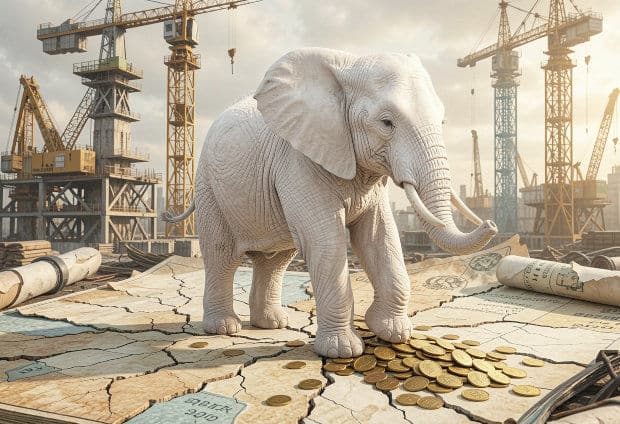
A white elephant is an asset, project, or investment whose maintenance and operating costs far exceed any benefit it provides — yet walking away from it feels impossible. The term traces back to ancient Southeast Asia, where kings gifted rare sacred elephants to courtiers as a form of disguised punishment. In modern business, government, and personal finance, white elephants quietly drain resources while pride, sunk costs, and political pressure keep them alive long past their usefulness.
Key Takeaways
- A white elephant is any asset or project where upkeep costs consistently outweigh the benefits it delivers.
- The term originates from ancient Siam (Thailand), where kings gave sacred white elephants to punish disfavored courtiers — beautiful gifts that were ruinously expensive to maintain.
- Researcher Bent Flyvbjerg found that roughly 90% of global megaprojects exceed their original budget and 70% run over their planned timeline.
- The Sunk Cost Fallacy — continuing to invest because of money already spent — is the single biggest reason white elephants survive far longer than they should.
- Famous examples include the Concorde supersonic jet, Montreal's 1976 Olympic Stadium (nicknamed 'The Big Owe'), and Brazil's 2014 World Cup stadiums now used as parking lots.
- The antidote is disciplined feasibility analysis, a planned exit strategy, and the courage to cut losses before throwing good money after bad.
What Is a White Elephant? — Definition and Origin
The Story Behind the Name
Picture ancient Siam — present-day Thailand — somewhere around the 13th century. A rare white elephant is spotted in the jungle. The king's men rush to capture it. Why? Because in the kingdoms of Southeast Asia, a white elephant was not just an animal. It was a sacred creature, believed to carry divine blessings. Owning one was a sign of royal power and cosmic favor.
But here is the catch. Because the white elephant was sacred, it could not be put to work. You could not use it to plow fields, haul timber, or carry soldiers into battle. It had to be housed in special quarters, fed expensive food, attended by dedicated caretakers. And because it was sacred, you could not sell it, give it away without permission, or let it die through neglect. To do any of those things was considered an act of disrespect — even treason.
This created a perfect trap. According to legend, when a king of Siam wanted to ruin a courtier he disliked — but could not punish openly — he would gift that courtier a white elephant. The courtier could not refuse a royal gift. He could not get rid of it. And slowly, the cost of keeping the magnificent beast would bleed him dry. A gorgeous punishment wrapped in royal generosity.
The Modern Definition
Fast-forward to today. In business and economics, a white elephant refers to any asset, project, or investment whose maintenance and operating costs consistently exceed the value or benefit it provides — and which is difficult or awkward to sell, shut down, or abandon.
The parallels are exact. You cannot easily get rid of it. Keeping it is expensive. But walking away feels even harder — because of money already spent, political pressure, pride, or contractual obligation.
White elephants show up everywhere. An empty office tower where half the floors sit vacant, yet rent, utilities, and maintenance bills roll in every month. A car that gets driven two days a month but costs a fortune in insurance, parking, and repairs. A government airport in the middle of nowhere with no flights and no passengers — but a full maintenance crew on the payroll.
The Historical Origins of White Elephants — A Deeper Look
The White Elephant concept stretches far beyond a simple business metaphor. Its roots run through centuries of Asian royalty, European colonialism, and American popular culture.
Ancient Siam and Burma:
In Thai, a white elephant is called "Chang Phueak." Siamese kings measured their power partly by how many white elephants they possessed. The Thai national flag featured a white elephant until 1917. Burmese kings similarly used white elephants as royal symbols — their official title included "Lord of the White Elephants."
The Indian Subcontinent:
In Hindu mythology, Airavata — the white elephant of Lord Indra — is deeply sacred. In Buddhist tradition, Queen Mayadevi dreamed of a white elephant before giving birth to Siddhartha Gautama (the Buddha). This is why white elephants across South and Southeast Asia carry immense religious significance — and why using them for practical work was strictly forbidden.
How the Concept Reached Europe:
European merchants traveling to Siam in the 17th century brought back stories of this tradition. The English idiom "White Elephant" first gained popular use around 1851, when P.T. Barnum — the famous circus showman — purchased a so-called white elephant at enormous expense. It turned out to be a grayish animal that disappointed audiences. It became his most expensive and least profitable acquisition — a literal white elephant.
The American 'White Elephant Sale':
In the United States, "White Elephant Gift Exchange" is a popular tradition where people give each other unwanted or humorous items. It's directly inspired by the Siamese legend — an unwanted "gift" you're stuck with but can't use. The phrase has become so deeply embedded in English that most people use it without knowing its royal Asian origins.
White Elephants in Business — When Corporate Investments Become Burdens
In the corporate world, White Elephants destroy billions of dollars every year. The pattern is almost always the same: a big bet, initial excitement, then a slow realization that the investment is bleeding money — but nobody wants to admit it.
Example 1 — Quibi (2020): $1.75 Billion Up in Smoke
Quibi was a short-form video streaming platform designed for mobile — bite-sized episodes from top Hollywood talent. Founded by legendary executive Jeffrey Katzenberg, it raised $1.75 billion before even launching. It launched in April 2020 and shut down just 6 months later. The reason? YouTube and TikTok were already doing the same thing — for free. Nearly $2 billion vanished in half a year.
Example 2 — WeWork's Office Empire
WeWork signed long-term leases on massive office spaces worldwide, then subleased them in smaller chunks at a premium. When COVID hit and remote work exploded, most WeWork offices sat empty — but the lease payments kept coming. In 2023, WeWork filed for bankruptcy. A company once valued at $47 billion became the poster child for corporate White Elephants.
Example 3 — Yahoo's Tumblr Acquisition
In 2013, Yahoo acquired Tumblr for $1.1 billion. Just 6 years later, Verizon (Yahoo's parent) sold it for less than $3 million — under 0.3% of the original price. Over 99.7% of the investment evaporated.
Example 4 — Vanity Headquarters
Many companies build extravagant headquarters as CEO ego projects. In the age of remote work, these gleaming towers sit half-empty. The rent, electricity, and maintenance bills keep coming — but the building serves more as a monument to past ambition than a productive workspace.
White Elephants in Economics — When Nations Bear the Burden
At the national level, White Elephants hit even harder — because the bill is paid by an entire country's taxpayers, not just one company's shareholders.
The Olympics — The World's Most Expensive White Elephant Factory
Research from Oxford Economics shows that over the past 50 years, every single Olympic Games has exceeded its budget by an average of 172%. The 2004 Athens Olympics is widely cited as a contributor to Greece's economic crisis — approximately $15 billion was spent, and many venues now sit abandoned and crumbling.
The story repeated in Rio 2016: the Maracana's grass has dried up, the Aquatic Center is closed, and the Olympic Village stands empty. Billions spent, almost nothing left.
Government-Subsidized Zombie Industries
Many countries keep unprofitable industries alive through government subsidies — even when those industries can't compete in the open market. This is another form of White Elephant. Taxpayer money props up businesses that benefit a few while the cost is spread across the entire nation.
National Airlines — A Classic Example
Many state-owned airlines run at perpetual losses but survive on government subsidies because they're seen as symbols of national pride. Italy's Alitalia ran at a loss for decades before finally shutting down in 2021. Pakistan International Airlines (PIA) faces the same situation — absorbing billions in annual subsidies while providing deteriorating service.
Inflation and Opportunity Cost
When governments spend heavily on White Elephant projects, they often need to borrow or print money — which fuels inflation. Meanwhile, that same money invested in education, healthcare, or productive infrastructure would have generated far greater economic returns. This is the true hidden cost of White Elephants — not just what you spent, but what you could have built instead.
White Elephants in Real Estate — The Brick-and-Mortar Trap
Real estate is the most fertile ground for White Elephants. The investments are large, illiquid (hard to sell quickly), and maintenance costs never stop.
Example 1 — China's Ghost Cities
China has entire cities that are fully built — modern apartments, shopping malls, roads, parks — but virtually nobody lives there. These are called "Ghost Cities." The most famous example is Ordos Kangbashi — built for 1 million residents but sitting nearly empty for years. China's drive to boost GDP through construction created supply without demand — the textbook definition of a White Elephant.
Example 2 — Dubai's 'The World' Islands
"The World" is a collection of 300 artificial islands off Dubai's coast, shaped to look like a world map when viewed from above. Launched in 2003, most islands remain incomplete and uninhabited after the 2008 financial crisis. Some are reportedly sinking back into the sea — a White Elephant quite literally disappearing underwater.
Example 3 — Spain's Housing Bubble
Between 2000 and 2008, Spain experienced a massive real estate boom. Developers built enormous housing projects far from city centers. When the bubble burst in 2008, over 1 million newly built homes sat without buyers. Many "urbanizaciones" remain abandoned today — empty swimming pools, rusted gates, overgrown streets. Spain's banking crisis was largely fueled by these real estate White Elephants.
Example 4 — Bangladesh's Unsold Apartments
Bangladesh is showing early signs of real estate White Elephants. Housing projects outside Dhaka have produced thousands of apartments with no buyers. Developers took bank loans to build — unsold units mean unpaid loans, which feed into the banking sector's non-performing loan crisis. What starts as a developer's White Elephant can become a systemic banking problem.
When Does Real Estate Become a White Elephant?
When annual maintenance costs (taxes, repairs, insurance, security) exceed rental income or appreciation — it's a White Elephant. When you want to sell but can't find a buyer — it's a White Elephant. When demand has evaporated but contractual obligations force you to hold — it's a White Elephant. The key lesson: property is only valuable if someone wants to use it.
Five Signs You're Dealing With a White Elephant
Not every underperforming asset is a white elephant. How do you know when something has truly crossed that line? Look for these five warning signs.
Sign 1: Maintenance costs consistently exceed the benefit
This is the defining characteristic. If what you spend to keep something running is reliably higher than what you get out of it — financially, operationally, or strategically — you are looking at a white elephant. The gap does not need to be dramatic. A small, persistent drain is just as damaging over time as a large, obvious one.
Sign 2: You cannot easily sell it, close it, or walk away
White elephants have a grip. Maybe it is a long-term lease with heavy penalties. Maybe it is a government project that cannot be cancelled without a political firestorm. Maybe no one wants to buy it at any reasonable price. Whatever the reason, the exit door feels locked — and that is precisely what keeps the cost bleeding.
Sign 3: The 'we've already spent so much' argument keeps it alive
This is the Sunk Cost Fallacy in action. The logic sounds reasonable: 'We have already put $50 million into this — we cannot just walk away now.' But economics is clear on this point. Money already spent is gone regardless of what you decide next. The only question that matters is whether future spending will generate future returns. If the answer is no, past spending is irrelevant.
Sign 4: It is tied to someone's ego or prestige
Many white elephants survive not because of financial logic but because of emotional attachment. A CEO's flagship headquarters. A politician's signature infrastructure project. A founder's pet technology. When the project becomes a symbol of identity, admitting it has failed feels like admitting personal failure — and that makes rational decision-making nearly impossible.
Sign 5: It has drifted far from its original purpose
Sometimes a project starts with genuine intent but the world changes around it. The market it was built for disappears. The technology it was designed to serve becomes obsolete. The problem it was meant to solve gets solved a different way. But the project keeps going — because stopping requires someone to say out loud that the original vision no longer makes sense.
Types of White Elephants — Where They Appear
Government Mega-Projects
Government is where white elephants breed most freely. The incentive structure is almost designed to produce them. Politicians need visible wins before the next election. Accountability is diffuse — when a project fails, it is hard to point to one person responsible. And once construction begins, stopping feels politically unacceptable, no matter how bad the economics look.
Oxford University professor Bent Flyvbjerg spent decades studying large infrastructure projects around the world. His conclusion: roughly 90% of megaprojects exceed their original budget, and about 70% run over their planned timeline. Many of these eventually become white elephants, consuming public funds for years after their initial failure becomes obvious.
A textbook example: Sri Lanka's Mattala Rajapaksa International Airport, opened in 2013. Built at a cost of hundreds of millions of dollars in a low-population region with no significant air traffic demand, it quickly earned the grim distinction of being called 'the world's emptiest international airport.' On many days, the airport handled a handful of flights. Maintenance costs continued regardless. It sat there — gleaming, nearly silent, and enormously expensive.
Business Investments
Corporations are not immune. A company builds a massive factory to meet a demand forecast that turns out to be wildly optimistic. The factory cannot be shut down easily — there are workers under contract, lease obligations, equipment loans. But running it means hemorrhaging cash every quarter.
Enterprise Resource Planning (ERP) software implementations are another classic corporate white elephant. Companies spend tens of millions — sometimes hundreds of millions — on ERP systems that employees refuse to use effectively, that never deliver the promised efficiency gains, and that are too deeply embedded in operations to rip out. The investment is too big to abandon, too broken to justify expanding. It just sits there, costing money.
Personal Finance
White elephants are not just for governments and corporations. They live in individual lives too — and they are often harder to see because we are emotionally attached to them.
That gym membership you bought in January and have visited four times. The oversized SUV that costs more in monthly loan payments, insurance, fuel, and parking than you would spend on rideshares or a smaller car. The timeshare vacation package that seemed like a deal until you discovered how difficult — and expensive — it is to get out of the contract. Personal white elephants drain wealth quietly, one recurring bill at a time.
Technology
Technology is a particularly fertile ground for white elephants because products can become obsolete almost overnight. Google Glass, launched commercially in 2013, is a near-perfect example. Google invested enormous resources developing augmented-reality eyewear. The product was technologically impressive. But consumers recoiled. Privacy concerns were immediate and serious — who wants to be filmed without knowing it? Social awkwardness followed the device everywhere. People wearing Glass were mocked.
The commercial rollout collapsed. Google quietly shelved the consumer version. Despite the billions invested in research, development, and marketing, the product generated almost no sustainable revenue. The technology lived on in enterprise applications, but the grand consumer vision became a celebrated case study in how quickly an investment can become a burden.
Famous White Elephant Examples
1. The Concorde — Britain and France
The Concorde was the world's only commercial supersonic passenger aircraft. It could fly from London to New York in roughly 3.5 hours — less than half the time of a conventional jet. The engineering was extraordinary. But the economics were catastrophic. Each Concorde flight burned approximately four times the fuel of a comparable subsonic aircraft. Ticket prices were astronomical, limiting the passenger base to a tiny slice of ultra-wealthy travelers.
Only 20 Concorde aircraft were ever built. The British and French governments subsidized the program for roughly 30 years, pouring in billions because the Concorde had become a matter of national pride — a symbol of European technological capability. Shutting it down felt like admitting defeat on an international stage.
The Concorde finally retired in 2003, more than three decades after its first commercial flight. The total financial loss from the program, when development costs and decades of subsidies are included, runs into the billions. It was a magnificent machine and a ruinous investment.
2. Montreal's 1976 Olympic Stadium — 'The Big Owe'
When Montreal won the bid to host the 1976 Summer Olympics, city planners envisioned a bold architectural statement. The original budget for the Olympic Stadium was $134 million. Cost overruns began almost immediately. By the time the Games opened, the stadium was not even finished — the retractable roof had to be added later.
The final cost? $1.6 billion — nearly 12 times the original estimate. Montreal residents were so burdened by the debt that they nicknamed it 'The Big Owe.' The city did not finish paying off the Olympic debt until 2006 — thirty years after the closing ceremony. For three decades, taxpayers funded a stadium built for a two-week event.
3. Sri Lanka's Hambantota Port — A 99-Year Lease to China
In the 2000s, Sri Lanka's government borrowed heavily from China to build a deep-sea port at Hambantota, the home district of then-President Mahinda Rajapaksa. The project had strong political motivation. The economic rationale was thin — Hambantota had little existing shipping traffic and no natural reason to become a major maritime hub.
As the debt mounted and revenue never materialized, Sri Lanka found itself unable to service the loan. In 2017, the government struck a deal with China Merchants Port Holdings: a 99-year lease of the Hambantota port in exchange for debt relief. A sovereign asset, built with borrowed money that could not be repaid, handed over to a foreign company for nearly a century. The white elephant had consumed an entire port.
4. Brazil's 2014 FIFA World Cup Stadiums
Brazil built or renovated 12 stadiums for the 2014 FIFA World Cup. Total spending reached approximately $3.6 billion. Some of those venues were built in cities with no professional football clubs capable of filling them — cities like Manaus, deep in the Amazon rainforest, which hosted four group-stage matches and then had no further use for a 44,000-seat arena.
The Arena da Amazônia in Manaus became one of the most photographed symbols of white elephant excess. In the years following the World Cup, it was used occasionally for local matches and — in one particularly striking image that circled the globe — as a parking lot. A $300 million stadium doubling as a car park. If you needed a single image to explain the white elephant concept, that would be it.
Why White Elephants Happen — Psychological and Structural Causes
Cause 1: The Sunk Cost Fallacy
This is the engine that keeps most white elephants running long after they should have been shut down. The reasoning feels intuitive: we have already spent $200 million, so stopping now means $200 million wasted. But this logic is backwards. That $200 million is gone whether you stop or continue. The real question is whether the next dollar you spend will generate more than a dollar in return. Sunk costs are irrelevant to that calculation — but emotionally, they feel like everything.
Cause 2: Political Pressure and Prestige
For government projects especially, the decision to invest is rarely made purely on financial grounds. An infrastructure project might be a campaign promise. A national stadium might be a symbol of development and modernity. A new airport might be built in a powerful politician's home region as a gesture of patronage. Once these projects carry political weight, cancelling them requires someone to publicly admit failure — and in politics, that is a rare commodity.
Cause 3: Optimism Bias
Harvard Business Review research on large project failures found a consistent pattern: costs are systematically underestimated and benefits are systematically overestimated in the planning stages of major investments. This is not always deliberate dishonesty. Often it is genuine optimism — planners believe in their project and project that belief onto their forecasts. But optimism in a spreadsheet does not change the economics of reality.
Cause 4: Diffuse Accountability — Nobody Wants to Own the Failure
In large organizations and governments, decisions about major investments are made by committees, approved by boards, championed by executives who may have moved on by the time the problems become undeniable. When no single person is clearly responsible for recognizing and stopping a failing project, everyone waits for someone else to pull the trigger. The project keeps going because stopping it requires someone to volunteer for blame.
How to Avoid White Elephants — Do's and Don'ts
Do:
1. Commission a realistic feasibility study before committing capital — not an optimistic one designed to justify a decision already made. Use independent analysts with no stake in the outcome.
2. Build an exit strategy into every major investment from day one. Define in advance: what conditions would cause us to stop this project? What is the minimum acceptable return, and by what date? Having pre-committed criteria makes it easier to act on them later.
3. Conduct regular structured reviews — every six months or year — where the question is asked honestly: if we were making this investment decision today, with what we now know, would we proceed? If the answer is no, that is important information.
4. Separate sunk costs from future decisions. Train yourself and your team to ask only: what happens from here? Past spending is gone. It cannot be a reason to continue.
5. Seek independent evaluation from people who will tell you what they actually think, not what they think you want to hear. External reviewers with no political or financial stake in the project's continuation are invaluable.
Don't:
1. Do not start a major investment for political or emotional reasons without rigorous economic justification. Prestige is not a business case.
2. Do not authorize additional spending on a failing project just because a lot has already been spent. Each new dollar needs to stand on its own merits.
3. Do not confuse admitting failure with defeat. Cutting losses quickly is a sign of financial discipline and mature judgment, not weakness.
4. Do not evaluate investments based on initial cost alone. Calculate the Total Cost of Ownership (TCO) — acquisition plus operating, maintenance, and eventual disposal costs over the full life of the asset. The sticker price is almost never the whole story.
Pros and Cons of White Elephants — A Different Perspective
White elephants are, by definition, bad investments. But a balanced analysis acknowledges that large, flawed projects sometimes produce unintended benefits alongside their obvious costs. Here is the full picture.
The Case For (Such As It Is):
1. Job creation — Large construction projects employ thousands of workers. Even a white elephant generates real income and economic activity during its building phase. In regions with high unemployment, that is not nothing.
2. Infrastructure spillover — A project that fails in its primary purpose may still leave behind roads, utilities, and connections that benefit surrounding communities. The value is unintended, but it is real.
3. Capability building — The Concorde never made money. But the engineering challenges it forced British and French aerospace companies to solve advanced aviation technology in ways that benefited the entire industry for decades. Sometimes the process of attempting something ambitious builds capability even when the end product fails.
The Case Against (The Real Story):
1. Massive financial loss — Billions of dollars, euros, or rupees locked into assets that generate little or no return. In organizations with finite resources, this is not an abstraction. It means other things do not get funded.
2. Opportunity cost — Every dollar committed to a white elephant is a dollar not invested in something productive. The true cost of a failing megaproject is not just what it cost to build — it is everything that could have been built instead.
3. Debt burden — Government white elephants are frequently financed with borrowed money. When the project fails to generate the revenue needed to service that debt, taxpayers carry the load — sometimes for decades, as Montreal's citizens discovered.
4. Erosion of public trust — A high-profile failure makes citizens and investors skeptical of the next project. The reputational damage can be severe and long-lasting, making it harder to fund genuinely worthwhile investments in the future.
White Elephants in Developing Economies
The white elephant problem is universal, but its consequences are far more severe in countries with limited fiscal resources. When a wealthy nation wastes a billion dollars on a failed megaproject, it is painful. When a developing nation does the same, the effects ripple through hospitals, schools, and social programs that never got the funding they needed.
Bangladesh's Padma Bridge — A Megaproject Done Right:
Not every large infrastructure project becomes a white elephant. Bangladesh's Padma Bridge — the country's longest, built with domestic financing after international lenders withdrew — is a compelling example of how to get it right. The bridge connected a densely populated, economically active southwestern region to the capital, addressing genuine, documented demand. Early traffic and toll revenue data suggests the project will deliver on its economic promise. The key ingredients were present: real demand, sound planning, and accountability.
The Risk That Remains:
But not every project in developing economies meets that standard. Some large-scale investments are driven more by political signaling, debt-financed ambition, or prestige than by careful demand analysis. In these contexts, the stakes of getting it wrong are especially high.
When a country with limited public resources locks billions into a white elephant, those funds cannot simultaneously go to primary education, rural healthcare, or poverty reduction programs. The opportunity cost is not hypothetical — it is measured in unbuilt schools and unfilled hospital beds. Every megaproject proposal deserves honest, rigorous scrutiny before the first dollar is committed.
Final Thoughts
The white elephant concept is more than a historical curiosity or a colorful metaphor. It describes one of the most persistent failure modes in human decision-making — the tendency to keep pouring resources into something that is not working, because stopping feels more costly than continuing.
It happens in boardrooms and parliaments. It happens in personal finance. It happens whenever pride, sunk costs, or political pressure overrides clear-eyed economic analysis. And it is remarkably difficult to stop once it starts — because by the time the elephant is obviously white, too many people have staked their reputations on it staying alive.
"When you find yourself in a hole, stop digging." — Warren Buffett
That advice sounds simple. Applying it is one of the hardest things organizations and individuals are ever asked to do. Admitting that a significant investment has failed — that the original vision was wrong, that the money is not coming back, that continuing will only make things worse — requires a kind of institutional courage that is genuinely rare.
The first step is recognition. Learn to see the signs: costs that consistently exceed benefits, exits that feel blocked, decisions held hostage by what has already been spent, projects that survive on prestige rather than performance. Once you can name what you are looking at, you are already ahead of most.
The second step is action — cutting losses before they compound, redirecting resources toward investments that actually work, and building the culture and processes that make it easier to ask hard questions early. Not every investment will succeed. The ones that truly damage organizations and nations are not the ones that fail — it is the ones that fail and keep going.
Recommended for you

Minimum Viable Product (MVP): The Smart Way to Launch Your Business With Less Risk
Every entrepreneur wants their product to be perfect before launching it to the market. But spending months — sometimes years — building something fully, only to discover that customers do not actually want it, is one of the most painful and expensive mistakes a founder can make. The Minimum Viable Product, or MVP, is the business strategy that solves this exact problem. Instead of building everything at once, you launch your product with only the most essential features, collect real feedback from real customers, and then improve it step by step. It is not about launching something incomplete — it is about launching something smart. Companies like Pathao, Uber, and Dropbox all started this way, and today they are among the most successful tech businesses in the world.
Investment
Investment: What It Is, Types, and Real Life Examples
Accounting
Gross Profit: Definition, Formula, and Why It Matters
Accounting
Tax Rebate: Definition, Types, and How to Claim One

Accounting
Tax Planning and Strategies: A Comprehensive Guide

Agreement
Paris Agreement

Agreement
Basel Accords

Analysis
PESTLE Analysis in depth

Analysis
Business Analysis: What It Is, Why It Matters, and How to Do It

Banking
The History of Banking: From Ancient Times to the Digital Age