The 80/20 Principle: How to Achieve More by Doing Less
G
GeoRenus Editorial Team
524 views

GeoRenus Editorial Team
Discover Richard Koch's transformative 80/20 Principle—the secret to achieving extraordinary results with minimal effort. Learn how 80% of your outcomes come from just 20% of your inputs, and master practical strategies for applying this powerful principle to sales, decision making, time management, and personal happiness. This comprehensive review explores the connection to chaos theory, provides a 5-step analysis framework, and reveals why focusing on the vital few is the key to success in business and life.
What if I told you that 80% of your results come from just 20% of your efforts? It sounds almost too simple to be true, yet this powerful insight forms the foundation of Richard Koch's groundbreaking book, "The 80/20 Principle: The Secret to Achieving More with Less."
Published in 1997 and spanning 336 pages, this self-help classic has transformed how millions of people approach work, business, and life. Koch takes the mathematical observation made by Italian economist Vilfredo Pareto in 1896 and turns it into a practical philosophy for achieving more by doing less.
Pareto noticed that 80% of the land in Italy was owned by just 20% of the population. This wasn't just a quirk of Italian society—it was a pattern that appears everywhere in nature, business, and human behavior. Koch's book explores how understanding and applying this principle can revolutionize your productivity, happiness, and success.
Whether you're a business owner trying to maximize profits, a professional seeking better work-life balance, or simply someone who wants to get more done in less time, the 80/20 Principle offers a refreshing alternative to our culture's obsession with doing more. Instead, it teaches us to focus on doing what matters.
At its core, the 80/20 Principle states that a minority of causes, inputs, or efforts usually lead to a majority of results, outputs, or rewards. While the numbers don't always work out to exactly 80 and 20, the principle holds true: things are not equal. Some things matter much more than others.
Richard Koch explains that the Pareto Principle appears in countless areas of life:
Koch emphasizes that "The 80/20 Principle asserts that when two sets of data, relating to causes and results, can be examined and analyzed, the most likely result is that there will be a pattern of imbalance." This imbalance is the key to unlocking extraordinary productivity and success.
One of the most counterintuitive aspects of Koch's book is the idea that doing less can actually lead to achieving more. This flies in the face of conventional wisdom that tells us we need to work harder, put in more hours, and hustle constantly.
Koch argues that most of what we do is low-value activity that contributes little to our desired outcomes. By identifying and focusing on the vital 20%, we can dramatically increase our effectiveness while simultaneously reducing our effort.
Consider Apple Inc. under Steve Jobs' leadership. While competitors offered dozens of product lines, Apple famously focused on a small number of exceptional products. This minimalist approach allowed them to pour resources into making those few products extraordinary, ultimately making Apple one of the world's most valuable companies.
Koch divides the book into two main sections: using the 80/20 Principle in business and applying it to personal life. In business, he covers topics like strategy, sales, marketing, cost reduction, and organizational efficiency. In personal life, he explores time management, career decisions, relationships, and happiness.
The beauty of the 80/20 Principle is its universal applicability. Whether you're running a Fortune 500 company or trying to figure out how to spend your weekends, the same principle applies: identify what truly matters, focus on it relentlessly, and eliminate or minimize everything else.
In a world that glorifies busyness and celebrates 80-hour work weeks, "The 80/20 Principle" offers a refreshing and scientifically grounded alternative. This book is essential reading for anyone who feels overwhelmed, overworked, or underwhelmed by their results.
First, Koch provides actionable frameworks that you can immediately apply to your work and life. This isn't abstract theory—it's practical wisdom backed by countless real-world examples and case studies.
Second, the book challenges our deeply ingrained assumptions about effort and reward. We're taught that hard work equals success, but Koch shows that smart work trumps hard work. Understanding this distinction can save you years of wasted effort.
Third, "The 80/20 Principle" is incredibly versatile. Whether you're an entrepreneur, executive, freelancer, student, or stay-at-home parent, you'll find insights that directly apply to your situation. The principle works across all domains because it's based on fundamental patterns in how the world works.
Finally, this book can dramatically improve your quality of life. By focusing on what truly matters and eliminating low-value activities, you'll have more time for the people and pursuits that bring you joy. As Koch writes, "The 80/20 Principle can help anyone to get more out of life. It can help you to be more effective, and also to be happier."
Richard Koch's writing is filled with memorable insights that challenge conventional thinking. Here are some of the most powerful quotes from the book:
"The 80/20 Principle states that 80% of results come from 20% of causes. This is a fundamental law of the universe that applies to almost everything."
This foundational quote captures the essence of the entire book. Koch isn't just offering productivity tips—he's revealing a fundamental pattern in how the world works.
"A few things are important; most are not."
This simple statement cuts through the noise of modern life. It's a call to focus and a rejection of the idea that everything deserves equal attention.
"The 80/20 Principle shows how we can achieve much more with much less effort, time, and resources, simply by concentrating on the all-important 20%."
Here, Koch articulates the book's central promise: you can achieve more by doing less. It's not about working harder—it's about working smarter.
"Conventional wisdom is not to put all your eggs in one basket. 80/20 wisdom is to choose a basket carefully, load all your eggs into it, and then watch it like a hawk."
This quote captures Koch's philosophy on focus and concentration. It echoes the investment philosophy of Warren Buffett, who famously concentrated his investments in a few carefully chosen companies rather than diversifying broadly.
Koch's book is packed with fascinating concepts that go beyond simple productivity advice. Let's explore some of the most intriguing ideas that make "The 80/20 Principle" such a compelling read.
One of the most intellectually stimulating sections of the book explores the connection between the 80/20 Principle and Chaos Theory. At first glance, these might seem like completely different concepts, but Koch reveals a profound relationship.
Chaos Theory teaches us that small changes in initial conditions can lead to dramatically different outcomes. This is often called the "butterfly effect"—the idea that a butterfly flapping its wings in Brazil could theoretically set off a chain of events that leads to a tornado in Texas.
Koch argues that the 80/20 Principle is essentially the practical application of chaos theory. Both concepts tell us that the universe is fundamentally imbalanced and nonlinear. Small inputs can have massive outputs, while large inputs can have minimal outputs.
Understanding this connection has profound implications. It means that finding and focusing on the high-leverage 20% isn't just a productivity hack—it's working with the fundamental structure of reality. When you identify the small changes that can lead to massive results, you're tapping into the same forces that shape weather patterns, ecosystems, and economies.
For example, Amazon started by focusing on just one product category: books. This small, focused beginning created the foundation for what would become one of the world's most valuable companies. Jeff Bezos understood that starting small in the right place could lead to exponential growth—a perfect example of chaos theory and the 80/20 Principle working together.
Koch doesn't just explain the principle—he provides a systematic methodology for applying it. His five-step process for conducting an 80/20 analysis can be applied to virtually any area of business or life.
Step 1: Identify the Key Factors
First, you need to determine what factors you're analyzing. In business, this might be customers, products, marketing channels, or employees. In personal life, it could be activities, relationships, or time allocations. The key is to be specific and measurable.
For example, if you're analyzing your business, you might ask: Which customers generate the most profit? Which products have the highest margins? Which marketing channels deliver the best return on investment?
Step 2: Collect the Data
Next, gather relevant data about these factors. This doesn't need to be perfect—Koch emphasizes that rough accuracy is sufficient. You're looking for patterns, not precision to the decimal point.
The data should connect inputs to outputs. For customers, you'd look at revenue or profit per customer. For your time, you'd track hours spent versus results achieved. The goal is to understand the relationship between effort and results.
Step 3: Rank and Analyze
Now comes the revealing part: rank your factors from highest to lowest impact. List your customers from most to least profitable. Rank your activities from most to least productive.
This is where the 80/20 pattern typically becomes visible. You'll often discover that a small minority of factors account for the vast majority of results. Koch notes that the ratio might not be exactly 80/20—it could be 70/30 or 90/10—but the imbalance will almost always be there.
Step 4: Eliminate or Minimize Low-Value Items
Here's where courage comes in. Based on your analysis, you need to drastically reduce or eliminate the low-impact 80%. This might mean firing unprofitable customers, discontinuing underperforming products, or saying no to time-wasting activities.
This step is often the hardest because it requires going against conventional wisdom. We're taught that more is better, but the 80/20 Principle teaches that less (of the right things) is better.
Step 5: Monitor and Adjust Regularly
The 80/20 analysis isn't a one-time exercise. Koch emphasizes the importance of continuous evaluation and flexibility. What's in the vital 20% today might not be there tomorrow. Markets change, circumstances evolve, and priorities shift.
Regular monitoring ensures you stay focused on what's currently most important. Koch recommends conducting an 80/20 analysis quarterly or annually, depending on how fast your environment changes.
Koch's discussion of minimalism goes beyond simple decluttering advice. He argues that complexity is the enemy of effectiveness, and that systematically removing unnecessary complexity is one of the highest-leverage applications of the 80/20 Principle.
In business, this means simplifying strategies, streamlining product lines, and removing processes that don't add value. Koch points out that most companies have far too many products, serve too many customer segments, and operate with unnecessarily complex organizational structures.
Consider the success of companies like In-N-Out Burger. While competitors offer dozens of menu items, In-N-Out focuses on a small menu of burgers, fries, and shakes—and does them exceptionally well. This minimalist approach allows them to maintain consistent quality, operate efficiently, and build a cult following.
In personal life, the minimalist approach means ruthlessly cutting activities, commitments, and possessions that don't contribute to your goals or happiness. Koch argues that most people's lives are cluttered with obligations that drain energy without providing meaningful returns.
The minimalist approach isn't about deprivation—it's about creating space for what truly matters. By removing the trivial many, you make room for the vital few. As Koch writes, the goal is to "maximize the time spent on the few things that really give us pleasure and meaning."
One of the most practical sections of Koch's book focuses on applying the 80/20 Principle to sales and revenue generation. Since sales are the lifeblood of any business, understanding how the principle applies here can have immediate and dramatic impacts on profitability.
Koch identifies five key strategies for leveraging the 80/20 Principle in sales:
In virtually every sales organization, a small percentage of salespeople generate the majority of revenue. Koch's research suggests that typically 20% of salespeople account for 80% of sales—and sometimes the imbalance is even more extreme.
The implication is clear: retaining your top performers should be your highest priority. Koch recommends paying them whatever it takes, giving them the best territories and accounts, and ensuring they're happy and engaged.
Losing a top salesperson can devastate a company's revenue, yet many organizations take their star performers for granted. Koch argues that doubling the compensation of your top 20% would be a bargain compared to the cost of losing them.
Once you've identified your top performers, analyze what makes them successful. What characteristics do they share? What's their background? How do they approach selling?
Koch suggests creating a detailed profile of your best salespeople and then hiring people who match that profile. This might seem obvious, but most companies hire based on generic criteria rather than the specific traits that predict success in their particular context.
For example, if your top performers all have technical backgrounds and succeed by providing deep expertise to customers, you should prioritize hiring technically skilled salespeople—even if conventional wisdom suggests hiring "natural-born salespeople" with charismatic personalities.
Just as some salespeople are more productive than others, some sales methods are far more effective than others. Koch encourages conducting an 80/20 analysis of your sales activities to identify which methods generate the most results.
You might discover that referrals produce 10 times more revenue per hour than cold calling. Or that attending certain industry conferences generates far more qualified leads than others. Or that certain types of demonstrations convert at much higher rates.
Once you've identified the high-output methods, focus your team's time and energy there. Stop wasting time on low-yield activities just because "that's how it's always been done."
Koch suggests that certain combinations of salespeople working together can produce extraordinary results. Some people work exceptionally well in teams, while others are better solo operators.
He recommends experimenting with different team structures and partnerships. You might find that pairing a technical expert with a relationship builder creates a powerful combination. Or that certain salespeople bring out the best in each other.
The key is to measure results and be willing to try unconventional approaches. The 80/20 Principle suggests that a few team combinations will dramatically outperform the rest—your job is to find them.
Here's a counterintuitive insight from Koch: you should invest the most training resources in your best performers, not your worst. Conventional wisdom suggests focusing training on underperformers to "bring them up to standard," but the 80/20 Principle suggests this is backwards.
Koch argues that improving a top performer from good to great has far more impact than improving a poor performer from terrible to mediocre. Your top 20% have already demonstrated they can succeed—giving them additional tools, skills, and knowledge will yield enormous returns.
This doesn't mean abandoning poor performers, but it does mean allocating training resources proportionally to potential impact. If your top salesperson can increase revenue by $1 million with the right training, that's a much better investment than trying to salvage someone who's fundamentally mismatched for the role.
Beyond specific business applications, Koch offers a framework for improving decision making across all areas of life. These four rules embody the essence of 80/20 thinking and can dramatically improve the quality of your choices.
Whether in business or life, not all relationships are created equal. Koch argues that we should identify the people and relationships that provide the most value—financially, emotionally, or otherwise—and prioritize them ruthlessly.
In business, this means focusing on your most profitable customers. Koch shares examples of companies that discovered they were actually losing money on 60-80% of their customers once they did a detailed profitability analysis. The solution isn't necessarily to fire these customers, but to radically shift resources toward serving the profitable ones.
Amazon exemplifies this principle through its relentless focus on customer satisfaction for Prime members. By identifying their most valuable customer segment and obsessively serving them, Amazon has built extraordinary loyalty and profitability.
In personal life, this means investing time in relationships that energize and fulfill you, while minimizing time spent with people who drain your energy. Koch acknowledges this sounds harsh, but argues that life is too short to waste on unfulfilling relationships.
Koch's second rule is to prioritize with extreme discipline. This goes beyond making a to-do list—it means constantly asking which activities will have the biggest impact and focusing exclusively on those.
He introduces the concept of "creative neglect"—deliberately choosing not to do things that aren't in your vital 20%. This requires saying no frequently and being comfortable with leaving things undone.
Warren Buffett is famous for this approach to investing. Rather than diversifying across hundreds of stocks, he concentrates his investments in a small number of companies he understands deeply. His partner Charlie Munger once said they succeed by "being smart about what we don't do."
Koch emphasizes that "The person who makes a few things work has a much better life than the person who tries to do everything." Ruthless prioritization is the key to making those few things work brilliantly.
Koch's third rule challenges our tendency to overcomplicate decisions. He argues that complex analysis often obscures rather than illuminates the truth. The 80/20 Principle suggests that usually a few key factors matter far more than anything else.
Instead of creating elaborate spreadsheets and detailed projections, Koch recommends identifying the 1-3 variables that will actually determine success or failure. Focus your analysis on those critical factors and make decisions based on them.
For example, when evaluating a business opportunity, you might be tempted to analyze dozens of factors. But the 80/20 approach would ask: What are the 2-3 things that must go right for this to succeed? Focus your evaluation on those critical factors.
This doesn't mean being simplistic—it means cutting through complexity to find the essence of the decision. As Koch notes, "The most valuable insights are usually simple."
Koch's fourth rule recognizes that the world is constantly changing. What's in your vital 20% today might not be there tomorrow. Therefore, successful 80/20 thinking requires regular reassessment and willingness to change course.
He recommends setting aside time for regular strategic reviews—quarterly for business, annually for life. During these reviews, ask: What's working? What's not? What should I do more of? What should I eliminate?
This flexibility is crucial because markets shift, personal circumstances change, and new opportunities emerge. Being rigidly committed to last year's 80/20 analysis can be as dangerous as not doing the analysis at all.
Koch emphasizes that "flexibility and continuous improvement are essential to making the 80/20 Principle work over time." The principle itself is timeless, but its application must adapt to changing circumstances.
"The 80/20 Principle" by Richard Koch is more than a productivity book—it's a fundamentally different way of thinking about work, life, and success. In a world that constantly tells us to do more, be more, and have more, Koch offers a liberating alternative: focus on less, and do it better.
The book's central message is both simple and profound: not everything matters equally. A small percentage of your efforts produce the vast majority of your results. A small percentage of your customers generate most of your profits. A small percentage of your time creates most of your happiness.
By identifying and ruthlessly focusing on that vital few percent, you can achieve extraordinary results while simultaneously reducing stress, workload, and complexity. This isn't theoretical—Koch provides detailed frameworks, real-world examples, and practical steps for applying the principle.
Whether you're struggling with time management, trying to grow a business, seeking better work-life balance, or simply feeling overwhelmed by modern life, "The 80/20 Principle" offers actionable wisdom. The principle applies universally, from sales strategy and decision making to personal happiness and relationships.
Perhaps most importantly, Koch's book gives you permission to let go. Permission to stop trying to do everything. Permission to ignore the trivial many. Permission to focus your precious time and energy on what truly matters to you.
As Koch powerfully concludes, "The 80/20 Principle can and should be used by every intelligent person in their daily life, by every organization, and by every social grouping and form of society. It can help individuals and groups achieve much more, with much less effort. The 80/20 Principle can raise personal effectiveness and happiness."
In an age of distraction, overwhelm, and endless options, the 80/20 Principle is your guide to cutting through the noise and focusing on what truly matters. It's not about working harder—it's about working smarter, living better, and achieving more by doing less.
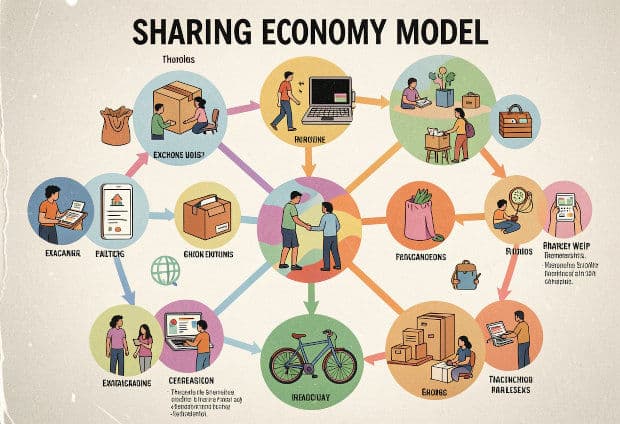
The sharing economy is a peer-to-peer business model where the main company acts as a middleman — connecting people who have something to offer with people who need it. The company itself does not own the product or service being exchanged. Instead, it uses technology to bring two sides together: the service provider and the service receiver. Pathao in Bangladesh, Uber globally, and Airbnb worldwide are all perfect real-world examples of this model in action. Simply put, the sharing economy turns unused assets into income-generating opportunities — for everyone involved.