The Dollar Ecosystem: How a Piece of Paper Controls the Entire World
G
GeoRenus Editorial Team
850 views
Summary
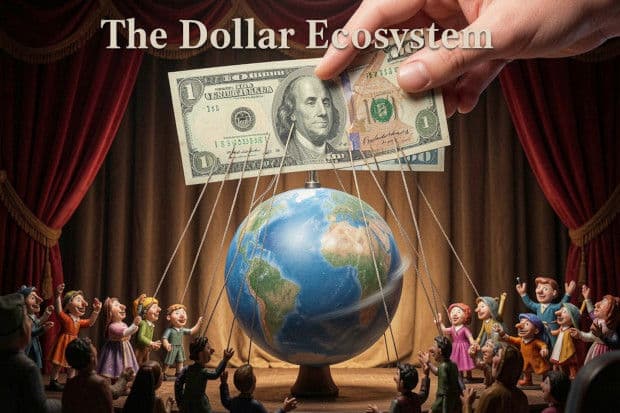
Whether you're buying oil, taking a loan, or booking a flight ticket anywhere in the world — there's one currency behind it all: the American dollar. But this dominance didn't happen overnight. Two world wars, a secret conference, the severing of gold ties, and an unwritten deal with oil — together they built the dollar's invisible empire. This article traces how a piece of paper became the world's most powerful financial weapon, and what the future may hold.
Key Takeaways
- The 1944 Bretton Woods Agreement formally made the dollar the world's reserve currency.
- In 1971, Nixon severed the dollar's link to gold, launching the fiat currency era.
- The 1974 petrodollar deal with Saudi Arabia replaced gold with oil as the dollar's foundation.
- IMF, World Bank, and SWIFT form the three pillars of dollar hegemony.
- Approximately 58% of all global foreign exchange reserves are still held in dollars.
- China, Russia, and the BRICS bloc are actively seeking dollar alternatives — the biggest challenge to dollar dominance yet.
The Setup — Why You Should Care
It was 1971. President Richard Nixon sat before television cameras and delivered a speech that would permanently alter the course of global financial history.
He announced that the dollar would no longer be convertible to gold.
Many thought this was the beginning of the dollar's decline. The opposite happened. In the years that followed, America built a system where instead of gold, the entire world's oil would be traded exclusively in dollars. This system — the petrodollar — became the beating heart of the dollar ecosystem.
But the story goes much further back. To truly understand the dollar's rise, we need to return to a time when two world wars placed one currency on the throne.
Before the Dollar — How the World Used to Work
The Gold Standard Era
A century and a half ago, most nations operated on a simple principle: whoever had the most gold was the most powerful. This system was called the Gold Standard. Britain formally adopted it in 1816. The rule was straightforward — for every paper note a government printed, an equivalent amount of gold had to sit in the vault.
The advantage was clear: you could walk into any central bank, hand over paper currency, and demand real gold in return. International trade functioned on trust — because everyone knew the money was backed by something tangible.
But the system had a fatal flaw. Gold supply is limited. As economies grew and needed more money, the gold constraint became a straitjacket. Eventually, it had to break.
The British Pound's Reign
In the 19th century, London was the world's financial capital. The British Empire ruled a third of the planet. Most global trade was conducted in pounds sterling. The Bank of England was the world's most trusted central bank. This was the world's first true "reserve currency" — one nation's money becoming the language of global commerce.
Two world wars would strip that crown away.
Two World Wars and the Rise of the Dollar
When World War I erupted in 1914, European nations began destroying each other. But wars require weapons, food, and ammunition — and that requires money. Europe turned to America.
America sold to both sides. In return, it received gold. Enormous amounts of gold. According to the Federal Reserve Bank of New York, America held about 25% of the world's gold reserves before WWI. By 1918, that figure rose to roughly 40%.
Europe sank into debt. America rose atop a mountain of gold.
World War II accelerated this shift dramatically. Britain exhausted its foreign assets within two years. Churchill famously wrote to Roosevelt: "We are on the verge of bankruptcy." America's Lend-Lease program provided billions in aid — but not for free. The price was leadership of the postwar financial order.
Bretton Woods — The Dollar's Coronation
July 1944. The war wasn't over yet, but the Allies knew they'd win. 730 delegates from 44 nations gathered at a mountain resort in Bretton Woods, New Hampshire, to design the postwar financial system.
Two competing plans emerged. British economist John Maynard Keynes proposed "Bancor" — an international currency controlled by no single nation. American Harry Dexter White proposed making the dollar itself the global anchor, pegged to gold at $35 per ounce. All other currencies would be pegged to the dollar.
Keynes's plan was idealistic. White's was pragmatic — and America had the most gold. America won.
The agreement established two institutions that still govern global finance today: the IMF (to bail out countries in currency crises — but on America's terms) and the World Bank (to fund reconstruction — but in dollars). Both are headquartered in Washington, D.C. America's voting share in the IMF is structured so that it alone can veto any major decision.
The system worked like a layered cake: gold at the bottom, the dollar in the middle (backed by gold), and all other currencies on top (pegged to the dollar). This "Bretton Woods Era" lasted from 1944 to 1971 — the golden age of international monetary stability.
The Nixon Shock — Breaking Free from Gold
Through the 1950s and 60s, America was fighting the Korean War, the Vietnam War, and spending billions on domestic programs. All that spending meant printing more dollars — but the gold reserves stayed the same.
France's President Charles de Gaulle saw through it. In 1965, he sent a ship to New York carrying $150 million in dollar bills and demanded gold in return. Germany and Switzerland followed. America's gold vaults were emptying.
On August 15, 1971 — a Sunday night — Nixon appeared on television and announced that America would no longer exchange dollars for gold. Overnight, the entire Bretton Woods system collapsed.
The dollar became a fiat currency — backed by nothing but the government's promise. "Fiat" is Latin for "let it be done." The government says it's money, so it's money.
But without gold, what would keep the dollar valuable? The answer came from Henry Kissinger, and he found it buried beneath desert sands — in oil.
The Petrodollar — Oil Replaced Gold
In October 1973, the Arab-Israeli war triggered an oil embargo. Oil prices quadrupled — from $3 to $12 per barrel in months. Gas stations across America saw endless lines. This was the 1973 Oil Crisis.
In 1974, Secretary of State Henry Kissinger visited Saudi Arabia with Treasury Secretary William Simon. The deal was simple but world-changing:
America offers: Military protection, weapons sales, and a guarantee to keep the royal family in power.
Saudi Arabia offers: All oil sales exclusively in dollars. Surplus oil revenue invested in US Treasury bonds.
This deal was never formally signed. But it took effect immediately. And soon, every other oil-exporting nation followed suit.
How the Petrodollar Works — A Bangladesh Example
Let's trace this with a real-world example. Bangladesh Petroleum Corporation needs to buy 1 million barrels of oil from Saudi Arabia at $80/barrel — that's $80 million. But Saudi Aramco won't accept taka. They want dollars.
So Bangladesh Bank dips into its reserves for $80 million. Where did those dollars come from? Garment exports, remittances, foreign investment. Bangladesh had to earn those dollars through real labor and trade.
That $80 million goes to Saudi Arabia. According to the EIA, Saudi oil export revenue in 2023 was approximately $210 billion. Saudi Arabia then invests a large portion in US Treasury bonds ($119 billion in holdings as of 2023), US stocks via its sovereign wealth fund PIF, and American weapons ($38 billion in arms purchases in 2022 per SIPRI).
The cycle is self-reinforcing: World buys oil → pays in dollars → dollars go to Saudi → Saudi invests in America → America stays strong → America protects Saudi → Saudi sells oil in dollars → world buys oil again.
For Bangladesh, this means vulnerability. When oil prices spiked during the 2022 Russia-Ukraine war, Bangladesh's reserves plummeted from $44 billion to $20 billion. Fuel prices jumped 50%. Inflation hit double digits.
The Dollar Ecosystem — The Invisible Web
Pillar 1: Trade dominance. According to BIS, approximately 88% of all foreign exchange transactions in 2022 had the dollar on one side. Even when Japan buys coffee from Brazil — two countries with no American connection — the trade likely happens in dollars.
Pillar 2: Reserve currency. Per IMF's COFER data, 58% of all central bank foreign exchange reserves are held in dollars. The euro is a distant second at 20%.
Pillar 3: SWIFT. The global financial messaging system handles 50 million transactions daily. America can — and has — cut nations off from SWIFT: Iran in 2012, Russia partially in 2022. Disconnection from SWIFT means isolation from global trade. Overnight.
In the 1960s, French Finance Minister Valery Giscard d'Estaing called this America's "exorbitant privilege." America can print paper and receive real goods in return. No other country on Earth has this power.
Consider Bangladesh: garment workers earn dollars through hard labor. Those dollars are held as reserves — mostly in US Treasury bonds. Effectively, Bangladeshi workers' earnings are lending money to the American government. That's the dollar ecosystem in action.
How Dollars Circulate Around the World
Five paths out of America:
1. Massive imports — the US trade deficit was $773 billion in 2023.
2. Foreign investment — Apple factories in China, McDonald's in India.
3. Military spending — bases in 70+ countries.
4. Money printing — the Fed created ~$4 trillion after 2008 and another $4-5 trillion during COVID.
5. IMF and World Bank loans to developing nations — in dollars, naturally.
Three paths back to America:
Oil payments, Treasury bond purchases (foreigners held $7.6 trillion in US Treasuries by end of 2023), and stock market investments.
Here's a fascinating example: when Bangladesh buys onions from India, even that transaction happens in dollars. India uses those dollars to buy Saudi oil. Saudi puts those dollars in US bonds. Two Asian countries trading vegetables — and America benefits in the end.
America gets goods. The world gets dollars. Those dollars buy oil from Saudi. Saudi parks them back in America. The currency at the center of this cycle wins the most.
The Weaponization of the Dollar
Dollar dominance has given America a new kind of weapon — financial sanctions. No bullets required. Just cut someone off from dollar transactions.
When Iran was partially disconnected from SWIFT in 2012, its oil exports halved, currency dropped 50%, and inflation exceeded 40% — without a single bomb being dropped.
In 2022, after Russia invaded Ukraine, America froze approximately $300 billion of Russia's central bank foreign assets. This was unprecedented — a major nation's sovereign reserves, seized overnight.
This sent a chilling message to every country on Earth: if you ever cross America, your savings could vanish. And that fear is precisely what's driving the push for alternatives.
Challenges — The Rising Tide Against Dollar Dominance
China's Yuan
China has introduced yuan-denominated trade settlements with multiple countries. In 2023, part of Saudi-China oil trade was conducted in yuan — previously unthinkable. But IMF data shows the yuan's share of global reserves is just 2.3% versus the dollar's 58%. China's strict capital controls are the biggest barrier — a reserve currency must be freely convertible.
BRICS and De-Dollarization
The expanded BRICS bloc now produces roughly 37% of global GDP. If they truly abandoned the dollar, it would matter. But internal distrust — India-China border tensions, Saudi-Iran rivalry — makes a unified BRICS currency unlikely anytime soon.
Digital Currencies
Bitcoin is interesting but too volatile — 20% price swings in a day. Central Bank Digital Currencies (CBDCs) are more promising, but they're just digital versions of existing currencies. If America launches a digital dollar, it could actually strengthen dollar dominance rather than weaken it.
The Future of the Dollar Ecosystem
Scenario 1: Dollar dominance continues. America still has the world's largest economy, deepest capital markets, and strongest military. Brookings research shows reserve currency transitions take 80-100 years historically.
Scenario 2: A multipolar currency world. Dollar, euro, yuan, and digital currencies each dominate different regions — similar to the pre-1944 era when pounds, francs, marks, and dollars all competed.
Scenario 3: Dollar collapse. US national debt passed $34 trillion in 2024 — 123% of GDP. If confidence erodes, the unraveling could be dramatic. But history suggests such shifts happen gradually, then suddenly.
Cracks in the Petrodollar
Saudi Arabia has openly stated it's willing to accept non-dollar currencies for oil. The original 1974 petrodollar agreement's 50-year term expired in 2024. No formal renewal has been announced. Is this the beginning of the end? Perhaps not immediately. But the cracks are visible.
Final Thoughts
From the Bretton Woods mountain resort in 1944 to the petrodollar deal of 1974, America built an invisible empire — not through military conquest, but through financial architecture.
The ecosystem's greatest strength is its interdependence. Every nation is so deeply woven into this system that sudden exit is nearly impossible. Abandoning the dollar means trade stops, reserves become worthless, and debts become unpayable.
But history teaches us that no system lasts forever. The pound's dominance once seemed equally unshakable. Two world wars ended it.
How and when the dollar's dominance will change is hard to predict. But when it does, it won't just be one currency falling — it will be the reconstruction of the entire global financial order.
And the battle for who gets a seat at that new table has already begun.
Recommended for you
Money: What It Is, How It Works, and Its Complete History
Every single day you go to a shop, hand over some notes, and walk away with what you need. The shopkeeper happily accepts those notes without any hesitation. But have you ever stopped and thought — why does that work? What is actually behind those pieces of paper that makes everyone willing to accept them? Why does a 500 taka note say "চাহিবামাত্র ইহার বাহককে দিতে বাধ্য থাকিবে" — meaning the bearer must be paid on demand? Money is so deeply embedded in our daily lives that most of us never question how it actually works. But understanding money — what it really is, how it functions, where it came from, and what different types exist — is the foundation of understanding any economy. At its core, money is simply a medium of exchange that people use to trade goods and services, repay debts, and measure value. It sounds simple. But the story behind it spans thousands of years and several fascinating transformations — from cowrie shells and whale teeth to gold coins, paper notes, and digital deposits.
Money
From Barter to Bitcoin: The Evolution of Money
Business
Needs, Wants, and Demands

Business
Red Ocean and Blue Ocean Strategy: Fight the Competition or Make It Irrelevant — The Complete Guide
Business Law
Business Law: What It Is, Why It Matters, and Types You Must Know

Crime and Fraud
Ponzi Scheme: The Investment Fraud That Has Been Fooling People for Over 100 Years
E-Commerce
E-Commerce: The Complete Guide to Online Business

Economics
Economics: What It Is, Why It Matters, and How It Shapes Our Lives
Sales
What Is Sales and How Does It Work?
Accounting
Corporate Taxation and International Tax Challenges Explained