Debt Trap Diplomacy: The Strategy of Buying Countries With Loans
G
GeoRenus Editorial Team
1,169 views
GeoRenus Editorial Team
Debt Trap Diplomacy is the geopolitical strategy where a powerful country lends massive sums to a weaker nation for infrastructure — knowing full well it cannot repay. When repayment fails, the borrower surrenders strategic assets like ports, mines, or military bases. China's Belt and Road Initiative is the biggest modern example, spanning 150+ countries with over $1 trillion in commitments. But debt diplomacy is not China's invention alone — the IMF, colonial powers, and Western nations have all played versions of the same game. The real question is whether borrowing countries have the institutional strength to protect their sovereignty.
Picture a loan shark who shows up at your door. He says — 'Need money to fix your house? I'll help. Low interest, no tough conditions.' You take the deal, grateful. But the loan shark already knows you can't pay it back. Because what he really wants is your house.
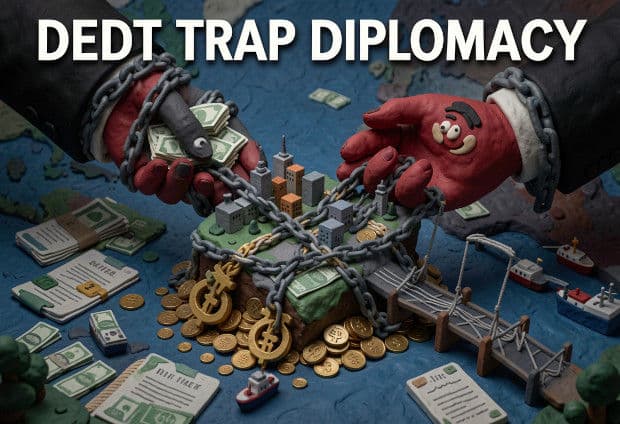
That is the essence of Debt Trap Diplomacy — a geopolitical strategy where a powerful country offers a weaker nation large loans for infrastructure, knowing the borrower will likely default, so the lender can then extract strategic concessions: ports, mines, land, military access, or political loyalty.
This is not charity. It is strategic investment disguised as development aid. The lender calculates exactly where to put its money for maximum geopolitical return.
Indian strategic analyst Brahma Chellaney coined the term 'Debt Trap Diplomacy' in 2017 while analyzing China's foreign lending practices. Since then it has become one of the most debated concepts in international relations.
"A debt trap is like the loan shark who lends you money knowing he wants your house in return." — The simplest analogy for debt trap diplomacy
One important note: Debt Trap Diplomacy is rarely about brute force. Everything is legal on paper, every contract is signed. But the terms are structured so that failure becomes nearly inevitable — and the lender is first in line when it happens.
Debt Trap Diplomacy does not happen overnight. It unfolds slowly and deliberately, typically in six stages:
Step 1: Target countries with weak institutions and infrastructure gaps
The lender country looks for nations with no decent roads, unreliable power, no deep-water port — and governments too weak to scrutinize complex contracts. These countries are attractive for two reasons: there is a ready justification ('we are helping development'), and local officials often lack the capacity to parse the fine print.
Step 2: Offer loans with apparently attractive terms
The loan offer arrives in a sweet package — low interest rates (sometimes advertised as zero), no IMF-style political conditions, fast approval. Many countries, frustrated by World Bank bureaucracy and IMF conditionality, eagerly turn to this alternative. But buried in the contract: the lender's own companies will be the contractors, repayment must be in the lender's currency, and strategic assets serve as collateral.
Step 3: Build using your own companies and workers
The loan money flows right back to the lender — because lender-country firms do the construction, bring their own workers, and source materials domestically. The borrower country gets the finished infrastructure but no local jobs, no technology transfer, and no supply chain benefit. It receives the structure and a massive debt.
Step 4: Cost overruns and hidden clauses surface
AidData research found that over 75% of Chinese loan contracts contain 'cross-default' clauses — meaning if you default on one loan, all loans become immediately due. Project costs routinely exceed initial estimates by 20–30%.
Step 5: Default and debt restructuring
The project generates insufficient revenue, the economy struggles, and repayment becomes impossible. The lender then offers 'compassionate' debt restructuring — in exchange for control of assets. The borrower, with no alternatives, accepts.
Step 6: Lender acquires strategic assets
The final step delivers what the lender always wanted — a long-term lease on a port, mining rights, a military basing agreement, or binding political support in multilateral forums. The debt diplomacy cycle is complete.
Many people assume Debt Trap Diplomacy is a modern invention — something China cooked up in the 21st century. History tells a very different story. Using debt to control and ultimately seize sovereignty from weaker nations is a strategy that's centuries old. Colonial powers — Britain, France, and even the United States — perfected this playbook long before Beijing's Belt and Road Initiative existed.
Egypt's Khedive Ismail Pasha borrowed massively from European banks to build and modernize the Suez Canal — the most strategically important waterway in the world, connecting Europe to Asia. Costs spiraled far beyond projections. Egypt couldn't keep up with repayments.
In 1875, Ismail was forced to sell Egypt's 44% stake in the Suez Canal to Britain for just £4 million. It was a fire sale of the world's most valuable strategic asset.
But that wasn't the end. In 1882, Britain invaded Egypt militarily, using "protection of creditor interests" as justification — and maintained effective control over Egypt for the next 72 years, until 1954. Debt → asset sale → military occupation. The entire Hambantota playbook, executed a century earlier.
In the 19th century, the Ottoman Empire borrowed heavily from European banks to modernize — railways, military upgrades, administrative reforms. The costs ballooned.
The Ottomans defaulted in 1875. In 1881, European creditors created the "Ottoman Public Debt Administration" — an organization that directly controlled Ottoman tax collection. A sovereign empire's revenue system was handed over to foreigners — solely to ensure debt repayment.
This financial weakness accelerated the Ottoman Empire's collapse — and paved the way for the Sykes-Picot Agreement that carved up the Middle East after World War I.
Here's the deepest irony in the debt trap debate: the country most accused of running debt traps today was itself one of history's most prominent victims.
After losing the First Opium War (1840-42), China was forced to pay Britain 21 million silver dollars in war indemnities and cede Hong Kong. This was followed by a cascade of "Unequal Treaties" — China had to open ports to foreign trade, exempt foreign citizens from Chinese law, and hand over customs revenue to foreign administrators to guarantee debt payments.
China calls this period the "Century of Humiliation" (1839-1949). Many analysts believe China's current BRI strategy carries echoes of this historical trauma. A country that was once trapped by debt is now accused of trapping others — the historical irony is striking and fuels fierce debate.
Perhaps the cruelest debt trap in history. In 1804, Haiti won independence from France through the world's first successful slave revolution. But in 1825, France demanded Haiti pay 150 million francs (approximately $21 billion in today's money) as "compensation" — to the former slave owners. Yes, the enslaved people were forced to compensate the people who had enslaved them.
It took Haiti 122 years to pay off this debt — until 1947. A 2022 New York Times investigation demonstrated that this debt permanently crippled Haiti's economy. The country remains the poorest in the Western Hemisphere to this day. The effects of colonial debt trapping haven't faded even after 200 years.
In the early 20th century, the United States ran its own version of Debt Trap Diplomacy across Latin America.
President Theodore Roosevelt's "Roosevelt Corollary" (1904) declared that if any Latin American country failed to repay European creditors, the United States would intervene militarily. Under this policy, the US sent troops to the Dominican Republic (1916), Haiti (1915), Nicaragua, and Honduras — among others.
Under "Dollar Diplomacy," American banks would lend to these nations. When repayment faltered, the US would seize customs houses, control central banks, or even orchestrate government changes. The language was different from today's BRI — but the mechanics were remarkably similar.
Similarities:
The real purpose of lending is strategic control, not economic development. Weak institutions and poor governance in borrowing countries are exploited. When repayment fails, sovereign assets (ports, mines, revenue) are seized.
Differences:
Colonial powers used direct military force — today's approach relies on "soft power." Colonial-era debts were often imposed by gunboat (like Haiti) — today countries borrow "voluntarily," though how informed those decisions are remains debatable. Colonial-era meant one dominant power — today multiple lenders (China, IMF, World Bank, Western banks) compete, giving borrowers some negotiating leverage.
"History doesn't repeat itself, but it often rhymes." — Mark Twain (attributed)
The structural framework is identical across centuries: lend money, create dependency, extract strategic advantage. The packaging changes. The underlying logic doesn't.
Chinese President Xi Jinping launched the Belt and Road Initiative (BRI) in 2013. The stated vision: revive the ancient Silk Road and connect Asia, Africa, and Europe through roads, railways, ports, pipelines, and digital networks.
According to the World Bank, BRI total investment exceeds $1 trillion across 150+ countries — making it the largest infrastructure initiative in human history.
AidData (William & Mary University) found that China lent $843 billion to developing countries between 2000 and 2021 — surpassing World Bank lending in the same period.
BRI investments span ports, railways, highways, and power plants. But the most strategically significant pattern is China's 'String of Pearls' — a chain of port investments encircling India across the Indian Ocean.
The 'String of Pearls' strategy:
Gwadar (Pakistan) → Colombo (Sri Lanka) → Hambantota (Sri Lanka) → Djibouti → Kyaukpyu (Myanmar) — these ports string together like pearls around India's maritime perimeter. India views this as a direct threat to its regional dominance.
A fair caveat: not every BRI project is a debt trap. Some have genuinely improved connectivity and living standards. The debate is about which projects serve real development and which serve China's strategic interests — and how borrowers can tell the difference before signing.
Enough theory — here is what has actually happened on the ground:
This is the most cited example of debt trap diplomacy in action. Hambantota is a small district in southern Sri Lanka where China financed a deep-water port with a $1.4 billion loan.
The problem was simple: the port sat largely empty. It was poorly connected to major shipping lanes and had a weak business case. Revenue never materialized, but loan installments kept coming due.
In 2017, Sri Lanka was forced to hand over Hambantota Port on a 99-year lease to China Merchants Port Holdings. In return it received $1.1 billion — which it used to service other debts.
Many Sri Lankan analysts argue Hambantota was partly a political vanity project pushed by then-President Rajapaksa in his home constituency. But regardless of how the debt was incurred, the contract terms ensured the outcome.
The China-Pakistan Economic Corridor (CPEC) is a $62 billion mega-project — the largest foreign investment in Pakistan's history. It runs from the Karakoram Highway to Gwadar Port on the Arabian Sea.
Pakistan's debt to China now stands at approximately $30 billion and rising. Gwadar Port is on a 40-year lease to China Overseas Ports Holding Company (COPHC).
Pakistan has repeatedly turned to the IMF for bailouts, and the IMF has explicitly identified Chinese debt as a threat to Pakistan's debt sustainability. Many CPEC contract terms are so confidential that Pakistan's own parliament has not seen them.
"CPEC is a game changer for Pakistan — but the question is whose game is being changed." — Pakistani economists on CPEC's terms
Zambia took on heavy Chinese loans for power grids, roads, and airports — infrastructure it genuinely needed.
In 2020, Zambia became the first African country to default on its sovereign debt during COVID-19. Total external debt exceeded $12 billion, with China holding a major share.
Multiple analysts claimed ZESCO, Zambia's state electricity company, was used as collateral for Chinese loans — though China officially denied this. The opacity of the contracts made independent verification nearly impossible.
Djibouti is a tiny country at the Horn of Africa, guarding the entrance to the Red Sea. Its strategic location is extraordinary — sitting at the center of the Europe-to-Asia shipping corridor.
Chinese debt reached approximately 75% of Djibouti's GDP. In 2017, China opened its first-ever overseas military base in Djibouti.
The United States also has a military base in Djibouti. This tiny nation has become a great-power chessboard — and its debt dependency on China has significantly constrained its diplomatic independence.
Under President Abdulla Yameen (2013–18), the Maldives accumulated over $1.4 billion in Chinese debt — roughly equivalent to the country's entire GDP at the time.
When a new government took power in 2018, it discovered a web of undisclosed debts that parliament had never approved. Chinese entities had directly leased land on islands to build infrastructure projects.
The Maldives sits in India's traditional sphere of influence in the Indian Ocean. China's growing foothold there represents a direct security concern for India and a warning for any small island nation.
The Laos-China railway cost $6 billion — but Laos's entire GDP is only $19 billion. The country borrowed more than one-third of its GDP for a single railway line.
Chinese loans now account for over 35% of Laos's total external debt.
The railway opened in 2021 and passenger and freight trains are running. But whether it generates enough revenue to justify the debt burden remains an open question. Laos is increasingly locked into China's economic orbit, with limited room to maneuver.
Whenever debt trap diplomacy comes up, China is the name that dominates the conversation. But history tells a different story — strategic lending is an old game. China is simply the newest and biggest player.
IMF and World Bank — The Washington Consensus:
In the 1980s and 1990s, the IMF and World Bank lent to developing countries under Structural Adjustment Programs (SAPs) — demanding privatization, subsidy cuts, and market liberalization as conditions. These programs caused social devastation in many countries. Africa still carries the fiscal scars of those years.
France's Françafrique — The CFA Franc System:
France maintained economic control over its former African colonies long after independence through the CFA franc. These countries were required to deposit 50% of their foreign reserves in the French Treasury. Economic sovereignty in name only — dependency by design.
Japan — Southeast Asia Infrastructure:
Japan's JICA (Japan International Cooperation Agency) has financed major infrastructure across Southeast Asia for decades. Terms are less aggressive than China's, but Japanese companies typically win the construction contracts — money circles back.
US Aid Diplomacy:
American foreign aid through USAID has regularly come with political conditions: hold elections, respect human rights, support US policy positions. Financial assistance in exchange for political alignment is the universal currency of great-power diplomacy.
The bottom line: China is not unique — but the speed and scale of BRI are unprecedented. What sets China apart is the opacity of its contracts and the explicit pursuit of military basing rights alongside commercial interests.
Every complex issue has two sides — and debt trap diplomacy is no exception. A fair analysis requires looking at both.
Potential benefits for recipient countries:
1. Real infrastructure gets built — roads, ports, and power plants that did not exist before. Laos got a railway. Pakistan got Gwadar Port. Ethiopia got a light rail system.
2. No harsh political conditions like IMF structural adjustment — at least on the surface. Governments retain the appearance of policy autonomy.
3. Faster approval — no years of bureaucratic review that World Bank projects require.
4. Some projects do deliver genuine economic returns — though these tend to be the less-publicized cases.
Risks and downsides:
1. Sovereignty loss — strategic assets end up under foreign control through long-term leases or operational agreements.
2. Overpriced projects — many Chinese-financed projects cost 30–40% more than comparable market-rate construction.
3. Tied loans — lender-country firms handle construction, meaning 70–80% of the loan money flows directly back to the lender's economy.
4. Secret terms — parliaments and citizens often have no idea what was agreed until it is too late to renegotiate.
5. Environmental damage — rapid construction timelines frequently bypass environmental regulations.
6. No local jobs — imported workers mean local communities see the project rise around them but gain nothing in employment.
The debt trap is not an inevitable fate — it can be avoided with the right institutions, policies, and political will. Here is practical guidance:
Do's — What to do:
✓ Diversify lenders: Never become dependent on a single country. Mix World Bank, ADB, AIIB, bilateral, and domestic financing. Concentration is vulnerability.
✓ Independent feasibility studies: Before accepting any loan, commission a third-party feasibility analysis — not one provided by the lender. Does the project generate enough revenue to repay the debt?
✓ Debt Sustainability Analysis (DSA): Use the IMF's DSA framework. Keep Debt-to-GDP below 60% and Debt Service Ratio below 15%. These are not just academic targets — they are sovereignty thresholds.
✓ Parliamentary approval: Major loan contracts should go through open parliamentary debate before signing. Secrecy in government lending is a red flag.
✓ Local currency clauses: Negotiate repayment in local currency wherever possible to eliminate foreign exchange risk.
✓ Build domestic capacity: Train your own engineers, procurement officials, and contract lawyers so you are not dependent on the lender to explain the terms of the deal.
Don'ts — What to avoid:
✗ No vanity projects: Reject politically motivated mega-projects that serve electoral purposes rather than economic ones. Every project must show a credible revenue model.
✗ No tied loans without competition: Never accept a contract that requires using the lender's companies without running a competitive tender.
✗ Never sign without parliamentary review: If a government insists a loan contract must remain secret, that is itself the warning sign.
✗ Never let Debt-to-GDP exceed 60%.
✗ Reject cross-default clauses: These link all your loans together so a single default cascades into a national debt crisis.
Bangladesh has entered into several large Chinese infrastructure agreements — Payra Port, the Padma Rail Link, Karnaphuli Tunnel, and a number of power projects. The scale is significant and growing.
According to Bangladesh Economic Zones Authority (BEZA) and Ministry of Finance data, Chinese loan commitments to Bangladesh total approximately $26 billion (some disbursed, some in the pipeline). The exact figure remains contested by different sources.
Bangladesh's total public debt stands at approximately 40% of GDP — still within manageable bounds. For context: Pakistan is at 78%, Sri Lanka exceeded 100% before its 2022 crisis.
Warning signs to watch:
1. Rapid debt growth concentrated in mega-projects: Chinese loan commitments have multiplied several times over in five years.
2. Project revenue questions: Is Payra Port attracting enough commercial traffic? Is Karnaphuli Tunnel generating its projected toll revenue?
3. Lender concentration: Heavy reliance on a single bilateral lender creates leverage — political as well as financial.
Reassuring factors:
1. Bangladesh borrows from multiple sources — World Bank, ADB, Japan (JICA), India, Islamic Development Bank. Diversification provides real protection.
2. India also lends to Bangladesh through Lines of Credit. Political strings are attached there too — no lender is purely altruistic.
3. Bangladesh's current DSA classification is 'Moderate Risk' — not High Risk. The buffer still exists.
The key question is whether the projects being financed actually increase the country's productive capacity and generate enough revenue to service the debt. If yes — borrowing is fine and the debt is healthy. If no — the trap is being set, one project at a time.
Is debt trap diplomacy a genuine geopolitical threat — or is it a narrative manufactured by Western countries to contain China's rise? This is a real scholarly debate, not just political spin.
Those who say the debt trap is real:
Brahma Chellaney (India), Clyde Prestowitz (United States), and many Western analysts argue China's lending strategy is deliberate geopolitical engineering. Hambantota Port and the Djibouti military base are their primary exhibits.
Those who say it is exaggerated:
Professor Deborah Brautigam of Johns Hopkins SAIS — a longtime researcher of Chinese lending in Africa — argues that the 'debt trap' narrative is largely Western propaganda. Her research found that China has not systematically seized assets in Africa when borrowers defaulted.
AidData's research adds nuance: China has restructured and written off debts in a number of cases. The picture is not simply predatory lender versus helpless borrower.
Where does the truth actually lie?
The honest answer is: outcomes vary significantly by country. Some broad conclusions hold:
• Not all Chinese loans are traps — some projects deliver genuine development value.
• But opacity, hidden clauses, and overpricing in a significant share of contracts are real documented problems, not propaganda.
• The borrowing country's own institutional weakness and corruption often amplify the damage — bad governments take bad deals.
• China is neither a pure villain nor a development saint — it is a state acting in its own national interest, as all states do.
"Every lender has an agenda. The question is whether the borrower has the institutional capacity to understand that agenda before signing."
Debt Trap Diplomacy is a real geopolitical tool — and it is not China's invention. Colonial powers, the IMF, and Western donors have all used versions of it. China is not unique; it is just newer, faster, and operating at a scale the world has not seen before.
From Hambantota to Gwadar, Djibouti to Laos, the lesson repeats: no loan is free. Every lender has a strategic objective. Developing nations need the institutional strength to understand what they are signing and to negotiate on their own terms — not just accept what is offered.
Bangladesh is in a relatively safe position today — Debt-to-GDP at 40%, a diversified lender base, and a Moderate Risk DSA rating. But the trajectory of rapid mega-project borrowing needs active monitoring. Before every new loan, the questions must be asked: Does this project generate enough revenue to repay? Are the terms protecting our sovereignty? Is there a competitive tender, or are we tied to one contractor?
"When you owe the bank a million dollars, you are at the bank's mercy. When you owe the bank a billion dollars, the bank is at your mercy." — But in geopolitics, the lender always finds a way to win.
History is clear: buying countries with loans is not new — only the instruments change. The answer is awareness, transparency, and strong institutions. Because in the end, the country that understands its own debt is the country that stays free.

In 1944, as the world was still engulfed in the devastation of World War II, the global economy had collapsed and people’s living standards had plummeted. In an effort to stabilize the international economy and address pressing global financial issues, the Allied nations convened a historic summit. Nearly 730 delegates from 44 countries gathered at the Mount Washington Hotel in Bretton Woods, New Hampshire, for the United Nations Monetary and Financial Conference. The outcome of this summit was the landmark Bretton Woods Agreement, which gave birth to the Bretton Woods System.