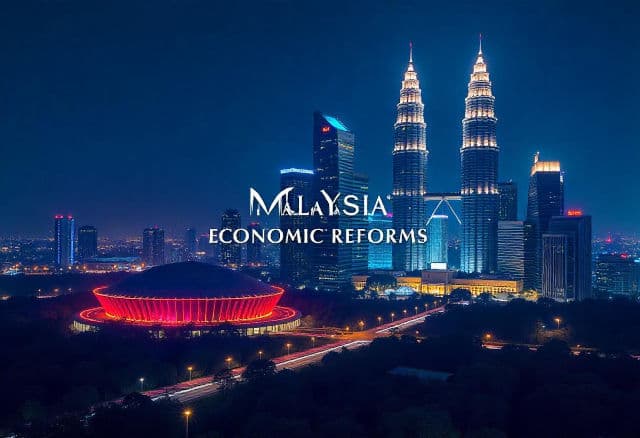
Part 2: Modern Reforms and the Road Ahead
This is Part 2 of our series on Malaysia's economy. In this installment, we cover Malaysia's modern economic reforms from 2000 to 2020, the 1MDB scandal, post-pandemic recovery efforts, and the country's strategies for future growth. If you haven't read Part 1, which covers Malaysia's early economic foundations and the New Economic Policy era, we recommend starting there.
Malaysia's Modern Economic Reforms (2000-2020)
By the 2000s, Malaysia had already established itself as one of Southeast Asia's most dynamic economies. But the country faced a new set of challenges: adapting to a rapidly changing global economy, moving up the value chain from low-cost manufacturing, and reducing dependence on commodity exports — particularly oil and palm oil.
In 2010, the Malaysian government launched the Economic Transformation Programme (ETP) — an ambitious plan to transform Malaysia into a high-income economy by 2020. The programme identified 12 National Key Economic Areas (NKEAs) as priority sectors for investment and development.
The NKEAs included traditional strengths like oil and gas, palm oil, and electronics, alongside newer sectors like education, healthcare, tourism, and financial services. The idea was straightforward: strengthen what Malaysia already does well, while building new pillars of economic growth that are less vulnerable to commodity price swings.
The results were significant. The ETP facilitated the creation of 3.3 million new jobs and attracted substantial private investment. Malaysia's per capita income rose steadily, though it fell short of the ambitious high-income threshold the World Bank sets at approximately $13,000 GNI per capita. By 2019, Malaysia's GNI per capita had reached roughly $11,200 — close, but not quite there.
As one economist observed: "Malaysia got stuck in what we call the middle-income trap — too expensive for low-cost manufacturing, not yet innovative enough for the high-income league." Breaking out of this trap remains one of Malaysia's central economic challenges.
The GST Experiment: Introduced and Abolished
To reduce its dangerous dependence on oil revenues, Malaysia introduced the Goods and Services Tax (GST) at 6% in April 2015. The rationale was sound — oil prices are volatile, and a broad-based consumption tax provides more stable, predictable government revenue.
However, the GST proved deeply unpopular with ordinary Malaysians. It raised the cost of goods and services at a time when many families were already struggling with stagnant wages and rising living costs. The tax became a major political issue, and when the opposition coalition Pakatan Harapan won the historic 2018 general election — defeating the ruling Barisan Nasional coalition that had governed for over 60 years — one of its first acts was to abolish the GST.
The GST was replaced with the older Sales and Services Tax (SST), which generates significantly less revenue. This created a fiscal gap that Malaysia is still grappling with today. The episode illustrates a common dilemma in developing economies: economically sound reforms can be politically impossible if they hurt voters' wallets without visible immediate benefits.
The 1MDB Scandal: When Corruption Shook the Economy
The 1Malaysia Development Berhad (1MDB) scandal, which erupted in the mid-2010s, was not just a corruption case — it was an earthquake that shook Malaysia's entire economic and political foundation.
1MDB was a state investment fund established in 2009, ostensibly to drive strategic economic development. However, investigations by the US Department of Justice, Swiss authorities, and Malaysian prosecutors revealed that billions of dollars had been misappropriated from the fund. The DOJ described it as "the largest kleptocracy case in US history", alleging that over $4.5 billion was stolen.
The scandal devastated investor confidence. The Malaysian ringgit weakened significantly, foreign direct investment slowed, and Malaysia's international reputation — long seen as one of the best-governed countries in the developing world — suffered enormously.
The political fallout was equally dramatic. Former Prime Minister Najib Razak was arrested, tried, and convicted on multiple charges related to 1MDB. He was sentenced to 12 years in prison in 2022. The scandal was a key factor in the historic 2018 election result that ended over six decades of single-coalition rule.
The 1MDB case carries important lessons for any developing economy: state-owned investment funds without proper governance, transparency, and independent oversight are invitations for abuse, regardless of how well-intentioned their original purpose may be.
Achievements and Ongoing Challenges
Despite the setbacks from the 1MDB scandal and the GST reversal, Malaysia's long arc of economic reforms has produced genuinely impressive results:
- Poverty rate fell below 0.4% by 2020 — an extraordinary achievement for a country that was largely agricultural just five decades ago
- Unemployment remained low at approximately 3.3% in 2019, one of the lowest rates in Southeast Asia
- Major infrastructure projects like the MRT (Mass Rapid Transit) system and high-speed rail proposals significantly improved connectivity
- Malaysia became the world's second-largest palm oil producer and a major player in electronics manufacturing and Islamic finance
However, significant challenges persist. Income inequality remains a concern — the gap between Malaysia's richest and poorest citizens has not narrowed as fast as overall economic growth would suggest. The Bumiputera ownership targets set decades ago have improved but remain unmet. And the country's heavy reliance on foreign migrant labor in sectors like construction and agriculture raises long-term questions about productivity growth and social cohesion.
Then came 2020, and everything was disrupted.
Post-Pandemic Recovery Efforts
Like every other country, Malaysia was hit hard by COVID-19. Lockdowns brought economic activity to a near-standstill, tourism collapsed, supply chains were disrupted, and small businesses across the country faced existential threats. The government responded with a series of unprecedented stimulus packages.
PRIHATIN: The Emergency Response
In March 2020, the government launched the PRIHATIN Economic Stimulus Package worth 250 billion ringgit (approximately $60 billion). This massive package provided direct cash transfers to affected households, wage subsidies to prevent mass layoffs, loan moratoriums for individuals and businesses, and funding for healthcare infrastructure.
The scale of PRIHATIN was unprecedented in Malaysian history. It represented roughly 17% of GDP — one of the largest pandemic stimulus packages in Southeast Asia relative to economic size.
PENJANA and Budget 2021
In June 2020, the National Economic Recovery Plan (PENJANA) followed with an additional 35 billion ringgit focused on economic revitalization. PENJANA targeted three areas: empowering people, propelling businesses, and stimulating the economy through targeted investment incentives and hiring subsidies.
Budget 2021 shifted focus toward long-term stability, prioritizing public health spending, vaccine procurement, and SME (small and medium enterprise) support — acknowledging that the pandemic would not be a short-term disruption but a prolonged challenge requiring sustained government intervention.
MyDIGITAL: Betting on the Digital Future
In February 2021, Malaysia launched the Malaysia Digital Economy Blueprint (MyDIGITAL) — an ambitious initiative to position Malaysia as a regional leader in the digital economy by 2030. The blueprint set concrete targets:
- Increase the digital economy's contribution to GDP to 22.6% by 2025
- Create 500,000 new jobs in the digital sector
- Achieve 100% 4G coverage in populated areas
- Position Malaysia among the top 20 countries in digital competitiveness
MyDIGITAL represents a strategic bet that the future of economic growth lies in technology, data, and digital services rather than traditional manufacturing and commodities.
PEMULIH: Additional Support
The PEMULIH package, launched in mid-2021, provided an additional 150 billion ringgit in support for affected families, businesses, and the healthcare system. Combined with earlier packages, Malaysia's total pandemic-related spending exceeded 430 billion ringgit — an enormous fiscal commitment that kept the economy afloat but also significantly increased government debt.
Challenges and Future Directions
While Malaysia has made remarkable progress, several challenges threaten to slow its journey toward high-income status:
Income inequality remains a persistent concern. Despite decades of affirmative action policies, the wealth gap between ethnic communities and between urban and rural areas has not closed as quickly as hoped. The Gini coefficient — a standard measure of inequality — suggests that Malaysia still has significant work to do.
Political instability has become a recurring issue. Frequent changes of government and coalition politics have created policy uncertainty that discourages long-term foreign investment. Between 2018 and 2022, Malaysia had three different prime ministers — a level of political turbulence that does not inspire business confidence.
Fiscal sustainability is another concern. The combination of pandemic spending, the abolition of GST, and continued subsidies (particularly fuel subsidies) has strained government finances. Malaysia needs to find sustainable revenue sources without repeating the political backlash that killed the GST.
Future Growth Strategies
To maintain its growth momentum and finally break into high-income territory, Malaysia is pursuing several key strategies:
Economic Diversification
While manufacturing and palm oil remain important, Malaysia is investing heavily in higher-value sectors. The country is positioning itself as a hub for semiconductor manufacturing, biotechnology, and IT services. Major global technology firms have announced significant investments in Malaysian data centers and chip manufacturing facilities, recognizing the country's strategic location, educated workforce, and business-friendly environment.
Renewable Energy Push
Aligned with global sustainability goals, Malaysia is expanding its renewable energy sector — particularly solar power, hydroelectric energy, and biomass. The government has set targets to increase the share of renewable energy in the national power mix, recognizing that green energy is not just an environmental imperative but an economic opportunity as global supply chains increasingly demand sustainable sourcing.
Human Capital Development
Malaysia understands that competing in the global knowledge economy requires a skilled, digitally literate workforce. The government is investing in education reform, vocational training programs, and digital literacy initiatives. The goal is to reduce reliance on low-skilled migrant labor and develop a domestic workforce capable of driving high-value industries.
As one Malaysian policymaker noted: "We cannot become a high-income nation with a medium-skill workforce. The investment in people is the investment that matters most."
The Bottom Line
Malaysia's economic story is one of continuous adaptation and reform. From the New Economic Policy of the 1970s through the modern Economic Transformation Programme, from the devastating 1MDB scandal to the unprecedented COVID-19 pandemic response, Malaysia has repeatedly shown its ability to absorb shocks and continue moving forward.
The country's achievements are undeniable — poverty virtually eliminated, a diversified economy built from agrarian roots, world-class infrastructure, and a growing technology sector. But the road to high-income status is not yet complete. Breaking free from the middle-income trap, addressing inequality, maintaining fiscal discipline, and building political stability are challenges that will define Malaysia's next chapter.
For other developing economies watching from the sidelines, Malaysia offers both inspiration and cautionary lessons. Its successes show that deliberate, sustained economic reform can transform a nation. Its setbacks — particularly the 1MDB scandal — demonstrate that without strong governance and institutional integrity, even the best economic plans can be undermined by corruption and mismanagement. The key takeaway is simple but powerful: economic growth without good governance is a house of cards.