The Silk Road: The Trade Route That Created the World's First Globalization (Part 1)
G
GeoRenus Editorial Team
1,065 views
Summary
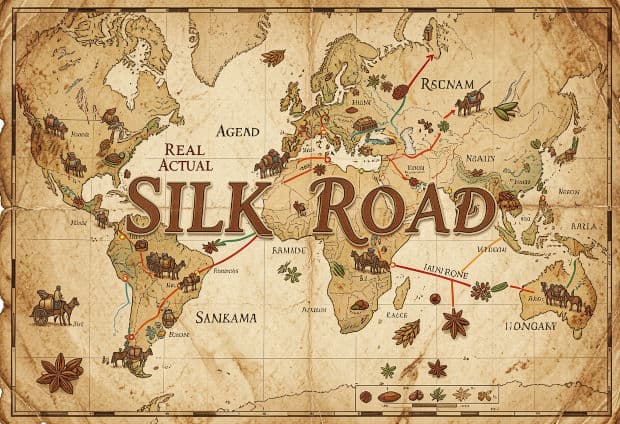
The Silk Road was never a single road — it was the ancient world's most expansive trade network, stretching roughly 6,400 kilometers from China to the Mediterranean and far beyond via sea. For over 1,500 years, this web of routes carried far more than silk: spices, gold, paper, gunpowder, religion, language, and even deadly disease all traveled these paths. It was the original engine of globalization, reshaping every civilization it touched — from the Han dynasty in China to the Roman Empire in the west. Understanding the Silk Road means understanding how the modern world was built, one caravan at a time.
Key Takeaways
- The Silk Road was a network of hundreds of routes covering roughly 6,400 km — not a single road — connecting China, Central Asia, Persia, and the Mediterranean.
- The name 'Silk Road' was coined by German geographer Ferdinand von Richthofen in 1877; the ancient traders who used it had no such name for it.
- Han Emperor Wu-Di's envoy Zhang Qian launched the route in 130 BC, and Han military expansion secured it for centuries of trade.
- Silk was China's most guarded export — smuggling silkworm eggs was punishable by death, and silk sold for its weight in gold in Rome.
- Paper, gunpowder, the compass, Buddhism, and Islam all spread along the Silk Road — making it a highway for ideas and technology, not just goods.
- The Mongol Empire's Pax Mongolica (13th–14th century) was the Silk Road's golden age — when Marco Polo traveled to China and sparked Europe's Age of Exploration.
What Was the Silk Road? — Not a Road, But a World System
When most people hear 'Silk Road,' they picture a single dusty highway snaking from China all the way to Rome. That image is romantic — and completely wrong. The Silk Road was never one road. It was a vast, ever-shifting network of hundreds of overland and maritime routes that connected East Asia, Central Asia, South Asia, the Middle East, East Africa, and Europe into a single, messy, glorious trading system.
The total span of this network stretched roughly 6,400 kilometers (about 4,000 miles) along the main overland corridors alone. Factor in the sea routes, and the reach becomes truly planetary.
Interestingly, the traders who used these routes never called it the 'Silk Road.' That name was invented much later — by German geographer Ferdinand von Richthofen in 1877, who coined the term 'Seidenstraße' (German for Silk Road) in his geographical writings, because Chinese silk was the most iconic commodity moving along the routes.
But silk was just the headline. The Silk Road carried religions, technologies, languages, artistic styles, political ideas — and diseases. Think of it as the ancient world's internet: a sprawling infrastructure for moving not just goods, but information and culture across continents. Without the Silk Road, the world as we know it simply would not exist.
The Birth of the Silk Road — Zhang Qian's Epic Journey
The Silk Road's official origin story begins in 130 BC — when Han Emperor Wu-Di sent his trusted envoy Zhang Qian (張騫) westward on what was essentially a diplomatic mission, not a trade expedition.
The goal was purely strategic: Wu-Di wanted to form a military alliance with the Yuezhi people against the Xiongnu nomads, who were a persistent threat on China's northwestern border. Zhang Qian was the man for the job. What followed was one of history's great adventure stories.
Zhang Qian never made it to the Yuezhi without incident. The Xiongnu captured him and held him prisoner for ten years. He eventually escaped, continued west, and finally reached the Yuezhi — only to find they had resettled comfortably in the Ferghana Valley and had zero interest in fighting old enemies. The alliance never happened.
But Zhang Qian returned to China with something far more valuable than a military pact: detailed knowledge of the western world. He brought back accounts of the Ferghana Valley's 'heavenly horses' — fast, powerful warhorses that the Han military desperately wanted — along with information about the wealth and markets of Persia, Bactria, and India.
The great Han historian Sima Qian recorded Zhang Qian's journey in his 'Records of the Grand Historian' (Shiji) — the earliest detailed historical account of what would become the Silk Road. It remains one of the most important primary sources in Asian history.
Emperor Wu-Di immediately grasped the commercial and strategic potential. He launched a series of military campaigns to the west, pushing back the Xiongnu and establishing garrisons at oasis towns along the Gansu Corridor and into Central Asia. Those garrisons became the security backbone that made long-distance trade possible. The Silk Road was open for business.
The Geography — Where Exactly Was the Silk Road?
Eastern Section
The Silk Road's eastern terminus was Chang'an (modern-day Xi'an), the Han dynasty capital — one of the largest cities in the ancient world. Caravans departed westward through the Gansu Corridor, a narrow strip of land squeezed between the Gobi Desert to the north and the Tibetan Plateau to the south. The Han fortified this corridor heavily, extending the Great Wall to protect it.
At the corridor's end loomed the Taklamakan Desert — one of the world's most hostile environments, whose name in Uyghur roughly translates to 'you go in, you don't come out.' Travelers had two options: the northern route hugging the Tian Shan mountains, or the southern route along the Kunlun range. Both paths hopscotched between oasis towns, converging at the great trading hub of Kashgar.
Central Section
From Kashgar, the route pushed further west into the heart of Central Asia — through the fertile Ferghana Valley and into the legendary cities of Samarkand and Bukhara (in modern Uzbekistan). These were the Silk Road's crown jewels: wealthy, sophisticated cosmopolitan hubs where merchants from China, Persia, India, and the Mediterranean mingled and traded.
Peter Frankopan captures this vividly in 'The Silk Roads: A New History of the World': while Samarkand and Bukhara ranked among the most cultured and prosperous cities on earth — with grand mosques, world-class bazaars, and sophisticated universities — London and Paris were little more than muddy, disease-ridden villages by comparison. The center of gravity of the ancient world lay not in Europe, but along these Central Asian trade routes.
Western Section
From Central Asia, the route entered Persia (modern Iran) and wound through Mesopotamia (modern Iraq). There the road forked: one branch ran north to Constantinople (Istanbul), the gateway to Europe; the other ran south through Syria's great city of Antioch and on to the Mediterranean coast of Palestine and Egypt.
Once goods reached the Mediterranean, Roman merchants took over — shipping silk, spices, and exotic luxury items back to Rome, Alexandria, and ports across the empire. The western end of the Silk Road was essentially the Roman Empire's supply chain for everything luxurious and expensive.
The Maritime Silk Road
The overland routes get most of the attention, but the Maritime Silk Road was equally — arguably more — important. Ships departing from China's southern ports sailed through Southeast Asia, across the Indian Ocean, and on to the Arabian Peninsula and East Africa.
According to UNESCO research, the Maritime Silk Road actually transported a higher volume of goods than the land route — particularly heavy bulk commodities like ceramics, timber, and spices that were impractical to haul by camel across mountains and deserts. Sri Lanka was a critical transshipment hub. The Strait of Malacca in Southeast Asia served as the ancient world's equivalent of the Suez Canal — whoever controlled it controlled the flow of maritime trade.
What Was Traded on the Silk Road?
East to West
Silk:
China's most prized export, and the product that gave the route its name. Silk production was China's most closely guarded state secret — the penalty for smuggling silkworm eggs or mulberry seeds out of the country was death. In Rome, Chinese silk sold for its weight in gold. Roman aristocrats were obsessed with it. The Senate actually tried to ban silk garments on men for being 'too decadent' — and failed completely.
Porcelain:
Chinese ceramics were so coveted in the West that the English language simply named the product after its country of origin — we still call fine ceramics 'china' today. Blue-and-white porcelain was particularly prized across the Islamic world and Europe.
Paper and Gunpowder:
Paper-making technology traveled from China through the Arab world and eventually into Europe via the Silk Road — transforming literacy, administration, and intellectual life wherever it arrived. Gunpowder made the same journey, ultimately revolutionizing warfare across Eurasia in ways the Chinese inventors could never have imagined.
Spices:
Cinnamon, pepper, cloves, and nutmeg flowed west from South and Southeast Asia. In medieval Europe, black pepper was so valuable it was nicknamed 'black gold' and used as currency. A pound of pepper could pay a laborer's wages for several days. The sheer markup on spices would eventually drive Europeans to search for direct sea routes to Asia — setting off the Age of Exploration.
West to East
Trade was never one-directional. From the Roman Empire came gold, silver, glassware, and wine. Persia exported gorgeous hand-knotted carpets, fine metalwork, and gemstones. India sent cotton textiles, ivory, and more spices (before they'd been forwarded west). Arabia contributed perfumes, horses, and dates.
Valerie Hansen makes an important point in 'The Silk Road: A New History': the popular image of the Silk Road as a highway for luxury goods only is misleading. Everyday commodities — grain, salt, leather, metals — moved along these routes too. The Silk Road fed ordinary people, not just emperors and aristocrats.
The Silk Road and Politics — How Empires Controlled the Route
Here's the thing about the Silk Road that most history textbooks miss: it was never just a trade route. It was a geopolitical prize. Every great empire that rose between China and Rome understood that controlling these routes meant controlling extraordinary wealth. The history of the Silk Road is, in large part, a history of empires fighting over it.
The Han Dynasty
The Han dynasty (206 BC – 220 AD) controlled the Silk Road's eastern half through a combination of military force and diplomatic cunning. They maintained garrisons along the Gansu Corridor and at strategic oasis towns deep in Central Asia. But their most powerful tool wasn't armies — it was silk itself. Han emperors used silk as a diplomatic weapon, gifting bolts of it to nomadic chieftains to secure peace treaties and political loyalty. Silk was simultaneously China's top export commodity and its primary instrument of soft power.
The Roman Empire
Rome was the Silk Road's biggest and most passionate customer. Roman elites developed what amounted to a silk addiction. Pliny the Elder, writing in the 1st century AD, complained bitterly that Rome was hemorrhaging 100 million sesterces annually — an enormous sum — flowing east to pay for silk, spices, and other eastern luxuries. He called it a ruinous trade deficit. The ancient world's version of a country spending more on imports than it earns from exports.
Despite this, Rome could never establish direct commercial contact with China. A great middleman empire stood in the way.
Parthian & Sasanian Empires (Persia)
The Persian empires — first the Parthians, then the Sasanians — occupied the critical middle ground between China and Rome. Their geographic position was pure economic genius. They sat astride every major overland route connecting East and West, collecting taxes and tolls on every caravan that passed through. They actively prevented direct Roman-Chinese contact, because their entire business model depended on being the indispensable intermediary.
Think of it as the ancient world's middleman economy — exactly like modern Singapore or Dubai, which generate enormous wealth not by producing much themselves, but by positioning themselves as unavoidable transit hubs for global commerce. The Parthians and Sasanians essentially invented that model two thousand years ago.
The Mongol Empire & Pax Mongolica
The Silk Road's greatest golden age came not under China or Rome, but under the Mongols. In the 13th and 14th centuries, the Mongol Empire became the largest contiguous land empire in human history — stretching from the Pacific coast of China to the doorstep of Eastern Europe.
The Mongols enforced brutal security along the trade routes. Banditry was crushed. The famous proverb of the era captures the transformation: 'A virgin carrying a dish of gold could walk safely from one end of the empire to the other.' This era of enforced peace and open trade is known as Pax Mongolica — the Mongol Peace.
It was during Pax Mongolica that the Venetian merchant Marco Polo (1254–1324) traveled the Silk Road to China in 1271, spent 17 years at the court of Kublai Khan, and returned to write 'The Travels of Marco Polo.' His account electrified Europe with descriptions of China's unimaginable wealth — and planted the seeds of curiosity that would eventually drive Columbus, da Gama, and the entire Age of Exploration.
The Silk Road Business Model — The Ancient Supply Chain
Let's talk about how the Silk Road actually worked as a business — because it's surprisingly sophisticated and remarkably relevant to modern supply chain economics.
Nobody traveled the full route:
One of the most persistent myths is the image of a Chinese merchant loading up his camels in Xi'an and trudging all the way to Rome. That almost never happened. Instead, goods changed hands repeatedly along the way. A Chinese merchant would carry silk to Kashgar and sell it to a Sogdian trader. The Sogdian would haul it to Samarkand and sell it to a Persian merchant. The Persian would move it to Antioch, where a Roman trader would buy it for transport to Rome. Each leg of the journey was handled by specialists who knew their particular stretch of road intimately.
The economic consequence was dramatic markups. Chinese silk that cost a modest sum in Xi'an could fetch 10 to 20 times that price by the time it reached Rome — every intermediary taking their cut. This is the ancient world's version of a modern supply chain, with wholesalers, middlemen, and final distributors all extracting margin.
The caravan system:
Moving goods across thousands of kilometers of desert and mountain required serious logistics. Merchants banded together into large caravans — sometimes hundreds of camels, horses, pack animals, guides, and armed guards. Organizing a caravan was itself a profitable business. Caravan leaders (caravanbashy) operated like ancient shipping companies, charging freight fees for space in the convoy. The camel was the workhorse of the operation: capable of carrying heavy loads, surviving days without water, and navigating desert terrain that would kill horses.
Oasis city economics:
The oasis towns along the route — Kashgar, Khotan, Turfan, Dunhuang — functioned as ancient free trade zones. They provided everything a traveling merchant needed: water, fodder for animals, food, lodging, currency exchange, and markets to buy and sell goods. Local rulers taxed every caravan that passed through, generating enormous revenues. These cities were essentially ancient versions of modern transit economies — their prosperity was entirely dependent on the flow of trade passing through them.
Beyond Goods — Religion, Language, and Technology
The Silk Road's most enduring impact may not be economic at all. The same routes that carried silk and spices also carried ideas — and those ideas reshaped civilizations.
The spread of Buddhism:
Buddhism originated in India and spread north and east along Silk Road trade routes into Central Asia and China. The colossal Buddha statues of Bamiyan in Afghanistan (destroyed by the Taliban in 2001, but standing for 1,500 years before that) and the magnificent Mogao Caves at Dunhuang in China — filled with thousands of Buddhist murals and manuscripts — are direct monuments to the Silk Road's role as a religious highway. Later, Islam traveled the same routes from Arabia into Central Asia and Southeast Asia, carried by Arab and Persian merchants.
Technology transfer:
The Silk Road delivered some of history's most consequential technology transfers. Paper-making: China → Arab world → Europe. The compass: China → Arab navigators → European sailors. Gunpowder: China → Middle East → Europe, where it demolished castle walls and ended feudalism. Arabic numerals (originally Indian): India → Arab mathematicians → Europe, where they replaced Roman numerals and made advanced mathematics possible. Every one of these transfers happened along Silk Road routes.
Language and culture:
The Silk Road's working language — its ancient lingua franca — was Sogdian, spoken by the merchant communities of Central Asia. Sogdian traders were the road's consummate middlemen: they spoke multiple languages, maintained trade networks stretching from China to Persia, and left inscriptions along the route from India to Mongolia. Arabic, Persian, Sanskrit, and Chinese all influenced each other along the route. Even food culture crossed borders — the noodle-to-pasta connection between China and Italy, while endlessly debated by historians, reflects the kind of cultural cross-pollination the Silk Road made possible.
The Dark Side — Disease, Slavery, and Plunder
The Silk Road connected the world. That connection was not always a good thing. The same infrastructure that moved silk and Buddhism also moved plague, enslaved people, and violence.
The Black Death:
The most catastrophic consequence of Silk Road connectivity was the Black Death of 1347–1351. The bubonic plague originated in Central Asia or China and traveled westward along trade routes, reaching the Crimea by 1346 and Sicily by 1347. Within four years, it had killed an estimated 30% to 60% of Europe's entire population — roughly 25 million people. Some regions lost more than half their inhabitants. The same merchant networks that carried silk and spices from East to West also carried the fleas on the rats that spread Yersinia pestis. Trade routes are disease highways too.
The slave trade:
Human beings were traded along the Silk Road just like any other commodity. War prisoners, kidnapped civilians, and captured nomads were bought and sold at markets across Central Asia and the Middle East. The Mamluk slave soldiers — originally Turkic captives from Central Asia — were transported along Silk Road routes to Egypt, where they served as elite military forces. They eventually overthrew their masters and founded the Mamluk Sultanate, which ruled Egypt and Syria from 1250 to 1517. The Silk Road made them possible.
Banditry and insecurity:
Travel on the Silk Road was dangerous. Desert passes and mountain trails were prime territory for bandits. Caravans were regularly attacked and robbed. This is precisely why merchants traveled in large, armed groups — safety in numbers. But the deeper pattern is revealing: the Silk Road thrived under strong empires that could police the routes and declined whenever political power fragmented. When the Han dynasty weakened, Central Asian trade collapsed. When Rome fell, western commerce contracted. The Silk Road's vitality was always a function of political stability.
Conclusion — Part 1 Summary
The Silk Road was the ancient world's most consequential infrastructure project. It was never just about commerce — it was about connection. For over fifteen centuries, these routes tied together civilizations that might otherwise have remained strangers to each other. Chinese silk ended up in Roman bedrooms. Buddhist philosophy reshaped Chinese culture. Arab mathematics transformed European science. The Black Death killed a third of Europe.
Four great powers took turns controlling these routes — the Han dynasty, the Roman Empire, the Persian empires, and the Mongols — and each extracted enormous wealth from that control. The lesson they all learned, and that modern powers are relearning today, is simple: whoever controls the trade routes controls the world.
In Part 2, we'll explore why the Silk Road declined — the role of the Ottoman Empire in disrupting western trade, how that disruption drove European navigators to search for sea routes to Asia, and how China's modern Belt and Road Initiative (BRI) is a direct attempt to revive Silk Road geopolitics for the 21st century. History, it turns out, has a very long memory.
"To understand the world today, you need to understand the Silk Road. This is where civilization was forged." — Peter Frankopan
Recommended for you
From Barter to Bitcoin: The Evolution of Money
Since the dawn of human civilization, people have engaged in trade through barter. However, around 5,000 years ago, humans gradually abandoned the barter system and began using metallic coins. These coins were made from copper, silver, and gold. Around 1260 AD, the first paper currency was introduced in China and eventually spread throughout the world. In the 1930s, the first credit cards were issued by commercial establishments, and by the 1950s, banks began issuing them as well.
Business
Needs, Wants, and Demands

Business
What is Equity? A Comprehensive Guide to Ownership, Value, and ROE

Books
The $100 Startup
Business Law
Business Law: What It Is, Why It Matters, and Types You Must Know

E-Commerce
E-Commerce: The Complete Guide to Online Business
Finance
Finance: What It Is, Why You Need It, and How It Works in Real Life
Accounting
Assets, Liabilities, and Equity: The Building Blocks of Finance
Accounting
Accounting for Startups: A Complete Guide to Getting It Right

Accounting
Tax Rebate: Definition, Types, and How to Claim One