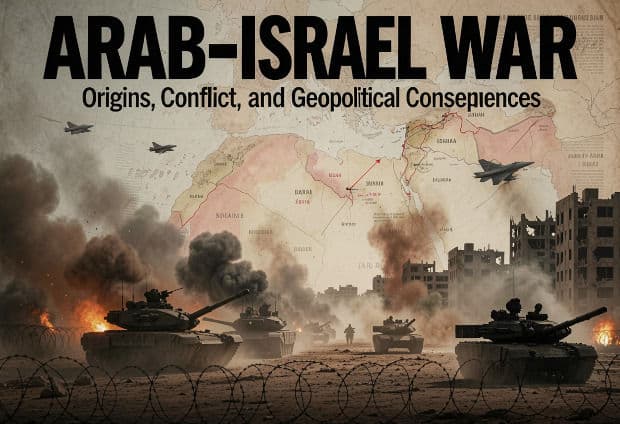
The Arab-Israeli Wars: The Conflict That Reshaped Middle Eastern Geopolitics and the Global Balance of Power
G
GeoRenus Editorial Team
1,019 views
GeoRenus Editorial Team
The Arab-Israeli conflict is far more than a territorial dispute between two peoples. Since 1948, every war has redrawn the global power map — spiking oil prices, triggering superpower proxy battles, and forging new geopolitical alliances. From the 1973 oil weapon that shook the world economy to October 7, 2023, the shockwaves of this conflict reach Bangladesh's remittance earnings, global shipping lanes, and the very architecture of the international order. This article covers the full arc: history, superpower rivalry, the oil weapon, the Iran factor, diplomacy's rise and fall, and what it all means for the rest of the world.
Many people reduce the Arab-Israeli conflict to a simple land dispute between two peoples. But that framing misses the bigger picture entirely. Since Israel's founding in 1948, this conflict has pulled the United States and the Soviet Union into indirect war, wielded oil as a weapon against the global economy, and reshuffled the world's alliance architecture more than once.
The 1973 oil weapon: As a direct consequence of an Arab-Israeli war, OPEC Arab members cut off oil exports. American gas stations ran dry. European countries banned Sunday driving. A global recession followed. One regional conflict, worldwide pain.
October 7, 2023, proved that 75+ years later, this conflict still sits at the center of world politics. Houthi attacks in the Red Sea are disrupting global shipping. The Abraham Accords are frozen. An ICJ genocide case has captured the world's attention. Every time the Middle East catches fire, the smoke reaches every corner of the planet.
What this article covers: How a regional conflict reshaped global power — the history, the superpower rivalry, the oil weapon, the Iran factor, the rise and collapse of diplomacy, and the direct connection to Bangladesh.
For roughly 400 years, Palestine was part of the Ottoman Empire. When the Ottomans were defeated in World War I, Britain and France carved up the Middle East between them. In 1920, the League of Nations formalized British control over Palestine through the Mandate system. Britain got the territory — and with it, an almost impossible contradiction.
The problem: During World War I, Britain had made three separate, incompatible promises about the same piece of land to three different parties.
1. The Hussein-McMahon Correspondence (1915-16): Britain promised Sharif Hussein of Mecca that if the Arabs fought against the Ottomans, they would receive an independent Arab state. Arabs understood Palestine to be included in that promise.
2. The Sykes-Picot Agreement (1916): Britain and France secretly agreed to divide the Middle East between themselves after the war. Palestine would come under international control. Arab independence was a promise written only on paper.
3. The Balfour Declaration (1917): British Foreign Secretary Balfour wrote to Jewish leader Lord Rothschild that 'His Majesty's Government views with favour the establishment in Palestine of a national home for the Jewish people.' Same land, third promise.
'Three contradictory promises made to three different parties for the same piece of land — that is the original sin of the modern Arab-Israeli conflict.'
From the late 19th century, European Jews began immigrating to Palestine in waves driven by the Zionist movement. After the Holocaust — six million Jews murdered — the demand for a Jewish state became unstoppable.
UN Resolution 181 (1947): The United Nations proposed dividing Palestine into two states — 56% of the land to the Jewish population (then just 33% of people), 44% to the Arabs (67% of people). Jerusalem would be under international control. Jewish leaders accepted; Arab leaders rejected. The stage was set for war.
| Year | Jewish Population | Arab Population | % Jewish | Key Event |
| 1900 | 50,000 | 500,000 | ~9% | Early Zionist immigration |
| 1917 | 56,000 | 644,000 | ~8% | Balfour Declaration |
| 1936 | 370,000 | 983,000 | ~27% | Arab Revolt begins |
| 1947 | 630,000 | 1,237,000 | ~33% | UN Resolution 181 |
| 1948 (after) | 716,000 | 160,000 (remaining) | ~82% | Israel founded, Nakba |
May 14, 1948 — Israel declared independence. The next morning, the armies of five Arab states crossed the border: Egypt, Jordan, Syria, Iraq, and Lebanon. The world expected the new state to collapse within days. The reality was the opposite.
Israel's victory: After 15 months of fighting, Israel held more territory than the UN plan had allocated — 78% of historic Palestine. Jordan took the West Bank; Egypt took Gaza.
The Nakba ('catastrophe'): Over 700,000 Palestinians were displaced — some fled, others were driven out. UNRWA data shows over 5.8 million registered Palestinian refugees exist today, a crisis that has never been resolved.
Geopolitical significance: First, a new state was created through armed force. Second, a refugee crisis was born that continues to this day. Third, the Arab world's 'great humiliation' became the fuel for the Pan-Arab nationalist movement that would dominate the region for a generation.
| Side | Troop Strength | Arms Supplier | Outcome | Territory Gained |
| Israel (Haganah/IDF) | ~35,000 → 100,000 | Czechoslovakia, France | Victory | 78% of Palestine |
| Egypt | ~10,000 | British equipment | Defeat | Gaza Strip |
| Jordan (Arab Legion) | ~8,000 | British training & arms | Partial success | West Bank |
| Syria | ~5,000 | French equipment | Defeat | Nothing |
| Iraq | ~3,000 | British equipment | Defeat | Nothing |
Egyptian President Gamal Abdel Nasser: the embodiment of Arab nationalism. In July 1956, he announced the nationalization of the Suez Canal. His message was blunt: the revenues going to British and French companies would now finance the Aswan Dam.
Britain, France, and Israel hatched a secret plan. In October, Israel crossed Sinai. Britain and France, posing as 'peacekeepers,' landed troops on both sides of the canal. Then something nobody expected happened.
The United States and the Soviet Union — bitter enemies — spoke with one voice: 'Withdraw your forces.' Eisenhower told the British prime minister directly, threatening to cut off oil supplies. The Soviet Union issued nuclear threats.
Britain and France withdrew in humiliation. The geopolitical earthquake: this was the formal death of British and French imperialism in the Middle East. Two new players had taken the stage — the United States and the Soviet Union. Nasser became the hero of the Arab world, and the Cold War had officially arrived in the region.
June 5 to June 10, 1967 — just six days. But those six days permanently redrew the map of the Middle East in ways that still define the conflict today.
Israel's preemptive strike: At 7:45 a.m., the Israeli Air Force destroyed the Egyptian Air Force on the ground — in just six hours. Over 300 Egyptian warplanes burned on their runways. Syria and Jordan's air forces met the same fate.
Territory seized: From Egypt: the Sinai Peninsula and Gaza. From Jordan: the West Bank and East Jerusalem. From Syria: the Golan Heights. In six days, Israel tripled its territory.
| Territory | Previous Control | Area (sq km) | Strategic Value | Status Today |
| Sinai Peninsula | Egypt | 61,000 | Suez Canal security | Returned to Egypt 1982 |
| Gaza Strip | Egypt | 365 | Mediterranean access | Occupied until 2005 |
| West Bank | Jordan | 5,655 | Jerusalem connection | Still occupied (57 years) |
| East Jerusalem | Jordan | 71 | Holy to three religions | Annexed by Israel 1980 |
| Golan Heights | Syria | 1,150 | Water resources, high ground | Annexed by Israel 1981 |
Geopolitical consequences: Israel became a regional superpower. An occupation began that continues 57 years later. UN Resolution 242 passed — 'withdraw from occupied territories' — but nobody complied. In Cold War terms: the Soviet Union rearmed Arab states; the US deepened its commitment to Israel. The proxy war grew sharper.
The 1973 war was militarily inconclusive — but geopolitically, it was the most revolutionary conflict of the 20th century. It proved the power of oil as a weapon, gave birth to the petrodollar system, and permanently altered the global economy. No other Arab-Israeli war came close to its worldwide impact.
October 6, 1973 — Yom Kippur (the holiest day of the Jewish calendar): Egypt and Syria launched a coordinated surprise attack. Egyptian forces crossed the Suez Canal into Sinai; Syria struck the Golan Heights. In the first days, Arab armies advanced.
Israel's counterattack: Within days Israel stabilized and struck back hard. Egypt's Third Army was encircled near Cairo.
The nuclear shadow: Israel reportedly activated the Samson Option — 13 nuclear weapons were readied. The United States emergency-airlifted $2.2 billion in weapons in response.
October 17, 1973: OPEC's Arab members announced an oil embargo against nations supporting Israel. The United States was the first target.
The result: Oil prices jumped from $3 to $12 per barrel in a matter of months — a fourfold increase. American gas stations had miles-long queues. The Netherlands banned Sunday driving entirely. Japanese industrial output fell 20%.
'In 1973, for the first time, developing nations proved that economic weapons could bring superpowers to their knees.'
The Petrodollar System (1974): Henry Kissinger struck a historic deal with Saudi Arabia — oil would be sold exclusively in US dollars, and in return the US would provide military protection. This deal locked the dollar in as the world's reserve currency — a system that persists to this day.
Creation of the IEA: At US initiative, the International Energy Agency was created — a coordinated Western platform to manage energy security and prevent future oil shocks.
Cold War at the brink: In the war's final phase, US and Soviet naval forces faced off in the Mediterranean. The United States raised DEFCON 3 — the world came close to nuclear war over a regional conflict.
| Consequence | Details | Long-Term Impact |
| Oil price quadrupled | $3 → $12 per barrel | Global inflation, recession |
| Petrodollar System | Kissinger-Saudi deal 1974 | Dollar dominance continues today |
| OPEC's rise to power | Oil producers' bloc strengthened | Third World geopolitical leverage |
| IEA established | Western energy security alliance | Strategic oil reserve systems |
| US dominance in Middle East | Replaced Britain as hegemon | Foundation of today's US-Gulf axis |
| DEFCON 3 nuclear alert | US-USSR near-confrontation | Proved conflict carries global nuclear risk |
September 1978: President Jimmy Carter brought Egypt's Anwar Sadat and Israel's Menachem Begin to Camp David. Thirteen days of negotiations.
The deal: Egypt would recognize Israel — becoming the first Arab country to do so. Israel would return the Sinai. America's reward to the parties: Egypt received $2.1 billion in annual US aid (still ongoing), Israel $3.8 billion.
Consequences: Egypt was expelled from the Arab League. Sadat was assassinated by his own military in 1981. Geopolitically: Arab unity fractured, and a US-Egypt-Israel axis was born that anchors Middle Eastern diplomacy to this day.
Israel's stated goal: expel PLO guerrillas from Lebanon. But the war became Israel's Vietnam.
The Sabra and Shatila massacre: Lebanese Christian militias slaughtered Palestinian refugees in camps under direct Israeli watch, triggering international condemnation.
Birth of Hezbollah: With Iranian backing, Lebanese Shia Muslims formed Hezbollah to resist Israeli occupation. Today Hezbollah is the most powerful non-state armed group in the Middle East.
In 1987, a Palestinian mass uprising erupted in Gaza — stone-throwing, strikes, civil disobedience. The world watched on television as soldiers with rifles faced teenagers with rocks.
Oslo Accords 1993: Yasser Arafat and Yitzhak Rabin shook hands on the White House lawn. The Palestinian Authority was created. Hope for a two-state solution flickered to life. But Israeli settlement construction never stopped — it accelerated.
'Hands were shaken for peace — but the construction cranes never stopped.'
Soviet support: Advanced weapons supplied to Egypt, Syria, and Iraq (MiG-21 fighters, T-54 tanks, SAM missile systems). Arab military officers trained in Soviet academies. Consistent votes against Israel in the UN Security Council.
In the 1973 war, the Soviet Union threatened direct military intervention to prevent Arab defeat — the trigger for the US DEFCON 3 alert. The Middle East had become the hottest theater of the Cold War.
$150+ billion in military aid: From 1948 to 2023, the United States has provided Israel an average of roughly $3.8 billion in military assistance annually.
UN Veto Shield: Since 1945, the United States has vetoed 40+ UN Security Council resolutions against Israel, providing diplomatic protection unavailable to any other US ally.
Why this level of support? Strategic Cold War rationale: a US foothold in the Middle East. Democratic values argument. Domestic politics: AIPAC (American Israel Public Affairs Committee) lobbying. Intelligence sharing — Israeli intelligence has aided the CIA repeatedly.
After the Soviet Union collapsed in 1991, the United States became the unchallenged mediator of the Middle East. The Madrid Conference (1991) and the Oslo Accords (1993) were both American-sponsored. But this 'Pax Americana' did not hold — the Iraq War, the War on Terror, and post-2003 Middle Eastern turbulence all unfolded in the shadow of the Arab-Israeli conflict's unresolved geopolitical weight.
| Dimension | US Support (Israel) | Soviet Support (Arab States) |
| Weapons supplied | F-15, F-16, Apache, Iron Dome | MiG-21, T-54/55 tanks, SAM systems |
| Financial aid | $3.8 billion/year (still ongoing) | Grants and subsidized loans |
| Diplomatic protection | 40+ UN vetoes | UN votes in favor of Arab positions |
| Intelligence cooperation | CIA-Mossad information sharing | KGB-Egyptian intelligence liaison |
| Military training | US military academies | Soviet military academies |
| Nuclear umbrella | Effectively yes (silence on Dimona) | Nuclear technology offered to Egypt |
The 2000 Camp David Summit: Clinton, Barak, and Arafat met. No deal was reached. In September 2000, Ariel Sharon visited the Temple Mount (known to Muslims as Haram al-Sharif) — the Second Intifada began.
Violence ran from 2000 to 2005 — 3,000+ Palestinians and 1,000+ Israelis killed. Israel began constructing the Separation Wall in the West Bank. Settlements continued expanding. The two-state solution was effectively dead.
The 2006 elections: Hamas won Gaza's elections. Israel, the US, and the EU — calling Hamas a terrorist organization — cut off aid. From 2007, a joint Israeli-Egyptian blockade began.
Gaza's reality: 2.3 million people in just 365 square kilometers — one of the most densely populated places on earth. Electricity available 8-12 hours a day, 97% of water undrinkable, unemployment above 45%.
Repeated wars: 2008-09, 2012, 2014, 2021 — each round killed thousands of civilians and destroyed infrastructure, yet settled nothing.
September 2020: The UAE, Bahrain, and Morocco officially recognized Israel — brokered by the Trump administration. Sudan and others followed.
Geopolitical meaning: Arab states bypassed the Palestinian issue to normalize ties with Israel, because they now shared a common adversary — Iran. Saudi Arabia was next in line; the Biden administration was working toward it. Then came October 7.
October 7, 2023: Hamas launched the largest single attack on Israel in history. 1,200 Israelis killed, 240+ taken hostage. Israel called it its 'Pearl Harbor moment.'
Israel's response: A massive air and ground campaign across Gaza. By early 2024, 40,000+ Palestinians killed (UN figures), 1.7 million displaced, hospitals, schools, and mosques destroyed.
Regional escalation: Hezbollah launched rockets from the north (Israel struck Lebanon in 2024). Houthi forces in Yemen began attacking Israel-linked ships in the Red Sea. Iran directly launched drones and missiles at Israel in April 2024.
| Year | Event | Deaths | Geopolitical Impact |
| 2000-05 | Second Intifada | 4,000+ | Peace process dead, Separation Wall built |
| 2006 | Lebanon War | ~1,300 Lebanese | Hezbollah strengthened, Israel checked |
| 2008-09 | Gaza War (Cast Lead) | ~1,400 Palestinians | Hamas survived |
| 2014 | Gaza War (Protective Edge) | ~2,200 Palestinians | International condemnation |
| 2020 | Abraham Accords | Peace agreements | Arab-Israel new alignment |
| 2023-24 | Gaza War (post-Oct 7) | 50,000+ (UN) | ICJ case, Red Sea crisis, regional war |
The 1979 Islamic Revolution: Shah Mohammad Reza Pahlavi — US-backed — fell from power. Ayatollah Khomeini took over. Israel became the 'Little Satan,' the United States the 'Great Satan.' This religious-political framing became the foundation of Iranian foreign policy.
The 'Axis of Resistance': Iran funds and trains Hamas (Gaza), Hezbollah (Lebanon), Islamic Jihad (Gaza), the Houthis (Yemen), and Iraqi militias — a networked alliance designed to confront Israel and American power across the region.
Iran's strategy is elegant in its simplicity: avoid direct war with Israel while using proxy forces to surround it from every direction — forcing Israel to spend military resources on all fronts simultaneously.
The 'Ring of Fire' strategy: Iran has encircled Israel with proxies — Hezbollah to the north in Lebanon, Hamas and Islamic Jihad to the west in Gaza, Iraqi militias to the east, and the Houthis to the south threatening Red Sea shipping lanes.
Iran's nuclear program: After Trump's 2018 withdrawal from the JCPOA nuclear deal, Iran has significantly expanded uranium enrichment. An Iranian nuclear weapon is Israel's declared 'red line' — it would completely transform the Middle East's strategic equation.
Sunni-Shia divide: Saudi Arabia (Sunni leadership) and Iran (Shia leadership) compete for regional supremacy. This rivalry adds a complex sectarian layer to the Arab-Israeli conflict.
Unofficial Saudi-Israel relations: The two countries' shared enemy is Iran. Quiet cooperation existed before the Abraham Accords. Saudi normalization with Israel was the next target — October 7 shut that door, at least for now.
China's new role: In 2023, China brokered a Saudi-Iran diplomatic rapprochement — the first serious challenge to American monopoly on Middle East mediation. It signaled China's geopolitical entry into a region Washington has dominated for decades.
Bangladesh does not recognize Israel: Since independence, Bangladesh has maintained a clear position — in favor of Palestinian sovereignty. As an OIC (Organisation of Islamic Cooperation) member, Bangladesh votes for Palestine at international forums.
But beyond formal diplomacy, the indirect effects are substantial: every Arab-Israeli war sends shockwaves that reach Bangladesh.
The remittance connection: Over one million Bangladeshi workers are employed in the Middle East. In FY 2023-24, Bangladesh received $21.6 billion in remittances — a large portion from the Gulf. War in this region means direct risk to workers' safety and earnings.
The 1973 oil shock: Newly independent Bangladesh was badly hit by the 1973 oil crisis. The fuel shortage disrupted agricultural production and early industrialization — it was one contributing factor to the devastating 1974 famine.
Red Sea disruption and Bangladeshi exports: The 2023-24 Houthi attacks on Red Sea shipping forced Bangladeshi garment exporters sending goods to Europe to reroute via the Cape of Good Hope — adding weeks to delivery times and hundreds of dollars per container in costs.
Oil prices hit Bangladesh directly: Middle East conflict means higher oil prices. Bangladesh is heavily import-dependent for fuel — price spikes drive inflation and raise production costs across the economy.
Bangladesh has no direct role in this conflict. But there is no escaping its geopolitical waves — remittances, oil prices, shipping routes, and regional stability are all connected. What happens in Gaza reverberates in Dhaka.
75+ years, six major wars, hundreds of thousands killed, millions displaced — and still no resolution.
Every war has forged new alliances and shattered old balances of power. In 1948, a state was created by force. In 1956, British and French imperialism died. In 1967, the map was redrawn. In 1973, the oil weapon shook the global economy and gave birth to the petrodollar system. In 1982, Hezbollah was born. In 1993, peace looked possible. In 2023, that possibility was buried under rubble.
The Cold War ended — this conflict did not. The US-Soviet proxy war transformed into a US-Iran rivalry. The Abraham Accords offered a new architecture — October 7 cracked it. Iran's Ring of Fire strategy has made every Israeli military operation a potential regional escalation. China is now a diplomatic player in a region America once dominated alone.
This conflict is not local. It is the axis around which Middle Eastern — and often global — geopolitics revolves. Every unresolved grievance is a loaded spring. Every war creates new facts on the ground that make the next peace harder to achieve. Until a just and durable resolution is found, the world will keep absorbing the shockwaves.
'The Middle East is where the world's great power games intersect with the oldest human conflicts — and no one gets to watch from the sidelines.'
History teaches one lesson above all: wars can win territory, but only justice wins peace. The resolution to this conflict exists — not in force, but in fairness, recognition, and the political will that has so far always arrived too late.

In 1944, as the world was still engulfed in the devastation of World War II, the global economy had collapsed and people’s living standards had plummeted. In an effort to stabilize the international economy and address pressing global financial issues, the Allied nations convened a historic summit. Nearly 730 delegates from 44 countries gathered at the Mount Washington Hotel in Bretton Woods, New Hampshire, for the United Nations Monetary and Financial Conference. The outcome of this summit was the landmark Bretton Woods Agreement, which gave birth to the Bretton Woods System.