Trade Routes: The Roads That Built Civilizations, Wealth, and Empires (Part 1)
G
GeoRenus Editorial Team
920 views
Summary
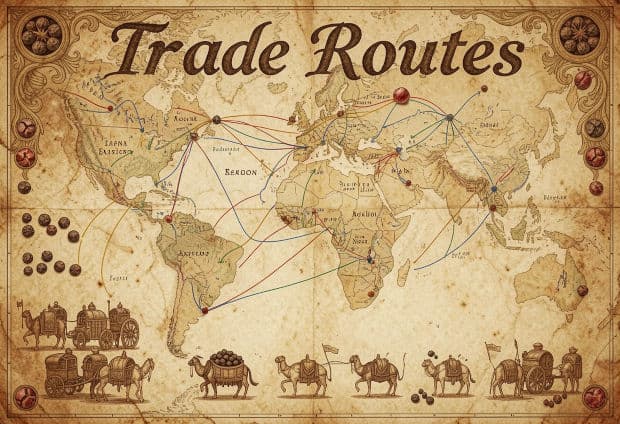
The history of human civilization is, at its core, the history of trade routes. Since ancient times, people have carved paths across deserts, oceans, and rivers to exchange goods, ideas, and culture — and along those paths, empires rose, civilizations flourished, and the foundations of the world economy were laid. The Silk Road, the Spice Route, the Trans-Saharan Route, the Incense Route — behind every trade route lies a complex story of power, wealth, and politics. In this first part, we explore what trade routes are, why they were created, and how the great routes of the ancient world transformed the planet forever.
Key Takeaways
- Trade routes are the land, sea, and river paths along which goods, culture, and power have moved for thousands of years — they are the arteries of civilization.
- According to the WTO, roughly 80% of world trade still travels by sea today — a direct continuation of ancient maritime trade routes.
- Whoever controlled trade routes controlled the wealth — every major empire from Persia to Rome to Britain built its power on trade route dominance.
- On the Trans-Saharan Route, gold and salt were traded equal weight for weight — salt was so scarce in the desert that it matched the value of gold.
- Portugal, Spain, and the Netherlands launched their age of exploration specifically to break the Arab and Venetian monopoly on the Spice Route.
- Trade routes did not carry only goods — they also transported religions, languages, technologies, and deadly diseases like the Black Death.
What Are Trade Routes? — Definition and Significance
Think about the last time you ordered something on Amazon. The product was probably manufactured in China, shipped through the port of Singapore, loaded onto a container vessel that crossed the Indian Ocean, and then delivered to your doorstep by a local courier. That entire chain — from factory to front door — is a trade route. Just a modern one.
A trade route is a land, sea, or river path along which people have exchanged goods, services, ideas, and culture over hundreds or thousands of years. These are not merely roads — they are the arteries of civilization. Just as blood carries nutrients to every organ in the body, trade routes carried wealth, knowledge, and power to every corner of the ancient world.
According to the World Trade Organization (WTO), roughly 80% of global trade still travels by sea today. That is the same ocean that Phoenician and Arab merchants sailed thousands of years ago. The ships have changed, the technology has changed — but the fundamental principle remains: get goods from where they are produced to where they are needed.
"The history of the world is the history of its trade routes — for it is along these paths that civilizations were built, and along them that empires eventually fell." — Peter Frankopan
Why Trade Routes Were Born — Five Fundamental Reasons
Reason 1: Geographic Diversity — Not Every Place Has Everything
Arabia produced frankincense in abundance but had no deposits of iron or tin. China could manufacture silk of unmatched quality but had no horses suited for war. Europe had tin in its western peninsula but lacked spices entirely. This geographic unevenness is the engine that drove people to travel dangerous distances in search of what they could not produce at home.
Reason 2: Surplus Production — When You Make More Than You Need
After the agricultural revolution, certain regions began producing food and goods beyond what their own populations could consume. Trading that surplus for other necessary items was a logical step — and it is precisely this logic that gave birth to commerce and, eventually, to long-distance trade routes.
Reason 3: Luxury Demand — The Appetite of the Powerful
Roman emperors craved Chinese silk so badly that Roman senators passed laws against men wearing it — the fabric was that expensive and that desirable. Egyptian pharaohs demanded cedar wood from Lebanon for their temples. Indian kings imported war horses from Arabia. The luxury appetites of the powerful have always been one of the strongest forces driving long-distance trade.
Reason 4: Military Needs — War Requires Resources from Distant Places
Bronze weapons require copper and tin — but these two metals are rarely found together in the same location. Copper came primarily from Cyprus and the Middle East; tin came from as far away as Britain and Iberia. The need to arm armies created some of the earliest and longest trade routes in history.
Reason 5: Religious Demand — Sacred Goods for Sacred Purposes
Ancient temples from Egypt to Mesopotamia burned frankincense and myrrh during religious ceremonies. These aromatic resins grew only in southern Arabia and the Horn of Africa. The Incense Route was born almost entirely out of this religious demand — proof that spiritual needs can drive economic infrastructure just as powerfully as material ones.
Types of Trade Routes — Land, Sea, and River
Overland Trade Routes
The oldest trade routes were overland paths. Goods moved on the backs of camels, horses, donkeys, and oxen-drawn carts across deserts, mountain passes, and open plains. The Silk Road, the Incense Route, and the Trans-Saharan Route were all primarily overland networks.
Overland routes had clear advantages: they were well-suited for transporting high-value, lightweight goods like silk, gold, spices, and precious stones over very long distances. But they came with serious drawbacks — travel was slow, physically dangerous (bandits, harsh terrain, extreme weather), and fundamentally impractical for heavy or bulky cargo.
Maritime Trade Routes
According to UNCTAD, approximately 80% of global trade by weight and 70% by value is carried by sea today. This dominance is not new — maritime routes have been the most efficient commercial transport system since antiquity.
The Phoenicians of ancient Lebanon were sailing organized commercial routes across the Mediterranean as early as 1500 BC. Arab merchants mastered the Indian Ocean monsoon winds to trade regularly between Arabia, the East African coast, India, and Southeast Asia — centuries before European explorers arrived in those waters.
River Trade Routes
The great ancient civilizations did not arise by accident on riverbanks — the river was the first highway. The Nile in Egypt, the Tigris and Euphrates in Mesopotamia, the Yangtze and Yellow River in China, the Indus and Ganges in South Asia — these waterways were not only essential for agriculture but were the primary arteries of internal trade and communication.
In medieval Europe, the Rhine, Danube, and Volga rivers served as major trade corridors. The Vikings, famous as warriors, were equally skilled traders who navigated Russia's river systems south to Constantinople and east to Baghdad — exchanging amber, furs, and slaves for silver, silk, and spices.
The Major Trade Routes of the Ancient and Medieval World
History records hundreds of trade routes. But some changed the course of civilization itself. Here is a comprehensive look at the most important ones.
1. The Silk Road — The World's Most Famous Trade Network
Stretching approximately 6,400 kilometers (4,000 miles) from Chang'an (modern Xi'an, China) to the Mediterranean, the Silk Road was not one road but a vast network of interconnected routes.
Officially launched around 130 BC when Han Dynasty envoy Zhang Qian ventured west, the Silk Road carried Chinese silk, porcelain, paper, and gunpowder westward, while Roman gold, glass, and Persian carpets flowed east. The route passed through the Gansu Corridor, the deadly Taklamakan Desert, Samarkand, Bukhara, Persia, and finally Constantinople.
The Mongol Empire's Pax Mongolica (13th-14th century) was the Silk Road's golden age — when Marco Polo traveled to China and his account ignited European fascination with the East.
2. The Incense Route — The Sacred Path of Fragrance
From southern Arabia (modern Yemen and Oman), frankincense and myrrh traveled north to Egypt, Jerusalem, and the Mediterranean. These aromatic resins were essential for ancient religious ceremonies across civilizations.
Herodotus wrote: "Arabia is the only country which produces frankincense and myrrh." The Nabataean Kingdom controlled this route — their capital Petra, carved into rock cliffs, was funded almost entirely by incense trade taxes.
3. The Trans-Saharan Trade Routes — The Gold and Salt Highway
Crossing the Sahara Desert, these routes connected North Africa (Morocco, Tunisia, Egypt) with West Africa (Ghana, Mali, Songhai). The primary goods were gold, salt, slaves, ivory, and kola nuts.
West Africa had enormous gold deposits; the Sahara (Taghaza) had salt mines. Gold and salt were traded at equal weight. Mali Emperor Mansa Musa's 1324 pilgrimage to Mecca became legendary — he distributed so much gold in Cairo that he crashed the gold market for a decade. He is considered the wealthiest person in recorded history.
Camel caravans took 40-90 days to cross the Sahara. Timbuktu was the route's most famous city — a center of trade, learning, and Islamic scholarship.
4. The Spice Route — The Path That Changed the World
From South and Southeast Asia (India, Sri Lanka, Indonesia, Malacca), spices traveled through Arab middlemen to the Mediterranean and Europe. Pepper, cinnamon, cloves, and nutmeg were not just flavorings — they preserved food and served as medicine.
In medieval Europe, pepper was worth its weight in gold — it was called "Black Gold." To break the Arab-Venetian monopoly, Portuguese navigator Vasco da Gama sailed around Africa and reached India directly in 1498 — launching the age of European imperialism.
The Spice Islands (Moluccas/Maluku, Indonesia) were fought over by Portugal, Spain, the Netherlands, and Britain for centuries. The Dutch East India Company (VOC) — history's first multinational corporation — was created specifically to control the spice trade.
5. The Amber Road — Europe's Oldest Trade Route
Amber (fossilized resin) was found along the Baltic Sea coast (modern Poland, Lithuania). In ancient times, it was used for jewelry and medicine and was valued close to gold. The Amber Road carried it south to Rome and Greece — establishing the first regular commercial link between Northern Europe and the Mediterranean civilizations.
6. The Tin Route — The Lifeline of the Bronze Age
Making bronze required copper and tin — but they rarely occurred in the same location. Copper came from Cyprus in the Mediterranean, while tin came from distant Cornwall (Britain) and Iberia (Spain/Portugal). From approximately 2000 BC, tin was transported to the Mediterranean — Britain's first entry into the global trade network, millennia before the British Empire.
7. The Royal Road — The Persian Empire's Highway
Persian Emperor Darius the Great (5th century BC) built a royal highway stretching approximately 2,700 kilometers from Susa (his capital) to Sardis (modern Turkey).
According to Herodotus, a message could travel the entire distance in just 7 days using a horse relay system — compared to 90 days on foot. This was the ancient world's predecessor to postal services. Alexander the Great later used this same road to conquer Persia.
8. The Via Maris and King's Highway — The Middle East's Twin Arteries
The Via Maris ("Way of the Sea") ran along the Mediterranean coast from Egypt to Mesopotamia. It was the ancient Middle East's most important overland commercial route.
The King's Highway ran parallel to it — from Egypt to Damascus along the eastern bank of the Jordan River. Mentioned in the Bible, together these two routes formed the backbone of ancient Middle Eastern trade and military movement.
9. The Maritime Silk Road — The Ocean's Silk Highway
Alongside the overland Silk Road, a maritime version connected China's southern ports (Guangzhou, Quanzhou) through Southeast Asia, across the Indian Ocean to the Arabian Peninsula and East Africa.
According to UNESCO research, the Maritime Silk Road carried even more goods than the overland route. Chinese ceramics, silk, and tea flowed out; Indian spices and cotton, Arabian perfumes and horses flowed in. Sri Lanka and the Strait of Malacca were the route's most critical hubs.
10. The Varangian Route — The Viking Trade Highway
The Varangians (eastern branch of the Vikings from Scandinavia) used Russian river systems (Dnieper, Volga) to trade from the Baltic Sea all the way to Constantinople (Byzantine Empire) and Baghdad (Abbasid Caliphate).
They sold furs, wax, honey, and slaves. In return, they brought back silver coins (Arabic dirhams), silk, and spices. Massive hoards of Arabic silver coins have been discovered in Sweden — direct evidence of this trade. The Kievan Rus state (precursor to modern Ukraine and Russia) grew directly along this route.
11. The Salt Route — The Path of "White Gold"
In ancient times, salt was extraordinarily valuable — essential for food preservation, flavor, and medicine. The English word "salary" comes from Latin "salarium" — Roman soldiers were partly paid in salt.
Salt trade routes existed across Europe, Africa, and Asia. Germany's "Old Salt Route" from Luneburg to Lubeck was a crucial medieval trade path. In the Sahara, salt blocks from Taghaza mines were carried by camel to West Africa and exchanged for gold.
12. The Tea Horse Road — China's Hidden Trade Route
Less famous than the Silk Road but equally significant, the Tea Horse Road stretched from China's Yunnan and Sichuan provinces to Tibet, Nepal, and India.
Tibetans needed Chinese tea (essential for health at high altitudes). China needed Tibetan horses for its military. The route crossed some of the Himalayas' most treacherous mountain passes — porters carried 70-90 kg loads of tea on their backs through peaks above 4,000 meters.
13. The Grand Trunk Road — South Asia's Great Highway
The Grand Trunk Road was South Asia's longest and most important overland route — stretching approximately 2,500 kilometers from Kabul (Afghanistan) to Chittagong (Bangladesh).
Dating back to the Maurya Emperor Chandragupta (3rd century BC), it was rebuilt by Sher Shah Suri in the 16th century. The Mughal Empire governed through this road. The British modernized it during colonial rule.
Rudyard Kipling called it "a river of life" in his novel 'Kim.' Most of this ancient route still serves as national highways in India, Pakistan, and Bangladesh today.
14. The Hanseatic Trade Routes — Medieval Europe's Commercial Alliance
From the 12th to 17th century, the Hanseatic League was a powerful commercial confederation of Northern European cities. Lubeck, Hamburg, Bremen, Danzig (modern Gdansk) — these cities collectively controlled Baltic and North Sea trade.
Furs, timber, grain, salt, and fish (especially herring) traveled these routes. The League was an informal precursor to the European Union — cities banding together for commercial interests and gaining political power in the process.
15. The Phoenician Trade Routes — The Founders of Maritime Commerce
The Phoenicians (modern Lebanon) were the ancient world's greatest sailors and merchants. From approximately 1500 BC, they built a commercial network spanning the entire Mediterranean. Carthage (modern Tunisia) was their most famous colony — which later became Rome's greatest rival.
Phoenicians exported cedar wood (Lebanon's cedars — essential for Egyptian Pharaohs' ships and temples), Tyrian Purple dye (the royal color, extracted from sea snails), glass, and metalwork. They also invented the alphabet — born from the practical need to keep commercial records.
Trade Routes and Politics — The Geography of Power
The relationship between trade routes and political power is one of history's most consistent patterns. Across every era and every continent, the same truth repeats itself: whoever controls the trade route controls the wealth, and whoever controls the wealth controls the power.
Trade Taxes — The Revenue Engine of Empires:
Every major empire in history levied taxes on goods passing through its territory. The Persian Empire taxed the Silk Road's western approaches. The Nabataean kingdom taxed the Incense Route through Petra. The Ottoman Empire taxed Mediterranean trade after it seized Constantinople in 1453 — and the resulting price hikes on Asian goods are a direct reason why European powers began searching for alternative sea routes to Asia.
Military Control — Protecting the Golden Goose:
Rome did not merely trade across the Mediterranean — it built a navy to suppress piracy and make the sea safe for commerce, calling it Mare Nostrum (Our Sea). The Han dynasty stationed soldiers along the Silk Road to protect caravans. The British Royal Navy built its global dominance around protecting sea lanes. Even today, the United States Navy maintains a permanent presence near the Strait of Hormuz, the Strait of Malacca, and the Suez Canal — for exactly the same reason.
Trade Wars — Competition That Turns Violent:
Many of history's wars were fundamentally about controlling trade routes. The century-long conflict between Venice and Genoa was a commercial war over who would dominate Mediterranean trade. The Dutch-Portuguese wars were fought over control of the Spice Islands of Indonesia. Even the modern dispute over the South China Sea is, at its core, a contest over one of the world's most important maritime trade corridors.
The Business Model of Trade Routes — The Ancient Supply Chain
The Middleman Economy:
Here is the most important thing to understand about how ancient trade routes actually worked: no single merchant traveled the full length of the route. Goods moved in stages, passing from hand to hand — and at each handoff, the middleman collected his margin. This was the ancient supply chain, and it made extraordinary fortunes for those positioned in the middle.
Consider Indonesian cloves as an example. A clove farmer in Maluku sold his crop to a local trader. That trader sold to an Arab merchant in Malacca. The Arab merchant shipped the cloves to Alexandria. A Venetian merchant bought them in Alexandria and shipped them to Venice. From Venice, they spread across European markets. At each of those four or five handoffs, the price roughly doubled or tripled. By the time cloves reached a kitchen in London or Paris, they might cost 100 times what the original farmer received.
The Caravan System — Ancient Shipping Company:
Overland trade routes operated through the caravan system. A large caravan might consist of hundreds or even thousands of camels, accompanied by professional guides who knew the desert wells and mountain passes, armed guards who could repel bandits, cooks, veterinarians, and merchants. Organizing and financing a caravan was itself a serious business — the ancient equivalent of running a shipping company.
Caravanserai — Where Cities Were Born:
Along every major land route, entrepreneurs built caravanserai — fortified inns where caravans could rest, water their animals, repair equipment, store goods, and conduct transactions. These stopping points attracted merchants, moneychangers, artisans, and food sellers. Over generations, the most successful caravanserai grew into major cities. Samarkand, Bukhara, Cairo, and Constantinople all owe their founding or their greatness to their position on trade routes — they were, in essence, ancient commercial hubs.
Pros and Cons of Trade Routes
The Benefits:
1. Economic Prosperity — Cities and empires positioned on trade routes accumulated immense wealth. Samarkand at its peak was one of the richest cities in the world, not because it produced anything unique, but because every caravan between China and Europe passed through it.
2. Technology Transfer — Paper, the compass, gunpowder, and the printing press all traveled from China to Europe along trade routes. Arabic numerals (including the concept of zero) reached Europe via Islamic merchants. Trade routes were the internet of the ancient world — the primary pathway for spreading knowledge and innovation.
3. Cultural and Religious Exchange — Buddhism spread from India to China, Japan, and Southeast Asia along trade routes. Islam spread along Arab maritime and caravan networks. Christianity spread along Roman roads. No religion could have become a world religion without trade routes to carry it.
4. Employment and Livelihoods — Merchants, caravan leaders, guides, guards, caravanserai operators, port workers, ship captains, translators — trade routes generated employment across entire societies. Millions of people across the ancient world depended on trade route activity for their daily income.
The Costs:
1. Disease Spread — The Black Death (bubonic plague) traveled along trade routes from Central Asia to China and then west along the Silk Road and sea routes to Europe. Between 1347 and 1351, it killed an estimated 30 to 60 percent of Europe's entire population — one of the most catastrophic demographic events in human history, delivered courtesy of trade route connectivity.
2. Exploitation and Colonialism — The desire to control the Spice Route drove European powers to colonize vast stretches of Asia and Africa. Centuries of resource extraction, forced labor, and political subjugation followed directly from trade route competition.
3. The Slave Trade — Both the Trans-Saharan Route and the later Atlantic trade routes carried human beings as cargo. Millions of men, women, and children were transported and sold into slavery — a direct and horrifying consequence of the commercial logic of trade routes applied to human lives.
4. Military Conflict — Competition for trade routes produced constant warfare, from the Crusades (partly driven by control of eastern Mediterranean trade) to the colonial wars that ravaged Africa, Asia, and the Americas over four centuries.
Lessons for Modern Businesses
Lesson 1: Being a Middleman Is Always Profitable
Arab merchants did not grow spices and did not weave silk — but they accumulated some of history's greatest fortunes by positioning themselves between producers and consumers. Amazon and Alibaba do not manufacture most of what they sell — they are middlemen, connecting buyers and sellers and taking their margin on every transaction. The middleman model is one of the oldest and most reliable in commercial history.
Lesson 2: Location Is Everything
Samarkand, Constantinople, and Singapore all became extraordinarily wealthy for one primary reason: their geographic position at the intersection of major trade routes. In physical commerce, location determines foot traffic. In digital commerce, location means visibility — your presence on the platforms and search results where your customers are already looking. Position yourself where the flow is.
Lesson 3: Build Networks, Do Not Go Alone
No merchant traveled the full Silk Road alone. Trade worked through networks of trusted partners, agents, and intermediaries spanning thousands of miles. Modern business is no different — supply chains, distribution networks, strategic partnerships, and referral systems all reflect the same ancient logic. The merchant who tried to do everything alone was quickly overtaken by the one who built reliable networks.
Lesson 4: Understand Demand, Then Supply It
Rome had demand for silk; China had the supply. The merchants who identified that gap and bridged it became wealthy beyond imagination. Every successful business today is doing exactly the same thing — identifying a gap between what people need and what is currently available, and profiting by closing that gap. The geography has changed; the principle has not.
Conclusion — Part 1 Summary
Trade routes are among the most consequential human creations in history. They did not merely transport goods — they connected civilizations, built empires, spread religions and ideas, and laid the foundations of the world economy as we know it today.
In this first part, we have covered what trade routes are, why they were created, what forms they took, and which routes shaped the ancient world most profoundly. We have seen how political power and trade route control were inseparable, and how the ancient supply chain model generated wealth for those smart enough to position themselves in the middle.
In Part 2, we will explore the full story of maritime expansion, the Age of Exploration, colonial trade networks, the Industrial Revolution's transformation of global commerce, and the modern trade routes that move the world's goods today — from the Suez Canal and Panama Canal to China's Belt and Road Initiative.
"Whoever controls trade, controls the world." — Ancient Proverb
Recommended for you
Money: What It Is, How It Works, and Its Complete History
Every single day you go to a shop, hand over some notes, and walk away with what you need. The shopkeeper happily accepts those notes without any hesitation. But have you ever stopped and thought — why does that work? What is actually behind those pieces of paper that makes everyone willing to accept them? Why does a 500 taka note say "চাহিবামাত্র ইহার বাহককে দিতে বাধ্য থাকিবে" — meaning the bearer must be paid on demand? Money is so deeply embedded in our daily lives that most of us never question how it actually works. But understanding money — what it really is, how it functions, where it came from, and what different types exist — is the foundation of understanding any economy. At its core, money is simply a medium of exchange that people use to trade goods and services, repay debts, and measure value. It sounds simple. But the story behind it spans thousands of years and several fascinating transformations — from cowrie shells and whale teeth to gold coins, paper notes, and digital deposits.
Money
From Barter to Bitcoin: The Evolution of Money
Business
Needs, Wants, and Demands

Business
Red Ocean and Blue Ocean Strategy: Fight the Competition or Make It Irrelevant — The Complete Guide

Business Law
Business Law: What It Is, Why It Matters, and Types You Must Know

Crime and Fraud
Ponzi Scheme: The Investment Fraud That Has Been Fooling People for Over 100 Years
E-Commerce
E-Commerce: The Complete Guide to Online Business
Economics
Economics: What It Is, Why It Matters, and How It Shapes Our Lives
Sales
What Is Sales and How Does It Work?
Accounting
Corporate Taxation and International Tax Challenges Explained