The British Pound: Rise, Dominance, and Fall — Part 2: From the Peak of Empire to the Beginning of Decline
G
GeoRenus Editorial Team
1,016 views
GeoRenus Editorial Team
Part 1 traced the pound's origins from King Offa's silver pennies to the formal Gold Standard of 1816. Part 2 covers the dramatic middle act — the 130 years in which sterling ruled the world and then lost everything. The golden age of the Gold Standard, the British Empire at its peak, the shock of World War I, Churchill's catastrophic policy blunder, World War II bankruptcy, and the 1944 Bretton Woods conference where the dollar took the throne — the full story is here.
Part 1 took us through sterling's origins — from King Offa's silver penny in 775 AD to the founding of the Bank of England in 1694, and then to the formal adoption of the Gold Standard in 1816. That was the first chapter: the childhood of a currency.
Part 2 is the dramatic middle act — 1816 to 1944. These are the 130 years during which the pound sat at the very top of the global financial order, and then lost it all through two world wars, one catastrophic policy blunder, and a single conference table.
In this part, we will cover: why the Gold Standard era was so extraordinarily powerful, how the British Empire fuelled sterling's dominance, how World War I changed everything, why Churchill's 1925 decision ranks among history's great economic mistakes, how World War II left Britain bankrupt, and how the 1944 Bretton Woods conference handed the throne to the dollar.
"The story of sterling's 130 years of dominance is really the story of an empire — one that seemed eternal at its peak, but two world wars changed everything." — Benn Steil, 'The Battle of Bretton Woods'
Ready? Let's begin at that golden age — when the pound essentially was the world economy.
The Gold Standard had one remarkable feature: it balanced itself automatically. The economist David Hume gave this mechanism a name — the price-specie flow mechanism. Think of it as the economy's autopilot.
Here is how it worked: If a country imported too much, gold flowed out, the money supply shrank, prices fell, exports became cheaper, and balance was restored — all without any central bank intervention.
The results were extraordinary by any modern standard. From 1816 to 1914 — almost a full century — average inflation across the major economies hovered near zero. Exchange rates were stable. A merchant in Liverpool knew exactly what his pound would buy in Buenos Aires next month.
Economists call the 1870–1914 period "the first age of globalisation" — trade, capital flows, and migration reached levels so open that they would not be matched again until the 1980s.
At the centre of all this stability sat the pound. Britain had adopted the Gold Standard first, and London had become the world's financial heart. When the Bank of England changed its interest rate, capital moved globally in response. The pound was not just Britain's currency — it was the world's operating system.
The statistics are almost hard to believe today:
More than 60% of all international reserves were held in pounds sterling.
More than 60% of international trade was invoiced in sterling.
Brazilian coffee, Indian tea, Argentine wheat, Egyptian cotton — the price of nearly everything in the world was quoted in pounds. If you were an American merchant wanting to buy Chilean copper, you first had to buy pounds.
The City of London was the world's financial capital without a close rival. Lloyd's of London was the world's largest insurance market — if you wanted to insure a ship anywhere on the globe, you came to London. The Baltic Exchange set global shipping rates. The London Metal Exchange priced copper, tin, and lead for the entire planet.
Everything that New York and Shanghai do today, London did alone.
The Sterling Area was history's largest currency zone — predating the eurozone by decades and dwarfing it in geographic scope.
More than 50 countries and colonies within the British Empire kept their currencies pegged to the pound.
India, Australia, Canada, South Africa, New Zealand, Hong Kong, Egypt, Malaya, Nigeria, Ghana — this vast network formed a single monetary zone covering roughly 25% of the world's entire land surface.
The arrangement benefited both sides. Britain gained automatic export markets and cheap capital. The other countries got a stable currency and access to London's unmatched financial services.
This concept would later be replicated with the dollar — the key difference being that the dollar's zone is maintained by military bases and alliances, while sterling's was held together by direct imperial control.
Key Indicators of Sterling's Dominance (1870–1914):
| Indicator | Value | Modern Comparison |
| Share of global reserves in sterling | 60%+ | US dollar today ~58% |
| International trade invoiced in sterling | 60%+ | US dollar today ~48% |
| Countries in the Sterling Area | 50+ | Dollar zone today ~65 countries |
| British share of global outward FDI | 40%+ | US share today ~20% |
| London Stock Exchange (world's largest) | World #1 | Today: NYSE, New York |
| British merchant fleet (global share) | 40%+ | Today: China leads |
There is a simple truth that history has demonstrated repeatedly — behind every dominant currency stands a dominant state, and as empires decline, so do their currencies.
Sterling was powerful because the British Empire was powerful. The British Empire was powerful because sterling gave it cheap capital and frictionless global trade.
It was a self-reinforcing loop. The empire gave the currency strength; the currency gave the empire strength. For as long as that loop held, sterling was unrivalled. When the loop broke — first through war, then through the empire's disintegration — the pound fell with it.
The economic structure of the British Empire was cleverly designed — and sterling was its central component.
Put simply: raw materials came from the colonies, manufacturing happened in Britain, finished goods were sold back to the colonies — all priced in pounds.
Indian cotton was spun into cloth in Manchester mills and shipped back to India as finished fabric — priced in sterling. Australian wool was auctioned in London — in pounds. South African gold went directly into the Bank of England's vaults — as sterling reserves.
This circular system kept constant demand flowing through the pound. From Calcutta to Cape Town, Singapore to Cairo, all commerce was denominated in sterling. That perpetual demand kept the currency strong regardless of short-term economic fluctuations.
In 1914, Britain was the world's largest creditor nation. British outward foreign investment represented more than 40% of global FDI.
Argentina's railways were built with British capital. Brazil's ports were financed from London. American westward agricultural expansion drew heavily on British investment. India's telegraph lines, the Suez Canal in Egypt — British money was everywhere.
London functioned as the world's bank. Countries issued bonds in London, borrowed from London, and stored their reserves in London. This created what economists now call the "exorbitant privilege" — the structural advantage enjoyed by the issuer of the world's reserve currency.
Put plainly: Britain printed paper and called it pounds, then exchanged that paper for real goods and services from around the world. America does precisely this today.
In 1871, Germany unified. Under Bismarck, dozens of small principalities merged into a powerful nation-state — and what followed was industrialisation at a speed that left Britain looking sluggish.
The Rhineland's coal, the Ruhr's steel, Berlin's chemical industry — within a few decades Germany had become the world's second-largest industrial power. In some sectors, particularly chemicals and electrical engineering, Germany led the world outright.
In 1876, the Reichsbank was established. The Gold Mark was introduced. And by 1913, Germany's industrial output had overtaken Britain's.
Yet the German mark never became an international currency. Germany lacked the naval reach, the global colonial network, and the deep financial markets that sterling had built over centuries. Industrial strength without financial infrastructure is not enough to create a reserve currency.
America's story is even more dramatic. After the Civil War ended in 1865, US industrialisation accelerated at a breathtaking pace. Railways spread across an entire continent. Steel, oil, automobiles — one industrial revolution followed another.
By 1890, America had become the world's largest economy, overtaking Britain for the first time.
But there was a serious problem: America had no central bank. The Federal Reserve was only created in 1913. Before that, a major financial panic hit roughly every decade — 1873, 1893, 1907. The dollar had no international credibility. Foreign investors regarded it with suspicion.
The world's biggest economy, but a currency of only regional importance — that gap would close only after two world wars.
On the eve of World War I, global economic power was distributed like this: Britain led in financial services but was losing ground industrially; Germany led in manufacturing but was weak in financial infrastructure; America was the largest economy but financially immature; France was stable but relatively small. The picture was one of transition — sterling's dominance was real, but increasingly fragile.
Add it all up, and the pound's supremacy was built on shifting sand. One large enough shock, and everything could change.
That shock arrived in August 1914.
Comparative Snapshot of Major Economies in 1913:
| Country | Share of Global GDP | Industrial Output (relative) | Gold Reserves | Currency Status |
| Britain | ~8% | Top 3, but declining | Strong | Global reserve currency #1 |
| America | ~19% | World #1 | Growing rapidly | Domestic use only |
| Germany | ~9% | World #2 | Moderate | Regional importance |
| France | ~6% | Top 5 | Strong | Limited international role |
| Russia | ~8% | Growing fast | Weak | No international role |
August 1914. Within weeks of war breaking out, every major belligerent nation suspended the Gold Standard.
The reason was straightforward. The cost of modern industrial warfare vastly exceeded any country's gold reserves. Britain's GDP was roughly £2.5 billion, but the four-year war cost approximately £9 billion — more than three and a half times annual output. You cannot fund that with gold alone.
So where did the money come from? The printing press. Pounds were created, soldiers were paid, weapons were bought. The century of monetary discipline that the Gold Standard had enforced was swept away in months.
Inflation surged. A basket of goods that cost £1 in 1914 cost roughly £2.20 by 1918 — a 120% rise in four years. Sterling's reputation for iron stability was shattered for the first time in living memory.
Before the war, Britain was the world's number-one creditor. After the war, Britain was in debt to America.
Between 1917 and 1918, Britain borrowed approximately $4 billion from the United States — an almost unimaginable sum by the standards of the time.
America's gold position shifted dramatically: from holding 25% of global gold in 1914 to approximately 40% by 1918. An ocean's worth of gold had crossed the Atlantic.
This shift had profound long-term consequences. Under a gold-based monetary order, whoever holds the gold holds the power. By the war's end, America had accumulated the gold — and therefore the latent financial authority — to reshape the global monetary system on its own terms.
Before the war, the pound traded at £1 = $4.86. That rate had been essentially unchanged for over a century — a symbol of sterling's bedrock reliability.
During the war, the pound fell sharply — touching $3.66 at its low. For the first time in over a hundred years, sterling had suffered a significant devaluation.
Confidence in the pound began to erode. Central banks around the world started accumulating dollars alongside — or instead of — pounds. Britain's political establishment understood that sterling's prestige had to be restored after the war. The question was how. The answer to that question would produce the next catastrophic mistake.
Economic Impact of World War I on the Major Powers:
| Country | Total War Cost | National Debt Change | Gold Reserve Shift |
| Britain | £9 billion | GDP ratio: 136% → 174% | Significant loss; transferred to America |
| America | $32 billion | Relatively modest increase | World share: 25% → 40% |
| Germany | 150 billion marks | Catastrophic rise | Near zero by armistice |
| France | 200 billion francs | 300%+ of GDP in debt | Substantial decline |
In 1924, Winston Churchill became Britain's Chancellor of the Exchequer — finance minister. Before him lay a fateful question: should Britain return the pound to the Gold Standard, and if so, at what rate?
Churchill's reasoning was emotional rather than analytical: before the war, £1 = $4.86. That rate was a symbol of British prestige, of Victorian solidity. Restoring the pound to its pre-war parity would signal to the world that Britain was back — that the war had been a temporary setback, not a permanent decline.
The City of London's bankers lobbied hard for the same outcome. Returning to the old rate would restore London's standing as the pre-eminent financial centre. The Governor of the Bank of England, Montagu Norman, gave his backing.
In 1925, Churchill announced the decision: sterling would return to the Gold Standard at the pre-war rate of £1 = $4.86.
The problem was fundamental. Britain had experienced significant inflation since 1914. The pound's real purchasing power had eroded. In honest market terms, sterling in 1925 was worth roughly $4.40 against the dollar — not $4.86.
Pegging at the old rate therefore meant the pound was artificially overvalued by approximately 10%.
The consequences were immediate and brutal. British exports became 10% more expensive in every foreign market overnight. Coal, steel, textiles — the backbone of British export industry — suddenly could not compete on price.
Factories had no choice but to cut wages. Workers walked out. The 1926 British General Strike — one of the largest labour actions in history — was a direct consequence of Churchill's overvalued exchange rate destroying workers' real wages.
John Maynard Keynes had spoken out against Churchill's decision — before it was made.
In 1925, Keynes published his famous pamphlet: "The Economic Consequences of Mr. Churchill." In it, he argued with forensic precision how the decision would destroy the living standards of British workers, cripple exports, and drive up unemployment. Every major prediction came true within a year.
"Churchill's decision was not merely wrong economically — it was cruel. The living standards of millions of workers were deliberately lowered to defend a symbolic exchange rate." — John Maynard Keynes, 'The Economic Consequences of Mr. Churchill' (1925)
Churchill later acknowledged that returning to gold at the pre-war rate was the greatest mistake of his life — worse, he said, than any military error he had made during World War II. Coming from a man who had presided over Gallipoli and a good deal else, that is a striking admission.
The Great Depression struck in 1929. Wall Street crashed. Banks failed across the world. Trade collapsed. The global economy entered its deepest peacetime contraction of the modern era.
In September 1931, Britain finally abandoned the Gold Standard — permanently.
The immediate result? Sterling fell 25% in a matter of weeks. And yet — paradoxically — the British economy began to recover faster than most countries that stayed on gold.
Keynes had been right all along. Freed from the gold constraint, monetary policy could ease. Interest rates fell. Investment revived. Britain came out of the Depression faster than France, Germany, and even the United States. The lesson — painful as it was to learn — was that clinging to a nominal exchange rate for prestige reasons destroys real economies.
World War II was far more expensive than the First, and its financial consequences for Britain were far more severe.
Britain's total war expenditure: £28 billion — more than three times the cost of the First World War.
By 1945, Britain's national debt stood at 250% of GDP. The entire country owed two and a half times its annual output to creditors.
To pay for the war, Britain sold off foreign investments at fire-sale prices. A quarter of Britain's overseas assets — accumulated over generations — were liquidated. The country that had been the world's largest creditor in 1914 was now deeply in debt and stripping its own wealth.
The blunt truth: Britain won the war and went bankrupt doing it.
In 1941, America launched the Lend-Lease programme — Britain would receive weapons, food, and equipment, to be repaid later in kind or cash. It kept Britain fighting. It also created a dependency that permanently altered the power relationship between the two countries.
Total Lend-Lease aid to Britain: $31.4 billion. In today's money, an almost incomprehensible figure.
"We are at the very edge of bankruptcy." — Winston Churchill, in a letter to President Roosevelt, 1940
Britain made its final Lend-Lease payment in 2006 — 61 years after the war ended. That single fact captures more than any statistic how completely the war had hollowed out British finances.
America did not provide this aid unconditionally. In return, Britain granted the US military base rights across its empire, accepted trade agreements that opened imperial markets, and effectively acknowledged America's coming financial supremacy.
By the war's final years, it was obvious to anyone paying attention that the British Empire could not survive in its existing form. India's independence movement was reaching its climax. African nationalism was stirring. Britain simply lacked the financial resources to hold the empire together.
The 1945 balance sheet: Britain bankrupt, empire fragmenting, Sterling Area contracting. America intact, wealthy, and the world's sole nuclear power.
And yet — and this is the crucial point — the Sterling Area was still enormous. India was still holding pound reserves. Sterling was still the world's second most important currency. The pound had not fallen yet; it was about to be formally relegated. That happened at a resort hotel in New Hampshire in July 1944.
July 1944. At the Mount Washington Hotel in Bretton Woods, New Hampshire, 730 delegates from 44 countries gathered to design the post-war global financial order.
The war was not yet over, but the outcome was no longer in doubt. Allied planners turned their attention to what came next — because everyone agreed the old system was broken and a new one had to be built deliberately, not improvised in the rubble.
The central question: which currency would anchor the new system? Who would hold the world's reserve currency — and therefore wield the exorbitant privilege that Britain had enjoyed for over a century?
Two camps. Two plans.
Britain was represented by John Maynard Keynes. America was represented by Harry Dexter White.
Keynes's plan was idealistic and technically elegant — create an entirely new international currency called the "Bancor." All countries would trade in Bancor through a new clearing union. No single nation would control the world's reserve currency. Everyone would be equal, and trade imbalances would be self-correcting through the system's design.
White's plan was blunt and self-interested: put the dollar at the centre. The dollar would be fixed at $35 per ounce of gold. Every other currency would be pegged to the dollar. The US would have effective veto power over the IMF.
Keynes was right in principle. A neutral international currency was — and remains — the correct solution to the problem of reserve currency dominance. But White had an argument that trumped all principles.
White's argument was simple: "We hold 75% of the world's gold. We set the terms."
"America had the gold, so America made the rules. In politics and economics alike, the golden rule is simple — he who has the gold makes the rules." — Benn Steil, 'The Battle of Bretton Woods'
The agreement followed White's blueprint. The dollar became the world's primary reserve currency, fixed at $35 per ounce of gold. The IMF and World Bank were established in Washington, not London. America held effective veto power over both institutions.
Sterling became the world's second reserve currency. After more than 130 years in first place, the pound had been formally relegated.
This was not merely a financial rearrangement. It was a transfer of civilisational power — from London to Washington, from the pound to the dollar, from the British Empire to American hegemony. The consequences would ripple through global politics for the rest of the twentieth century and beyond.
Keynes returned to Britain a broken man. He died in April 1946, a few months after the conference's formal outcomes took shape.
Bretton Woods: Before and After:
| Factor | Before 1944 | After 1944 |
| Primary reserve currency | British pound sterling | US dollar |
| Global financial centre | London (City of London) | Washington DC / New York |
| International lending institutions | Bank of England / London markets | IMF and World Bank (Washington) |
| Who sets the rules | Bank of England / British government | America (veto power at IMF) |
| Currency anchor | Gold (Gold Standard) | Dollar pegged to gold at $35/oz |
| World's gold holdings | Britain held significant share | America held 75% |
It is worth pausing to understand exactly where the pound stood at the end of 1944, just after Bretton Woods, because the situation was genuinely paradoxical.
Britain was simultaneously bankrupt and still influential.
On the debit side: national debt at 250% of GDP, overseas assets liquidated, the empire visibly crumbling, £28 billion spent on the war, and $31.4 billion owed to America. On the credit side: sterling was still the world's second-largest reserve currency, accounting for roughly 30% of global reserves. The Sterling Area still encompassed dozens of countries. London was still a major financial centre, even if no longer the unchallenged first.
This duality — broke but still relevant — would define the next three decades of sterling's story. Part 3 will trace how that remaining relevance was gradually, and sometimes dramatically, stripped away.
Sterling vs. Dollar — A Comparative Snapshot in 1944:
| Indicator | British Pound (1944) | US Dollar (1944) |
| Share of global reserves | ~30% | ~40% and rising fast |
| Country's share of world GDP | ~6% | ~50% |
| Share of world's gold | Substantially reduced | 75% |
| National debt (% of GDP) | 250% | ~120% (less war damage) |
| Currency zone coverage | 50+ countries (shrinking) | Expanding rapidly |
| Trajectory | Empire fragmenting, weakening | Military and economic hegemony |
The numbers tell the story clearly. Sterling's days as the number-one currency were over. The only questions left were how far it would fall as number two, and how quickly.
Part 2 has covered 130 years — from the adoption of the Gold Standard in 1816 to the formal dethronement of sterling at Bretton Woods in 1944. What a century of patient accumulation had built, two world wars and one catastrophic policy decision dismantled.
The key lessons from this period are worth stating clearly:
First: when military strength and financial strength diverge, currency dominance does not survive. Britain won both world wars but was economically ruined by them — that is the core reason sterling lost its throne.
Second: wrong policies compound over time. Churchill's 1925 decision was not a minor miscalculation — it was a refusal to accept reality, and it cost a generation of British workers their living standards.
Third: the financial costs of war do not end when the guns fall silent. Britain was still paying for World War II in 2006. That is not a metaphor — it is a literal fact.
Fourth: at the negotiating table, power flows from strength, not ideas. Keynes's Bancor plan was intellectually superior to White's dollar-centred system. It lost because America had the gold.
The pound did not disappear in 1944. The following three decades brought further dramatic chapters — a 30% devaluation in 1949, another devaluation in 1967, the humiliation of begging the IMF for a bailout in 1976, and then George Soros forcing Britain out of the European Exchange Rate Mechanism on Black Wednesday in 1992.
Part 3 will cover all of that: post-war devaluations, the IMF crisis, the Soros attack, Brexit, the Truss mini-budget catastrophe — and where sterling stands today in a world where even the dollar's dominance is being questioned.
"Sterling's decline came slowly at first, then suddenly. That is always how great falls work — nobody believes it until everyone knows it." — After Ernest Hemingway, 'The Sun Also Rises'
Part 3 coming soon.
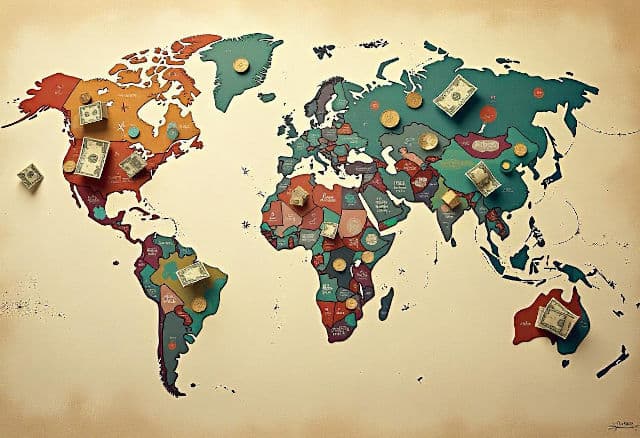
Since the dawn of human civilization, people have engaged in trade through barter. However, around 5,000 years ago, humans gradually abandoned the barter system and began using metallic coins. These coins were made from copper, silver, and gold. Around 1260 AD, the first paper currency was introduced in China and eventually spread throughout the world. In the 1930s, the first credit cards were issued by commercial establishments, and by the 1950s, banks began issuing them as well.