The Politics of Oil: How Black Gold Controls the World (A Complete Overview)
G
GeoRenus Editorial Team
645 views
GeoRenus Editorial Team
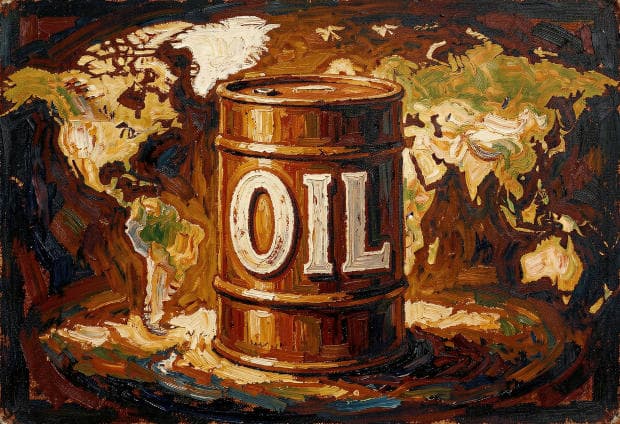
Oil is not just a fuel — it is the most powerful geopolitical weapon in the modern world. From the first oil wells in Pennsylvania to OPEC embargoes, from Russia's gas leverage over Europe to China's petro-yuan ambitions, oil has shaped wars, toppled governments, and redrawn global alliances. This comprehensive overview traces how a single natural resource became the centerpiece of world politics, economics, and power struggles that continue to define international relations today.
Imagine if every gas station in your country shut down tonight. Cars would stop. Trucks carrying food and medicine would sit idle. Factories would go dark. Even electricity grids would falter. That scenario is not science fiction — it is essentially what happened during the 1973 oil embargo, when a handful of oil-producing nations brought the world's most powerful economies to their knees.
Oil is the lifeblood of the modern world. Since the Industrial Revolution, this single substance has shaped global economics, politics, and the very calculus of war and peace. The country that controls oil controls power — and that simple reality has driven some of history's most consequential decisions, conflicts, and alliances.
As Daniel Yergin, the Pulitzer Prize-winning energy historian, famously wrote: "Oil is 10% economics and 90% politics." This overview traces the complete story of how a thick, black liquid found deep underground became the most politically charged commodity on Earth.
The modern oil industry began in 1859, when Edwin Drake successfully drilled the first commercial oil well in Titusville, Pennsylvania. At that point, oil was mostly used for kerosene lamps — nobody imagined it would one day determine the fate of nations.
Everything changed with World War I. When Britain's First Lord of the Admiralty, Winston Churchill, made the fateful decision to convert the Royal Navy's ships from coal to oil in 1911, oil's strategic importance skyrocketed overnight. Oil-powered ships were faster, had greater range, and could be refueled more quickly. But there was a catch — Britain had plenty of coal but almost no oil. That single decision tied Britain's national security directly to Middle Eastern oil fields.
During World War II, oil became even more critical. Japan's attack on Pearl Harbor in 1941 was partly motivated by America's oil embargo against Japan. Germany's defeat at Stalingrad was significantly influenced by its desperate need to capture Soviet oil fields in the Caucasus. As the US Senator Henry Berenger declared after WWI: "He who owns the oil will own the world."
In 1908, oil was discovered in Persia (modern-day Iran), and the British company Anglo-Persian Oil Company (later renamed BP) quickly moved in to exploit it. The profits were staggering, but they flowed almost entirely to London — Iran received a pittance in royalties.
Then came the bigger discoveries. Oil was found in Saudi Arabia in 1938, followed by Kuwait and Bahrain. American oil companies — known as the "Seven Sisters" — carved up the Middle East's oil reserves among themselves through concession agreements with local rulers. These agreements typically gave the Western companies 80-90% of the profits, leaving the oil-producing nations with crumbs from their own natural wealth.
Think about that for a moment. Some of the world's poorest nations were sitting on the world's most valuable resource, and foreign corporations were taking nearly all the money. That arrangement could not last forever — and when it finally broke apart, it changed the world.
In 1951, Iranian Prime Minister Mohammad Mossadegh made a decision that would echo through history: he nationalized Iran's oil industry. His argument was straightforward — why should a British company profit from Iranian oil while Iranian people remained poor?
The reaction from the West was swift and brutal. Britain imposed an international boycott on Iranian oil, and in 1953, the CIA and MI6 jointly orchestrated Operation Ajax — a covert coup that overthrew Mossadegh and restored the Shah to power. The message was clear: any leader who tried to take control of oil away from Western companies would face regime change.
This episode is crucial because it established a pattern that would repeat across the Middle East for decades. Oil was too important to be left in the hands of local governments — or so the Western powers believed.
Frustrated by Western companies unilaterally cutting oil prices without consulting them, five oil-producing nations gathered in Baghdad in 1960 for a historic meeting. Saudi Arabia, Iran, Iraq, Kuwait, and Venezuela founded the Organization of the Petroleum Exporting Countries — OPEC.
OPEC's founding mission was simple: coordinate production policies to stabilize prices and ensure fair returns for producing nations. Over time, more countries joined — Libya, Algeria, Nigeria, the UAE, and others — turning OPEC into a force that could genuinely challenge Western control of the oil market. But it was not until the 1973 crisis that the world truly understood just how much power OPEC wielded.
In October 1973, Egypt and Syria launched a surprise attack on Israel during the Jewish holiday of Yom Kippur, sparking what became known as the Yom Kippur War. When the United States rushed military aid to Israel, the Arab members of OPEC (known as OAPEC) retaliated with the most powerful economic weapon they had — they completely cut off oil exports to the US and other Western nations supporting Israel.
The consequences were immediate and staggering. According to the International Energy Agency (IEA), crude oil prices quadrupled from roughly $3 to $12 per barrel within just a few months — an unprecedented shock to the global economy.
In America, mile-long lines formed at gas stations. Some states introduced odd-even rationing — you could only buy gas on certain days depending on your license plate number. In Europe, governments banned weekend driving. The Netherlands, which had particularly supported Israel, was hit hardest. Japan's industrial output dropped sharply as factories struggled with energy shortages.
The 1973 embargo was a watershed moment. It proved that a group of developing nations could bring the world's wealthiest economies to a standstill simply by controlling the flow of oil. As one analyst put it: "The embargo didn't just raise prices — it shattered the illusion that cheap energy would last forever."
OPEC operates as a cartel — member nations collectively agree on production quotas, and by controlling how much oil enters the global market, they influence prices. As of 2023, OPEC members collectively produce approximately 40% of the world's crude oil and hold about 80% of the world's proven oil reserves.
When OPEC cuts production, supply decreases and prices rise. When it increases production, prices fall. This ability to effectively set the price of the world's most important commodity gives OPEC enormous geopolitical leverage — far beyond what its member nations' military or economic size would otherwise warrant.
But OPEC is not a monolith. The organization is plagued by internal tensions, particularly between its two most powerful members — Saudi Arabia and Iran. Their long-standing Sunni-Shia rivalry often spills into OPEC meetings, making consensus difficult.
In 2014, when oil prices were plummeting, Saudi Arabia controversially refused to cut production. Many analysts believe this was a deliberate strategy to bankrupt US shale producers and maintain market share, even at the cost of lower revenues. The gamble partially failed — shale producers proved more resilient than expected, and both Saudi Arabia and Russia suffered significant budget shortfalls.
In 2016, OPEC formed a broader alliance called OPEC+ by partnering with Russia and other non-OPEC producers. This expanded cartel now coordinates production among over 20 nations, giving it even greater market influence — though coordination has become correspondingly more complex.
Russia is one of the world's largest oil and natural gas producers. According to the Russian Federal Budget Office, oil and gas revenues accounted for approximately 45% of Russia's total federal budget in 2021. This makes Russia's economy heavily dependent on energy exports — and gives it both enormous leverage and a significant vulnerability.
Until 2022, Europe imported roughly 40% of its natural gas from Russia, according to the European Commission. Germany was the most dependent — Russian gas fueled its industrial powerhouse, homes, and power plants. The Nord Stream pipelines running under the Baltic Sea became symbols of this deep dependency.
For years, critics warned that Europe was walking into an energy trap — that depending on Russia for such a critical resource was a strategic vulnerability. But cheap Russian gas was too economically attractive to resist. As one European diplomat reportedly acknowledged: "We traded security for savings, and we got neither."
When Russia invaded Ukraine in February 2022, Western nations imposed sweeping sanctions. Russia retaliated by dramatically reducing gas supplies to Europe — effectively weaponizing energy in the most significant way since the 1973 embargo.
The results were severe. According to the IEA, European natural gas prices spiked nearly 300% in 2022. Germany, Italy, and other dependent nations scrambled to find alternative suppliers. Energy bills for ordinary Europeans skyrocketed, fueling a cost-of-living crisis across the continent.
Europe's response has been a crash course in energy diversification — importing liquefied natural gas (LNG) from the US and Qatar, accelerating renewable energy projects, and reopening mothballed coal plants as emergency measures. By 2023, Russian gas's share of European imports had fallen below 15%, but the economic and strategic damage had already been done.
Shale oil is petroleum trapped within layers of shale rock deep underground. Extracting it requires a technology called hydraulic fracturing ("fracking") — essentially pumping high-pressure water and chemicals into rock formations to crack them open and release the oil. For decades, this process was too expensive to be commercially viable. But advances in drilling technology in the 2000s changed everything.
According to the US Energy Information Administration (EIA), American oil production roughly doubled between 2008 and 2019 — from about 5 million barrels per day to over 12 million. The United States went from being one of the world's largest oil importers to becoming the world's largest oil producer, surpassing both Saudi Arabia and Russia.
The geopolitical implications were enormous:
China is the world's largest oil importer. According to the IEA, China imported an average of approximately 11 million barrels of crude oil per day in 2023 — more than any other country. This massive dependency on foreign oil is China's greatest strategic vulnerability, and Beijing knows it.
China has developed a sophisticated strategy to secure its oil supplies and reduce its vulnerability:
1. Middle East Diplomacy: Unlike the US, which picks sides, China maintains good relationships with all major Middle Eastern oil producers — Saudi Arabia, Iran, and Iraq alike. In 2023, China brokered a historic diplomatic normalization between Saudi Arabia and Iran, demonstrating its growing influence in the region.
2. The Petro-Yuan Push: China is actively working to conduct oil trades in Chinese yuan instead of US dollars. In 2023, some Saudi oil purchases were settled in yuan — a small but symbolically significant crack in the petrodollar system that has underpinned American financial dominance since the 1970s.
3. Belt and Road Energy Investments: Through its Belt and Road Initiative (BRI), China has invested billions in infrastructure projects across oil-rich African and Central Asian nations. These investments are not charity — they are strategic plays to secure long-term energy supplies. Countries like Angola, Nigeria, and Kazakhstan now have deep economic ties with Beijing, partly built on oil.
To truly understand oil geopolitics, you need to understand the petrodollar system. In 1974, the United States and Saudi Arabia struck a secret deal: Saudi Arabia would sell its oil exclusively in US dollars, and in return, America would provide military protection. Other OPEC members followed suit.
This arrangement gave the US dollar an extraordinary advantage. Since every country needs oil, every country needs dollars to buy it. This creates constant global demand for the dollar, allowing the US to run massive trade deficits and borrow at lower interest rates than would otherwise be possible. The petrodollar system is arguably the single most important pillar of American financial dominance.
Here is where it gets interesting — and troubling for the US. When Iraq's Saddam Hussein announced in 2000 that he would sell oil in euros instead of dollars, and when Libya's Gaddafi proposed an African gold dinar for oil trades, both leaders were overthrown within a few years. Whether these events were directly connected is debated, but the coincidence has not gone unnoticed by the rest of the world. As one commentator observed: "You can do many things to challenge America, but threatening the petrodollar is not one of them."
In recent years, OPEC+ has repeatedly cut production to keep oil prices at desired levels. In 2023-24, OPEC+ implemented production cuts of approximately 3.66 million barrels per day — one of the largest coordinated cuts in the organization's history. The goal was to keep Brent crude above $80 per barrel, which most OPEC members need to balance their national budgets.
The Israel-Hamas conflict and Houthi attacks on shipping in the Red Sea during 2023-24 disrupted maritime oil transportation routes. A significant portion of global oil trade passes through the Strait of Hormuz and the Bab el-Mandeb Strait — narrow chokepoints where any disruption can send shockwaves through global energy markets.
These events are reminders that oil markets remain deeply vulnerable to geopolitical shocks. Despite all the talk of energy diversification and renewable transitions, a single conflict in the right location can still cause global economic turmoil.
The rapid growth of solar power, wind energy, and electric vehicles is raising serious questions about oil's long-term future. The IEA's 2023 World Energy Outlook projected that global oil demand could peak before 2030 — a statement that would have been unthinkable a decade ago.
Oil-producing nations are already hedging their bets. Saudi Arabia's Vision 2030 program aims to diversify the kingdom's economy beyond oil — investing in tourism, technology, and entertainment. The UAE is building massive solar farms. Even Russia has begun exploring natural gas as a transition fuel.
But let us not get ahead of ourselves. Oil remains absolutely essential for several sectors that have no viable alternatives in the near term:
The energy transition is real, but it will be measured in decades, not years. And during those decades, oil will remain at the center of geopolitical competition.
For oil-importing developing nations, the politics of oil are not abstract — they are deeply personal. When global oil prices spike, these countries face immediate consequences: higher fuel costs, rising food prices (since transportation costs increase), trade deficits, currency depreciation, and inflation that hits the poorest citizens hardest.
Consider the impact: when oil prices surged following the Russia-Ukraine war, many developing nations were forced to raise domestic fuel prices by 40-50%, triggering widespread inflation and social unrest. Some countries had to seek emergency IMF loans just to pay their energy import bills.
For these nations, energy security is not just a policy issue — it is a matter of economic survival. Investing in domestic renewable energy, building strategic petroleum reserves, and diversifying trade partnerships are not luxuries — they are necessities. The lesson of oil geopolitics is clear: dependence on any single energy source controlled by others is a vulnerability that will eventually be exploited.
Oil is not just a commodity — it is a symbol of power, a tool of coercion, and the centerpiece of global geopolitics. Over the past century, oil has fueled more wars, toppled more governments, and shaped more alliances than perhaps any other factor in international relations.
The journey from the first oil well in Pennsylvania to today's complex web of OPEC quotas, petrodollar politics, shale revolutions, and energy weaponization tells a single, consistent story: whoever controls energy controls the world.
The transition to renewable energy has begun, but it will be neither quick nor smooth. Oil-producing nations are already adapting. New players like China are reshaping the rules. And for developing economies caught in the middle, the stakes could not be higher.
As Winston Churchill reportedly said when making the decision to switch the Royal Navy from coal to oil: "Safety and certainty in oil lie in variety and variety alone." More than a century later, that advice remains as relevant as ever — not just for oil, but for energy strategy as a whole.
Most people use banks every single day — depositing salaries, withdrawing cash, transferring money, paying bills — without ever really thinking about how the whole system actually works. A bank is a licensed financial institution that accepts deposits from the public and uses those deposits to provide loans to individuals and businesses. Everything a bank does — from accepting your savings to issuing credit cards to printing cheques — falls under the broad category of banking. But banks are not just convenient places to store your money. They are the central nervous system of any economy — the institutions that keep money flowing productively through the system, connecting people who have surplus funds with people and businesses that need capital. And in Bangladesh, where Bangladesh Bank serves as the central authority overseeing the entire financial system, understanding how banking works is genuinely useful knowledge for anyone managing their personal finances, running a business, or simply trying to make smarter decisions with their money.