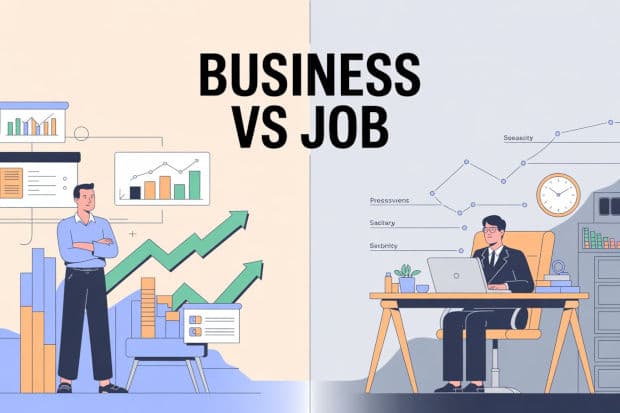
Business vs Job: What's the Real Difference and Which One Is Right for YOU? — A Self-Evaluation Guide
G
GeoRenus Editorial Team
557 views
GeoRenus Editorial Team
Should you start a business or stick with a job? Your parents say get a stable government job, your college friend says launch a startup, and social media is full of '22-year-old millionaire entrepreneur' stories. But the honest truth is — both paths are hard, and the right answer depends entirely on your personality, risk tolerance, financial situation, and life goals. This guide walks you through a 15-point comparison, a 10-question self-assessment quiz, age-based advice, and a final decision framework so you can find your own right path — not someone else's.
At some point, almost every young person faces this question head-on. Your parents say, 'Get a government job — stable, respectable, safe.' Your friend says, 'Start something, build something, be your own boss.' And social media? It's showing you a 22-year-old who supposedly turned a dorm room idea into a million-dollar company.
But here's the uncomfortable reality: Estimates suggest roughly 90% of startups fail within five years. At the same time, youth unemployment globally — including in Bangladesh — hovers above 10% according to ILO data. So both paths carry real risk.
Which one is right for you? The honest answer is: it depends. Not on trends, not on what your parents did, not on who's going viral on YouTube. It depends on your personality, your risk tolerance, your financial cushion, your skills, and what you actually want from life.
This article isn't just another pros-and-cons list. It's a self-evaluation guide. By the end, you won't just know the differences between a job and a business — you'll know which one fits YOU right now. Read carefully, answer honestly, and let the data guide your decision.
Before diving in, let's clear the air. A job isn't 'slavery' and a business isn't 'freedom.' Each path has its own advantages, drawbacks, and trade-offs. Here's a side-by-side breakdown across 15 dimensions that actually matter:
| Dimension | Job | Business |
| Income | Fixed monthly salary | Variable — from zero to unlimited |
| Risk | Low (salary is guaranteed) | High (total loss is possible) |
| Working Hours | Defined (8-10 hrs/day) | Unlimited (startup phase: 24/7) |
| Freedom | Limited (boss makes decisions) | Full (you make every call) |
| Income Ceiling | Capped by salary scale | Theoretically unlimited |
| Security | High (PF, medical, leave, gratuity) | Low (no safety net) |
| Startup Capital | None required | Capital investment required |
| Type of Stress | Boss, deadlines, office politics | Cash flow, customers, survival |
| Learning Style | Structured (training, mentorship) | Unstructured (learn by doing, failing) |
| Social Status (BD) | Govt job = highest prestige, private = respectable | Risky but celebrated if successful |
| Income Growth | Slow and incremental (5-15%/year) | Rapid upside — or steep downside |
| Legacy | Ends at retirement | Can be inherited, scaled, or sold |
| Time to First Income | Immediate (first month's salary) | Delayed (months or years) |
| Scalability | Limited (you = 1 person) | High (hire, automate, franchise) |
| Failure Consequence | Find another job | Potential financial ruin |
Disclaimer: The table above reflects general tendencies — not absolutes. Every individual's situation differs. The type of job (government vs. private, junior vs. senior) and the type of business (service vs. product, bootstrapped vs. funded) can significantly shift these characteristics.
Many people call a job the 'safe option.' But that's not the whole picture. Jobs have their own risks and limitations — and their own very real advantages. Let's look honestly at both sides.
1. Predictable Income: A fixed salary every month means mental peace, easier budgeting, and the ability to plan ahead without guessing.
2. Benefits Package: Provident fund, health insurance, paid leave, gratuity — a structured financial safety net that self-employed people have to build on their own.
3. Clear Career Path: Defined promotion ladders, performance reviews, and professional development programs give you a roadmap — even if it's slow.
4. Social Security: Government jobs in particular come with pension, housing allowances, and children's education support — long-term security that business income rarely guarantees.
5. Lower Day-to-Day Stress: You don't lie awake wondering if the business survives next month. The paycheck comes regardless of market conditions.
6. Work-Life Balance: Defined hours, annual leave, and weekends off mean you can actually be present for your family — especially important in your 30s and 40s.
7. Structured Learning: Companies invest in training their people. You gain skills, certifications, and mentorship at the company's expense, not yours.
1. Income Ceiling: No matter how hard you work, your salary is capped by the pay scale. Outstanding performance rarely translates to proportional reward.
2. Dependency on the Employer: If the company downsizes, goes bankrupt, or simply lets you go, your income drops to zero overnight.
3. Limited Autonomy: You execute someone else's vision. Your ideas may be good, but final decisions belong to management.
4. The Time-for-Money Trap: Stop working, stop earning. Your income is directly tied to the hours you show up — there's no passive component.
5. Office Politics: Promotions sometimes depend more on relationships than merit. Navigating workplace dynamics is a real and exhausting part of corporate life.
6. Slow Wealth Building: Building significant wealth from salary alone is a very long game. Without investing aggressively, most employees remain middle-class throughout their careers.
7. Monotony: The same routine, same desk, same tasks — for years. For people wired for variety and creation, this can be deeply unfulfilling.
Private Sector: According to BBS estimates, entry-level salaries typically range from BDT 15,000-25,000 — below what most urban households need to build savings.
Government Jobs: Starting salaries of BDT 16,000-22,000 plus benefits. But BCS attracts over 100,000 applicants for fewer than 2,000 posts — the competition is brutal.
RMG Sector: 4.5 million workers, minimum wage around BDT 12,500 — low but guaranteed. The backbone of Bangladesh's export economy.
IT Sector: Fast-growing but limited positions locally. Freelancing opens the global market, where Bangladeshi developers earn significantly more than local averages.
Many people romanticize entrepreneurship as the dream path. And yes — the upside is real. But so are the thorns. Let's look at business with clear eyes.
1. Unlimited Earning Potential: There's no salary cap. As the business grows, income grows with it. The compounding effect of a successful business is something a paycheck can never match.
2. Autonomy and Self-Direction: You set your own rules, make your own decisions, and build something that reflects your vision — not someone else's quarterly targets.
3. Building a Legacy: A business outlasts you. Your children, partners, or a buyer can continue what you built — unlike a job, which ends when you walk out the door.
4. Tax Advantages: Business expenses can offset taxable income in ways that salaried employees simply cannot access. This is a significant financial edge over time.
5. Scalability: Hire people, use technology, franchise the model — unlike a job, you're not the bottleneck. One person's effort can multiply into enterprise-level output.
6. Flexibility (Eventually): A mature, well-run business gives you genuine control over when, where, and how you work. This is rarely available in year one, but it becomes real.
7. Accelerated Personal Growth: Running a business forces you to learn sales, management, finance, leadership, and problem-solving all at once. The growth curve is steep — and worth it.
1. Financial Risk: You can lose everything — including family savings, borrowed capital, and years of effort. This is not hypothetical; it happens to the majority of new businesses.
2. No Guaranteed Income: Especially in the first 2-3 years, there is no salary. No business, no income. This reality breaks most aspiring entrepreneurs.
3. Extreme Stress: Every problem is yours — payroll, rent, customer complaints, supplier delays. The weight of responsibility never fully goes away.
4. Loneliness: The hardest decisions must be made alone. Even with co-founders or advisors, final accountability rests with you.
5. No Safety Net: No paid sick days, no provident fund, no employer health coverage. If you stop working, revenue stops — and bills don't.
6. Work-Life Balance Is a Myth (Early On): 80-hour weeks in the first few years are not a horror story — they're the norm. Anyone who tells you otherwise is selling something.
7. High Failure Rate: The majority of businesses close within their first few years. Enthusiasm and hard work are necessary but not sufficient.
Informal Economy Dominance: According to SME Foundation data, over 90% of businesses in Bangladesh operate informally — most without a trade license, formal accounts, or access to institutional credit.
Difficult Business Environment: The World Bank's Doing Business Index ranks Bangladesh 168 out of 190 — bureaucracy, corruption, unreliable infrastructure, and limited access to financing are genuine obstacles.
But the Opportunity Is Real: 180 million people, a young and growing population, a rising middle class, and rapidly increasing digital adoption create a market with enormous untapped potential.
Disclaimer: Business conditions and rankings evolve. The figures above reflect recent reports and indices; check the relevant organizations' websites for the latest data before making decisions.
This is the most important section of this entire guide. Get a pen and paper. For each question, choose A or B — honestly, based on how you actually feel, not how you think you should answer. Count your A's and B's at the end.
Want a Deeper Assessment? Use Our Business Readiness Analyzer:
These 10 questions give you a starting point. But for a more precise, data-driven evaluation of your business readiness, we have built two dedicated Business Readiness Analyzers that generate personalized reports:
Simple Analyzer — Quick 5-minute assessment to find out if you are ready for business: https://georenus.com/analyzer/business-readiness-analyzer
Pro Analyzer — Comprehensive analysis covering financial readiness, mental resilience, skills, and market understanding with a detailed report: https://georenus.com/analyzer/business-readiness-analyzer-pro
The questions in this article help you START thinking. The Analyzer helps you make a DATA-DRIVEN decision.
A) I prefer smaller but guaranteed income. Uncertainty about my paycheck makes me anxious.
B) I'm willing to go 1-2 years with little or no income if the upside is big enough.
A) Uncertainty makes me nervous. I function best when I have a clear plan and defined expectations.
B) Uncertainty energizes me. I adapt quickly and find solutions when the situation is unclear.
A) I work best with clear instructions, defined roles, and a structured environment.
B) I create my own work. I enjoy building something from nothing and hate waiting to be told what to do.
A) Failure deeply discourages me. It takes me a significant amount of time to bounce back emotionally.
B) I treat failure as data. I analyze what went wrong, adjust, and try again — usually faster than before.
A) I have dependents, loans, or financial obligations that make zero-income periods impossible right now.
B) I have 6-12 months of living expenses saved, or family support, that would cover me during a startup phase.
A) I have deep expertise in a specific field — engineering, medicine, law, accounting. I'm a specialist.
B) I can sell, negotiate, manage people, and also do the core work myself. I'm a generalist who can wear many hats.
A) I'm comfortable working under good leadership. I'd rather execute well than be responsible for everything.
B) Being told what to do — even by a good boss — grates on me. I need to own my decisions.
A) I want a set amount deposited on the same date every month. Irregular income, even if higher overall, stresses me out.
B) I'm fine with income that varies month to month, as long as the annual total is strong.
A) Evenings and weekends belong to me and my family. Work-life separation matters deeply to me.
B) I'm willing to work 80 hours a week for 5 years if it means building something that gives me real freedom later.
A) My primary goal is financial stability, a good quality of life, and social respect for my career.
B) I want to build something significant — an organization, a brand, a legacy that outlasts me.
8-10 A's: A job is likely the right fit for you right now. That's not a consolation — it's self-knowledge, which is the foundation of every good decision.
5-7 A's: The hybrid path is your best move. Keep your job, build skills and savings, start a side project, and transition deliberately when the numbers support it.
0-4 A's (6-10 B's): You have an entrepreneurial mindset. But don't leap blindly — preparation is what separates successful entrepreneurs from cautionary tales.
| Score | Recommendation | Next Step | Risk Level |
| 8-10 A's | Job is right for you now | Plan your career path, invest in skills | Low |
| 5-7 A's | Hybrid path | Keep job + launch a side project | Medium |
| 3-4 A's | Planned entrepreneur | Prepare your business while employed | Medium-High |
| 0-2 A's | Business-ready mindset | Confirm savings and plan, then go | High |
Disclaimer: This quiz is a self-reflection tool, not professional career advice. Your specific circumstances may require guidance from a career counselor, mentor, or experienced entrepreneur before making major decisions.
Most people frame this as a binary choice: job OR business. But there is a third path that is often the smartest, least risky, and most evidence-backed approach — doing both at the same time.
Many of the world's most successful founders started their companies on the side while holding a day job. Sara Blakely was selling fax machines door-to-door when she developed Spanx at night. In Bangladesh, thousands of IT professionals work corporate jobs by day and serve international freelance clients in the evenings — building a second income stream that often exceeds the first.
The advantages of a side hustle are powerful: your job salary covers your living expenses, so business revenue can be reinvested rather than eaten up by rent and groceries. You gain real entrepreneurial experience with dramatically lower personal financial risk.
The challenges are real too: time management becomes critical, and you must check your employment contract to ensure there's no conflict-of-interest clause that prohibits outside business activities.
| Dimension | Full-Time Job | Full-Time Business | Side Hustle |
| Income Security | High | Low (early stage) | Medium (job salary stays) |
| Entrepreneurial Experience | None | Full | Partial but real |
| Financial Risk | Low | High | Low-Medium |
| Time Commitment | 8-10 hrs/day | Unlimited | Job hours + extra time |
| Growth Potential | Limited | Unlimited | Moderate (time-constrained) |
| Best For | Risk-averse, stability-seekers | Fully prepared, high-conviction founders | Those testing the waters before committing |
Social media has a severe selection bias toward entrepreneur success stories. But a successful career in employment is equally valid, equally rewarding, and far more common. Let's look at real examples from both paths.
A BCS cadre officer who rises to Deputy Secretary builds genuine social impact, financial stability, a pension, and the respect of their community. A skilled doctor, engineer, or teacher who achieves mastery in their profession creates irreplaceable value. Not everyone needs to be an entrepreneur — and pretending otherwise is dishonest advice.
bKash: Founder Kamal Quadir left a corporate career to build Bangladesh's mobile financial services market from scratch. Today bKash processes billions of dollars in transactions and is valued at over $2 billion — transforming how 50 million+ people move money.
Pathao: Founded by young entrepreneurs while still in university, Pathao grew into one of Bangladesh's largest tech companies, covering ride-hailing, food delivery, and logistics — built on a problem they observed firsthand.
Thousands of garments entrepreneurs who started with a single machine and a rented shed now run factories employing hundreds — driving the industry that accounts for over 80% of Bangladesh's export revenue. Their stories don't trend on social media, but they are the spine of the economy.
Many Bangladeshi IT professionals have built hybrid careers that neither a pure job nor a pure business could offer alone. They hold full-time positions at tech firms or NGOs while simultaneously freelancing on platforms like Upwork and Fiverr — with some eventually growing their freelance income large enough to build their own agencies. The job provided stability while the side hustle built the future.
Do:
Be honest with yourself: Revisit the quiz above. Answer it again, alone, away from social pressure. Your gut answer in the first two seconds is usually the true one.
Talk to people on both paths: Don't just listen to successful entrepreneurs. Find successful, fulfilled salaried professionals too. Both perspectives are essential.
Start small before committing: Test your business idea at small scale — a few customers, a weekend market, a freelance project — before quitting your income source.
Build an emergency fund first: Whatever path you choose, have 6-12 months of living expenses saved before any major transition.
Invest in the skills your path requires: Job path? Develop deep expertise and leadership. Business path? Learn sales, financial basics, and operations.
Consider your age and life stage: Taking a risk at 22 with no dependents is categorically different from taking the same risk at 42 with a mortgage and two kids in school.
Don't:
Follow social media hype: 'Everyone is becoming an entrepreneur' is a myth. Most working adults are employees — and many of them are happy, financially secure, and deeply fulfilled.
Quit impulsively after a bad day: A terrible boss or a frustrating project is not a sign that employment is wrong for you. It may just be the wrong employer.
Borrow what you cannot afford to lose: Business capital should never come from money earmarked for rent, school fees, or your emergency fund.
Choose under pressure from others: Whether it's family insisting on a government job or friends mocking you for not starting a company, your career decision belongs to you alone.
Compare your Chapter 1 to someone else's Chapter 20: The entrepreneur you see celebrating on Instagram is not showing you the five years of failed experiments that came before.
Age is one of the most important variables in this decision. Your risk capacity, financial obligations, energy levels, and recovery time from setbacks all change significantly across decades.
The golden window for risk-taking: Responsibilities are typically low, recovery time from failure is long, and the ability to learn quickly is at its peak.
Consider joining a startup as an early employee — you get a salary, but you experience entrepreneurship from the inside. This often teaches more than starting cold. If you do want to start something, the cost of failure is never lower than right now.
The most common transition window: By now you have marketable skills, a professional network, and ideally some savings. You understand how businesses work from the inside.
This is the sweet spot for a deliberate transition from employment to entrepreneurship — if you've done the preparation. It's also the best window to accelerate your career into senior and leadership roles if employment is your path.
Higher stakes, higher risk: Family obligations, EMIs, children's education costs, aging parents — financial responsibilities compound significantly in this decade.
Business is possible here, but the bar for readiness is much higher: a strong plan, adequate savings, family support, and a business model with faster-than-average time to first revenue. For most people in this age group, employment stability is the higher priority.
Starting a high-risk, capital-intensive new business at this stage is rarely advisable. But consulting, advisory services, and franchise models (lower risk, proven systems) are viable alternatives. If employed, shift focus toward retirement planning, maximizing pension contributions, and building passive income through investments.
| Age Range | Best Path | Risk Capacity | Key Consideration | Bangladesh Context |
| 20-25 | Business / startup employment | High | Low obligations, long recovery runway | Try alongside BCS prep — low downside |
| 25-35 | Hybrid or planned transition | Medium-High | Skills and savings in place | IT freelancing + job is a proven combo |
| 35-45 | Job as priority | Low-Medium | Heavy family financial obligations | Only business if plan is airtight |
| 45+ | Job / low-risk business | Low | Retirement planning is critical | Consulting or franchise, not high-risk ventures |
Disclaimer: Age-based recommendations reflect general trends. Your individual financial situation, health, family circumstances, and specific opportunities may differ significantly from these averages.
Before starting a business, ask yourself these five questions. If all five answers are 'yes,' you're genuinely ready. If even one is 'no,' that's not a failure — that's your preparation checklist.
Question 1: Do you have 6-12 months of living expenses saved?
Early-stage businesses often take months — sometimes years — before generating meaningful income. You need to cover rent, food, and family expenses without touching business capital.
Question 2: Can you solve a real problem that people will actually pay money to solve?
'I have a great idea' is not enough. Have you validated it? Have real people — strangers, not just supportive friends — confirmed that they would pay for your solution? Test it at small scale first.
Question 3: Does your family support you — or at minimum, will they not actively oppose you?
Running a business while managing active family resistance is extraordinarily difficult. You need your home environment to be a source of energy, not a drain on it.
Question 4: Can you survive 1-2 years with no income?
Many successful businesses take 12-24 months to reach profitability. This isn't pessimism — it's the historical base rate. Are you financially and mentally prepared for that reality?
Question 5: Do you have the mental resilience to fail and start again?
Behind virtually every well-known successful entrepreneur are multiple earlier failures — some of them public and painful. The ability to absorb failure, extract the lesson, and get back up is not optional. It's the job.
| Decision Type | Recommendation |
| All 5 Yes | You're ready — start, but with a written plan and defined milestones |
| 4 Yes | Nearly ready — address the one 'no' before launching |
| 3 Yes | Not yet — continue building in your current job while preparing |
| 2 or fewer Yes | Stay in employment for now — build the foundation, then revisit in 12-18 months |
Here's the truth that no social media algorithm will show you: both paths work. Both paths produce fulfilled, financially secure, purpose-driven people. And both paths produce miserable, financially stressed people who chose without self-knowledge.
Your Next Step:
If this article has you leaning toward business, test yourself right now with our Business Readiness Analyzer:
Quick Check (Simple): https://georenus.com/analyzer/business-readiness-analyzer
Detailed Analysis (Pro): https://georenus.com/analyzer/business-readiness-analyzer-pro
And if you are leaning toward a job — that is an equally excellent decision. What matters is choosing CONSCIOUSLY, not blindly.
A happy, successful employee is worth infinitely more — to themselves, their family, and society — than a stressed, bankrupt entrepreneur who was chasing someone else's definition of success.
A thriving entrepreneur who built something meaningful is worth infinitely more than a miserable corporate worker who stayed only because leaving felt too scary.
The variable that determines which version of either path you become is not intelligence, not luck, and not timing. It's self-knowledge. Know your strengths. Know your limits. Know what you actually want from your one professional life — not what your parents want, not what trends on LinkedIn, not what looked impressive at a college reunion.
'The biggest risk is not taking any risk. In a world that is changing quickly, the only strategy that is guaranteed to fail is not taking risks.' — Mark Zuckerberg
'Choose a job you love, and you will never have to work a day in your life.' — Confucius (attributed)
One final thought: Whichever path you choose — commit to it with excellence. Mediocrity on two paths is far worse than mastery on one. Use this guide, retake the quiz, talk to people you respect on both sides — and then decide. Your decision, made with honesty and evidence, is the right one.

A ‘SWOT’ analysis is essentially a planning process that helps an organization identify new directions it can pursue while overcoming its challenges. The acronym ‘SWOT’ stands for Strengths, Weaknesses, Opportunities, and Threats. Therefore, a SWOT analysis is an excellent strategy for evaluating these four aspects of any organization.