How Does a Business Create Value? — The Complete Guide to Value Creation
G
GeoRenus Editorial Team
760 views
Summary
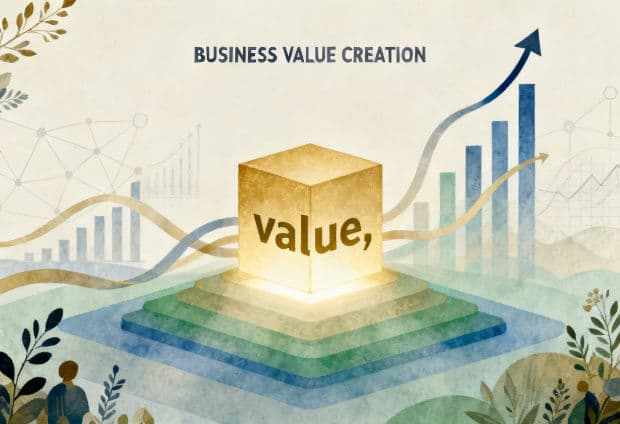
In 2014, Facebook bought WhatsApp — a company with just 55 employees — for $19 billion. Meanwhile, a corner store with five workers might be worth a few thousand dollars at best. What explains that staggering difference? One answer: Value Creation. The more genuine value a business creates for people, the more it survives, grows, and becomes worth something. This guide covers the seven methods of value creation, Michael Porter's Value Chain, the Value Proposition Canvas, the critical balance between value creation and value capture, and a real look at where Bangladesh stands — a complete explanation of the most fundamental concept in all of business.
Key Takeaways
- 1. Value Creation Is the Only Foundation of Business: A business survives only when it produces something worth more to customers than it costs to make. No problem solved, no customer. No customer, no business.
- 2. Value Created vs. Value Captured: Growing the total pie (creation) and taking your slice (capture) are two different things. Amazon creates enormous value but captures only ~4% margin. Apple creates AND captures 25%+ — thanks to ecosystem lock-in. Both strategies work, but for different reasons.
- 3. Seven Methods of Value Creation: Problem Solving, Convenience, Time Saving, Experience, Emotional/Status Value, Information & Knowledge, and Connection/Network — each adds value in a distinct way and opens different business model possibilities.
- 4. The Value Chain: Porter's model shows that value is added at every step from raw material to customer. Bangladesh sits in the manufacturing step of the garment chain — but Design and Branding capture the most value, and that is where Bangladesh's participation is weakest.
- 5. A Strong Value Proposition: 'Why should a customer choose YOU?' — a clear, one-sentence answer to that question is your value proposition. Uber: 'Tap a button, get a ride.' bKash: 'Banking in the palm of your hand.' Clarity is power.
- 6. Five Strategies to Increase Value: Understand customers deeply, innovate relentlessly, invest in quality, obsess over customer experience, and build an ecosystem. These five levers, applied together, compound over time.
Introduction: Why Is WhatsApp Worth $19 Billion With 55 Employees?
In 2014, Facebook paid $19 billion for WhatsApp — a company with just 55 employees. Around the same time, a corner store with five staff members was chugging along, worth perhaps a few thousand dollars at best.
How is that gap even possible? Both businesses solve real problems. Both employ people. Both take in money. So what makes one worth tens of billions and the other worth almost nothing?
One answer: Value Creation. WhatsApp gave hundreds of millions of people a free, effortless way to stay connected across borders. The value it created for those users — in time saved, relationships maintained, friction removed — was almost incomprehensibly large. The corner store creates real value too. But for a few hundred neighbors, not a few hundred million strangers.
Value Creation is the single most important concept in business. Every revenue line, every profit margin, every growth story — all of it traces back to this one idea. Miss it, and every business decision you make will be built on sand.
'The purpose of a business is to create a customer.' — Peter Drucker
But Drucker's famous line raises the obvious question: how, exactly, do you create a customer? You do it by creating value first. Whether you run a tea stall or build a search engine, the logic is identical: SOLVE A PROBLEM → CREATE VALUE → CAPTURE PART OF THAT VALUE AS REVENUE.
A tea stall creates value by satisfying thirst and a caffeine habit in a convenient spot. Google creates value by organizing every piece of human knowledge. The scale is different. The principle is the same.
Chapter 1: What Is Value Creation?
A Simple Definition
Value Creation = producing something worth more to the recipient than it cost you to make.
Say you spend BDT 50 on tea leaves, sugar, milk, and gas — and sell one cup for BDT 15. Your customer pays happily, because that cup is worth more than BDT 15 to them — the morning caffeine hit, the familiar corner spot, the few minutes of warmth before work. They are getting a deal. You are covering your costs and making a margin. Everyone wins.
The gap between what something costs to produce and what a customer is willing to pay — that gap is the value created. The wider the gap, the stronger the business.
Apple's iPhone costs roughly $200-300 to manufacture and assemble. It sells for $999-1,499. That enormous gap exists because customers genuinely believe an iPhone is worth $999 to them. That belief — that perceived value — is not an accident. Apple engineers it deliberately, year after year.
Value Created vs. Value Captured
This is the most important distinction that most entrepreneurs miss.
Here is a simple example:
You create BDT 100 of value for a customer — that is the maximum they would ever pay.
You charge them BDT 60.
Customer surplus = BDT 40 — they got more than they paid for. They are happy and will come back.
Your revenue = BDT 60. Your cost = BDT 30. Your profit = BDT 30.
You cannot capture 100% of the value you create. If you try, customers leave. Amazon creates massive value — convenience, enormous selection, low prices — and captures only about 4% as margin. They share most of the value with the customer, which is exactly why hundreds of millions of people shop there. Apple, with its switching costs and ecosystem lock-in, captures 25%+. Both strategies are valid. The logic is just different.
Amazon: share more value, attract more customers, win on volume. Apple: capture more value, but build an experience so good that customers stay anyway.
Why Value Creation Is the Only Foundation of Business
No value = no customer. No customer = no revenue. No revenue = no business.
Every successful business in history is just a real problem, solved well enough that people pay for the solution. Every failed business either did not create enough genuine value, or tried to capture so much of it that customers stopped coming.
Kodak created enormous value in the age of film photography — then digital cameras created even more. Kodak could not reinvent itself for the new world. It vanished. Nokia built the world's most popular phones — then could not make the leap to smartphones. Same story.
'Your work is going to fill a large part of your life, and the only way to be truly satisfied is to do what you believe is great work.' — Steve Jobs
Chapter 2: Seven Methods of Value Creation
1. Problem Solving
The most direct method. Find a real pain. Build a real solution. Charge for access to that solution.
Uber: can't find a taxi? Solved. bKash: can't send money without a bank account? Solved. Google: can't find information? Solved.
The bigger the problem, the more value you create by solving it. bKash brought mobile financial services to over 70 million Bangladeshis who had never had access to any formal banking before. That is a massive problem — which is exactly why bKash became massively valuable.
2. Convenience
Take something that already exists and make it dramatically easier. This is not invention — it is reinvention.
Amazon did not invent shopping. It made shopping frictionless — one click, home delivery, easy returns. Foodpanda did not invent restaurants. It made ordering effortless. Chaldal did not invent grocery stores. It made weekly shopping a two-minute phone task.
Convenience creates enormous value because time and energy are finite. A business that reliably saves people time and effort creates something people will pay for again and again. This is why convenience-first business models grow so fast once they find product-market fit.
3. Time Saving
Time is money. Not just as a saying — as an economic reality.
A washing machine turns hours of hand-washing into a 30-minute task. Accounting software turns a full day of bookkeeping into an hour. Pathao saves the time you would spend waiting for a bus that may never show up.
McKinsey research suggests that professionals value their time at roughly $200-500 per hour (approximate). If your product saves someone one hour, you have created $200-500 worth of value. That is a powerful proposition.
This is why productivity tools, automation software, and delivery services are such enormous industries. People will pay, often repeatedly, for more time.
4. Experience Creation
Not problem-solving — the creation of an entirely new, memorable experience.
Starbucks is not selling a BDT 15 cup of coffee. It is selling a BDT 400-600 premium coffee-shop experience: comfortable chairs, a curated atmosphere, a customized drink, an Instagrammable cup. Disney is not selling rides. It is selling magic.
A concert ticket solves no problem. It creates joy. A cinema trip solves no problem. It creates an entertainment experience. Experience value often commands the highest margins precisely because there is no obvious 'fair price' for a feeling.
5. Emotional and Status Value
A Rolex tells time — just like a BDT 500 watch. But a Rolex also signals achievement, identity, and belonging to a certain world. That is why it costs BDT 500,000 to BDT 5,000,000.
Louis Vuitton is leather plus a brand — and sells for ten times what a comparable bag would cost without the logo. Nike sells shoes, but the real value is the feeling: 'I am an athlete.' Emotional value is the foundation of the entire luxury industry.
In Bangladesh: iPhone ownership signals social status. Dining at a specific restaurant is an identity statement. Wearing a premium brand communicates community membership. People pay extra for that emotional value — every time.
6. Information and Knowledge
The difference between knowing and not knowing can be worth an enormous amount of money.
10 Minute School organized quality educational content and made it accessible — creating real value for millions of students. A tax consultant creates value by knowing what you do not.
A Bloomberg Terminal costs $24,000 per year. Traders pay it because the financial data it provides is worth far more than $24,000 in better trading decisions. Information = power = value.
7. Connection and Network
Connect people who need each other. This is the foundation of the platform business model.
Facebook connects friends. LinkedIn connects professionals. Daraz connects buyers and sellers. Uber connects riders and drivers.
The remarkable thing about platform businesses is that they create enormous value without owning what is being exchanged. Airbnb is the world's largest hospitality company without owning a single hotel room. Uber is the world's largest taxi company without owning a single car. The value is the connection itself.
| Method | How It Works | Global Example | Bangladesh Example | Typical Revenue Model |
| Problem Solving | Identify a pain, build a solution | Google, Uber | bKash, Pathao | Transaction fee, subscription |
| Convenience | Make existing things dramatically easier | Amazon, DoorDash | Chaldal, Foodpanda | Delivery fee, commission |
| Time Saving | Turn hours of work into minutes | Slack, Zoom | Shohoz, PortalBD | Subscription, license fee |
| Experience Creation | Create a memorable moment or feeling | Starbucks, Disney | Premium cafes, concerts | Premium pricing |
| Status / Emotional | Build identity and belonging | Rolex, Louis Vuitton | iPhone BD, luxury brands | Brand premium |
| Information / Knowledge | Close the gap between knowing and not knowing | Bloomberg, Coursera | 10 Minute School, consultants | Subscription, consulting fee |
| Connection / Network | Unite two sides that need each other | Facebook, Airbnb | Daraz, Bikroy | Commission, advertising |
Note: The examples above are for illustrative purposes only. Most businesses use several of these methods simultaneously — and the strongest businesses combine multiple methods to build defensible moats.
Chapter 3: The Value Chain — From Raw Material to Customer
Michael Porter's Value Chain Model
In 1985, Harvard's Michael Porter showed that every step in a business adds value. Every activity in the chain contributes to the final product's worth — and where you sit in that chain largely determines how much value you can capture.
Primary Activities: Inbound Logistics (sourcing raw materials) → Operations (production) → Outbound Logistics (distribution) → Marketing & Sales → Service.
Support Activities: Infrastructure, Human Resource Management, Technology Development, Procurement.
Each primary activity adds a layer of value. How efficient your Operations are determines your gross margin. How effective your Marketing is determines your sales volume. The total efficiency of the chain determines the final value delivered to the customer.
A T-Shirt's Value Chain
Here is how a BDT 50 ball of cotton becomes a BDT 1,500 T-shirt hanging in a store:
Cotton farmer: BDT 50/kg of raw cotton produced.
Spinning mill: Turns cotton into yarn — output value BDT 80.
Fabric mill: Turns yarn into fabric — output value BDT 150.
Garments factory (Bangladesh): Cuts and sews — output value BDT 300.
Brand (H&M, Zara): Designs, labels, markets — output value BDT 800.
Retailer: Sells to final customer — BDT 1,500.
From BDT 50 cotton to BDT 1,500 shirt — BDT 1,450 of value was added across the entire chain.
Bangladesh sits in the garments manufacturing step (BDT 150 → BDT 300). We add BDT 150 of value — roughly 10% of the total created in the chain. H&M and Zara sit in design, branding, and retail (BDT 300 → BDT 1,500) — capturing more than 80% of the value. This is the structural reason Bangladesh garments factories operate on thin margins, no matter how efficiently they run.
Where Is the Most Value Added?
The general rule: Design > Branding > Marketing > Distribution > Manufacturing > Raw Materials.
Apple designs in California (highest value step) and manufactures in China (lower value step). Nike designs in Oregon and manufactures in Bangladesh and Vietnam. The idea is always worth more than the making of the idea.
This is why Intellectual Property — patents, trademarks, brand equity — is the most valuable asset in the modern economy. Apple's most valuable asset is not its factories. It is its brand and its iOS ecosystem.
| Step | Who Does It | Input Value (BDT) | Output Value (BDT) | Value Added (BDT) | Bangladesh Participation |
| Cotton farming | Farmers | 10 (seed/water/labor) | 50 | 40 | Limited |
| Spinning (yarn) | Spinning mills | 50 | 80 | 30 | Present |
| Fabric weaving | Fabric mills | 80 | 150 | 70 | Present |
| Garments (sewing) | Garments factories | 150 | 300 | 150 | Strong (RMG industry) |
| Brand + Design | Brand (H&M/Zara) | 300 | 800 | 500 | Nearly absent |
| Retail (selling) | Retailers | 800 | 1,500 | 700 | Present in domestic market |
Note: The figures above are approximate and intended only to illustrate proportions. Actual values vary significantly by product, market, and season.
Chapter 4: Value Proposition — Why Should Customers Choose YOU?
What Is a Value Proposition?
A Value Proposition is your promise to the customer: 'Here is why you should buy from me, not from my competitor.'
It answers three questions in one breath: What problem do you solve? For whom? And how are you different?
A weak Value Proposition: 'We offer the best quality products.' (Everyone says this.) A strong Value Proposition: 'We deliver groceries to your door in Dhaka within one hour — Chaldal.' Specific. Measurable. Differentiated.
The Value Proposition Canvas
Alexander Osterwalder built a tool that maps two sides:
The customer side: Jobs (what they are trying to get done), Pains (their frustrations), Gains (what they want more of).
Your side: Products/Services (what you offer), Pain Relievers (which frustrations you remove), Gain Creators (which benefits you deliver).
The tighter the fit between the two sides, the stronger your value proposition. bKash's success comes from an almost perfect fit: customer Pain (no bank account, cannot send money) matched exactly to their solution (send money from your phone). Simple. Powerful. Hard to argue with.
World-Famous Examples
Uber: 'Tap a button, get a ride' — everything in seven words.
Domino's: '30 minutes or free' — a speed guarantee, perfectly measurable.
FedEx: 'When it absolutely, positively has to be there overnight' — a reliability promise.
Slack: 'Be less busy' — an emotional benefit in three words.
bKash: 'Banking in the palm of your hand' — accessibility, instantly understood.
Pathao: 'Your daily ride' — convenience, ownership, everyday relevance.
Chaldal: 'Groceries delivered in 1 hour' — time saving, measurable.
How to Build a Strong Value Proposition
1. Say it in one sentence. If you cannot explain your value in a single sentence, you do not understand it well enough yet.
2. Lead with the benefit, not the feature. Not '4GB RAM' — 'Run ten apps at once without a slowdown.'
3. Be specific. Not 'best quality' — '30-minute delivery' or '50% cheaper than the alternative.' Use numbers wherever you can.
4. Test it with real customers. If they cannot repeat your value proposition back to you after hearing it once, it is not clear enough yet.
Chapter 5: Value Creation vs. Value Capture — The Critical Balance
Value Creation = Growing the Pie
Value Creation means increasing the total value that exists in a transaction — making the pie bigger.
Amazon creates vast value — a nearly infinite product catalog, fast delivery, easy returns, Prime membership perks. The total convenience Amazon provides to its customers is worth far more than what Amazon charges.
Wikipedia gives away the sum of all human knowledge for free — an extraordinary act of value creation. Yet Wikipedia captures none of it financially.
Value Capture = Your Slice of the Pie
Value Capture = how much of the value you created you actually keep.
Amazon: enormous value created, roughly 4% margin captured. Wins on volume.
Wikipedia: enormous value created, 0% captured. Runs on donations.
Apple: enormous value created AND 25%+ captured. Ecosystem lock-in gives them pricing power.
Why the Balance Matters
Too much capture (overpriced, poor service) → customers leave for a competitor. Too little capture (underpriced, value given away) → the business starves and dies.
The art is: maximize what you create, and capture enough — enough to survive, grow, and invest in creating even more value.
New businesses typically create more and capture less early on — to attract customers and build trust. As they mature, they capture more. Instagram started free and ad-less. Today it captures billions in advertising revenue. The creation came first; the capture followed.
Costco vs. Luxury Brands
Costco: creates enormous value through bulk purchasing, low prices, and consistently good quality. Captures only ~2.5% margin — but on $230+ billion in annual revenue, that is enough.
Hermes: creates value through exclusivity and extraordinary craftsmanship. Captures 35%+ margin — but on much lower volume.
Both strategies are successful. The creation-to-capture ratio is simply different. Which approach is right for your business depends on your market, your product, and your competitive position.
| Company | Value Created for Customer | Price Charged | Approx. Margin | Strategy |
| Amazon | Convenience + Selection + Low Price | Competitive | ~4% | Low capture, high volume |
| Apple | Premium experience + Ecosystem | Premium | ~25% | High capture, ecosystem lock-in |
| Costco | Bulk + Quality + Low price | Near-cost | ~2.5% | Ultra-low capture, membership fee |
| Hermes | Exclusivity + Craftsmanship | Luxury premium | ~35%+ | High capture, artificial scarcity |
| Wikipedia | All human knowledge | Free | 0% | Zero capture, donation-based |
| bKash (BD) | Financial inclusion + Convenience | Transaction fee | Moderate | Volume + transaction fee model |
Note: The margin figures above are approximate estimates for illustrative purposes. For precise figures, refer to each company's latest annual report or investor disclosures.
Chapter 6: Five Strategies to Increase Value Creation
1. Understand Your Customer Deeply
Do not assume — ask. Talk to at least ten customers every month. Read their complaints. Watch how they actually use your product, not how you imagine they do.
Jeff Bezos famously read customer complaint emails personally at Amazon — and forwarded them to the responsible team with a single '?' in the subject line. Every complaint was a signal of value not yet created. That relentless attention to customer pain is a core reason Amazon grew the way it did.
Toyota's Kaizen philosophy: improve by a little, every single day. Every small customer frustration is an opportunity to add value. That mindset turned Toyota from a cheap-car brand in the 1970s into the world's most reliable automobile manufacturer.
2. Innovation — Solve Old Problems in New Ways
Innovation does not always mean invention. It usually means finding a better solution to a problem that already exists.
The iPhone did not invent the phone. It redefined what a phone could be. bKash did not invent banking. It redefined who could access banking.
In Bangladesh: ShajGoj digitized skincare advice. 10 Minute School made quality education accessible. Sheba.xyz organized the home services market. Every one of these is a new answer to an old problem — and every one created genuine new value.
3. Invest in Quality
Higher quality = higher perceived value = customers willing to pay more and stay longer.
Toyota's lean manufacturing and Six Sigma obsession revolutionized car quality. In the 1980s, 'Made in Japan' meant cheap. By the 2000s, Toyota meant reliable. That shift was built on thousands of tiny quality improvements over decades.
Quality investment is a short-term cost and a long-term value multiplier. A customer who experiences failure twice may forgive you once. But they will not come back a third time. A customer who consistently gets a great product becomes a loyal repeat buyer — and tells their friends.
4. Obsess Over Customer Experience
Zappos, the online shoe store, was acquired by Amazon for $1.2 billion — entirely on the strength of its customer service. Zappos spent almost nothing on advertising. The experience itself was the marketing — customers told their friends.
Every touchpoint is a value creation opportunity: How easy is your website? How fast is your delivery? How helpful is your customer service? How satisfying is unboxing your product? How painless is the return process?
This is where the biggest untapped opportunity lies in Bangladesh. Most businesses invest in the product and neglect the experience. Any business that treats customer experience as a core asset — not an afterthought — will stand out.
5. Build an Ecosystem
Apple's iPhone is valuable on its own. But iPhone + App Store + AirPods + MacBook + iCloud + Apple Watch = an ECOSYSTEM — and that ecosystem is worth dramatically more than the sum of its parts. Each product makes every other product more valuable.
This creates two powerful defenses: network effects and switching costs. Once a customer is inside the ecosystem, leaving becomes genuinely inconvenient.
In Bangladesh: Pathao started with ride-sharing — then added food delivery, courier services, and payments. Each new service makes the others stronger. That is ecosystem building, and it compounds over time.
Chapter 7: Value Creation in Bangladesh
Where Bangladesh Creates Value Well
The RMG (Ready-Made Garments) industry: $55 billion in exports. Manufacturing excellence at scale — fast turnaround, competitive cost, reliable quality. This is Bangladesh's proven competitive advantage and the engine of the country's economic transformation.
bKash: revolutionary value through financial inclusion. Over 70 million people brought into mobile banking — people who had never had access to any formal financial service. The value created here is not just commercial. It is social and economic at a national scale.
Grameenphone: connectivity as value. Started in 1997, now serving over 80 million subscribers. Grameenphone transformed rural communication in Bangladesh and connected communities that were previously isolated.
10 Minute School: value through educational access. High-quality educational content at low cost — reaching millions of students who cannot afford private tutoring. A genuine value creation story built on a simple insight: good teaching should not be scarce.
Where Bangladesh Falls Short
Stuck in the low-value steps of the chain: In RMG, Bangladesh handles manufacturing. But Design and Branding — the steps that capture the most value — are owned by foreign companies. The structural ceiling on garments margins will not lift until Bangladesh moves up the chain.
No globally recognized consumer brands: Bangladesh has no brand that commands premium pricing internationally. India has Tata, Infosys, Wipro. Vietnam is building VinFast. Bangladesh's effort to build global brands is still in its earliest stages.
Persistent service quality gaps: In many service sectors, inconsistent quality undermines customer trust. Poor quality is not just a missed opportunity — it actively destroys value. Customers pay and walk away disappointed. That is value destruction.
A weak innovation ecosystem: India has over 100 unicorn startups. Bangladesh has a handful. R&D investment is below 0.3% of GDP (India: ~0.7%, China: 2.5%+). Without a stronger investment in research and innovation, moving up the value chain will remain aspirational.
The Opportunities Ahead
Moving up the value chain: Transitioning from CMT (Cut, Make, Trim) to design-led and brand-led garments. Some Bangladeshi companies are already making this move — Aarong, Yellow, Ecstasy — proving it is possible.
Digital services: SaaS, IT outsourcing, digital marketing services — Bangladesh has the talent and the cost advantage to compete in global digital markets. This is a genuine opportunity to create and capture high-margin value internationally.
Agri-tech: Bangladesh is still heavily agricultural, but technology adoption in farming remains low. Precision farming, cold-chain logistics, and direct farmer-to-market platforms represent significant untapped value creation opportunities.
Climate innovation: Bangladesh is among the most climate-vulnerable countries on earth. That vulnerability is also an innovation imperative — flood-resilient crops, solar energy, green manufacturing. The world will pay for credible solutions to these problems.
Chapter 8: Do's and Don'ts
What To Do:
1. Always start with the customer's PROBLEM — not your solution. Confirm the problem is real and large enough before you build anything.
2. Measure the value you create — not just the revenue you collect. How satisfied are customers? What is your NPS score? Are they coming back? Are they telling friends?
3. Invest in Quality and Customer Experience. These feel like costs today. They are value multipliers over time. Zappos proved it. Toyota proved it.
4. Think about building an ecosystem, not just a product. How can one service make another more valuable? That compounding effect is the most defensible moat in business.
5. Work to move up the value chain. Do not stay a manufacturer if you can become a designer, a brand, or a platform. Higher up the chain, more value waits.
What NOT To Do:
1. Do not compete on price alone. A price war is a race to the bottom where everyone loses. Compete on value instead.
2. Do not copy without adding new value. If you look identical to your competitor, why would a customer choose you? Copying without differentiation is a strategy for irrelevance.
3. Do not ignore customer feedback. Every complaint is a signal of value not yet delivered. Fix it fast. The business that listens fastest improves fastest.
4. Do not confuse activity with value creation. Working ten hours does not mean you created ten hours of value. What you do matters far more than how long you do it.
5. Do not try to capture 100% of the value you create. Leave value on the table for your customers. Their surplus is what keeps them coming back.
Final Thoughts
Value Creation is the only sustainable foundation any business can be built on. Revenue, profit, and growth are all downstream effects. Value comes first.
If you are not genuinely solving a real problem, genuinely saving someone time or money, genuinely creating an experience people want to return to — then you are not really building a business. You are just keeping busy.
WhatsApp became a $19 billion company with 55 employees because it created genuine, large-scale value for hundreds of millions of people. The scale of the business was a direct reflection of the scale of the value. That relationship always holds.
Once you understand value creation, the natural next question is: how do you structure it into a repeatable, scalable business? Read our article on Business Models: https://georenus.com/edu/en/business-models/business-model-what-is-english
'Price is what you pay. Value is what you get.' — Warren Buffett
One question to ask yourself every day about your business: 'Whose life is genuinely better today because of what we did?' The answer is your value creation scorecard — and the only metric that truly matters in the long run.
Recommended for you

The Bretton Woods Agreement: A Turning Point in Global Economic History
In 1944, as the world was still engulfed in the devastation of World War II, the global economy had collapsed and people’s living standards had plummeted. In an effort to stabilize the international economy and address pressing global financial issues, the Allied nations convened a historic summit. Nearly 730 delegates from 44 countries gathered at the Mount Washington Hotel in Bretton Woods, New Hampshire, for the United Nations Monetary and Financial Conference. The outcome of this summit was the landmark Bretton Woods Agreement, which gave birth to the Bretton Woods System.
Business
Needs, Wants, and Demands

Economics
Economics: What It Is, Why It Matters, and How It Shapes Our Lives
Organization
What Is the International Monetary Fund (IMF)?

Startup
What Is a Startup? The Ultimate Guide You Need to Read

Accounting
Corporate Taxation and International Tax Challenges Explained
Accounting
Accounting for Startups: A Complete Guide to Getting It Right

Accounting
Tax Rebate: Definition, Types, and How to Claim One
Accounting
Financial Recording and Transactions: The Complete Guide

Agreement
General Agreement on Tariffs and Trade (GATT)