Business Warfare: Sun Tzu's Logic of Market Control — The Philosophy That Made Google, Amazon, and Apple Unbeatable
G
GeoRenus Editorial Team
807 views
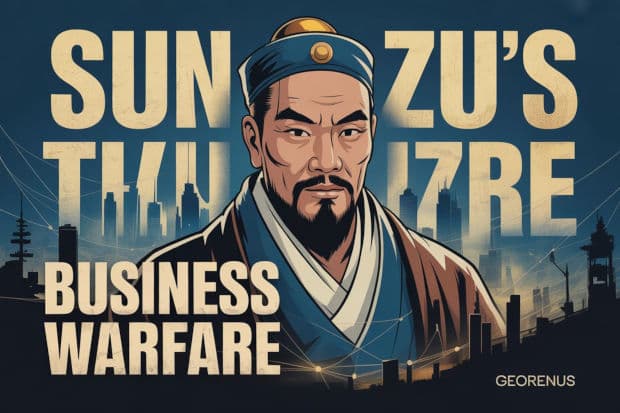
Summary
Sun Tzu's 2,500-year-old military philosophy from The Art of War — applied to modern business. How Google (92% search, $307B revenue), Amazon (60%+ e-commerce searches, 175+ fulfillment centers), Apple (92% retention rate), and bKash (210M+ accounts) use a 5-step control framework — terrain, intelligence, supply, terms, and lock-in — to make competition irrelevant rather than winning it.
Key Takeaways
- Sun Tzu's core teaching: the best general wins without fighting. In business, this means making competition irrelevant rather than outcompeting rivals directly.
- The 5-step control formula: Terrain Control → Intelligence → Supply Control → Dictate Terms → Lock-In. Each step reinforces the next.
- Google holds 92% search market share not through algorithmic superiority alone, but by becoming the default on Android (3B+ devices), Chrome (65%+ browser share), and paying Apple $20B+/year for iPhone default status.
- Apple pre-books TSMC's chip production capacity years in advance. During the 2020-21 chip shortage, competitors literally could not source chips — Apple launched iPhone 12 and 13 on schedule with record sales.
- Apple's customer retention rate is 92% (Bain & Company) — built through ecosystem lock-in: iPhone → AirPods → MacBook → Watch → Music → iMessage. Leaving means losing everything accumulated.
- bKash's control model: 210M+ accounts + 300,000+ agents + 'bKash koro' becoming a verb. Nagad offers better terms, but bKash controls the terrain — habit, network, and infrastructure.
- Bangladesh's garment industry earns only 5-10% margins because H&M/Zara control the demand side while factories compete against each other on supply — the opposite of Sun Tzu's supply control lesson.
- The ethics balance: Google received an $8.6B EU fine for monopoly abuse. The best controllers (Apple, Amazon) give customers so much value that customers choose to be controlled — that is the sustainable version of Sun Tzu's framework.
Business Warfare: Sun Tzu's Logic of Market Control — The Philosophy That Made Google, Amazon, and Apple Unbeatable
2014. Masayoshi Son, founder of SoftBank, is sitting across a table about to authorize a $32 billion investment. The largest single tech bet in history. His advisors are nervous. His analysts have spreadsheets. But on Son's desk, there is only one book.
The Art of War. Written in 500 BC. By a general who hated war.
Think about that for a second. The man deploying more capital than the GDP of most countries is drawing strategy from bamboo scrolls written 2,500 years ago. Why?
Because Son understood something that most business schools do not teach: markets are battlefields, and the winners are not the ones with the best products. They are the ones who control the terrain.
Consider the evidence. Google holds 92% of the global search market. Not because its algorithm is vastly superior to Bing or DuckDuckGo. Because it has made itself the default everywhere you look. Apple customers do not leave. Not because the iPhone is objectively the best phone on earth. Because Apple has built a prison they genuinely enjoy living in. Amazon is nearly impossible to compete with. Not because of low prices. Because Amazon controls the infrastructure that competitors need just to exist.
None of this happened by accident. It happened by design. Sun Tzu's design.
Sun Tzu's central teaching was not about tactics. It was about making tactics unnecessary. Do not fight for the market — control it so completely that fighting becomes pointless.
This article is a journey from an ancient Chinese battlefield to the modern boardroom. We will decode Sun Tzu's five-step control framework, see it operating inside the world's most powerful companies, and translate it into something you can actually use. Let us begin.
Chapter 1 — Sun Tzu: The Warrior Philosopher Who Hated War
Sun Tzu (544–496 BC) was a general in the state of Wu during China's Warring States period — an era of constant bloodshed, collapsing kingdoms, and political chaos. Every day brought a new battle, a new betrayal, a new shifting of power. Violence was the default tool of every ruler.
Into this chaos, Sun Tzu wrote a book. Thirteen chapters. Six thousand Chinese characters. Remarkably short for something so dense with insight. Every sentence was designed to be memorized, debated, and applied.
But his most revolutionary idea was the one no general expected. Sun Tzu argued that the greatest general is not the one who wins a hundred battles. The greatest general is the one who wins without fighting at all.
This was a startling claim. Every military thinker before and after him — Clausewitz, Machiavelli, Napoleon — celebrated the decisive battle. Sun Tzu said: if you need to fight, something has already gone wrong.
'Supreme excellence consists in breaking the enemy's resistance without fighting.' — Sun Tzu
This philosophy did not stay on the battlefield. Japanese corporations were the first to see the business application. In the 1960s and 70s, Sony, Toyota, and Honda used Sun Tzu's framework to enter American markets. They did not compete head-to-head. They chose terrain, controlled supply, built lock-in. American companies fought for market share. Japanese companies made the concept of market share irrelevant in their chosen niches.
Today, The Art of War is the #1 strategy book among Fortune 500 CEOs. It is read at West Point. It is read at Harvard Business School. It is read in Silicon Valley startup offices at 2 AM.
But what is Sun Tzu actually teaching? Not a bag of tactics. A complete, systematic framework for control. Let us look at it clearly.
Chapter 2 — The Philosophy First: Control, Not Capture
This is the most important chapter in the article. Before we look at any business example, we need to understand what Sun Tzu is actually saying — because most people who quote him miss the point entirely.
Capture vs. Control — A Fundamental Difference
Most generals — and most businesspeople — fight to capture territory. Sun Tzu said: do not capture, control.
Capture = you win today, but you must fight again tomorrow. Control = your enemy cannot fight even if they want to.
The capturer is exhausted, constantly defending what they seized. The controller sleeps soundly because the system itself works in their favor. Think of the difference between a company that wins a price war this quarter and a company that owns the distribution channel permanently. One fights every day. The other does not have to.
Sun Tzu's Control Formula — The 5 Steps
Step 1: Know the Terrain — Understand the battlefield better than your enemy. Every hill, every river, every chokepoint. In business: every platform, every distribution channel, every point where transactions happen.
Step 2: Position Invulnerably — Choose ground where you are protected and your enemy is exposed. In business: occupy spaces where competitors cannot easily attack you.
Step 3: Control Supply — Cut off the enemy's food, weapons, and resources. A hungry army cannot fight. In business: control the inputs your competitors need to function.
Step 4: Dictate Terms — You decide when, where, and how the battle happens. In business: you set the rules of the market.
Step 5: Win Before Fighting — Create conditions where surrender is the only rational option. In business: build switching costs so high that leaving becomes irrational.
Notice that this is not a random list of tactics. It is a system. Each step reinforces the next. Terrain control feeds intelligence. Intelligence enables supply control. Supply control lets you dictate terms. And all four together create lock-in that wins before the fight begins.
Translating Sun Tzu to Business
Replace a few words and the entire framework snaps into focus:
"Enemy" = competitor. "Battlefield" = market. "Army" = company. "Supply line" = distribution and infrastructure. "Surrender" = customer switching costs.
With those substitutions, every line in The Art of War reads like a modern strategy textbook.
| Sun Tzu's Military Concept | Business Equivalent | Real-World Example |
| Seize the terrain | Control platform / distribution | Google — default search everywhere |
| Espionage | Data advantage | Amazon — customer behavior data |
| Cut supply lines | Control the supply chain | Apple — TSMC chip pre-booking |
| Force the enemy to your terms | Set market rules | Apple App Store — 30% commission |
| Force surrender | Switching cost / lock-in | Apple Ecosystem — leaving is painful |
| Build fortifications | Economic moat | Amazon — 175+ fulfillment centers |
| Gather allies | Create network effects | bKash — 210M+ accounts |
| Break enemy morale | Make competitors irrelevant | Google — Bing exists, nobody cares |
(Source: Author's analysis. Business examples are simplified — actual strategies are more complex.)
'Victorious warriors win first and then go to war, while defeated warriors go to war first and then seek to win.' — Sun Tzu
Now let us see exactly how Google, Amazon, Apple, and bKash execute these 5 steps in the real world.
Chapter 3 — Step 1: Terrain Control — Whoever Controls the Ground Controls the War
'He who arrives first at the battlefield and waits for the enemy will be fresh for the fight.' — Sun Tzu
What Is 'Terrain' in Business?
In warfare, terrain means mountains, rivers, and passes — the physical geography that determines who can move, who gets ambushed, and who survives. In business, terrain means platforms, distribution channels, and infrastructure. Simply: wherever transactions happen, that is your terrain.
How do you control terrain? Arrive first. Build infrastructure that others must use. Become the default. Create network effects where every new user strengthens your position automatically.
Google — The Secret Behind 92% Search Market Share
Google's search algorithm is good. That is true. But Bing is also good. DuckDuckGo is good. Privacy-conscious alternatives exist. So why does Google have 92% of global search?
The answer is terrain control, not algorithmic superiority.
Android: Over 3 billion mobile devices worldwide run Android. On every one of them, Google is the default search engine. The user never chose it. It was simply there.
Chrome: Chrome holds 65%+ of the global browser market. The address bar is a Google search box. Most people never change it.
The Apple Deal: Google pays Apple over $20 billion per year — just to remain the default search engine on iPhones and Safari. That is not product excellence. That is terrain purchase.
The result? You have to actively try to avoid Google. Open your phone: Google. Open your browser: Google. Open your laptop: Google. Unless you consciously choose something else — and most people never do — Google answers every question you ask. That is terrain control at its purest.
Amazon — Who Owns the E-Commerce Ground
A statistic that surprises most people: over 60% of American product searches start on Amazon — not Google. When people want to buy something, they open Amazon first. Google has become the second step.
How did this happen? Amazon spent two decades building physical and digital infrastructure that competitors cannot replicate quickly:
175+ fulfillment centers strategically placed near major population centers. Products are pre-positioned close to customers, enabling one- or two-day delivery that feels like a superpower.
AWS (Amazon Web Services): Amazon controls 32% of global cloud computing. Netflix, Airbnb, and thousands of other companies run on Amazon's servers. Competitors are, in a strange sense, paying Amazon to exist.
The key insight: competitors are not competing against Amazon's products. They are competing against Amazon's infrastructure. And that is nearly impossible.
bKash — Bangladesh's Digital Terrain
210 million+ accounts. 300,000+ agent points spread across the country.
"bKash koro" — "Do a bKash" — has become a verb in Bangla. Mobile banking means bKash. That is the ultimate proof of terrain control: your brand name replaces the category name.
Nagad competes hard. Better offers, lower fees, government backing. But bKash owns the terrain — the agent network, the QR ecosystem, the national habit. The difference is stark: Nagad is competing, bKash is controlling.
Terrain secured. But terrain without intelligence is just real estate. Next step: knowing everything your enemy does not.
Chapter 4 — Step 2: Intelligence — The Side That Knows More, Controls More
'Know your enemy and know yourself and you need not fear the result of a hundred battles.' — Sun Tzu
This is arguably the most quoted line from The Art of War. But most people treat it as a motivational poster. Sun Tzu meant something much more operational.
He devoted Chapter 13 — the entire final chapter — exclusively to espionage. Not tactics. Not formations. Espionage. He considered intelligence the single highest-leverage activity in warfare, because information is the prerequisite for every other decision.
Modern Business: Data = Espionage
Best data = best decisions = market control. The logic is that simple. The execution is not.
Think about what Amazon knows about you. Every product you searched. Every item you bought. Every review you read before clicking. Every item you returned and why. How long you hovered on a product page. What time of day you shop. How price changes affect your behavior. Every click is a data point, and Amazon has been collecting them for thirty years.
McKinsey estimates that Amazon's recommendation engine drives approximately 35% of its total revenue. The algorithm knows what you want to buy before you do. That is Sun Tzu's intelligence chapter, operationalized at scale.
Google — The World's Most Powerful Intelligence Agency
Google knows what you want to know (Search), where you go (Maps), what you watch (YouTube), who you communicate with (Gmail), and how you plan your life (Calendar). This data is so comprehensive that Google's advertising can be targeted with frightening precision.
The phone is not listening to your conversations. Google simply knows you well enough that it does not need to. That is what Sun Tzu called perfect intelligence: knowing the enemy's intentions before they act.
Bangladesh — A Wide-Open Opportunity
Most Bangladeshi businesses have no data strategy whatsoever. They do not track who their customers are, what those customers want, when they buy, or why they leave. The entrepreneur who builds this intelligence infrastructure first — even in a small niche — gains a compounding advantage that is nearly impossible to replicate later.
Your terrain is set. Your intelligence network is running. Now we cut off the supply.
Chapter 5 — Step 3: Supply Control — Starve the Competition
'The line between disorder and order lies in logistics.' — Sun Tzu
One truth has held across every war ever fought: a hungry army cannot fight. Cut off your enemy's food, weapons, and reinforcements, and you do not need to defeat them in battle. They collapse on their own.
In business this translates directly: control the supply chain, and competitors cannot function.
Apple + TSMC — How to Win a War Before It Starts
Apple does not just buy chips from TSMC (Taiwan Semiconductor Manufacturing Company). Apple pre-books TSMC's entire advanced production capacity years in advance. They do not wait for chips to become available. They make sure competitors cannot get them.
When the global chip shortage hit in 2020 and 2021, here is what happened: Samsung, Qualcomm, and MediaTek — Apple's direct competitors — literally could not source chips. Phone launches were delayed. Production schedules collapsed. Meanwhile, Apple released the iPhone 12 and iPhone 13 on schedule and posted record sales.
Apple did not win that round in the marketplace. Apple won it in the supply chain, two years earlier, when they signed contracts that left no capacity for anyone else. Sun Tzu would recognize the move immediately.
De Beers — A Century of Artificial Scarcity
Are diamonds actually scarce? No. The earth contains enormous quantities of diamonds. But De Beers spent over a century controlling 80%+ of the global diamond supply, creating artificial scarcity that inflated prices far beyond what a free market would sustain.
"A Diamond is Forever" is not just a marketing slogan. It is the cover story for one of history's most successful supply chain control operations. Limit supply, maintain high price, prevent any competitor from accessing enough raw material to undercut you. Sun Tzu's supply chapter in action.
Bangladesh's Garment Industry — A Warning
H&M and Zara control the demand side of the global garment market. They decide what gets made, how much, at what price, and when. Bangladesh's factories sit on the supply side — but they compete against each other, constantly undercutting one another to win orders.
The result: margins of only 5–10%. The buyers capture all the value. The factories, which do all the physical work, keep almost none of it.
If Bangladesh's garment factories coordinated supply the way OPEC coordinates oil production — controlling volume and setting minimum prices — the industry's leverage would transform overnight. The raw material is there. The political will is not. Yet.
Terrain controlled. Intelligence running. Supply locked. Two final steps remain: force your competition onto your court, then lock the door behind them.
Chapter 6 — Steps 4 and 5: Dictate the Terms, Then Lock the Door
These two steps work together. One without the other is incomplete. First, you force your competitor to play by your rules. Then you make sure they can never leave the game.
Step 4: Play by Your Rules (Dictate Terms)
'The skillful commander imposes his will on the enemy; he does not allow the enemy's will to be imposed on him.' — Sun Tzu
Apple App Store: Every transaction on the App Store carries a 30% commission to Apple. Think about what that means. If you build an app and sell it for $10, Apple takes $3. Every time. You did not negotiate this. Apple set the terms.
Why do developers accept this? Because Apple's platform gives access to over 1 billion iPhone users. Epic Games (makers of Fortnite) sued Apple over the 30% rule. They lost most of the case. The court essentially confirmed: when you control the terrain, you set the terms.
Amazon Marketplace: Over 60% of Amazon's product sales come from third-party sellers. But Amazon writes every rule. Commission rates, search visibility, customer data ownership, and — most dramatically — Amazon monitors which third-party products are selling well, then manufactures and sells competing versions under the Amazon Basics brand.
You are selling on Amazon's platform, funding Amazon's market research, and competing against Amazon's own products. On their court. By their rules. With their referee.
Step 5: Make Leaving Impossible (Lock-In and Moats)
'Look for businesses with durable competitive advantages — economic castles protected by unbreachable moats.' — Warren Buffett (Sun Tzu's framework, modern language)
The Apple Ecosystem — examine your own behavior:
You bought an iPhone. Then AirPods, because they work best with iPhone. Then a MacBook, because iCloud sync is seamless. Then an Apple Watch, because it requires an iPhone to function. Then Apple Music, because your playlists were already there. Then you stayed on iMessage, because switching to green bubbles carries a social cost you did not want to pay.
Bain and Company reports Apple's customer retention rate at 92%.
Consider what you would lose by switching. Every photo in iCloud. Every app you purchased. Every subscription you run through Apple. Years of muscle memory in the interface. The social identity of being an Apple user. That accumulated cost — the switching cost — is the door Apple locked behind you. And you walked in willingly.
bKash — Bangladesh's Lock-In Model
Your mobile number is registered to bKash. Your local agent does bKash. Everyone in your network sends money via bKash. Your salary may arrive via bKash. The shop on your street has a bKash QR code.
What would it take to switch to Nagad? New registration. Telling everyone you know. Finding a new agent. Learning a new interface. Most people will not do it — not because bKash is better, but because the cost of leaving exceeds any potential gain. That is control.
Now let us see all 5 steps working simultaneously — because that is when Sun Tzu's framework becomes truly unbeatable.
Chapter 7 — The Full Framework: How All 5 Steps Create Market Invincibility
We have examined each step in isolation. But Sun Tzu's real genius was that these steps are not separate tactics — they are an interconnected system where each pillar reinforces every other. Let us see three companies running the full five-pillar control framework simultaneously.
Google: The Most Complete Control System in History
Terrain: Default everywhere — Android (3B+ devices), Chrome (65%+ browser share), Apple deal ($20B+/year). You encounter Google before you make a choice.
Intelligence: Search, Gmail, YouTube, Maps, Chrome history — Google's view of human information behavior is without parallel.
Supply: Near-monopoly on digital advertising infrastructure. Advertisers must use Google to reach Google's audience.
Terms: Google's algorithm decides which websites get traffic and which disappear. Google sets the rules for the entire digital economy.
Lock-in: Gmail, YouTube, Maps, Android, Chrome, Google Drive — all connected. Leave one, and the others become less useful.
Result? $307 billion in revenue in 2023. The US Department of Justice's antitrust case against Google is, in a sense, the ultimate validation: the company controls so much that the government had to intervene.
Amazon: Control of Everything That Moves
Terrain: #1 e-commerce destination + AWS (32% of global cloud infrastructure).
Intelligence: Every customer click, search, purchase, return, and review — the most comprehensive consumer behavior dataset ever assembled.
Supply: 175+ fulfillment centers plus a proprietary delivery network. Amazon moves the physical goods.
Terms: Marketplace commissions, search visibility, and product category rules are all Amazon's decisions. Sellers accept or leave.
Lock-in: Prime (200M+ members), purchase history, reviews, one-click ordering, Amazon's private label competition keeping sellers dependent.
bKash: Bangladesh's Own Market Control Model
Terrain: Agent network (300,000+), QR code ecosystem embedded in daily commerce.
Intelligence: Transaction data — who sends money to whom, when, how much, and for what purpose.
Supply: Cash-in/cash-out network — control over the flow of liquid money in informal and semi-formal economies.
Terms: Fee structures are bKash's decision. Agents and users accept or find alternatives that are significantly less convenient.
Lock-in: Registered number, ingrained habit, social network already on bKash, and the verb 'bKash koro' embedded in the language.
| Company | Terrain | Intelligence | Supply | Terms | Lock-In | Control Level |
| Maximum | Maximum | High | Maximum | High | Maximum | |
| Amazon | Maximum | Maximum | Maximum | High | High | Maximum |
| Apple | High | Moderate | High | Maximum | Maximum | Maximum |
| bKash | High | Moderate | High | High | High | High |
| BD Garments | Low | Low | Low | Low | Low | Low |
(Source: Author's analysis. Ratings are comparative and approximate — not absolute measurements.)
Chapter 8 — How to Build Market Control in Your Own Business
We have spent most of this article examining trillion-dollar companies. But Sun Tzu did not write for emperors only. He wrote for any commander who wants to stop losing ground and start controlling it. These principles scale down just as powerfully as they scale up.
A 6-Step Actionable Guide
Step 1: Choose Your Terrain — Which platform, channel, or location do your customers already use? Pick one. Go there first. Build your infrastructure there before competitors recognize its value. Become the default in that specific space.
Step 2: Build a Data Advantage — Start collecting information your competitors are not. Customer behavior, purchase patterns, complaints, preferences. Even a simple spreadsheet tracking why customers leave is more than most businesses have.
Step 3: Control Part of the Supply Chain — Find one input, one relationship, or one distribution channel that you can make exclusive. Partnerships, long-term supplier contracts, proprietary infrastructure — anything that a competitor cannot easily replicate.
Step 4: Set the Standard — In your niche, become the benchmark others are compared against. Publish research. Set quality standards. Define what 'good' looks like. When you define the terms, you control the evaluation.
Step 5: Build Switching Costs — Make your customer's life meaningfully harder if they leave you. Customization, saved data, integrated workflows, loyalty history, personal relationships — all of these are switching costs that do not require any monopoly power to build.
Step 6: Reinforce Continuously — A moat dug once will dry up. New competitors appear. Technology shifts. Customers' needs change. The framework must be maintained and updated or it erodes. Sun Tzu warned repeatedly: complacency is the greatest enemy of the victorious.
Do's and Don'ts
DO:
Pick one terrain and go deep. Companies that try to control everything usually control nothing well.
Build long-term relationships. Trust compounds. In any industry, the player customers trust most has a structural advantage over everyone else.
Give customers so much genuine value that they choose to be in your ecosystem.
DO NOT:
Enter price wars. This is Sun Tzu's worst-case scenario — direct frontal battle where the only outcome is mutual exhaustion. The side with bigger resources almost always wins, and you rarely have bigger resources.
Rely on product quality alone. The best product does not always win. The most strategically positioned product does. History is full of technically superior products that lost to strategically better-positioned competitors.
Copy your competitor's moves. If you are reacting to them, they are setting the terrain. Build your own ground.
Chapter 9 — The Ethics Question: When Does Control Become Monopoly Abuse?
We have examined control as a strategy. But there is an uncomfortable question underneath all of this: where is the line between brilliant market control and illegal monopoly?
Google received an $8.6 billion EU antitrust fine for using its search dominance to favor its own shopping and comparison services over competitors. The EU's argument was essentially: Google used terrain control (search dominance) to dictate unfair terms in adjacent markets.
Apple has faced multiple lawsuits over App Store commission rates — the same 30% cut we discussed. Critics argue that when you control the only viable distribution channel for an entire category of products (iOS apps), setting a 30% toll is not a market decision, it is extortion.
Amazon has been investigated in multiple jurisdictions for using third-party seller data to develop competing Amazon Basics products — a practice that benefits Amazon but arguably destroys the trust that makes the marketplace work for everyone else.
The legal principle is this: control is legitimate until it becomes monopoly abuse. The problem starts when market control is used to destroy competition rather than outperform it, to harm consumers rather than serve them, or to block innovation rather than enable it.
Here is the paradox that Sun Tzu would appreciate: the best controllers — Apple, Amazon — give customers so much value that customers choose to be controlled. You know Apple takes 30% from every App Store purchase. You still use the App Store. You know Amazon monitors your behavior. You still renew Prime. The control is visible, and you accept it because the value exceeds the cost.
Sun Tzu wrote: 'The supreme art of war is to subdue the enemy without fighting.' In modern business: the supreme art of market control is to control the customer without the customer feeling controlled.
Maintain that balance — give extraordinary value, build genuine switching costs, create real advantages — and the ethics question answers itself. The moment you extract value without delivering it, the control begins to crack.
Conclusion — Sun Tzu's Final Lesson: The Best Warrior Never Fights
We have traveled a long distance — from a bamboo-scroll battlefield in 500 BC to Google's server farms, Amazon's fulfillment centers, Apple's ecosystem, and the streets of Dhaka where bKash agents stand on every corner.
Sun Tzu did not teach generals how to fight better. He taught them how to make fighting unnecessary.
The best business leaders do the same. They do not outcompete — they make competition irrelevant. They do not win market share — they control the terrain where market share is determined. They do not build better products — they build systems that make competitors' products irrelevant regardless of quality.
Terrain control: they become the default before anyone else arrives.
Intelligence: they know what the market wants before the market does.
Supply control: they ensure competitors cannot get what they need to operate.
Dictating terms: they write the rules that everyone else plays by.
Lock-in: they make leaving feel more expensive than staying.
'The supreme art of war is to subdue the enemy without fighting.' — Sun Tzu
These words are 2,500 years old. They describe Google, Amazon, and Apple more precisely than anything written last week. And they describe the strategy available to any business — in any size, in any market, in any country — that is willing to think in systems rather than tactics.
Do not fight for your market. Control it. That is what Sun Tzu was teaching all along.
Read more: Explore MMF's full library of strategy and economic analysis.
Recommended for you

The Bretton Woods Agreement: A Turning Point in Global Economic History
In 1944, as the world was still engulfed in the devastation of World War II, the global economy had collapsed and people’s living standards had plummeted. In an effort to stabilize the international economy and address pressing global financial issues, the Allied nations convened a historic summit. Nearly 730 delegates from 44 countries gathered at the Mount Washington Hotel in Bretton Woods, New Hampshire, for the United Nations Monetary and Financial Conference. The outcome of this summit was the landmark Bretton Woods Agreement, which gave birth to the Bretton Woods System.
GeoPolitics
The U.S.-China Rivalry: What It Means for the World's Economy, Technology, and Military Balance
Accounting
Corporate Taxation and International Tax Challenges Explained
Accounting
GAAP: What It Is and Why It Matters in Accounting

Accounting
Business Accounting: What It Is and How It Works

Accounting
Accounting for Startups: A Complete Guide to Getting It Right

Accounting
Accrual Accounting: How It Works, Types, and Why It Matters

Accounting
Tax Planning and Strategies: A Comprehensive Guide

Accounting
Taxation for Individuals and Businesses: A Complete Overview

Analysis
PESTLE Analysis in depth