Entrepreneur vs Business Owner: Are They the Same Thing? — A Complete Analysis
G
GeoRenus Editorial Team
528 views
GeoRenus Editorial Team
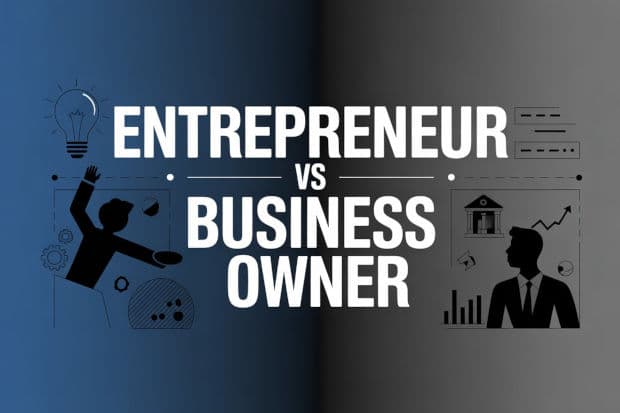
Everyone with an Instagram shop calls themselves an entrepreneur these days — but Elon Musk and your neighborhood grocery store owner are fundamentally different kinds of people, even if both run businesses. This article breaks down the real differences between entrepreneurs and business owners across 15+ dimensions, using global and Bangladesh examples, a self-assessment quiz, and honest pros and cons. Both roles are valuable — you just need to know which one you actually are.
Open Instagram in Bangladesh right now and you will find hundreds of people calling themselves entrepreneurs. Every small online shop, every homemade food seller, every freelancer — all proudly wearing the 'entrepreneur' label. Social media has made the word fashionable. But there is a real, meaningful difference that is worth understanding.
Elon Musk is an entrepreneur. Your corner shop owner who has been serving the neighborhood for 30 years is a business owner.
Both create value. Both deserve respect. But they think differently, operate differently, and have completely different goals. Understanding this distinction is not about putting labels on people — it is about understanding yourself and choosing the right path for your personality and ambitions.
Steve Jobs = Entrepreneur. The pharmacist who has run the same shop for three decades = Business Owner.
Both successful, both honorable — but fundamentally different. Let us dig into exactly what sets them apart.
An entrepreneur creates something new — a new product, service, market, or way of doing things. Innovation is the core. Joseph Schumpeter called entrepreneurs the agents of 'creative destruction': they break old industries and build new ones. Peter Drucker defined entrepreneurship as the act of creating something new and different.
Simply put: an entrepreneur does not play on an existing field — they build an entirely new field.
1. Innovation-driven: they create new things rather than copy what already works.
2. High risk tolerance: they are willing to bet everything on an unproven idea.
3. Visionary: they can see what does not yet exist and believe it is possible.
4. Growth-obsessed: scale, scale, scale — 10x or 100x growth is the target.
5. Market disruptors: they shake up existing industries rather than fitting neatly inside them.
6. Often serial: they work on multiple ventures, not just one.
7. Exit-oriented: they build to sell or take public, not necessarily to run forever.
Elon Musk: Tesla (electric cars), SpaceX (commercial space), Neuralink (brain chips) — multiple disruptions across multiple industries.
Steve Jobs: personal computer, then smartphone, then digital music — each one reshaped an entire industry.
Jeff Bezos: online bookstore, then everything store, then cloud computing — relentless reinvention.
Bangladesh — Fazle Hasan Abed: built BRAC and redefined what development organizations can achieve at global scale.
Bangladesh — Kamal Quadir: created bKash and built the mobile money market in Bangladesh from scratch.
Bangladesh — Pathao founders: introduced ride-hailing to the Bangladesh context and created a new urban mobility market.
A business owner runs an established business model — typically a proven one in an existing market. They may not have invented the model, but they operate it with skill and discipline. The core focus is stability, profitability, and day-to-day operations.
Simply put: a business owner plays by proven rules — and aims to be the best at playing that game.
1. Operations-focused: running things efficiently and reliably is the primary goal.
2. Moderate risk: calculated steps, not reckless bets.
3. Practical: they execute a proven model rather than experiment with unproven ideas.
4. Stability-oriented: sustainable profit matters more than explosive growth.
5. Works within existing markets: they serve demand rather than create entirely new categories.
6. Usually one business: a lifetime commitment to a single enterprise.
7. Builds to keep: the goal is to pass it to children or run it forever, not to sell it.
Your neighborhood grocery store that has served the community for 20 years. A successful garments factory owner running CMT operations. A pharmacy chain. A real estate developer. A catering business passed from parent to child.
They run proven models effectively. They create jobs, pay taxes, serve their communities.
They are the backbone of the economy. Their contribution should never be underestimated or dismissed.
The table below maps out the core differences between the two mindsets across 15 dimensions:
| Aspect | Entrepreneur | Business Owner |
| Core motivation | Innovation | Stability |
| Primary goal | Disrupt markets, change the world | Run a profitable, lasting operation |
| Risk appetite | Extremely high (often bets everything) | Moderate (calculated) |
| Relationship with innovation | Creates new things | Operates existing models |
| Growth trajectory | Exponential (10x-100x target) | Linear (10-20% per year) |
| Market approach | Creates new markets | Serves existing demand |
| Funding sources | VC, angel investors, IPO | Personal savings, bank loans |
| Failure rate | Very high (90%+ startups fail, CB Insights) | Lower (proven model reduces risk) |
| Time horizon | Build fast, exit | Build slowly, keep forever |
| Hiring philosophy | Hire for vision and mission | Hire for specific job functions |
| Revenue focus | Growth first, profit later | Profit from day one |
| Scalability | Must be highly scalable | May not scale beyond local/regional |
| Legacy | Company outlives the founder | Family business passes through generations |
| Global example | Elon Musk | McDonald's franchise owner |
| Bangladesh example | bKash's Kamal Quadir | Successful garments factory owner |
Disclaimer: The categories above describe general tendencies. In reality, many individuals display a mix of both mindsets and may shift from one to the other at different stages of their career.
1. Massive wealth potential: Bezos $200B+, Musk $200B+ — this scale of wealth creation is only possible through entrepreneurship.
2. Global-scale impact: Grameen Bank changed microfinance worldwide; bKash changed how millions of Bangladeshis move money.
3. Intellectual excitement: solving problems that have never been solved before is deeply satisfying.
4. Freedom to create: there is nothing quite like building something from zero.
1. 90%+ failure rate: according to CB Insights, most startups fail — often in the first two years.
2. Extreme stress and isolation: the entrepreneurial journey is mentally brutal in ways most people cannot imagine.
3. Years without income: no salary in the early stages; you burn your own savings.
4. Relationships suffer: family time and friendships shrink under the pressure of building something.
5. Society does not always understand: explaining 'I run a startup' is still met with blank stares in many circles.
1. Stable, predictable income: mental peace and the ability to plan your life around reliable cash flow.
2. Lower risk: a proven model means less uncertainty and a higher chance of survival.
3. Community roots: you become a trusted, recognized face in your neighborhood or industry.
4. Generational asset: a well-run business can be passed to children as a lasting family legacy.
5. Work-life balance is achievable: once systems are in place, a business owner can maintain reasonable hours.
1. Growth ceiling: the market and model set a natural limit on how big you can get.
2. Monotony risk: doing the same thing year after year can feel repetitive.
3. Disruption vulnerability: an entrepreneur can come along and make your entire model obsolete.
4. Exit is complicated: no VC buyout waiting for you; selling a traditional business is harder than selling a startup.
The bottom line: society needs both. An economy of only entrepreneurs is chaotic and unstable. An economy of only business owners is stagnant and fails to innovate. Balance is what makes economies thrive.
Elon Musk: electric cars, commercial space, brain chips — serial disruption across industries no one thought could be disrupted.
Mark Zuckerberg: social networking was not a new concept, but Facebook created an entirely new category at global scale.
Muhammad Yunus: microcredit as a financial model did not exist in its modern form before Grameen Bank — a true social innovation.
Brian Chesky: Airbnb turned private homes into hotels and shook the entire hospitality industry to its core.
Ray Kroc: did not invent McDonald's — he took the existing model from the McDonald brothers and scaled it with ruthless operational excellence.
Warren Buffett: he is an investor and business owner, not an entrepreneur — he buys and manages existing businesses rather than creating new categories.
Most franchise owners: they run a proven system provided by someone else; they do not invent anything new.
Three-generation restaurant chains: successful family businesses passed from parent to child, built to last rather than to disrupt.
Many people start as entrepreneurs and become business owners once the innovation phase ends. Steve Jobs in 1976 at Apple was a pure entrepreneur. Steve Jobs in 2007 launching the iPhone was more of a business leader running a massive organization. Jeff Bezos started as an entrepreneur; Amazon in 2024 is a corporate business empire.
The table below classifies famous figures for educational clarity:
| Name | Entrepreneur or Business Owner? | Why? | Key Trait |
| Elon Musk | Entrepreneur | Tesla, SpaceX, Neuralink — each created a new industry | Serial Disruptor |
| Warren Buffett | Business Owner / Investor | Buys and manages existing businesses, creates no new categories | Value Investor |
| Ray Kroc | Business Owner (Scaler) | Did not invent McDonald's, scaled the existing model | Operational Excellence |
| Muhammad Yunus | Entrepreneur | Microcredit — a completely new financial model for the world | Social Innovator |
| Kamal Quadir | Entrepreneur | bKash — created the mobile money market in Bangladesh | Market Creator |
| Successful garments owner | Business Owner | Runs proven CMT model with skill and efficiency | Operations Master |
| Brian Chesky | Entrepreneur | Airbnb — redefined hospitality with a platform model | Platform Innovator |
| McDonald's franchise owner | Business Owner | Follows a proven system, invents nothing new | System Operator |
Disclaimer: This classification is for educational purposes. In reality, many individuals' careers pass through both mindsets over time.
Answer these 5 questions honestly. Each one has two options — pick the one that genuinely fits you, not the one that sounds impressive:
Question 1: Do you want to create something new, or run something proven that already works?
Question 2: Can you handle years of uncertainty and the real possibility of failure without breaking down?
Question 3: Do you obsess over growth and scale, or do you value stability and consistency?
Question 4: Are you building something to eventually sell, or something to keep and run for life?
Question 5: Does risk energize you, or does predictability bring you peace?
Mostly first options = Entrepreneur mindset. Mostly second options = Business Owner mindset.
Neither answer is right or wrong. This is about honesty — knowing your true nature so you can choose the right path. A lot of unhappiness in business comes from entrepreneurs trying to be business owners, and business owners trying to be entrepreneurs.
For a more detailed self-assessment: https://georenus.com/analyzer/business-readiness-analyzer-pro
This is extremely common and completely natural. Once the startup phase ends and a model is proven, the focus shifts from innovation to operations. Facebook 2004 = Entrepreneur. Meta 2024 = Corporate Business. This is not a failure — it is evolution. The skills needed to launch something are different from the skills needed to run it at scale.
How it happens: the innovation cycle completes, the market stabilizes, and operational excellence becomes more valuable than creative disruption.
This is less common but powerful when it happens. A business owner who spots a new opportunity and decides to pursue it rather than stay comfortable. A traditional media owner who launches a digital platform. A restaurant chain owner who builds a food delivery app. A garments manufacturer who creates a fashion technology startup.
How it happens: market disruption creates a gap, the owner has the capital and credibility to act, and they choose courage over comfort.
Many Bangladeshi garments owners (business owners) are now investing in tech startups — transitioning, at least partly, into the entrepreneur mindset. bKash itself started with full entrepreneurial energy and has since matured into a business operations model as the market became established.
Key insight: this transformation is natural and often positive. Flexibility and self-awareness are what make the difference between thriving and getting stuck.
Bangladesh has 8 million+ SMEs. The vast majority of these are business owners running proven models — and that is enormously valuable.
Business owners provide: employment (80%+ of private sector jobs), stability, community services, and the tax base that funds public goods.
Entrepreneurs provide: innovation, global competitiveness, new markets, and the disruptive breakthroughs that push the entire economy forward.
What Bangladesh needs more of: true entrepreneurs in tech, agri-tech, health-tech, and climate solutions. The country has enormous talent and pressing problems that need innovative solutions — not just efficient execution of proven models.
But Bangladesh also needs better support for its business owners — simpler regulations, better financing, lower corruption, and more dignity for the people who quietly keep the economy running every single day.
Support both. Because both are absolutely essential to Bangladesh's economic future.
Entrepreneur and business owner — both valuable, just different. Knowing which one you are means making better decisions: the right funding, the right team, the right goals, and the right measure of success for your situation.
Do not call yourself an entrepreneur just because it sounds cool. And do not dismiss business owners as 'not innovative enough.' Both build economies. Both create jobs. Both matter.
'An entrepreneur is someone who jumps off a cliff and builds a plane on the way down.' — Reid Hoffman (LinkedIn founder)
'A business owner builds something that works. An entrepreneur builds something that changes how things work.' — Anonymous
Final word: whichever path you choose, pursue excellence in it. Know yourself first — then move forward with full commitment.

In 1944, as the world was still engulfed in the devastation of World War II, the global economy had collapsed and people’s living standards had plummeted. In an effort to stabilize the international economy and address pressing global financial issues, the Allied nations convened a historic summit. Nearly 730 delegates from 44 countries gathered at the Mount Washington Hotel in Bretton Woods, New Hampshire, for the United Nations Monetary and Financial Conference. The outcome of this summit was the landmark Bretton Woods Agreement, which gave birth to the Bretton Woods System.