Fixed Cost vs Variable Cost -- The Complete Guide to Understanding Your Business Expenses
G
GeoRenus Editorial Team
1,089 views
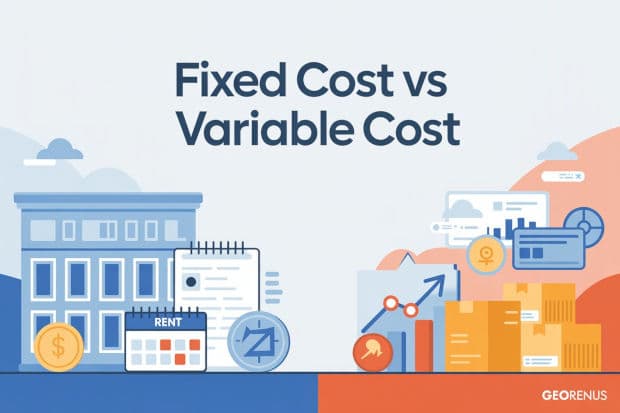
Summary
Fixed costs are expenses that remain constant regardless of how much you produce or sell -- such as rent, salaries, and insurance. Variable costs are expenses that rise or fall in direct proportion to production or sales volume -- such as raw materials, packaging, and shipping. Understanding the distinction between these two cost types is fundamental to pricing strategy, break-even analysis, profit planning, and business scalability. This guide covers definitions, formulas, three detailed real-world examples (restaurant, e-commerce, SaaS), industry cost structure benchmarks, operating leverage, and strategies for managing both cost types effectively.
Key Takeaways
- Fixed costs stay constant regardless of production or sales volume -- rent, salaries, and insurance are classic examples.
- Variable costs change in direct proportion to output -- raw materials, packaging, and shipping costs rise and fall with your sales.
- Contribution Margin = Selling Price - Variable Cost per Unit. It tells you how much each sale contributes toward covering your fixed costs.
- Break-Even Point = Total Fixed Costs / Contribution Margin. This is the minimum sales volume you need to avoid a loss.
- Per-unit fixed cost decreases as volume rises -- this is the mathematical foundation of economies of scale.
- High fixed cost businesses (airlines, SaaS, telecom) have high operating leverage -- profits scale fast, but losses can be devastating.
- SaaS businesses are the ultimate fixed-cost machines -- add 1,000 more users and variable costs barely move.
- In 2020, airlines lost $370 billion because 75% of their costs were fixed. Consulting firms (80% variable) survived by cutting projects.
- Every hiring, equipment, and outsourcing decision is a tradeoff between fixed and variable costs. Understand the implications before you decide.
- List every business expense, mark it F or V, then calculate your contribution margin and break-even point. This single exercise can transform your business strategy.
Introduction -- The Cost Structure That Killed Blockbuster
In 1999, Blockbuster Video was the undisputed king of home entertainment. It had over 9,000 stores worldwide, employed 60,000 people, and generated nearly $6 billion in annual revenue. Then a little startup called Netflix showed up with a DVD-by-mail service and later pivoted to streaming.
But here is what most people miss: Blockbuster did not die simply because Netflix had a better idea. Blockbuster died because of its cost structure.
Blockbuster carried lease obligations exceeding $200 million per month in fixed costs. Every single one of those 9,000 stores had a lease. Every month, the bills came due -- whether customers walked in or not.
Netflix, on the other hand, built a business with servers and content licenses. When they grew, they added more server capacity (a variable cost that scaled with demand). When users dropped off, costs could be trimmed. Blockbuster had no such flexibility.
In 2010, Blockbuster filed for bankruptcy with over $1 billion in debt. The stores that were once its greatest strength had become its anchor.
The COVID-19 pandemic in 2020 replayed this lesson on a global scale. Airlines, which carry roughly 75% fixed costs (planes, crews, airport leases, maintenance contracts), lost an estimated $370 billion globally. Planes sat grounded on tarmacs, but the bills kept arriving every month.
Meanwhile, consulting firms, advertising agencies, and freelance-driven businesses -- which run on 70-80% variable costs -- simply reduced their project load and rode out the storm. No project, no cost. It really is that simple.
"Only when the tide goes out do you discover who has been swimming naked." -- Warren Buffett
Buffett was talking about financial leverage, but the same wisdom applies to cost structure. During good times, a heavy fixed cost base looks like confidence -- big offices, full-time teams, long leases. During bad times, it looks like a trap.
Understanding fixed costs versus variable costs is not just an accounting exercise. It is the foundation of pricing strategy, break-even analysis, profit planning, hiring decisions, and long-term business survival. Whether you run a food truck, a software startup, or a manufacturing plant, your cost structure shapes every major decision you make.
Let's break it all down -- clearly, practically, and with real numbers.
What Are Fixed Costs?
A fixed cost is any business expense that remains constant regardless of how much you produce or how many units you sell. Whether your business has a record month or sells absolutely nothing, fixed costs keep accumulating.
The defining characteristic: fixed costs do not respond to changes in output volume.
If you run a bakery and your monthly rent is $2,000, you pay $2,000 in January whether you sell 500 loaves or 5,000 loaves. The rent does not know -- or care -- how many croissants you made. That is a fixed cost.
Here are the most common categories of fixed costs across businesses:
Rent and property leases: Office space, retail storefronts, warehouses, manufacturing floors -- any space you are committed to paying for on a monthly or annual lease.
Employee salaries: Salaried employees (not hourly workers) cost the same every month regardless of output. A $5,000/month operations manager costs $5,000 whether the business is booming or slow.
Insurance premiums: Business liability, property, health, and workers' compensation insurance are typically fixed annual or monthly costs.
Loan repayments and interest: If you took a $100,000 business loan at a fixed rate, your monthly repayment is fixed regardless of revenue.
Depreciation: When you buy equipment, its cost is spread over its useful life. A $60,000 delivery vehicle depreciated over 5 years costs $1,000/month regardless of how many deliveries it makes.
Software subscriptions: Monthly SaaS tools -- accounting software, CRM platforms, project management tools -- are fixed recurring costs.
Property taxes and business licenses: Government fees do not fluctuate with your sales. You pay them on schedule.
Equipment leases: Leased printers, refrigerators, ovens, or manufacturing equipment cost the same each month.
One important nuance: 'fixed' does not mean 'unchangeable forever.' It means the cost does not change IN RESPONSE to output volume. Rents can be renegotiated at lease renewal. Salaries can be adjusted annually. But in the short term, these costs are locked in.
There is also a concept called semi-fixed costs (also called step costs). These are fixed up to a certain point, then jump to a new level. For example, one warehouse might be enough for 10,000 monthly orders, but at 10,001 orders, you need a second warehouse. The cost does not scale smoothly -- it steps up in chunks.
A cautionary tale about fixed costs at scale: WeWork. At its 2019 peak, WeWork had committed to over $47 billion in long-term office leases around the world. Every single one of those leases was a fixed cost. When office occupancy dropped -- first from the pandemic, then from remote work trends -- WeWork could not reduce its expenses. The company's valuation collapsed from $47 billion to under $9 billion within a year. Its fixed cost structure made it extraordinarily fragile.
| Business Type | Fixed Cost Examples | Typical Monthly Range (USD) |
| Restaurant | Rent, chef salary, staff salaries, insurance, POS system, licenses | $8,000 - $25,000 |
| E-commerce | Warehouse rent, team salaries, platform fees, tools, photography | $4,000 - $15,000 |
| SaaS | Developer salaries, base server costs, office, marketing team | $10,000 - $80,000 |
| Manufacturing | Factory rent, machinery depreciation, management salaries, utilities base | $20,000 - $500,000 |
| Retail Store | Storefront lease, staff salaries, insurance, store fixtures | $5,000 - $30,000 |
| Consulting Firm | Office rent, partner salaries, software subscriptions | $3,000 - $20,000 |
| Food Truck | Truck payment/lease, insurance, permits, commissary kitchen fees | $1,500 - $4,000 |
Note: Ranges are approximate and vary significantly by city, business size, and industry. Use these as directional benchmarks only, not precise figures.
Fixed costs are the backbone of your business -- they define the minimum you need to earn before you make a single dollar of profit. The higher your fixed costs, the more you need to sell just to stay alive.
What Are Variable Costs?
A variable cost is any expense that changes in direct proportion to your production or sales volume. More output means higher variable costs. Less output means lower variable costs. Zero output means zero variable costs.
The defining characteristic: variable costs move lockstep with your business activity.
If each product you sell requires $5 in raw materials, then selling 100 products costs you $500, selling 1,000 products costs $5,000, and selling zero products costs you nothing. The relationship is perfectly proportional.
Variable costs are always calculated on a per-unit basis. The key question is: what does it cost me to produce or deliver one more unit?
Common variable cost categories include:
Raw materials and components: The direct inputs that go into each product. For a furniture maker, this is lumber, screws, and fabric. For a restaurant, it's food ingredients.
Direct labor (hourly/per-unit): Hourly workers, piece-rate workers, or contractors paid per job. Unlike salaried employees, their cost scales with work volume.
Packaging: Boxes, bags, labels, tape, and protective materials that are used per shipment or per product.
Shipping and fulfillment: Every order shipped incurs a postage or courier cost. 500 orders = 500 shipping costs.
Sales commissions: Commission-based salespeople cost you money only when they make a sale. Zero sales, zero commission.
Payment processing fees: Stripe, PayPal, and credit card processors typically charge around 2.9% + $0.30 per transaction. More transactions, more fees.
Production utilities: Electricity, gas, and water that are directly tied to running machines or cooking food scale with production volume.
Consumable supplies: Items consumed during production -- cutting blades, cleaning chemicals, gloves -- that are used proportionally to output.
A common mistake is misclassifying costs as variable when they are actually fixed. A salaried sales representative who earns $5,000/month whether they close deals or not is a fixed cost. A commission-only rep who earns 10% on every sale is a variable cost. The contract structure determines the classification, not the job title.
Amazon's variable cost advantage: Amazon has invested billions into its own logistics network -- delivery vans, fulfillment robots, regional warehouses. This infrastructure allows them to achieve a per-package fulfillment cost of approximately $2-3. A small e-commerce business using third-party shipping typically pays $5-8 per order. At Amazon's scale, those per-unit savings are worth billions annually.
The strategic insight here is that variable costs can often be reduced through scale, negotiation, and process improvement -- but they will never disappear entirely as long as you are making and selling things.
| Business Type | Variable Cost Examples | Per Unit Range (USD) |
| Restaurant | Ingredients, packaging (takeaway), cooking gas, payment processing | $4 - $10 per plate |
| E-commerce | Product cost, packaging, shipping, payment gateway fees, returns reserve | $15 - $35 per order |
| SaaS | Server scaling, payment processing, customer support, email/notifications | $0.50 - $3 per user/month |
| Manufacturing | Raw materials, direct labor, machine consumables, quality control | $5 - $200 per unit |
| Retail | Cost of goods sold, credit card processing, shrinkage | $3 - $50 per transaction |
| Consulting | Contractor fees, project-specific software, travel expenses | $50 - $300 per project hour |
| Food Truck | Ingredients, packaging, cooking supplies, transaction fees | $2 - $6 per item |
Note: Variable cost ranges are illustrative estimates. Actual costs depend on supplier relationships, order volume, geography, and operational efficiency. Always calculate your own per-unit costs.
The beauty of variable costs is their flexibility. When business is slow, your variable cost burden naturally shrinks. This is why businesses with high variable cost structures tend to be more resilient during downturns -- their expenses breathe with the business.
Fixed vs Variable -- The Key Differences
Now that we have defined both cost types, let's compare them directly across every important dimension. This comparison forms the foundation of everything that follows.
| Feature | Fixed Cost | Variable Cost |
| Definition | Remains constant regardless of output volume | Changes in direct proportion to output volume |
| Relationship to output | No relationship -- independent of production level | Direct relationship -- scales with every unit produced |
| At zero production | Still incurred (rent is due even if you make nothing) | Zero -- if you produce nothing, you pay nothing |
| Common examples | Rent, salaries, insurance, depreciation, loan payments | Raw materials, packaging, shipping, commissions, processing fees |
| Calculation method | Total cost (does not divide cleanly per unit at varying volumes) | Always calculated per unit of output |
| Per-unit behavior | Decreases as volume increases (economies of scale) | Stays roughly constant per unit regardless of volume |
| Time frame | Short-term: locked in. Long-term: can be renegotiated | Adjusts in real time with production decisions |
| Risk profile | High risk in downturns -- costs continue even with zero revenue | Low risk in downturns -- costs fall with revenue |
| Control ease | Harder to reduce quickly (leases, employment contracts) | Easier to control -- reduce output to reduce costs |
| Impact on break-even | Higher fixed costs = higher break-even point | Lower variable costs = higher contribution margin = lower BEP |
| Best suited for | Businesses expecting stable, high-volume output | Businesses with uncertain or seasonal demand |
| Accounting treatment | Period costs or depreciation schedules | Product costs tied directly to cost of goods sold |
Note: Some costs can be either fixed or variable depending on how they are structured. Electricity, for example, has a fixed base charge (fixed) plus a usage-based component (variable). Always analyze the specific contract or billing structure.
The most powerful insight from this comparison is how per-unit fixed costs behave as volume changes.
Example of economies of scale: Imagine a factory that pays $10,000/month in rent.
At 1,000 units produced: Fixed cost per unit = $10,000 / 1,000 = $10.00
At 5,000 units produced: Fixed cost per unit = $10,000 / 5,000 = $2.00
At 10,000 units produced: Fixed cost per unit = $10,000 / 10,000 = $1.00
The rent did not change. Not by a single dollar. But the per-unit fixed cost dropped from $10 to $1 -- a 90% reduction -- simply by increasing output volume. This is the mathematical foundation of economies of scale, and it is why large manufacturers can undercut smaller competitors on price while still earning higher margins.
Variable costs behave completely differently. If your material cost is $5 per unit, it is $5 whether you make 10 units or 10,000 units. There is no automatic economies-of-scale benefit (though you can negotiate bulk discounts, which is a separate lever).
This difference -- fixed costs shrinking per unit at scale, variable costs staying constant -- is why businesses chase volume. More volume does not just mean more revenue. It means fundamentally lower per-unit costs, higher margins, and a stronger competitive position.
The Formulas You Need to Know
Finance books love making this complicated. They don't need to. Here are the five formulas that govern everything in cost analysis, explained plainly.
Total Cost
TC = Total Fixed Costs + (Variable Cost per Unit x Quantity)
This is the master formula. It tells you exactly what it costs to operate at any given output level. If your fixed costs are $5,000/month and your variable cost per unit is $8, then producing 500 units costs $5,000 + ($8 x 500) = $9,000.
Cost per Unit
CPU = (Fixed Cost / Quantity) + Variable Cost per Unit
This formula shows your total cost for each unit sold. Notice that as quantity increases, the fixed cost portion gets smaller and smaller, driving down your total cost per unit. At low volumes, CPU is very high. At high volumes, CPU approaches just the variable cost per unit. This is the economies of scale effect in equation form.
Contribution Margin
CM per Unit = Selling Price per Unit - Variable Cost per Unit
The contribution margin is arguably the most important number in business. It tells you how much money each unit sale 'contributes' toward covering your fixed costs -- and then, once fixed costs are covered, toward profit.
If you sell a product for $25 and it costs $10 in variable costs to produce and deliver, your contribution margin is $15. Every sale puts $15 toward your rent, salaries, and other fixed costs. After you sell enough units to cover all fixed costs, every additional $15 is pure profit.
Break-Even Point
BEP (in units) = Total Fixed Costs / Contribution Margin per Unit
The break-even point is the exact sales volume at which your total revenue equals your total costs -- zero profit, zero loss. Below this number, you are losing money. Above it, you are making money.
Higher fixed costs = higher BEP = more units needed before you turn profitable.
Lower variable costs = higher CM = fewer units needed to break even.
This formula instantly reveals whether a business model is viable. If your BEP requires you to sell 50,000 units in a market of 10,000 potential customers, you have a structural problem that no amount of hustle can fix.
Operating Leverage
Degree of Operating Leverage (DOL) = Contribution Margin / Operating Income
Operating leverage measures how sensitive your profit is to changes in sales volume. A high DOL means that a small increase in sales leads to a large increase in profit -- but also that a small decrease in sales leads to a large decrease (or even a swing to a loss).
High fixed + low variable costs = high operating leverage. Examples: airlines, SaaS companies, telecom providers, streaming platforms.
Low fixed + high variable costs = low operating leverage. Examples: consulting firms, freelancers, staffing agencies, trading companies.
High leverage is great in a bull market or growth phase. It is dangerous in a downturn. Understanding your operating leverage is essential for risk management and financial planning.
| Formula | Equation | What It Reveals | Quick Example |
| Total Cost | FC + (VC/unit x Qty) | Total cost to operate at a given volume | FC=$5K, VC=$8, Qty=500 -> TC=$9,000 |
| Cost per Unit | (FC/Qty) + VC/unit | Average cost per unit at a given volume | FC=$5K, Qty=500, VC=$8 -> CPU=$18 |
| Contribution Margin | Price - VC/unit | Profit contribution per sale before fixed costs | Price=$25, VC=$10 -> CM=$15 |
| Break-Even Point | FC / CM per unit | Minimum units to sell to avoid a loss | FC=$5K, CM=$15 -> BEP=334 units |
| Operating Leverage | CM / Operating Income | Sensitivity of profit to volume changes | CM=$15K, Op.Income=$5K -> DOL=3x |
Note: These formulas assume a simplified single-product, linear cost model. Real businesses have multiple products, step costs, volume discounts, and mixed cost structures. Use these as frameworks for analysis, not as precise accounting outputs.
Mastering these five formulas -- not just memorizing them, but understanding what drives each variable -- gives you the analytical lens to evaluate any business model, investment, or pricing decision.
Example 1 -- A Restaurant
Let's ground these concepts in a real-world scenario. Meet Marco, who runs a mid-sized Italian restaurant in a mid-tier city. He serves lunch and dinner, offers takeaway, and averages about 60-80 plates per day on a busy week.
Marco's monthly fixed costs: these are the bills he pays every month no matter what.
Rent: $2,500 | Head chef salary: $3,500 | Three front-of-house staff salaries: $4,500 | Base utility package: $500 | Business insurance: $300 | POS system subscription: $100 | Business license and permits: $100
Total Monthly Fixed Costs: $11,500
Marco's variable costs per plate: these change with every plate he serves.
Ingredients: $4.50 | Takeaway packaging (average): $0.50 | Gas/cooking energy per plate: $0.30 | Delivery platform fee (on delivery orders): $1.00 | Payment processing: $0.20
Total Variable Cost per Plate: $6.50
Average selling price per plate: $15.00
Contribution Margin = $15.00 - $6.50 = $8.50 per plate
Break-Even Point = $11,500 / $8.50 = 1,353 plates per month = roughly 45 plates per day
So Marco needs to sell about 45 plates every single day just to cover his costs. That is his survival number. On days he sells fewer than 45 plates, he is losing money. On days he sells 80 plates, he is building toward his profit.
At 80 plates/day (2,400 plates/month):
Revenue: $36,000 | Variable Costs: $15,600 | Fixed Costs: $11,500 | Monthly Profit: $8,900
The moment Marco understands these numbers, his decision-making changes. Should he hire a part-time server? That increases fixed costs by maybe $1,500/month, raising his break-even by 176 plates/month (~6 plates/day). Is that extra service worth it? Now he can actually calculate the answer.
| Item | Amount (Monthly) | Cost Type |
| Rent | $2,500 | Fixed |
| Head Chef Salary | $3,500 | Fixed |
| Front-of-House Staff (3) | $4,500 | Fixed |
| Base Utilities | $500 | Fixed |
| Business Insurance | $300 | Fixed |
| POS System Subscription | $100 | Fixed |
| Business License and Permits | $100 | Fixed |
| TOTAL FIXED COSTS | $11,500 | Fixed |
| Ingredients (per plate) | $4.50 | Variable |
| Takeaway Packaging (per plate) | $0.50 | Variable |
| Cooking Gas/Energy (per plate) | $0.30 | Variable |
| Delivery Platform Fee (per plate) | $1.00 | Variable |
| Payment Processing (per plate) | $0.20 | Variable |
| TOTAL VARIABLE COST (per plate) | $6.50 | Variable |
| Selling Price (per plate) | $15.00 | - |
| Contribution Margin | $8.50 | - |
| Break-Even (plates/month) | 1,353 | - |
Note: Restaurant economics vary widely by location, cuisine type, and service model. These figures are illustrative and based on a mid-sized, moderately priced sit-down/takeaway hybrid. Fine dining and fast food operations have dramatically different cost profiles.
The restaurant example illustrates why so many eateries fail. High fixed costs (rent is the killer), thin margins, and a business that is always two slow weeks away from missing payroll. The restaurants that survive long-term are those that manage their cost structure obsessively.
Example 2 -- An E-Commerce Business
Now let's look at Sophie, who runs an online store selling handmade skincare products. She operates out of a small warehouse, handles orders with a small team, and ships across the country through a third-party courier.
Sophie's monthly fixed costs:
Shopify plan: $39 | Warehouse rental: $1,200 | Team (2 part-time employees): $4,000 | Tools and software (email, analytics, ads platform): $250 | Product photography and content: $400 | Domain and hosting: $50
Total Monthly Fixed Costs: $5,939
Sophie's variable costs per order:
Product cost (materials + labor): $12.00 | Packaging (box, tissue, sticker): $1.50 | Shipping courier: $4.50 | Payment gateway fee (3%): $0.90 | Returns reserve (estimated per order): $1.50
Total Variable Cost per Order: $20.40
Average selling price per order: $30.00
Contribution Margin = $30.00 - $20.40 = $9.60 per order
Break-Even Point = $5,939 / $9.60 = 619 orders per month = roughly 21 orders per day
At 1,000 orders/month:
Revenue: $30,000 | Variable Costs: $20,400 | Fixed Costs: $5,939 | Monthly Profit: $3,661
Sophie's business has a much lower fixed cost base than a restaurant -- under $6,000 per month versus Marco's $11,500. This means her break-even is achievable at a much lower order volume. However, her contribution margin ($9.60) is also thinner than ideal, largely because her product cost ($12 per order) is high relative to her selling price ($30).
To improve profitability, Sophie has two levers: raise the selling price (risky if customers are price-sensitive) or reduce variable costs -- negotiate better material costs at higher purchase volumes, switch to a cheaper courier, reduce return rates through better product descriptions and quality control.
| Item | Amount (Monthly / Per Order) | Cost Type |
| Shopify Plan | $39/month | Fixed |
| Warehouse Rental | $1,200/month | Fixed |
| Team (2 part-time) | $4,000/month | Fixed |
| Tools and Software | $250/month | Fixed |
| Product Photography/Content | $400/month | Fixed |
| Domain and Hosting | $50/month | Fixed |
| TOTAL FIXED COSTS | $5,939/month | Fixed |
| Product Cost (materials + labor) | $12.00/order | Variable |
| Packaging | $1.50/order | Variable |
| Shipping | $4.50/order | Variable |
| Payment Gateway Fee (3%) | $0.90/order | Variable |
| Returns Reserve | $1.50/order | Variable |
| TOTAL VARIABLE COST | $20.40/order | Variable |
| Selling Price | $30.00/order | - |
| Contribution Margin | $9.60/order | - |
| Break-Even | 619 orders/month | - |
Note: E-commerce cost structures vary significantly based on product type, fulfillment method (self-fulfilled vs. 3PL vs. dropship), and sales channels. These figures are based on a small, self-fulfilled direct-to-consumer operation and should not be used as benchmarks for other business models.
E-commerce businesses sit in an interesting middle ground -- lower fixed costs than physical retail, but variable costs that can quickly eat into margins if shipping, returns, and payment processing are not carefully managed. The best operators track their cost per order obsessively.
Example 3 -- A SaaS Product
Finally, let's look at Alex and Priya, who built a project management SaaS tool for small businesses. They charge $19/month per user and have built a lean team. Their product runs on cloud infrastructure that scales automatically with user demand.
Monthly fixed costs:
Developer salaries (2 engineers): $10,000 | Base server/cloud infrastructure: $1,200 | Office coworking space: $1,500 | Tools (GitHub, Figma, Intercom, etc.): $400 | Marketing team (1 person): $3,500
Total Monthly Fixed Costs: $16,600
Variable costs per user per month:
Server scaling per user: $0.20 | Payment processing (Stripe ~5%): $0.90 | Customer support allocation: $0.50 | Email/notifications: $0.05
Total Variable Cost per User: $1.65/month
Price per user: $19.00/month
Contribution Margin = $19.00 - $1.65 = $17.35 per user per month
Break-Even Point = $16,600 / $17.35 = 957 users
At 5,000 users:
Revenue: $95,000 | Variable Costs: $8,250 | Fixed Costs: $16,600 | Monthly Profit: $70,150
Profit margin at 5,000 users: 73.8%
This is why venture capitalists pour billions into SaaS companies. The math is extraordinary. Once Alex and Priya have covered their fixed costs at 957 users, every additional user adds $17.35 in pure profit -- because variable costs are only $1.65 per user.
At 50,000 users: Revenue $950,000 | Variable $82,500 | Fixed $16,600 | Profit: $850,900/month. And fixed costs barely moved.
This is the magic of a low variable cost structure. The product was built once (massive fixed cost investment upfront), but delivering it to the 50,000th user costs almost nothing more than delivering it to the first. Software does not run out. Servers scale. The economics are fundamentally different from any physical product business.
| Metric | Restaurant (Marco) | E-Commerce (Sophie) | SaaS (Alex & Priya) |
| Monthly Fixed Costs | $11,500 | $5,939 | $16,600 |
| Variable Cost per Unit | $6.50 / plate | $20.40 / order | $1.65 / user |
| Selling Price | $15.00 / plate | $30.00 / order | $19.00 / user |
| Contribution Margin | $8.50 (57%) | $9.60 (32%) | $17.35 (91%) |
| Break-Even Point | 1,353 plates/month | 619 orders/month | 957 users |
| Profit at 3x BEP | ~$14,500/month | ~$12,100/month | ~$35,400/month |
| Operating Leverage | Medium | Low-Medium | Very High |
| Scalability Rating | Low | Medium | Very High |
Note: These three examples are simplified models using a single-tier pricing structure. Real businesses have promotions, discounts, multiple product lines, churning customers (SaaS), and operational inefficiencies not captured here. The purpose is to illustrate structural differences, not precise projections.
The three-way comparison is illuminating. The restaurant and e-commerce business both have meaningful variable costs that limit how profitable they can get. The SaaS business has a 91% contribution margin -- meaning for every dollar of revenue above the break-even threshold, ninety-one cents flows directly to the bottom line.
Industry Cost Structures -- Who Pays What?
Your individual business is not operating in a vacuum. Understanding how your industry's typical cost structure compares to others reveals your competitive dynamics, your risk profile, and your scalability ceiling.
| Industry | Fixed % | Variable % | Operating Leverage | Risk in Downturn | Scalability |
| Airlines | ~75% | ~25% | Very High | Extreme | High |
| SaaS / Software | ~80% | ~20% | Very High | High | Very High |
| Manufacturing | ~40% | ~60% | Medium | Medium | Medium |
| Restaurants | ~45% | ~55% | Medium | High | Low |
| E-commerce | ~25% | ~75% | Low | Low | Medium |
| Consulting / Freelance | ~20% | ~80% | Very Low | Very Low | Low |
| Retail (Physical) | ~35% | ~65% | Medium | Medium | Medium |
| Telecom | ~70% | ~30% | High | High | High |
| Pharmaceutical | ~60% | ~40% | High | Medium | Very High |
| Media / Streaming | ~65% | ~35% | High | High | High |
Note: These are approximate industry-level averages based on publicly available financial data and analyst research. Individual companies within each industry can differ substantially based on their operating model, outsourcing strategy, and stage of growth. Fixed/variable splits also change over time as companies scale.
The COVID-19 pandemic in 2020 was a brutal stress test of these cost structures. Airlines, with roughly 75% fixed costs, could not turn off their expenses when flights dropped by over 90%. The global airline industry lost an estimated $370 billion in two years -- not because of bad management, but because of a cost structure that had no off switch.
Meanwhile, consulting firms, staffing agencies, and freelance-driven businesses simply reduced their active project load. Fewer projects meant fewer contractor costs, fewer project expenses, fewer billable hours. The variable nature of their cost base gave them the flexibility to survive by shrinking.
The lesson: a business with high fixed costs needs consistently high volumes to be viable. A business with high variable costs can survive at low volumes, but will struggle to achieve the profit margins that high-fixed-cost businesses can reach at scale.
Neither structure is universally superior. The 'right' cost structure depends on your industry, your growth stage, your risk appetite, and your access to capital. Early-stage startups usually benefit from variable-heavy structures (lean, flexible, lower burn rate). Mature, high-revenue businesses often deliberately take on more fixed costs to build operational leverage and defend market position.
The Do's and Don'ts
The Do's
Do map every single expense: Create a master list of all monthly expenses and classify each as Fixed, Variable, or Mixed. Most business owners are surprised by how many costs they have forgotten about.
Do calculate your contribution margin by product line: Not all products are equally profitable. Your best-selling product might have a terrible contribution margin while a less popular item carries the business.
Do know your break-even point at all times: This number should be printed and posted somewhere visible. Every member of your team should understand what 'we need to sell X units to cover costs' means.
Do stress-test your cost structure: Ask yourself: if revenue dropped 30% tomorrow, what would happen? Run the math. If the answer is 'we'd be insolvent in three months,' your fixed cost base is too high.
Do negotiate fixed costs aggressively: Rents, insurance, software subscriptions, and equipment leases are often negotiable. A 15% reduction in rent is equivalent to a permanent increase in contribution margin on every unit you sell.
Do convert fixed costs to variable where possible during uncertainty: Hiring freelancers instead of full-time employees, using pay-per-use cloud infrastructure instead of dedicated servers, and renting equipment instead of buying are all ways to reduce fixed cost exposure.
Do use break-even analysis before making major investments: Thinking about opening a second location? Adding a new product line? Calculate the new fixed cost burden and what contribution margin increase is needed to justify it.
Do track contribution margin trends over time: If your CM is shrinking month over month, you have either a pricing problem or a variable cost creep problem. Catch it early.
The Don'ts
Don't classify semi-variable costs carelessly: Utilities, maintenance, and hourly staff are mixed costs. Splitting them into fixed and variable components gives you a more accurate picture than dumping them all into one category.
Don't let fixed costs grow unchecked during good times: When revenue is strong, it is tempting to sign long leases, expand office space, and hire aggressively. Remember that every new fixed cost raises your break-even permanently.
Don't price without knowing your contribution margin: Selling a product below its variable cost -- even temporarily as a 'loss leader' -- destroys cash. Know your floor.
Don't confuse sunk costs with ongoing fixed costs: Money already spent on equipment is a sunk cost. The decision to continue operating should be based on future costs and revenues, not on what you already spent.
Don't assume variable costs are always proportional: At very high volumes, variable costs can decrease (bulk material discounts) or increase (overtime wages, expedited shipping). Build these non-linearities into your models.
Don't ignore the timing mismatch: Fixed costs are due monthly regardless of when revenue arrives. A business with seasonal revenue needs enough cash reserve to cover fixed costs during lean months.
Don't benchmark your costs against different industries: A 60% fixed cost ratio is perfectly normal for a telecom company but dangerously high for a restaurant. Always benchmark within your industry.
Don't make hiring decisions without modeling the cost impact: Every salaried hire is a permanent increase in your fixed costs and therefore your break-even point. Model it before you commit.
Advantages and Disadvantages
Both fixed and variable cost structures have genuine strengths and weaknesses. The best businesses understand both sides and make deliberate choices about their cost architecture.
High Fixed Cost Structure
Advantages:
Economies of scale: As volume increases, per-unit fixed costs drop dramatically, enabling higher margins and competitive pricing at scale.
Margin expansion: Revenue growth falls almost entirely to the bottom line once fixed costs are covered. This is why mature high-fixed-cost businesses can have extraordinary profit margins.
Competitive moat: Large fixed cost investments (factories, infrastructure, proprietary systems) are hard for competitors to replicate quickly, creating natural barriers to entry.
Predictable cost base: Knowing your costs are mostly fixed makes budgeting and financial planning much more straightforward.
Disadvantages:
High risk in downturns: Revenue can collapse overnight; fixed costs cannot. This combination can burn through cash reserves with terrifying speed.
Operational inflexibility: Long leases, employment contracts, and equipment purchases cannot be easily undone when business conditions change.
High break-even point: A large fixed cost base means you need significant revenue just to stay afloat, which is stressful for early-stage businesses.
Capital intensity: Building a high-fixed-cost business typically requires substantial upfront investment in assets, infrastructure, and team.
High Variable Cost Structure
Advantages:
Low downside risk: Costs fall naturally when revenue falls. In recessions or slow periods, the business can survive by simply doing less.
Operational flexibility: You can scale up or down quickly in response to market conditions without being locked into long-term cost commitments.
Lean startup-friendly: High variable cost structures allow businesses to launch and test with minimal upfront capital. Great for bootstrapped ventures and uncertain markets.
Low break-even point: Fewer fixed costs means you need less revenue to stay solvent, reducing existential risk.
Disadvantages:
Limited margin expansion at scale: Variable costs keep rising with revenue, preventing the dramatic margin improvement that fixed-cost businesses enjoy.
No economies of scale (by default): Without fixed assets and infrastructure, you do not automatically get cheaper per-unit costs as you grow.
Easily replicated: Without proprietary infrastructure or assets, competitors can copy your model with similar variable costs.
Revenue ceiling: Some variable cost models have a practical capacity limit (one consultant can only serve so many clients) that fixed-cost models do not face.
| Dimension | High Fixed Cost | High Variable Cost |
| Economies of Scale | Strong (per-unit cost drops with volume) | Weak (per-unit cost stays constant) |
| Margin at Scale | Excellent (profits expand rapidly) | Moderate (margins are capped by variable cost) |
| Downside Risk | High (costs continue in downturns) | Low (costs fall with revenue) |
| Flexibility | Low (locked into contracts) | High (easy to adjust) |
| Capital Requirement | High (upfront investment needed) | Low (pay-as-you-go) |
| Break-Even Point | High (needs significant revenue) | Low (achievable at low volume) |
| Competitive Moat | Strong (hard to replicate infrastructure) | Weak (easily copied) |
| Best for | Stable, high-volume, mature businesses | Early-stage, seasonal, or uncertain markets |
Note: Most real businesses have a mix of both fixed and variable costs. The goal is not to eliminate one type but to find the optimal balance for your specific market, growth stage, and risk tolerance.
Conclusion -- Know Your Costs, Know Your Business
Every single major business decision you make is, at its core, a choice between fixed and variable costs.
Hire a full-time employee (fixed) or work with a freelancer (variable)?
Buy equipment outright (fixed depreciation) or rent it month to month (variable)?
Sign a five-year lease on a bigger office (fixed) or stay in your current space (lower fixed)?
Build your own fulfillment warehouse (fixed) or use a third-party logistics provider who charges per order (variable)?
None of these decisions is automatically right or wrong. But each one shifts your break-even point, changes your contribution margin, alters your operating leverage, and shapes how your business behaves in both good times and bad.
Blockbuster made a bet on fixed costs -- thousands of expensive leases -- and it worked beautifully for two decades. Until the market shifted and those leases became a death sentence. Airlines made the same bet on expensive, long-depreciation aircraft. In normal times, the economics are stunning. In a global pandemic, the losses were catastrophic.
The most sophisticated business operators do not just track their costs. They understand the structure of their costs -- the ratio of fixed to variable, the break-even under different scenarios, the operating leverage that magnifies both gains and losses.
"In business, the biggest risk is not knowing your own numbers."
Here is an exercise that could genuinely change how you run your business. Open a spreadsheet. List every single expense your business incurs over a month. Mark each one with an F (fixed) or V (variable). Add up each column. Then calculate your contribution margin and break-even point.
That exercise -- done honestly and completely -- will tell you more about your business's health and risk profile than any revenue report or vanity metric.
Because at the end of the day, revenue tells you what people are willing to pay for what you offer. But your cost structure tells you whether you can actually build a sustainable, profitable business around it. Know your numbers. Know your structure. Know your business.
Recommended for you

SWOT Analysis
A ‘SWOT’ analysis is essentially a planning process that helps an organization identify new directions it can pursue while overcoming its challenges. The acronym ‘SWOT’ stands for Strengths, Weaknesses, Opportunities, and Threats. Therefore, a SWOT analysis is an excellent strategy for evaluating these four aspects of any organization.
Business
Red Ocean and Blue Ocean Strategy: Fight the Competition or Make It Irrelevant — The Complete Guide

Canvas & Methods
Minimum Viable Product (MVP): The Smart Way to Launch Your Business With Less Risk
Logo
Types of Logos: A Complete Guide to Every Logo Style You See Every Day

Marketing
The 7 P's of Marketing: The Complete Framework Every Business Needs
Organization
What Is the International Monetary Fund (IMF)?

Agreement
Basel Accords

Business
Break-Even Analysis — When Does Your Business Actually Start Making Money?
Analysis
Root Cause Analysis: The Five Whys Method Explained

Analysis
MOST Analysis: Definition, Framework, and How to Use It