What Should You Read for Business — The Complete Knowledge Blueprint for Entrepreneurs
G
GeoRenus Editorial Team
980 views
GeoRenus Editorial Team
Warren Buffett reads 500 pages daily, Bill Gates reads 50 books a year — the world's most successful entrepreneurs are relentless readers. This comprehensive guide covers every knowledge area you need for business success: accounting, marketing, operations, law, leadership, strategy, and personal development — with curated book lists, data-backed insights, and a stage-by-stage reading blueprint.
Picture this: it's 7 AM in Omaha, Nebraska. The world's most successful investor is already at his desk — not checking his phone, not sitting in meetings, not fielding calls from Wall Street. He's reading. He will spend approximately 80% of his day doing exactly this, working through roughly 500 pages of annual reports, newspapers, and books before the sun goes down.
Warren Buffett has built a net worth exceeding $100 billion through a strategy that sounds almost too simple: read voraciously, think clearly, act patiently. When asked the secret to his success, Buffett once pointed to a stack of books and said:
"Read 500 pages like this every day. That's how knowledge works. It builds up, like compound interest."
But Buffett is not alone in his reading obsession. Bill Gates reads approximately 50 books per year and is so serious about his intellectual development that he takes two 'Think Weeks' annually — a full week of isolation with nothing but books, notepads, and his own thoughts, twice a year. These retreat periods have directly influenced some of Microsoft's biggest strategic pivots.
Mark Cuban reads 3+ hours daily and has said plainly that he attributes his competitive edge not to luck or genius, but to outworking and out-reading competitors. 'I read every book and magazine I could,' he once explained. 'Turns out most people won't do that. So just by reading, I could dominate the competition.'
Then there's Elon Musk, who literally taught himself rocket science by reading textbooks. Engineers at SpaceX, one of the most technically demanding companies in history, were reportedly astonished at how deeply Musk had absorbed aerospace engineering knowledge entirely through books. When asked how he learned to build rockets, his answer was disarmingly simple: 'I read books.'
Charlie Munger, Buffett's legendary business partner, put it most bluntly: "In my whole life, I have known no wise people who didn't read all the time — none, zero." Munger himself reads for hours every day well into his nineties, collecting mental models across disciplines like a human encyclopedia.
So the reading habit of elite entrepreneurs is well established. But here's the critical question that this article exists to answer: WHAT should you read? Because not all business reading is created equal. Reading the wrong material at the wrong stage of your entrepreneurial journey can be just as costly as not reading at all.
A University of Phoenix study found that approximately 65% of small business owners lack knowledge in at least one critical business area. The SBA reports that approximately 20% of businesses fail in their first year and 50% by year five — and the number one reason is consistently lack of knowledge and planning, not lack of effort or resources.
This article is your complete blueprint — a curated, stage-aware, story-driven guide to exactly what you need to study to build a successful business. We cover twelve critical knowledge areas, from accounting to strategy, from operations to personal development, with real stories, hard data, and specific book recommendations in every section.
"But where do you even begin? With thousands of business books published every year, how do you separate the essential from the noise?"
That's the question we're going to answer, section by section, with the same rigor that Buffett brings to reading an annual report.
"Accounting is the language of business. If you want to be a successful investor or businessperson, you need to be able to read and understand financial statements." — Warren Buffett
Most aspiring entrepreneurs instinctively gravitate toward the exciting parts of business: the marketing campaigns, the product launches, the leadership culture. Accounting feels dry, technical, even intimidating. And that instinct is exactly why so many businesses fail. Because accounting isn't just a back-office function — it's the scoreboard, the navigation system, and the early warning radar of your entire operation.
Consider the story of Sara Blakely, founder of Spanx and one of the world's youngest self-made female billionaires. Before she had a business plan, an office, or even a product design, she sat down and taught herself accounting from books. She didn't hire a CFO first or take a course at a business school. She bought accounting textbooks, read them cover to cover, and built enough financial fluency to make smart decisions from day one. That foundation helped her bootstrap Spanx to a $1 billion valuation without a single outside investor.
The lesson isn't that you need to become a certified public accountant. The lesson is that you need enough financial literacy to ask the right questions, understand the answers, and recognize when something is wrong before it becomes catastrophic.
Every business, whether it's a sole proprietorship or a Fortune 500 corporation, lives and dies by three core financial documents: the Balance Sheet, the Income Statement (also called the Profit and Loss statement), and the Cash Flow Statement. You must understand all three — because they tell completely different stories, and ignoring any one of them can kill a business that looks healthy on paper.
The Balance Sheet shows what you own (assets), what you owe (liabilities), and what's left over (equity) at a specific point in time. Think of it as a photograph of your financial position.
The Income Statement shows revenues, costs, and profit over a period. This is what most people think of as 'how the business is doing' — but it's dangerously incomplete by itself.
The Cash Flow Statement is arguably the most important document of all. A business can be profitable on paper and bankrupt in reality if cash isn't flowing in fast enough to pay bills.
Here's a sobering story: Toys 'R' Us. For years, the company showed reasonable profits on its income statement. But a closer look at its balance sheet revealed $5 billion in debt and a cash flow statement bleeding red. When interest payments ate up operating cash, the company couldn't invest in e-commerce to compete with Amazon. In 2017, one of America's most iconic toy retailers filed for bankruptcy — not because it wasn't selling toys, but because it couldn't manage its financial structure.
Then there's Enron — 'profitable' for years on its income statement, its stock price soaring to $90 per share at its peak. But the real story was hidden off-balance-sheet liabilities and accounting fraud that eventually revealed $74 billion in losses. The financial statements were there; most investors just didn't read them carefully enough.
The ability to read and interpret all three financial statements isn't optional for a business owner. It's the minimum viable financial education.
Understanding historical financial statements tells you where you've been. Budgeting and forecasting tell you where you're going — and whether you'll survive the journey. These are the planning tools that separate businesses that grow intentionally from those that drift forward hoping for the best.
Zero-based budgeting (ZBB) is a discipline where every expense must be justified from scratch at the beginning of each period — rather than simply adjusting last year's numbers. Companies like Unilever and AB InBev have used ZBB to cut billions in unnecessary costs. For an entrepreneur, ZBB creates radical clarity about where money is actually going versus where you assume it's going.
Consider the early days of Airbnb in 2008. The company had a product that barely anyone was using, and the founders were completely running out of cash. Not because they had a bad idea — but because they hadn't forecasted their cash needs properly. Their solution was creative desperation: they designed and sold custom cereal boxes called 'Obama O's' and 'Cap'n McCain's' during the presidential election, raising around $30,000 to keep the company alive. The lesson: financial modeling and cash forecasting aren't administrative chores — they're survival tools.
Financial modeling basics every entrepreneur needs include: building a 12-month cash flow projection, understanding break-even analysis, scenario planning (best case, worst case, base case), and knowing your runway — how many months you can operate at current burn rate before running out of money.
Taxes are the one expense that every business owner must understand, because the tax code is simultaneously the government's most powerful revenue tool and the entrepreneur's most powerful legal savings mechanism. The difference between a business owner who understands tax strategy and one who doesn't can be worth tens of thousands of dollars per year.
The four core business taxes every owner must understand: income tax (federal and state on profits), sales tax (collected on transactions, varies by jurisdiction), payroll tax (employer contributions for employees), and corporate tax (if you're structured as a C-Corp, currently 21% federal rate in the US).
Jeff Bezos famously prioritizes his tax strategy: Amazon has paid relatively minimal corporate taxes for many years by reinvesting profits into the business. 'The tax code is the most efficient legal way to grow your money,' is a principle that sophisticated business owners internalize early.
Beyond taxes, compliance knowledge includes: proper business registration in your state and country, obtaining necessary licenses and permits, understanding annual filing requirements, payroll compliance, and employment law basics. Ignorance of compliance obligations doesn't exempt you from penalties — regulators don't grade on a curve.
Financial Intelligence by Karen Berman and Joe Knight is widely considered the best introduction to financial literacy for non-financial managers. It teaches you how to read financial statements without a background in accounting, using plain language and real business stories.
The Intelligent Investor by Benjamin Graham — Warren Buffett's favorite book, which he first read at age 19 — teaches the mental framework for analyzing businesses through their numbers. Even if you never invest in stocks, the analytical mindset Graham teaches is invaluable for evaluating your own business.
Accounting Made Simple by Mike Piper is exactly what it sounds like: a concise, jargon-free guide for absolute beginners. At under 100 pages, it can be read in a weekend and provides a solid foundation for understanding financial statements.
| Topic | What to Learn | Best Resource | Time to Learn | Priority |
| Financial Statements | Balance Sheet, P&L, Cash Flow | Financial Intelligence (Berman) | 2-3 weeks | Critical |
| Budgeting & Forecasting | Zero-based budgeting, cash projections, break-even | CFO-level YouTube courses + Excel | 3-4 weeks | Critical |
| Tax Basics | Income, sales, payroll, corporate tax | IRS publications + local CPA | 2 weeks | High |
| Investment Thinking | Value, risk, compound returns, financial ratios | The Intelligent Investor (Graham) | 4-6 weeks | High |
| Accounting Fundamentals | Debits/credits, journal entries, GAAP basics | Accounting Made Simple (Piper) | 1-2 weeks | Medium |
| Financial Modeling | Excel modeling, scenario analysis, valuation | Coursera / CFI online courses | 4-6 weeks | Medium |
Note: This table reflects estimated learning timelines for self-study. Actual time may vary based on prior knowledge and study intensity. Consult a licensed accountant or financial advisor for business-specific guidance.
"Numbers tell you where your business IS. But how do you get customers to give you those numbers in the first place? That's where marketing comes in — and it's as much science as it is art."
"The aim of marketing is to know and understand the customer so well the product or service fits him and sells itself." — Peter Drucker
Great marketing doesn't feel like marketing. When it's done right, customers don't feel sold to — they feel understood. And that distinction separates businesses that constantly fight for attention from those that attract customers like gravity.
In 2012, a startup called Dollar Shave Club released a single YouTube video with a production budget of $4,500. In the first 48 hours, they gained 12,000 subscribers. The video went viral not because of special effects or celebrity endorsements, but because it spoke directly to what men were thinking about overpriced razor blades. Four years later, Unilever acquired Dollar Shave Club for $1 billion. A $4,500 investment in marketing clarity turned into a billion-dollar exit.
But most entrepreneurs approach marketing backwards — they build a product, then try to figure out who wants it. The most successful businesses flip this process entirely. They start with a deep understanding of their customer, then build a product that fits that understanding so precisely it almost markets itself.
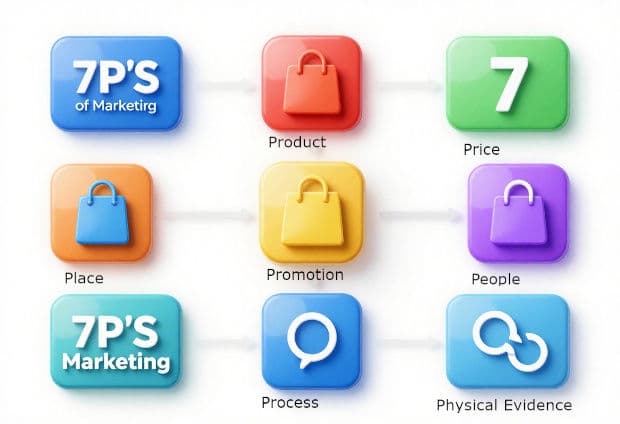
The classic 4Ps of marketing — Product, Price, Place, Promotion — have evolved for the modern era into the 4Cs: Customer solution (instead of product), Cost to the customer (instead of price), Convenience (instead of place), and Communication (instead of promotion). The shift is subtle but profound: it moves the entire marketing mindset from what the company wants to sell, to what the customer wants to buy.
The STP Framework — Segmentation, Targeting, Positioning — is the strategic foundation of effective marketing. Segmentation means dividing your total market into groups with shared characteristics. Targeting means choosing which segment to focus on. Positioning means deciding how you want that segment to think of your brand relative to alternatives.
Nike doesn't sell shoes. This is one of the most important marketing insights in business history. Nike sells aspiration, identity, and the feeling of athletic achievement. Their "Just Do It" campaign, launched in 1988, helped grow revenue from approximately $800 million to $9.2 billion over the following decade — not by improving the shoes, but by transforming the emotional meaning of wearing them.
HubSpot's annual State of Marketing report consistently finds that approximately 61% of marketers say generating traffic and qualified leads is their top challenge. The implication: most businesses have something to sell but struggle to be found, heard, and trusted by the right people.
In the modern business environment, digital marketing literacy isn't optional — it's table stakes. A business that doesn't understand how to be found online might as well not exist for the roughly half of all product searches that begin on a digital platform.
Google processes approximately 8.5 billion searches per day. Search Engine Optimization (SEO) is the discipline of making your business show up when people search for what you offer. Content Marketing is the practice of creating valuable information that attracts and educates your target customers. Social Media marketing builds communities and brand awareness. Email Marketing — still one of the highest ROI channels — keeps existing customers engaged. And Paid Advertising (PPC) puts your message in front of targeted audiences immediately.
Glossier is a case study in digital marketing done right. The beauty brand built a valuation of $1.2 billion almost entirely through Instagram and community building, without traditional advertising. Founder Emily Weiss started with a beauty blog, built an engaged audience of real women talking about real products, and turned that community into a customer base. The product was almost secondary to the community.
Every entrepreneur should have working knowledge of: how search engines rank content, how social media algorithms work, how to set up and measure email campaigns, and how to interpret basic analytics (website traffic, conversion rates, customer acquisition cost, lifetime value).
Here's an uncomfortable truth: every entrepreneur is in sales, whether they like it or not. You sell your product to customers. You sell your vision to employees. You sell your business case to investors. You sell your ideas to partners. Sales is not a department — it's a fundamental business competency.
Robert Cialdini's landmark book "Influence," published in 1984, identified 6 universal principles of persuasion: Reciprocity (people return favors), Commitment and Consistency (people act in line with past commitments), Social Proof (people follow the crowd), Authority (people trust experts), Liking (people say yes to people they like), and Scarcity (people want what is rare). These principles are embedded in virtually every effective marketing and sales strategy ever created.
Daniel Pink's "To Sell Is Human" argues with data that we spend approximately 40% of our work time in what he calls 'non-sales selling' — persuading, influencing, and moving people even outside formal sales contexts. Understanding sales psychology is not optional; it's embedded in most of what entrepreneurs do every day.
Apple Stores generate approximately $5,546 in revenue per square foot — the highest of any retailer in the world. They achieve this not through high-pressure sales tactics, but through an experience design that makes customers feel comfortable, educated, and respected. Apple's retail philosophy is built entirely on applied sales psychology.
Steve Blank, the godfather of the Lean Startup movement, famously observed: "No business plan survives first contact with customers." This isn't cynicism — it's a fundamental insight about the gap between what entrepreneurs think customers want and what customers actually need.
The Lean Startup methodology, developed by Eric Ries and built on Blank's work, offers a disciplined framework: Build → Measure → Learn. Instead of spending months or years building a perfect product in isolation, entrepreneurs build the smallest possible version (Minimum Viable Product), release it to real customers, measure what happens, and use the feedback to decide whether to persist, pivot, or stop.
Dropbox's origin story is perhaps the purest example of customer validation done right. Founder Drew Houston didn't build the product first — he made a simple explainer video showing how Dropbox would work. He posted it online and collected email signups from people who wanted to be notified when it launched. 75,000 people signed up overnight. The product didn't exist yet, but market demand was validated. Dropbox was built knowing customers were waiting.
Customer validation disciplines every serious entrepreneur should know: customer interviews (how to ask questions without leading the witness), survey design, A/B testing, landing page validation, and how to interpret user behavior data.
| Area | Key Concepts | Must-Read Book | Practical Application |
| Marketing Strategy | STP, 4Ps/4Cs, brand positioning, value proposition | Building a StoryBrand (Donald Miller) | Rewrite your homepage messaging |
| Digital Marketing | SEO, content, social, email, PPC, analytics | This Is Marketing (Seth Godin) | Launch a content marketing channel |
| Sales Psychology | Cialdini's 6 principles, consultative selling, objection handling | Influence (Robert Cialdini) | Audit sales copy for persuasion principles |
| Consumer Behavior | Decision-making, social proof, cognitive biases | Contagious (Jonah Berger) | Design a referral or word-of-mouth campaign |
| Customer Validation | MVP, Build-Measure-Learn, customer interviews | The Lean Startup (Eric Ries) | Run 10 customer discovery interviews |
| Pricing Strategy | Value-based, cost-plus, competitive, freemium, tiered | Confessions of the Pricing Man (Simon) | Review current pricing model |
Note: Book recommendations are based on widespread industry endorsement and educator consensus. Results from applying marketing principles vary based on market, product, and execution quality.
"Marketing fills the pipeline. But none of it matters if your operations can't deliver the promise. Behind every great customer experience is an even greater operational system."
Most business books spend their time on the glamorous parts: the vision, the brand, the fundraising. But the unsexy truth is that the businesses that dominate their industries for decades don't win on vision alone — they win on the relentless, systematic improvement of how they actually operate.
Taiichi Ohno, a production engineer at Toyota in the 1950s, developed what became known as the Toyota Production System (TPS). Ohno's central obsession was eliminating waste — any activity that consumes resources without adding value for the customer. He developed Just-In-Time manufacturing (produce what's needed, when it's needed, in the exact quantity needed) and built a culture of continuous improvement he called Kaizen. The result: Toyota went from a small regional automaker struggling to survive to the world's largest automobile manufacturer by volume.
The lesson from Toyota is transferable to any business: systematic operational excellence compounds over time. Small improvements made consistently become insurmountable competitive advantages.
Operations management is the science and art of designing, controlling, and improving the processes that create and deliver your product or service. It covers process design (how work flows through your organization), quality control (ensuring consistent standards), capacity planning (matching resources to demand), and inventory management (optimizing how much stock you hold and when).
No company demonstrates operational consistency better than McDonald's. The same Big Mac — same taste, same texture, same appearance — is served in 119 countries across 40,000+ locations. This isn't accidental. It's the result of Ray Kroc's obsessive documentation and standardization of every process, from the exact thickness of each potato slice to the precise temperature of each cooking surface. Kroc once said he was in the real estate business, not the hamburger business — but his real genius was in operational systems.
Six Sigma, a quality management methodology originally developed at Motorola and perfected at General Electric under Jack Welch, targets fewer than 3.4 defects per million opportunities. Kaizen (Japanese for 'continuous improvement') involves every employee in ongoing small improvements. Lean Manufacturing focuses on eliminating the 7 wastes: overproduction, waiting, transport, over-processing, inventory, motion, and defects. These aren't just manufacturing concepts — they apply directly to service businesses, software companies, and even solo entrepreneurs.
Your supply chain is every step that happens between raw materials and your customer's hands. For product businesses, this includes sourcing, manufacturing, warehousing, and logistics. For service businesses, it includes your vendor relationships, staffing pipeline, and service delivery systems. Supply chain disruptions can destroy even healthy, profitable businesses almost overnight.
The COVID-19 pandemic provided the most dramatic demonstration of supply chain fragility in modern history. Global supply chains — optimized for efficiency rather than resilience — collapsed under the strain, costing the global economy an estimated $4 trillion in disruptions. Businesses that had diversified suppliers, larger safety stock buffers, and contingency plans weathered the storm far better than those running purely lean, single-source supply chains.
Zara's supply chain is a masterclass in competitive advantage through operations. While most fashion retailers take 6 months from design to store shelf, Zara does it in 2 weeks. This gives Zara approximately 12 inventory turns per year compared to the industry average of 3-4. The result: Zara rarely has overstock, rarely discounts, and captures current fashion trends before competitors have even approved designs.
Amazon's logistics network is another extraordinary operational achievement: 175+ fulfillment centers worldwide, same-day delivery in dozens of cities, and a growing fleet of delivery vehicles and aircraft. Amazon turned logistics from a cost center into a competitive moat — and then started selling that logistics capability to other businesses through Fulfillment by Amazon (FBA).
You don't need to be a software engineer to run a modern business. But you do need basic technology literacy, because almost every business function — from customer relationship management to financial reporting to inventory tracking — now runs on digital systems. A business owner who can't navigate these tools is as handicapped as one who can't read a spreadsheet.
McKinsey's research estimates that approximately 60% of all occupations have at least 30% of activities that could be automated with currently available technology. Understanding which parts of your business can and should be automated — and which genuinely require human judgment — is a core leadership competency.
Tools every business owner should have working knowledge of: ERP systems (SAP, Oracle, or smaller alternatives like NetSuite for smaller companies) coordinate operations across departments. CRM platforms (Salesforce, HubSpot) manage customer relationships and sales pipelines. Project management tools (Asana, Trello, Notion) keep teams aligned and accountable. Understanding how to evaluate, implement, and get value from these tools is now a business literacy requirement, not a technical luxury.
| Area | What to Learn | Real-World Example | Recommended Resource |
| Process Design | Workflow mapping, bottleneck analysis, standardization | McDonald's kitchen system consistency | The Goal (Goldratt) |
| Quality Control | Six Sigma, DMAIC methodology, error proofing | Toyota's zero-defect manufacturing | Lean Thinking (Womack & Jones) |
| Supply Chain | Sourcing, inventory optimization, logistics, risk management | Zara's 2-week design-to-shelf | Supply Chain Management (Chopra) |
| Technology & Tools | ERP, CRM, automation, data analytics fundamentals | Amazon's FBA logistics network | The Phoenix Project (Kim) |
| Lean & Kaizen | Waste elimination, continuous improvement, 5S methodology | Toyota Production System | The Toyota Way (Jeffrey Liker) |
| Capacity Planning | Demand forecasting, resource allocation, scaling operations | Netflix server scaling strategy | Operations Management (Stevenson) |
Note: Operational tools and methodologies listed here are illustrative and may require professional implementation guidance. Technology costs and implementation timelines vary significantly by company size and industry.
"You can build the best product and the smoothest operation in the world. But without legal protection, everything you build can be taken from you in a courtroom."
Law is the part of business education that most entrepreneurs skip — until they can't. Until a co-founder dispute locks up the company. Until a vendor dispute paralyzes operations. Until a competitor copies their trademark. Until an employee sues. By then, the legal education they needed costs ten times what it would have cost to get it proactively.
Consider the most famous legal dispute in Silicon Valley history. In 2004, Harvard students Cameron and Tyler Winklevoss, along with Divya Narendra, approached Mark Zuckerberg to help build a social network called HarvardConnection. Zuckerberg agreed to help — then launched Facebook instead. The Winklevosses sued, claiming Zuckerberg stole their idea. They eventually settled for $65 million in Facebook stock and cash.
But here's the painful postscript: Facebook went public in 2012 valued at over $100 billion, and is now worth over $500 billion. The Winklevosses had no written agreement, no documented IP assignment, no formal partnership structure — just an email chain and a handshake. The lesson isn't that Zuckerberg was right. The lesson is that legal documentation protects everyone, including you.
The legal structure of your business determines how you pay taxes, how much personal liability you carry, how easily you can bring in investors, and how the business is treated when you sell or close it. The main options: Sole Proprietorship (simplest, but no liability protection), Partnership (shared ownership, shared liability), LLC or Limited Liability Company (liability protection plus tax flexibility — the most popular structure for small businesses), C-Corporation (preferred by venture investors, subject to double taxation), and S-Corporation (pass-through taxation with some corporate protections).
The tax implications of each structure can be enormous. LLCs are 'pass-through' entities — profits flow directly to owners' personal tax returns. C-Corps pay corporate tax on profits AND shareholders pay personal income tax on dividends (the 'double taxation' problem). S-Corps pass through like LLCs but have restrictions on shareholders.
Most venture-backed tech startups incorporate in Delaware — not because that's where they operate, but because Delaware has the most sophisticated and entrepreneur-friendly business court system in the US (the Court of Chancery), exceptionally flexible corporate laws, and a long history of precedent that gives investors confidence. Approximately 68% of Fortune 500 companies are incorporated in Delaware.
Contracts are promises made enforceable by law. Without them, you're running your business on goodwill and memory — two things that deteriorate rapidly when money is on the line. Every serious business relationship should be documented in writing before work begins.
The essential contracts every entrepreneur needs: Non-Disclosure Agreement (NDA) — protects confidential information shared with potential partners, employees, or investors. Operating Agreement — governs how your LLC is managed and how disputes are resolved. Partnership Agreement — critical for any co-founder relationship (most startup failures involve co-founder disputes). Employment Contracts — define roles, compensation, IP ownership, and non-compete terms. Vendor/Supplier Agreements — detail pricing, delivery terms, quality standards, and remedies. Terms of Service and Privacy Policy — essential for any online business to limit liability and meet regulatory requirements.
Here's a cautionary tale about what happens without proper employment contracts: a tech startup spent 18 months and significant investment building a proprietary software platform. When three of their core engineers left to join a competitor, the startup discovered they had no non-compete clause and, critically, no intellectual property assignment clause in the employment agreement. The engineers could — legally — take their knowledge of the codebase, the architecture decisions, and the problem-solving approaches and apply them directly for a competitor. The startup had to rebuild from scratch.
Your intellectual property — the ideas, designs, brands, and processes that make your business unique — may be your most valuable asset. And unlike physical assets, IP can be stolen without the original being missing. Understanding how to protect it is not optional.
Trademarks protect brand names, logos, and slogans. Patents protect inventions and processes for limited periods (typically 20 years). Copyrights protect original creative works automatically upon creation. Trade Secrets protect confidential business information — formulas, processes, methods — indefinitely, as long as reasonable steps are taken to keep them secret.
Coca-Cola's secret formula is the world's most famous trade secret. The company has deliberately chosen NOT to patent it — because patents expire after 20 years, after which anyone can copy the formula legally. Trade secrets, by contrast, can last forever. The formula has been kept confidential for over 130 years and is estimated to be worth approximately $80 billion. It is reportedly stored in a vault at the World of Coca-Cola museum in Atlanta, accessible to only two Coca-Cola executives at any given time.
Apple and Samsung fought one of the most expensive patent wars in corporate history, with Apple winning a judgment of over $1 billion against Samsung in 2012 for copying iPhone design elements. The legal battle stretched across a decade and multiple countries, demonstrating that IP protection isn't just defensive — it's a competitive weapon.
| Area | What You Need | Risk If Ignored | Estimated Legal Cost |
| Business Structure | Articles of incorporation/organization, EIN, state registration | Unlimited personal liability | $500–$2,000 |
| Partnerships/Co-founders | Partnership or shareholder agreement, equity split documentation | Ownership disputes, deadlock, forced dissolution | $1,500–$5,000 |
| Employment | Offer letters, IP assignment, confidentiality, non-compete | IP theft, wrongful termination suits | $500–$3,000 |
| Contracts | Vendor, customer, and service agreements | Payment disputes, unenforceable deals | $500–$2,000 per agreement |
| Trademarks | Federal trademark registration for brand name/logo | Brand dilution, loss of name rights | $350–$1,500 per class |
| Patents | Utility or design patents for inventions | Competitors copy your product legally | $5,000–$15,000+ |
| Online Business | Terms of Service, Privacy Policy, GDPR/CCPA compliance | Regulatory fines, user lawsuits | $500–$3,000 |
Note: Legal costs are estimates based on US market averages and vary significantly by jurisdiction, complexity, and attorney rates. This table is for educational purposes only and does not constitute legal advice. Always consult a qualified attorney for your specific situation.
"Legal structure is the foundation your business stands on. But the people inside your business are the ones who actually build it. How you lead them determines whether you build a company or just a job."
"Great things in business are never done by one person. They're done by a team of people." — Steve Jobs
Steve Jobs was famous for his relentless standards and demanding personality. But the insight behind this quote reveals something profound: even Jobs — perhaps the most celebrated individual product visionary in business history — understood that his vision could only be realized through a team. The Macintosh, the iPhone, the iPod — none of these were one-person achievements. They were team achievements made possible by extraordinary leadership.
Reed Hastings at Netflix created one of the most influential documents in modern management when he published the Netflix Culture Deck — a 125-slide presentation describing Netflix's philosophy of 'Freedom and Responsibility.' The document has been viewed over 15 million times and Sheryl Sandberg called it 'the most important document ever to come out of Silicon Valley.' Its core insight: treat employees like responsible adults, give them freedom, hold them to exceptional standards, and compensate them above market. The result was a culture that attracted and retained world-class talent.
There's a powerful principle in talent management: "A players hire A players, B players hire C players." B players feel threatened by exceptional talent and unconsciously select people who won't outshine them. A players, by contrast, want to be surrounded by people who will challenge and elevate them. This cascading talent effect means that a single hiring mistake at the leadership level can degrade the talent quality of an entire organization over time.
Google's Project Oxygen was a remarkable attempt to answer a seemingly simple question with data: what makes a great manager? Google analyzed performance reviews, feedback surveys, and nominations for top manager awards for thousands of managers, identifying 8 key behaviors of the best managers. The number one behavior was not technical expertise or business acumen. It was: be a good coach. People don't leave companies; they leave managers. The data confirmed what intuition had long suggested.
Ray Dalio at Bridgewater Associates, the world's largest hedge fund, implements what he calls 'radical transparency' — a system where all meetings are recorded and accessible to all employees, where anyone can challenge anyone's thinking (including the CEO's), and where performance data is public within the organization. The principle: when all information is available and all reasoning is challengeable, better decisions emerge. It's an extreme approach, but it illustrates how intentionally designed talent and culture systems can become competitive advantages.
There is no single right way to lead. Effective leaders adapt their style to the situation, the team, and the organizational stage. Understanding the spectrum of leadership frameworks gives you the vocabulary and judgment to deploy the right approach at the right time.
Servant Leadership, developed by Robert Greenleaf, inverts the traditional hierarchy: instead of employees serving the leader, the leader's primary role is to serve the employees — removing obstacles, providing resources, developing capabilities, and creating conditions for the team to do their best work. This philosophy has influenced leaders from Howard Schultz at Starbucks to Ken Blanchard's work on situational leadership.
Satya Nadella's transformation of Microsoft is one of the most studied leadership case studies of the 21st century. When Nadella became CEO in 2014, Microsoft was widely perceived as an aging tech giant that had missed mobile, cloud, and the cultural shift to open-source. Nadella's first move wasn't a product launch or an acquisition — it was a cultural transformation. He replaced what he called a "know-it-all" culture with a "learn-it-all" culture, drawing on Carol Dweck's growth mindset research. Microsoft's stock price, which was approximately $40 when Nadella took over, climbed above $400 as the company transformed into a cloud-first enterprise powerhouse.
The quote attributed to Peter Drucker — "Culture eats strategy for breakfast" — has become one of the most quoted phrases in business. Its meaning: no matter how brilliant your strategy, if your organizational culture is misaligned, dysfunctional, or toxic, the strategy will fail. Culture is the operating system that everything else runs on.
Tony Hsieh at Zappos made one of the boldest cultural bets in startup history. After an extensive onboarding and training program, Zappos offered every new employee $2,000 to quit. The logic: if you'd take the money rather than commit to the Zappos culture, you don't belong there, and it's better to find out now than later. Only about 2-3% of employees accepted the offer — which meant roughly 97% chose the culture over the cash. The result was a famously engaged workforce and a customer service reputation so strong that Amazon acquired Zappos for approximately $1.2 billion.
Spotify's 'Squad' model is another compelling example of intentional culture and structure design. Spotify reorganized their entire engineering organization into small, autonomous, cross-functional 'Squads' — each owning a specific feature area end-to-end, with the freedom to choose their own tools and methodologies. The model, which has been widely copied across the tech industry, embedded agility and ownership into the organizational DNA rather than trying to impose them through management mandates.
| Book | Author | Core Lesson | Impact Rating |
| Leaders Eat Last | Simon Sinek | Trust and safety create high-performing teams | 5/5 |
| Good to Great | Jim Collins | Level 5 Leadership: humble ambition drives greatness | 5/5 |
| The Five Dysfunctions of a Team | Patrick Lencioni | Absence of trust is the root cause of all team failures | 5/5 |
| Radical Candor | Kim Scott | Care personally while challenging directly | 4.5/5 |
| Turn the Ship Around! | L. David Marquet | Leader-leader model vs leader-follower model | 4.5/5 |
| An Everyone Culture | Kegan & Lahey | Deliberately developmental organizations outperform | 4/5 |
| The Culture Code | Daniel Coyle | Safety, vulnerability, and purpose build great cultures | 5/5 |
Note: Impact ratings reflect subjective consensus from business communities and review platforms. Individual value from any book depends on your current leadership context and challenges.
"A strong culture with great people is necessary but not sufficient. You also need a strategy — a clear, defensible answer to the question: why should customers choose us over everyone else?"
Strategy is the art of making choices. Not just any choices — the specific, deliberate decisions about what to do and, equally important, what NOT to do that position your business to win. Most entrepreneurs have a general direction. Far fewer have a genuine strategy.
Southwest Airlines has been profitable for 47 consecutive years — an almost incomprehensible achievement in an industry famous for bankruptcies, mergers, and razor-thin margins. How? By making a set of seemingly boring, counterintuitive strategic choices and sticking to them with absolute discipline: one aircraft type only (the Boeing 737, which reduces maintenance costs and training complexity), no assigned seats, no meals, no hub-and-spoke routing system, no code-sharing with other airlines. While every competitor was adding complexity, Southwest was eliminating it. Every decision reinforced every other decision. The strategy was a system.
Michael Porter, the Harvard Business School professor who essentially invented the field of competitive strategy, put it this way: "The essence of strategy is choosing what not to do." Southwest chose not to do almost everything the airline industry considered standard. That discipline was the strategy.
Porter's Five Forces framework analyzes the competitive intensity of any industry through five lenses: Threat of New Entrants, Bargaining Power of Suppliers, Bargaining Power of Buyers, Threat of Substitute Products, and Rivalry Among Existing Competitors. Understanding these forces tells you why some industries are structurally profitable and others structurally difficult — before you invest time or capital.
SWOT Analysis — Strengths, Weaknesses, Opportunities, Threats — is simple enough to sketch on a napkin and powerful enough to structure complex strategic decisions. Its value isn't in the framework itself but in the discipline of honest self-assessment it enforces. Most entrepreneurs are great at listing strengths and opportunities; the real strategic insight comes from unflinching acknowledgment of weaknesses and threats.
Blue Ocean Strategy, developed by W. Chan Kim and Renee Mauborgne, proposes that the most powerful strategic move is to stop competing in crowded markets (Red Oceans, red with competitive blood) and instead create entirely new market spaces (Blue Oceans) where competition is irrelevant. Their case study: Cirque du Soleil. Traditional circuses competed on the same dimensions: animal acts, star performers, multiple arenas. Cirque eliminated all of those expensive, competitive elements and instead combined circus athleticism with theatrical storytelling and premium pricing — creating a category of one. Cirque grew revenue over 22 times in just 10 years by making the competition irrelevant.
Alexander Osterwalder's Business Model Canvas is arguably the most useful single-page strategic tool ever developed for entrepreneurs. It maps your entire business model across 9 building blocks: Customer Segments, Value Propositions, Channels, Customer Relationships, Revenue Streams, Key Resources, Key Activities, Key Partnerships, and Cost Structure. It forces you to think holistically about how your business creates, delivers, and captures value — and to see the dependencies between each element.
The choice of revenue model is itself a profound strategic decision. Netflix uses subscription (predictable recurring revenue, strong customer retention incentive). Spotify uses freemium (free tier to acquire users, premium tier to monetize). Airbnb uses a marketplace model (take a percentage of each transaction between buyers and sellers). Gillette invented the razor-and-blade model: sell the hardware cheaply and profit from consumable refills.
Gillette's model has proven to be one of the most powerful business model innovations in history, copied across dozens of industries: printers and ink cartridges, gaming consoles and games, coffee machines and pods, laboratory equipment and reagents. The insight — lock customers in through the platform, profit through the consumables — is a masterclass in how business model design can create recurring revenue and switching costs simultaneously.
"Know your enemy and know yourself, and you need not fear the result of a hundred battles." — Sun Tzu, The Art of War
Sun Tzu wrote this 2,500 years ago for military generals. It applies with equal force to business competition today. Understanding your competitors — their products, pricing, marketing, customer feedback, financial health, and strategic direction — is not optional research. It's a survival discipline.
Systematic competitor analysis involves multiple layers: studying their product offerings and pricing publicly, reading their customer reviews on platforms like Amazon, Yelp, and G2 (your competitor's negative reviews are a direct gift telling you what customers wish existed), analyzing their marketing and content strategy, reviewing their job postings (which reveal strategic priorities), and — for public companies — reading their annual reports and earnings calls.
Samsung's rise to become the world's largest smartphone manufacturer by volume is a case study in disciplined competitive analysis. For years, Samsung's teams studied Apple's iPhone obsessively — attending launches, buying every model, reverse engineering components, analyzing customer reviews. They learned what Apple's customers loved and replicated it. They learned what Apple's customers wanted but didn't have and added it. This competitive intelligence discipline, combined with Samsung's manufacturing scale, allowed them to go from negligible smartphone market share in 2007 to leading the market within five years. Samsung shipped approximately 22% of all smartphones globally in recent years.
| Framework | Creator | Core Question | Best For | Time to Learn |
| Five Forces | Michael Porter | How competitive is this industry? | Market entry decisions | 1-2 days |
| SWOT Analysis | Various (1960s) | What are our real strengths and vulnerabilities? | Strategic planning sessions | Half-day workshop |
| Blue Ocean Strategy | Kim & Mauborgne | How can we create uncontested market space? | Differentiation and innovation | 1-2 weeks (book) |
| Business Model Canvas | Osterwalder | How does our business create and capture value? | Business model design/redesign | 1 day to learn, ongoing |
| Jobs-to-be-Done | Clayton Christensen | What job is the customer hiring this product to do? | Product development, positioning | 1-2 weeks |
| OKRs (Objectives & Key Results) | Andrew Grove / John Doerr | What are we trying to achieve and how will we measure it? | Goal setting and alignment | 1 week + practice |
Note: Time-to-learn estimates are for basic familiarity, not mastery. Deep application of any strategic framework typically requires months of practice across real business decisions.
"Strategy without execution is hallucination. And execution without the right mindset is just spinning wheels. Personal development is the foundation that every other business skill is built upon."
You can read every business book ever written. You can master accounting, marketing, operations, law, and strategy. But if your mindset is fragile, your habits are scattered, and your relationship with failure is fear rather than curiosity — none of that knowledge will reach its potential. Personal development isn't the soft, feel-good part of business education. It is the infrastructure on which everything else runs.
Carol Dweck spent decades at Stanford University studying why some students crumble under challenge while others thrive. Her landmark research identified two fundamental belief systems: a Fixed Mindset (the belief that abilities are innate and unchangeable — you either have it or you don't) and a Growth Mindset (the belief that abilities can be developed through dedication and hard work). Students with a growth mindset consistently outperformed their fixed-mindset peers in every measurable way — not because they were smarter, but because they saw challenge as an opportunity rather than a threat.
The business implications are profound. Entrepreneurs with a fixed mindset avoid challenges, give up after setbacks, ignore useful feedback, and feel threatened by others' success. Entrepreneurs with a growth mindset embrace challenges, persist through setbacks, learn from criticism, and find lessons in others' success. The mindset comes before the strategy.
Jack Ma's story is perhaps the most inspiring illustration of growth mindset in entrepreneurial history. Ma was rejected from 30 jobs after college, including famously being the only one of 24 KFC applicants to be rejected. He applied to Harvard 10 times and was rejected each time. He failed his college entrance exam twice. He started Alibaba at 35 years old with 17 friends in his apartment, with almost no starting capital. Today, Alibaba is worth approximately $200+ billion and Ma is one of the wealthiest people in Asia. None of that was possible without an extraordinary capacity to persist through repeated rejection.
Angela Duckworth's research at the University of Pennsylvania produced one of the most important findings in modern psychology for entrepreneurs: Grit — the combination of passion and perseverance for long-term goals — predicts success more accurately than IQ, talent, or socioeconomic status. In studies ranging from West Point military cadets to National Spelling Bee competitors to sales professionals, grit was the single best predictor of achievement.
James Dyson created 5,126 failed prototypes over 15 years before perfecting his bagless vacuum cleaner. He was rejected by every major manufacturer he approached and eventually had to build his own company to bring the product to market. His approach to failure was not stoic endurance — it was active curiosity. Every failed prototype taught him something. Today, Dyson generates approximately $7 billion in annual revenue and the company continues to innovate aggressively across product categories.
Nassim Nicholas Taleb's concept of Antifragility extends this thinking: some systems don't just withstand stress and uncertainty — they actually gain from it. Bones get stronger under stress. Immune systems get stronger after exposure to pathogens. The most successful entrepreneurs don't just survive adversity — they use it to learn, adapt, and build competitive advantages that could never have emerged from smooth sailing.
Cal Newport's Deep Work makes a provocative and well-evidenced argument: the ability to perform cognitively demanding tasks with complete focus and concentration is becoming both increasingly rare and increasingly valuable as digital distractions multiply. The entrepreneur who can protect blocks of deep focus — for strategy, writing, complex problem-solving, and learning — has a genuine cognitive advantage over the constant context-switcher.
Gary Keller's The ONE Thing asks a deceptively simple question: "What's the one thing I can do such that by doing it everything else will be easier or unnecessary?" The productivity science behind this is compelling: focusing on the single highest-leverage activity, rather than spreading effort across many good activities, produces exponentially better results. The most successful people aren't busier than everyone else — they're more focused.
Tactical time management tools that consistently appear in studies of high-performing executives: the Pomodoro Technique (25 minutes of focused work, 5-minute break, repeat), the Eisenhower Matrix (categorize tasks by urgency and importance to eliminate the low-value urgent work that dominates most people's days), and Time Blocking (scheduling specific activities in specific time blocks rather than working from a task list).
Robert Kiyosaki's Rich Dad Poor Dad introduced millions of readers to a single transformative concept: the difference between assets (things that put money in your pocket) and liabilities (things that take money out of your pocket). This seemingly simple distinction — which Kiyosaki argues most schools never teach — is the foundation of financial independence. Building a business that generates assets rather than just income is the difference between building wealth and building a job.
Morgan Housel's The Psychology of Money makes the counterintuitive argument that financial success has very little to do with how smart you are and almost everything to do with how you behave. The biggest financial risks aren't complex derivatives or obscure market mechanics — they're greed, fear, overconfidence, and the inability to maintain long-term perspective during short-term volatility. These behavioral tendencies are universal, and understanding them is worth more than an MBA in finance.
Chris Voss spent 24 years as the FBI's lead international kidnapping negotiator. His book "Never Split the Difference" brings hostage negotiation tactics to business settings — and the results are remarkable. Voss's core technique of "tactical empathy" — deeply understanding and articulating the other party's perspective before presenting your own — is arguably the single most powerful communication tool in the entrepreneur's toolkit. It works in salary negotiations, investor pitches, vendor negotiations, and customer conflict resolution.
Dale Carnegie's How to Win Friends and Influence People, first published in 1936 and still a bestseller today, remains the most practical guide to interpersonal effectiveness ever written. Its core principles — genuinely listening to people, making others feel important, finding common ground before disagreement — are timeless because they're grounded in fundamental human psychology.
Communication skills — writing, public speaking, storytelling, and negotiation — are the transmission mechanism for every other business skill you develop. You can have brilliant strategy, deep financial knowledge, and extraordinary operational systems. But if you can't communicate them clearly to employees, customers, investors, and partners, their value is trapped inside your head.
| Book | Author | Key Takeaway | Business Application |
| Atomic Habits | James Clear | Systems beat goals; 1% daily improvement compounds dramatically | Build consistent learning and productivity habits |
| Mindset | Carol Dweck | Growth mindset unlocks learning; fixed mindset caps potential | Develop resilience and embrace challenges as learning opportunities |
| Thinking Fast and Slow | Daniel Kahneman | Two systems of thinking: fast/intuitive vs slow/deliberate | Make better decisions by recognizing cognitive biases |
| Principles | Ray Dalio | Systematize decision-making using evidence-based principles | Create your own decision-making playbook |
| The 7 Habits | Stephen Covey | Effectiveness comes from character ethics and proactive thinking | Build a foundation of integrity and long-term thinking |
| Never Split the Difference | Chris Voss | Tactical empathy wins negotiations without compromise | Apply to investor, vendor, and customer negotiations |
| Grit | Angela Duckworth | Passion + perseverance predict success more than talent | Develop long-term persistence through deliberate practice |
Note: Personal development is a lifelong pursuit, not a one-time curriculum. The books listed here represent widely recommended starting points, not an exhaustive list. Building knowledge in multiple domains simultaneously tends to create valuable cross-disciplinary insights.
"Mindset and habits create the platform. But how much of a difference does reading actually make to business outcomes? The data is more compelling than you might expect."
Anecdotes about successful people who read are compelling. But is there systematic evidence that reading correlates with business success? The answer, drawn from research on CEO habits, business outcomes, and educational ROI, is an emphatic yes. Let's look at the numbers.
| Entrepreneur | Annual Books / Reading Time | Notable Quote About Reading |
| Bill Gates | 50 books per year (~1 per week) | "Reading is still the main way that I both learn new things and test my understanding." |
| Warren Buffett | ~500 pages per day, approx. 80% of work time | "Read 500 pages every day. That's how knowledge works. It builds up, like compound interest." |
| Mark Cuban | 3+ hours of reading daily | "Read every book and magazine I could. Most people won't do that. So just by reading, I could dominate." |
| Elon Musk | 2 books per day as a teenager; still voracious reader | When asked how he learned to build rockets: 'I read books.' |
| Oprah Winfrey | Book Club with 70M+ audience; personal avid reader | "Books were my pass to personal freedom." |
| Mark Zuckerberg | ~1 book every 2 weeks (26/year); ran public book club | "I'm going to read 25 books [per year] to learn about different cultures, beliefs, histories and technologies." |
| Charlie Munger | Described as 'a book with legs sticking out' | "In my whole life, I have known no wise people who didn't read all the time — none, zero." |
Note: Reading habits are reported from public interviews, biographies, and self-reported data. Exact figures may vary across different sources and time periods.
The pattern across these seven individuals is striking. They represent different industries, different eras, different starting conditions. One grew up in rural Nebraska, another dropped out of college, another was told she had no future in media. What they share is an almost religious commitment to continuous learning through reading.
And note something important: none of them read casually. Buffett doesn't skim — he absorbs annual reports with the focus of a surgeon. Gates takes structured isolation periods to read with full concentration. Cuban treats reading like a competitive sport, believing it gives him information advantages that translate directly to business advantages. The quality and intentionality of reading matters, not just the quantity.
| Metric | Finding | Source |
| Business failure with no planning knowledge | Approximately 82% failure rate within 5 years for businesses citing lack of knowledge as a factor | SBA Office of Advocacy |
| Average CEO annual book reading | Approximately 60 books per year vs 4-5 books for average American adult | Pew Research / Inc. Magazine analysis |
| Fortune 500 CEOs with MBA | Approximately 40% have an MBA; meaning ~60% reached the top without one | Harvard Business Review analysis |
| Self-taught entrepreneur success | Entrepreneurs who engage in continuous learning have approximately 30% higher survival rates at 5 years | Kauffman Foundation research |
| Reading-income correlation | Adults who read regularly earn approximately 20-30% more than non-readers in comparable roles | Pew Research Center |
| ROI of structured business education | Structured learning (books + courses) can yield 10-20x ROI when applied to business decisions | McKinsey Capability Building research |
| Business book market size | Approximately $14 billion annually; approximately 11,000 new business titles published in US per year | Publishers Association data |
Note: Statistics cited here are drawn from published research and reports. Business outcomes are influenced by many variables beyond reading habits. Data should be interpreted as directional indicators, not absolute predictors.
The gap between CEO reading rates (approximately 60 books per year) and average adult reading rates (approximately 4-5 books per year) is remarkable. Of course, correlation isn't causation — successful people may read more because they have more time and resources. But the consistency of the pattern across cultures, industries, and generations suggests something genuine: sustained, intentional reading builds the knowledge base, mental models, and judgment that enable better decisions.
| Rank | Book | Author | Key Insight | Times Recommended |
| 1 | The Lean Startup | Eric Ries | Validate before you build; fail fast and cheap | Very High |
| 2 | Good to Great | Jim Collins | Level 5 Leadership and the Hedgehog Concept drive lasting greatness | Very High |
| 3 | Zero to One | Peter Thiel | Create something new rather than copying what exists | Very High |
| 4 | Thinking Fast and Slow | Daniel Kahneman | Understanding cognitive biases improves every decision | High |
| 5 | The Hard Thing About Hard Things | Ben Horowitz | No formula exists for the hardest leadership decisions | High |
| 6 | Principles | Ray Dalio | Systematized, principle-driven decision-making outperforms intuition | High |
| 7 | The Innovator's Dilemma | Clayton Christensen | Industry leaders fail by doing everything right; disruption from below | High |
| 8 | Blue Ocean Strategy | Kim & Mauborgne | Create uncontested market space instead of fighting for existing demand | High |
| 9 | Start with Why | Simon Sinek | People don't buy what you do; they buy why you do it | High |
| 10 | Sapiens | Yuval Noah Harari | Understanding human psychology and history improves business judgment | Medium-High |
Note: Recommendation counts are based on aggregated lists from CEO surveys, business school curricula, and prominent entrepreneurship communities. Rankings are indicative, not definitive.
The books on this list share a common characteristic: they don't just provide tactics. They provide frameworks for thinking — mental models that continue generating insights long after the initial read. The Lean Startup doesn't just tell you to build an MVP; it gives you a whole new way of thinking about uncertainty, experimentation, and learning. Good to Great doesn't just list leadership behaviors; it gives you a model for distinguishing the exceptional from the merely good.
Charlie Munger's concept of a 'latticework of mental models' — collecting frameworks from many different disciplines and applying them across contexts — is precisely what the best business books enable. A mental model from evolutionary biology (variation, selection, retention) can illuminate why some companies adapt and others go extinct. A mental model from physics (compounding, leverage, feedback loops) can explain financial and organizational dynamics. The richer your mental model library, the more connections you see, and the better decisions you make. Munger calls this "worldly wisdom" and considers it the most powerful cognitive asset an investor or business leader can possess.
Reading is not a passive activity. Done right, it's one of the most powerful tools for business development available. Done wrong, it becomes intellectual entertainment — enjoyable but ultimately not useful. The difference between business reading that transforms your business and business reading that just fills your time comes down to how you approach it.
Start with fundamentals first. Before you dive into leadership philosophy or marketing creativity, build your foundation in finance and accounting. You cannot lead a business well without understanding whether it's profitable, solvent, and growing. Financial intelligence is the prerequisite skill for everything else.
Apply what you read — within 48 hours. The forgetting curve (Ebbinghaus, 1885) shows that we forget approximately 50% of new information within 24 hours without reinforcement. The most effective antidote is immediate application. After each chapter, write one specific action you'll take based on what you just read, and take it within two days.
Build a daily reading habit. Even 30 minutes of focused daily reading amounts to approximately 180 hours per year. At an average business book length of approximately 250 pages and an average adult reading speed of approximately 200 words per minute, that's over 20 books per year — five times the national average — without sacrificing significant time.
Take notes and create action items — not just highlights. Highlighting text in a book is the reading equivalent of watching someone else exercise. Active note-taking, summarizing key concepts in your own words, and translating insights into specific action steps creates durable learning and practical impact.
Mix formats strategically. Books provide depth. Audiobooks (at 1.5-2x speed during commute or exercise) extend your reading time without extending your day. Podcasts bring current conversations with practitioners. Online courses (Coursera, LinkedIn Learning, Udemy) provide structured curricula. The combination creates a diverse, self-reinforcing learning ecosystem.
Read biographies of both successes AND failures. Most business education focuses on winners. But you learn as much — often more — from studying failures: how Kodak invented digital photography and then didn't pursue it, how Blockbuster had the chance to acquire Netflix for $50 million and passed, how Theranos built a $9 billion fraud on falsified science. Failure case studies make you a more complete strategist.
Re-read the best books multiple times. Warren Buffett has read The Intelligent Investor over 4 times. Each re-read at a different stage of business experience yields different insights. A book you read at 25 as an aspiring entrepreneur will read completely differently at 40 as a seasoned operator.
Don't try to read everything. Reading broadly has value. But reading without focus creates cognitive clutter. Match your reading to your current business stage and your most pressing knowledge gaps. A founder in the idea stage needs different reading than an operator managing a 50-person company.
Don't only read success stories — survivorship bias is real. We hear about the 1,000 companies that failed for every Dollar Shave Club that succeeded. Business books naturally suffer from survivorship bias: we only write books about strategies that appeared to work. But many strategies that worked for one company in one context have failed when applied by others in different contexts.
Don't skip the 'boring' fundamentals (accounting, law, operations) for the 'exciting' ones (leadership, marketing, personal development). The boring fundamentals are where most businesses fail. Understanding cash flow prevents the most common cause of startup death. Understanding basic contracts prevents the most common source of legal disaster.
Don't think reading alone equals success. Knowledge without execution is entertainment. The most important word in the phrase 'actionable insight' is actionable. Approximately 90% of business success is execution — applying knowledge consistently and persistently in the real world despite uncertainty and setbacks.
Don't blindly follow Silicon Valley advice. Much business literature is written by and for VC-funded technology startups in high-resource environments with access to deep talent pools, large markets, and patient capital. That advice may be actively counterproductive for a bootstrapped business in Dhaka, Lagos, or Istanbul. Apply frameworks thoughtfully, filtered through your local context.
Don't follow only one guru. No single thinker has the complete picture. Charlie Munger's advice to collect mental models from many different disciplines — what he calls a 'latticework' — applies to business reading too. Read widely across disciplines, reconcile contradictions, and build your own synthesized worldview.
Don't multitask while reading. Stanford University research has repeatedly shown that multitasking reduces cognitive performance significantly — by some measures, reducing comprehension by approximately 40%. Reading while simultaneously checking email, watching TV, or managing notifications means you're not really reading. Protect your reading time as you would protect a meeting with your most important client.
One of the most spirited debates in entrepreneurship circles is whether you need a formal business education — specifically an MBA — to succeed as an entrepreneur. The debate generates more heat than light, largely because people argue from anecdotes rather than evidence. Let's try to be more systematic.
The case for the MBA is real: top programs provide structured curricula that ensure no major knowledge gaps, access to world-class faculty, powerful alumni networks, brand credibility, and the immersive experience of solving complex business problems with diverse, high-achieving peers. For careers in consulting, investment banking, or corporate leadership, the MBA credential remains a powerful signal.
But the case for self-education is equally compelling, particularly for entrepreneurs. Approximately 60% of billionaires did not have an MBA. Many of the most transformative companies of the last three decades — Apple, Amazon, Facebook, Uber, Airbnb, Spotify — were founded by people without MBAs or who dropped out of formal education entirely. The question is not whether formal education has value — it clearly does — but whether it is necessary, and whether the opportunity cost is worth it for every aspiring entrepreneur.
Cost effectiveness is the most obvious advantage. The top 20 business books cost approximately $300-500 total, providing access to the distilled knowledge of decades of business experience. A top-tier MBA costs between $60,000 and $200,000+ in tuition alone, before accounting for living expenses and two years of lost income. The ROI calculation is very different for a self-study learner versus an MBA student.
Flexibility is another major advantage. Self-directed learners can focus on exactly what they need right now — deep operations knowledge for a manufacturing challenge, or marketing strategy for a product launch — without spending time on curriculum designed for a hypothetical average student.
Most business books are written by practitioners rather than academics — people who have actually built, run, and sometimes destroyed companies. This gives the content a real-world texture that case studies and academic frameworks sometimes lack. Ben Horowitz's The Hard Thing About Hard Things, written from his experience as a CEO through nearly insurmountable crises, teaches lessons that cannot be found in an MBA syllabus.
The lifetime compound effect of a reading habit is perhaps its most powerful advantage. An MBA provides intense education for two years. A reading habit provides continuous education for decades. The knowledge compounds the same way Buffett describes financial compound interest — slowly at first, then with increasing momentum.
Self-directed learning has no structured curriculum, which means motivated learners can build impressive knowledge bases but may have significant blind spots. You don't know what you don't know — and there's no professor or syllabus to reveal the gaps.
Analysis paralysis is a real risk: the most avid business book readers can sometimes use reading as a substitute for action, endlessly preparing without ever executing. Knowledge accumulation becomes a comfort zone that delays the discomfort of actually building something.
Survivorship bias in business books is a systematic problem. Books about successful companies and leaders dominate the genre. We hear about Airbnb's ingenious pivot from selling cereal boxes during a cash crisis. We don't hear about the thousands of companies that tried similar pivots and still failed. This skews the mental model library toward what worked, without adequate grounding in why it worked and when it wouldn't.
The networking effect of formal education is genuinely difficult to replicate independently. MBA cohorts become professional networks that generate business partnerships, job opportunities, and investor introductions for decades. The classmate network of a Harvard Business School graduate is worth significant real economic value that doesn't appear on any ROI spreadsheet. Approximately 35-40% of VC funding flows through networks built in graduate school or previous high-status employment.
And finally, information overload: the US alone publishes approximately 11,000 new business books per year. Without curation, discernment, and a clear learning agenda, a self-directed learner can spend enormous time reading without building coherent, applicable knowledge.
| Factor | Self-Study / Books | Formal MBA | Online Courses |
| Cost | ~$300-500 for top 20 books | $60,000-$200,000+ tuition | $100-$5,000 per program |
| Time Investment | Flexible; 30 min/day = 20+ books/year | 2 years full-time commitment | Weeks to months per course |
| Networking | Self-built; mastermind groups | Strong cohort + alumni network | Limited; some community features |
| Credential | None formally recognized | High; especially top-tier schools | Growing; less recognized than MBA |
| Practical Application | Immediate; apply as you learn | Case studies + internships | Projects and assignments |
| Flexibility | Maximum; read anytime, anywhere | Minimal; structured schedule | High; mostly self-paced |
| Depth per Topic | Depends on selection; can be deep | Breadth across all business areas | Variable; some very deep |
| Currency of Knowledge | Latest publications; always current | 2-4 year curriculum lag possible | Frequently updated content |
Note: This comparison is generalized and may not reflect every MBA program or online course. Quality varies enormously within each category. The right choice depends on your career goals, financial situation, learning style, and the specific credential requirements of your target industry.
The honest conclusion: for most entrepreneurs, a combination approach works best. Read voraciously as your primary learning mode. Supplement with targeted online courses for specific skills. And if your career goals require it or your network would significantly benefit from it, consider a formal degree — but go in with clear eyes about what you're buying.
You don't need to read 500 pages a day like Warren Buffett. You don't need to take two Think Weeks per year like Bill Gates. You don't need to spend three hours every morning reading like Mark Cuban. What you DO need is a personalized, deliberate reading plan matched to your business stage, your knowledge gaps, and your most pressing challenges.
The biggest mistake aspiring entrepreneurs make with business reading is treating it as undifferentiated consumption — reading whatever is popular or recommended, in no particular order, without connecting the learning to immediate action. The result is a library full of highlighted books and a business unchanged by any of them.
Instead, match your reading to your stage:
Stage 1 — The Idea Phase: Before you've built anything, your most valuable reading focuses on market validation and strategic clarity. Start with The Lean Startup (Eric Ries) to build a framework for validating ideas before over-investing in them. Then Blue Ocean Strategy (Kim & Mauborgne) to think about market positioning. Then Zero to One (Peter Thiel) to challenge yourself to build something genuinely new rather than an incremental improvement.
Stage 2 — The Launch Phase: Once you're building and selling, operational and financial foundations become critical. The E-Myth Revisited (Michael Gerber) will prevent you from building a self-employed job rather than a business. Accounting Made Simple (Mike Piper) will give you essential financial literacy. Influence (Robert Cialdini) will transform your selling and marketing effectiveness.
Stage 3 — The Growth Phase: When you're managing a growing team and scaling operations, leadership and organizational design take center stage. Good to Great (Jim Collins) offers research-backed insights into what separates great companies from merely good ones. Scaling Up (Verne Harnish) provides practical frameworks for managing fast growth. The Hard Thing About Hard Things (Ben Horowitz) prepares you for the genuinely difficult decisions that growth creates.
Stage 4 — The Scale Phase: At scale, strategic thinking, innovation, and measurement become paramount. Principles (Ray Dalio) offers a systematic approach to organizational decision-making. The Innovator's Dilemma (Clayton Christensen) is essential reading for any leader who wants to understand how dominant companies get disrupted — and how to avoid it. Measure What Matters (John Doerr) introduces OKRs, the goal-setting framework used by Google, Intel, and dozens of high-growth companies.
The five books every entrepreneur should read regardless of stage: 1) Thinking Fast and Slow (Kahneman) — for better decisions; 2) The Lean Startup (Ries) — for building with evidence; 3) Good to Great (Collins) — for building a lasting company; 4) Influence (Cialdini) — for marketing and persuasion; 5) Atomic Habits (James Clear) — for the habit infrastructure that makes everything else possible.
Your action plan is simpler than you think:
Start ONE book this week. Don't spend three days deciding which book — pick one from the Stage 1 list above and start reading tonight. The best book is the one you actually read.
Read 30 minutes daily — non-negotiably. Before your phone, before the news, before email. Protect this time as the highest-return investment in your business.
Apply one insight each week. After each week's reading, identify one specific change you'll make in your business or work style based on what you learned. Write it down. Do it.
"The more that you read, the more things you will know. The more that you learn, the more places you will go." — Dr. Seuss
"In my whole life, I have known no wise people who didn't read all the time — none, zero." — Charlie Munger
The best investment you can make is in yourself. Unlike a stock that can crash, a piece of real estate that can depreciate, or a business that can fail — knowledge, once genuinely absorbed, cannot be taken from you. It compounds quietly, connecting dots you didn't know existed, surfacing insights at exactly the moment you need them, and building the judgment that turns information into action.
Open a book today. The entrepreneur you are in five years will be built, in significant part, by what you read between now and then. Start that construction now.

In 1944, as the world was still engulfed in the devastation of World War II, the global economy had collapsed and people’s living standards had plummeted. In an effort to stabilize the international economy and address pressing global financial issues, the Allied nations convened a historic summit. Nearly 730 delegates from 44 countries gathered at the Mount Washington Hotel in Bretton Woods, New Hampshire, for the United Nations Monetary and Financial Conference. The outcome of this summit was the landmark Bretton Woods Agreement, which gave birth to the Bretton Woods System.