Competitive Advantage: Definition, Types, and Real-World Examples
G
GeoRenus Editorial Team
760 views

GeoRenus Editorial Team
Competitive advantage is what makes a company stand out from its rivals by offering better value to customers. This article explores the three main types of competitive advantage strategies defined by Michael Porter, along with real-world examples and why it matters for business success.
In today's business world, starting a company is easier than ever. Open access to information, government incentives, and lower barriers to entry mean that new businesses are popping up every single day. But here is the real question: how does one company stand out in a sea of competitors all selling similar products or services?
The answer lies in something called competitive advantage. It is the secret sauce that separates market leaders from everyone else. Whether you are an entrepreneur launching a startup or a seasoned executive running a Fortune 500 company, understanding competitive advantage is essential to long-term success.
Competitive advantage is the edge that allows a company to outperform its rivals. In simple terms, it is what a business does better than anyone else in the market. When a company has a competitive advantage, it can attract more customers, charge better prices, and generate stronger profits.
Think about it from a customer's perspective. When you walk into a store or browse online, you are constantly evaluating your options. You look at price, quality, features, brand reputation, and after-sales service. All of these factors together make up what businesses call a value proposition — the total package of value a company delivers to its customers.
A company with a strong competitive advantage delivers a value proposition that competitors simply cannot match. It could be the lowest prices, the best quality, the most innovative features, or the most reliable customer support. Whatever it is, it gives customers a compelling reason to choose that company over others.
The concept of competitive advantage was popularized by Michael Porter, a Harvard Business School professor, in his groundbreaking 1985 book "Competitive Advantage: Creating and Sustaining Superior Performance." Porter argued that businesses must develop clear strategies to gain an edge over competitors, rather than trying to be everything to everyone.
Porter famously wrote: "The essence of strategy is choosing what not to do. A company can outperform rivals only if it can establish a difference that it can preserve."
This insight is incredibly important. Competitive advantage is not just about being better — it is about being different in a way that matters to customers and that competitors cannot easily copy. A sustainable competitive advantage is one that lasts over time because it is deeply embedded in the company's operations, culture, or resources.
For example, Apple does not compete primarily on price. Instead, it competes on design, ecosystem integration, and brand loyalty. Walmart, on the other hand, competes almost entirely on price. Both companies are wildly successful, but their competitive advantages are fundamentally different.
Understanding where your company's advantage lies is the first step toward building a strategy that sustains it.
Michael Porter identified three core competitive advantage strategies that businesses can pursue. These strategies form the foundation of competitive positioning and remain widely taught in business schools around the world.
Cost leadership is the strategy of becoming the lowest-cost producer in your industry. A company that achieves cost leadership can either sell its products at lower prices than competitors while still making a profit, or sell at the same price and enjoy higher profit margins.
How do companies achieve cost leadership? There are several key methods:
The classic example is Walmart. With over 10,500 stores in 19 countries, Walmart leverages its massive scale to negotiate the lowest possible prices from suppliers. It then passes those savings on to customers with its famous slogan: "Save Money. Live Better." Walmart's entire business model is built around cost leadership.
Another example is Amazon, which uses highly automated warehouses and an incredibly efficient logistics network to keep costs low and delivery times fast.
Differentiation is the strategy of offering something unique and valuable that competitors do not provide. Instead of competing on price, differentiated companies compete on features, quality, design, brand image, or customer experience.
The most iconic example of differentiation is Apple. When Steve Jobs introduced the iPhone in 2007, it revolutionized the smartphone industry. At a time when phones had physical keyboards, Apple launched a fully touch-based device with an intuitive interface. That single act of differentiation transformed Apple into one of the most valuable companies in the world, with a market capitalization exceeding $3 trillion.
Differentiation can take many forms:
One important thing to note: differentiation alone is not enough. You also need a strong marketing strategy to communicate your unique value to customers. The best product in the world will not sell if nobody knows about it.
The focus strategy is about targeting a very specific, narrow market segment rather than trying to serve the entire market. It essentially combines elements of both cost leadership and differentiation, but applies them to a niche audience.
A company using a focus strategy identifies a particular group of customers with specific needs and tailors its products or services exclusively for them. Because the target segment is small, the company can keep costs limited while offering a differentiated product.
For example, Rolls-Royce does not try to sell cars to everyone. It focuses exclusively on the ultra-luxury segment. Similarly, Whole Foods Market (before its Amazon acquisition) focused on health-conscious consumers willing to pay premium prices for organic and natural products.
The focus strategy works best when a particular market segment has distinct needs that are not being well served by larger, more generalized competitors.
Now that we understand the theory, let us look at seven practical examples of how competitive advantage plays out in the real world.
A strong brand is one of the most powerful competitive advantages a company can have. When customers trust a brand, they are more likely to choose it over alternatives, even if the competing product is virtually identical.
Consider this: if you see two pairs of sneakers side by side with the same quality and price, but one has the Nike swoosh and the other is from an unknown brand, which one would you pick? Most people choose Nike. That brand recognition translates directly into sales. Nike's brand value was estimated at over $53 billion in 2024, making it one of the most recognized brands on the planet.
Exceptional customer service can be a game-changer. In an age where products are increasingly similar, the experience a company provides before, during, and after the sale can be the deciding factor.
Amazon is a prime example. Its hassle-free return policy, fast delivery through Amazon Prime, and responsive customer support have created an incredibly loyal customer base. Studies show that over 200 million people worldwide are Amazon Prime members, largely because of the superior service experience.
Behind every successful company is a team of skilled managers making smart decisions. Good corporate management means hiring the right people, allocating resources wisely, and creating a culture that drives innovation.
Take Toyota, for instance. Its legendary Toyota Production System (TPS) revolutionized manufacturing with concepts like just-in-time production and continuous improvement (kaizen). This management philosophy gave Toyota a competitive advantage that other automakers have spent decades trying to replicate.
Being able to reach customers in places where competitors cannot is a massive competitive advantage. A strong distribution network ensures that products are available when and where customers want them.
Coca-Cola is arguably the best example. The company's distribution network reaches over 200 countries and territories. You can find a Coca-Cola in a remote village in Africa just as easily as in a convenience store in New York. This unmatched distribution reach is a competitive advantage that new beverage companies simply cannot replicate overnight.
When a company produces goods in large quantities, the per-unit cost of production drops significantly. This is known as economies of scale, and it gives large companies a cost advantage that smaller competitors struggle to match.
Samsung produces millions of smartphones, televisions, and semiconductors. Because of this massive production volume, Samsung can negotiate better prices for raw materials, spread fixed costs across more units, and ultimately offer competitive pricing while maintaining healthy margins.
Where a company sets up its production facilities can have a significant impact on costs. A factory located near its key suppliers or target markets can save substantially on transportation and logistics costs.
For example, many tech companies have established manufacturing plants in Southeast Asia to be closer to semiconductor suppliers and to benefit from lower labor costs. This strategic location choice reduces production costs and speeds up delivery times, creating a clear competitive advantage.
In the modern business landscape, technological expertise is one of the most powerful competitive advantages. Companies that invest in automation, artificial intelligence, and data analytics can operate more efficiently and serve customers better than those relying on outdated methods.
Tesla is a perfect example. Its investment in battery technology, autonomous driving software, and direct-to-consumer sales has given it a technological edge that traditional automakers are scrambling to catch up with. Tesla's Gigafactories use advanced automation to produce batteries at scale, reducing costs and improving performance simultaneously.
You might be wondering: does competitive advantage really matter that much? The answer is a resounding yes. Here is why.
First, competitive advantage helps a business stand out in a crowded marketplace. With globalization, companies today are not just competing with local rivals. They face competition from businesses around the world. Without a clear advantage, a company risks becoming just another option in a sea of choices.
Second, it enables companies to deliver better value at lower cost. Whether through cost leadership or differentiation, a competitive advantage means customers get more for their money. This creates satisfied customers who come back again and again.
Third, competitive advantage builds brand loyalty. When customers consistently have positive experiences with a company, they develop an emotional attachment to the brand. This loyalty is incredibly valuable because it means customers will stick with you even when competitors offer lower prices.
Finally, a strong competitive advantage creates brand value that money simply cannot buy. The trust, reputation, and recognition that come from years of delivering superior value are assets that no competitor can quickly replicate, no matter how much they spend.
These two terms sound similar, but they refer to different concepts. Understanding the distinction is important for any business professional.
Comparative advantage is an economics concept that refers to a company's (or country's) ability to produce a good or service at a lower opportunity cost than others. It is primarily about price and production efficiency. For example, Bangladesh has a comparative advantage in textile manufacturing because of its low labor costs.
Competitive advantage, on the other hand, is broader. It is about delivering better overall value to customers, which includes not just price but also quality, features, service, and brand experience. A company with a competitive advantage does not necessarily have the lowest price. Instead, it offers a combination of benefits that customers find more attractive than the alternatives.
Here is a practical way to think about it: comparative advantage asks, "Who can produce this most cheaply?" Competitive advantage asks, "Who can deliver the most value to the customer?"
In today's market, customers increasingly prefer better quality even at a slightly higher price. This is why competitive advantage often matters more than comparative advantage. A company that offers a superior product with excellent service can command premium prices and still win customers from cheaper alternatives.
Competitive advantage is one of the most important concepts in business strategy. Whether a company excels through cost leadership, differentiation, or a focused niche strategy, having a clear edge over competitors is what drives long-term success.
From Walmart's cost leadership to Apple's differentiation to Rolls-Royce's focus strategy, the most successful companies in the world all have one thing in common: they know exactly what makes them different, and they leverage that difference relentlessly.
However, having a competitive advantage is only half the battle. Without a proper marketing strategy to communicate your strengths to the right audience, even the best advantage can go unnoticed. The companies that win are those that not only build competitive advantages but also make sure the world knows about them.
As Michael Porter himself put it: "Competitive strategy is about being different. It means deliberately choosing a different set of activities to deliver a unique mix of value."
So whether you are running a small business or managing a global corporation, take the time to identify, build, and protect your competitive advantage. It is the foundation upon which lasting business success is built.
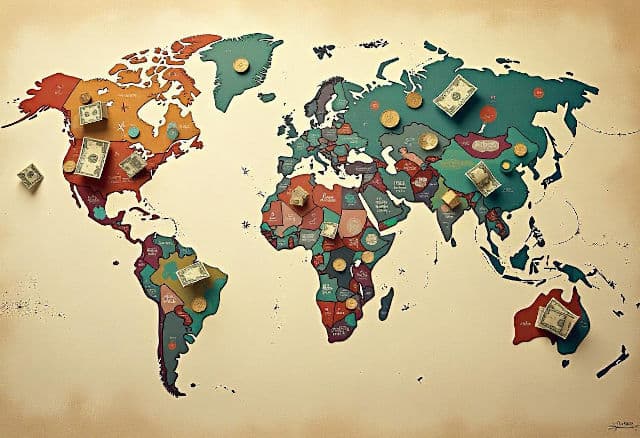
Since the dawn of human civilization, people have engaged in trade through barter. However, around 5,000 years ago, humans gradually abandoned the barter system and began using metallic coins. These coins were made from copper, silver, and gold. Around 1260 AD, the first paper currency was introduced in China and eventually spread throughout the world. In the 1930s, the first credit cards were issued by commercial establishments, and by the 1950s, banks began issuing them as well.