Gross Profit vs Net Profit -- The Complete Guide to Understanding Business Profitability
G
GeoRenus Editorial Team
666 views
GeoRenus Editorial Team
Gross Profit tells you how efficiently you produce; Net Profit tells you how much you actually keep. This guide explains both with three real-world examples (retail store, digital agency, e-commerce), a comparison of top global companies like Apple, Amazon, and Meta, 10 data tables, and actionable strategies to improve your margins.
In 2019, WeWork filed for its IPO revealing $1.8 billion in annual revenue — impressive on the surface.
But their net loss was $1.9 billion. Revenue was massive, gross profit looked decent, but operating costs devoured everything. The IPO collapsed. Valuation dropped from $47 billion to $9 billion almost overnight.
That's the brutal gap between revenue and actual profit.
Here's another story: Uber operated for 14 years before reporting its first full-year net profit in 2023.
During all those years, gross profit was consistently positive. The product worked. People were paying more than it cost to deliver each ride. But massive spending on expansion, driver subsidies, and R&D meant net profit stayed deeply negative year after year.
"Revenue is vanity, profit is sanity, cash is reality." -- Warren Buffett
Most new entrepreneurs obsess over revenue and ignore profit. They celebrate $100,000 in sales without realizing only $5,000 ever reaches their pocket. They're running hard on a treadmill that isn't moving them forward.
There are two types of profit every business owner MUST understand: Gross Profit and Net Profit. They tell very different stories about your business health. Understanding both is non-negotiable if you want to build something that lasts.
But what exactly is the difference? And why can a company be profitable at one level but losing money at another? Let's break it all down.
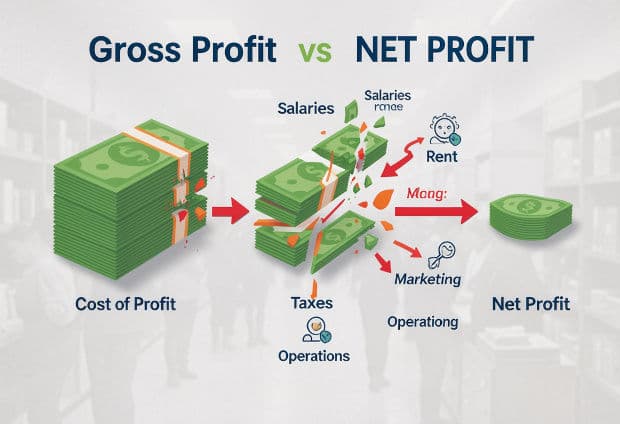
Gross Profit = Revenue - Cost of Goods Sold (COGS)
Gross Profit Margin = (Gross Profit / Revenue) x 100
Gross Profit is the money left after you subtract only the direct costs of producing or delivering your product or service. Nothing else. Just the costs directly tied to making the thing you sell.
For a manufacturing business: raw materials, direct labor, factory overhead directly tied to production.
For a retail business: the purchase cost of goods, shipping to warehouse, packaging materials.
For a SaaS or software company: server hosting costs, payment processing fees, direct customer support costs.
Rent, marketing spend, administrative salaries, taxes, interest payments — none of these belong in COGS. They come later, when calculating Net Profit.
Gross Profit tells you how efficiently you produce or procure what you sell. It's the foundation. If your Gross Margin is declining, your product economics are broken — and no amount of cost-cutting elsewhere will save you long-term.
Apple FY2023: Revenue $383 billion, COGS $214 billion, Gross Profit $169 billion, Gross Margin approximately 44%.
Walmart: Revenue $648 billion, Gross Margin approximately 24%. High volume, low margin model.
Microsoft: Gross Margin approximately 69%. Software has minimal variable cost — once built, replicating it costs almost nothing.
Meta/Facebook: Gross Margin approximately 81%. Digital advertising with almost no physical product means tiny COGS.
| Industry | Typical Gross Margin Range | Example Company | Their Gross Margin |
| Software / SaaS | 70% - 85% | Microsoft | 69% |
| Pharmaceuticals | 65% - 80% | Pfizer | 68% |
| Retail Clothing | 50% - 60% | Nike | 44% |
| Restaurants | 60% - 70% | McDonald's | 56% |
| Grocery / Retail | 20% - 30% | Walmart | 24% |
| Manufacturing | 25% - 40% | Toyota | 20% |
| E-commerce | 40% - 55% | Amazon | 47% |
| Telecom | 55% - 65% | Verizon | 58% |
| Social Media | 75% - 85% | Meta | 81% |
Note: Gross margin figures are approximate, sourced from public annual reports. Margins vary year to year based on pricing, input costs, and product mix.
Notice how different industries cluster at very different margin levels. A 25% gross margin is excellent for grocery but alarming for software. Always benchmark against your own industry, not the market overall.
Net Profit = Gross Profit - Operating Expenses - Interest - Taxes - Other Expenses
Or simply: Net Profit = Total Revenue - ALL Expenses
Net Profit Margin = (Net Profit / Revenue) x 100
Net Profit is the bottom line — literally the last line on the income statement. It's what's left after EVERY expense has been paid. This is the number that matters to owners, shareholders, and investors.
Rent, employee salaries, marketing and advertising, administrative costs, depreciation, amortization, interest payments on loans, income taxes, and any one-time charges like restructuring costs or legal settlements.
If Gross Margin is high but Net Margin is low, your operating costs are eating your profit. This is the WeWork problem — great product revenue, catastrophic operational spending.
Amazon 2023: Revenue $575 billion, Gross Margin approximately 47%, but Net Margin only approximately 5-6% (about $30 billion). Why? Massive investment in warehouses, delivery fleet, and AWS expansion consumes the difference.
Apple 2023: Net Margin approximately 25%. Premium pricing combined with ecosystem lock-in keeps costs predictable and margins high.
Netflix: Gross Margin approximately 40%, Net Margin approximately 16%. The gap? Billions in content spending every year.
| Industry | Typical Net Margin Range | Gross Margin (Comparison) | The Gap = OpEx Impact |
| Software / SaaS | 20% - 35% | 70% - 85% | 35% - 50% consumed by R&D, sales, admin |
| Pharmaceuticals | 15% - 25% | 65% - 80% | 40% - 55% consumed by R&D and marketing |
| Retail Clothing | 5% - 12% | 50% - 60% | 40% - 50% consumed by rent, staff, marketing |
| Restaurants | 3% - 9% | 60% - 70% | 55% - 65% consumed by labor, rent, operations |
| Grocery / Retail | 1% - 4% | 20% - 30% | 18% - 27% consumed by massive store networks |
| Manufacturing | 3% - 8% | 25% - 40% | 20% - 35% consumed by overhead, depreciation |
| E-commerce | 3% - 8% | 40% - 55% | 35% - 50% consumed by ads, fulfillment, tech |
| Telecom | 10% - 18% | 55% - 65% | 40% - 50% consumed by infrastructure, debt |
| Social Media | 20% - 30% | 75% - 85% | 50% - 60% consumed by R&D, data centers, staff |
Note: Net margin figures are approximate industry ranges. Individual company performance varies significantly based on business model, scale, and strategic investment decisions.
The gap between Gross Margin and Net Margin is your story. A shrinking gap means you're gaining operational leverage. A widening gap means costs are growing faster than revenue — a warning sign to investigate immediately.
Both metrics appear on the income statement, but they answer fundamentally different questions. Gross Profit asks: 'Is your product viable?' Net Profit asks: 'Is your entire business viable?'
| Feature | Gross Profit | Net Profit |
| Formula | Revenue - COGS | Revenue - ALL Expenses |
| What it measures | Product/service efficiency | Overall business profitability |
| Costs deducted | Only direct production costs | Every single cost including tax |
| Position on income statement | Middle section | Last line (the bottom line) |
| Margin formula | (Gross Profit / Revenue) x 100 | (Net Profit / Revenue) x 100 |
| Key insight | How well you produce what you sell | How much you actually keep |
| Primary audience | Production and operations managers | Shareholders, investors, owners |
| Can be positive while other is negative? | Yes (very common in startups) | Yes (low net while gross is positive) |
| Industry benchmark significance | Reveals product economics vs peers | Reveals operational efficiency vs peers |
| Frequency of calculation | Monthly / quarterly | Monthly / quarterly / annually |
Note: This comparison is a simplified overview. Specific accounting treatments may vary by company, industry, and jurisdiction.
Key insight: Positive Gross Profit + Negative Net Profit is very common, especially in startups. It means the product works, but the business model needs fixing. This is fixable.
Negative Gross Profit is a fundamental crisis. You are losing money on every single unit you sell. No amount of scaling, fundraising, or cost-cutting elsewhere will fix this. The product economics must change.
The cautionary tale: Pets.com (2000). They sold pet food online at prices BELOW their cost, hoping to make it up on volume. They couldn't. The company lasted exactly 268 days after its IPO before shutting down permanently. Negative gross margin is not a growth strategy -- it's a death sentence.
Let's walk through a complete income statement for a small retail clothing boutique to see how both profits are calculated in a real business scenario.
Monthly Revenue: $30,000
COGS Breakdown: Wholesale merchandise purchases $14,000 + alterations/tailoring $1,500 + packaging materials $500 + shrinkage and damage $500 = Total COGS $16,500
Gross Profit = $30,000 - $16,500 = $13,500 | Gross Margin = 45%
Operating Expenses: Rent $3,000 + 2 employees $4,500 + utilities $600 + marketing $1,000 + insurance $300 + POS software $200 + miscellaneous $400 = Total OpEx $10,000
Operating Profit = $13,500 - $10,000 = $3,500
Interest on business loan: $400
Estimated taxes (22%): $682
Net Profit = $3,500 - $400 - $682 = $2,418 | Net Margin = 8.1%
That's the reality of retail: $30,000 in sales, but only $2,418 actually reaches the owner's pocket. Most of it is eaten by inventory costs, rent, and staff. This is why retail businesses live and die by volume and location.
| Line Item | Amount | % of Revenue |
| Revenue | $30,000 | 100% |
| (-) Wholesale purchases | $14,000 | 46.7% |
| (-) Alterations | $1,500 | 5.0% |
| (-) Packaging | $500 | 1.7% |
| (-) Shrinkage/damage | $500 | 1.7% |
| = GROSS PROFIT | $13,500 | 45.0% |
| (-) Rent | $3,000 | 10.0% |
| (-) Employee wages (x2) | $4,500 | 15.0% |
| (-) Utilities | $600 | 2.0% |
| (-) Marketing | $1,000 | 3.3% |
| (-) Insurance | $300 | 1.0% |
| (-) POS / Software | $200 | 0.7% |
| (-) Miscellaneous | $400 | 1.3% |
| = OPERATING PROFIT | $3,500 | 11.7% |
| (-) Loan interest | $400 | 1.3% |
| (-) Taxes (22%) | $682 | 2.3% |
| = NET PROFIT | $2,418 | 8.1% |
Note: This is a hypothetical example for illustration purposes. Actual figures vary by location, lease terms, staffing model, and local tax rates.
A 45% gross margin is solid for retail clothing. The challenge is the operating cost layer. Rent and payroll alone consume 25% of revenue before any taxes or interest.
Service businesses have a fundamentally different cost structure than product businesses. No physical inventory changes everything. Let's look at a digital marketing agency with five clients.
Monthly Revenue: $25,000 (5 clients x $5,000 average retainer)
Direct Service Costs (COGS equivalent): Freelancer payments $6,000 + software/tools subscriptions $1,500 + ad spend pass-through for clients $3,000 = Total COGS $10,500
Gross Profit = $25,000 - $10,500 = $14,500 | Gross Margin = 58%
Operating Expenses: Office rent $1,800 + owner salary $5,000 + internet/utilities $400 + agency marketing $800 + professional development $200 = Total OpEx $8,200
Operating Profit = $14,500 - $8,200 = $6,300
Taxes (25%): $1,575
Net Profit = $6,300 - $1,575 = $4,725 | Net Margin = 18.9%
| Line Item | Amount | % of Revenue |
| Revenue | $25,000 | 100% |
| (-) Freelancer payments | $6,000 | 24.0% |
| (-) Software / tools | $1,500 | 6.0% |
| (-) Ad spend pass-through | $3,000 | 12.0% |
| = GROSS PROFIT | $14,500 | 58.0% |
| (-) Office rent | $1,800 | 7.2% |
| (-) Owner salary | $5,000 | 20.0% |
| (-) Internet / utilities | $400 | 1.6% |
| (-) Agency marketing | $800 | 3.2% |
| (-) Professional development | $200 | 0.8% |
| = OPERATING PROFIT | $6,300 | 25.2% |
| (-) Taxes (25%) | $1,575 | 6.3% |
| = NET PROFIT | $4,725 | 18.9% |
Note: This is a hypothetical scenario for educational purposes. Agency margins vary widely based on service type, team structure, client mix, and whether the owner takes a salary or draws profit distributions.
Service businesses typically enjoy higher net margins than product businesses because there's no inventory to carry, no warehouse, and no physical supply chain. But they face a hard ceiling: growth is limited by the hours your team can work. Scaling requires hiring, which eats into margins.
E-commerce sits somewhere between retail and digital services. You have physical products (like retail) but often no physical storefront (like digital). The cost structure is unique -- and often trickier than entrepreneurs expect.
Monthly Revenue: $50,000
COGS: Product sourcing $22,000 + outbound shipping $4,500 + packaging $1,500 + returns/damages $2,000 + payment processing (2.9%) $1,450 = Total COGS $31,450
Gross Profit = $50,000 - $31,450 = $18,550 | Gross Margin = 37.1%
Operating Expenses: Facebook/Google ads $6,000 + Shopify and apps $300 + employees (3) $5,500 + warehouse/storage $1,200 + photography/content $500 + other $500 = Total OpEx $14,000
Net Profit (before tax) = $18,550 - $14,000 = $4,550
Taxes (20%): $910
Net Profit = $4,550 - $910 = $3,640 | Net Margin = 7.3%
$50,000 in monthly revenue and only $3,640 in actual profit. This is the e-commerce reality. Advertising costs alone consumed 12% of revenue before anything else. This is why successful e-commerce businesses obsess over return on ad spend (ROAS) and lifetime customer value (LTV).
| Metric | Clothing Store | Digital Agency | E-Commerce |
| Revenue | $30,000 | $25,000 | $50,000 |
| COGS | $16,500 | $10,500 | $31,450 |
| Gross Profit | $13,500 | $14,500 | $18,550 |
| Gross Margin % | 45.0% | 58.0% | 37.1% |
| Operating Expenses | $10,000 | $8,200 | $14,000 |
| Net Profit | $2,418 | $4,725 | $3,640 |
| Net Margin % | 8.1% | 18.9% | 7.3% |
| Key Insight | Rent + payroll dominate | No inventory = cleaner margins | Ads + shipping eat margins |
| Scalability | Limited by location | Limited by team hours | High -- if unit economics work |
Note: All three examples are hypothetical and simplified for educational purposes. Real business financials include additional line items, seasonal variation, and accounting adjustments not shown here.
Three businesses, three very different profit structures. The digital agency earns nearly the same gross profit as the clothing store on less revenue -- because service businesses carry no inventory risk. E-commerce has the highest revenue but the lowest net margin, because every sale carries advertising, shipping, and payment processing costs.
Negotiate better supplier terms. Bulk discounts, extended payment terms, or exclusive arrangements can meaningfully reduce your COGS without changing your pricing.
Reduce production waste and inefficiency. In manufacturing, even small improvements in yield rates translate directly to margin gains.
Optimize your product mix. Not all products are equally profitable. Push higher-margin items through promotions, placement, and sales incentives.
Raise prices strategically. Add value to justify the increase -- better branding, improved quality, faster delivery, superior service. Customers pay premiums for perceived superiority.
Consider vertical integration. Cutting out the middleman improves margins. Apple's decision to design their own silicon chips (starting with M1 in 2020) reduced their dependence on Intel and dramatically improved both performance and margin.
Control operating costs aggressively. Renegotiate your lease, embrace hybrid or remote work to reduce office costs, audit every software subscription quarterly.
Automate repetitive processes. Accounting, email marketing, inventory management, customer support -- all can be partially or fully automated, reducing labor costs.
Reduce debt and interest burden. Refinancing at lower rates or paying down high-interest debt improves net margin dollar for dollar.
Optimize your tax position legally. Work with a qualified accountant. Legitimate deductions, retirement contributions, and entity structure choices can meaningfully reduce your tax bill.
Achieve operating leverage. Scale revenue without proportionally scaling costs. Netflix went from a net margin of -16% in 2017 to approximately +16% in 2023 as subscriber growth spread content costs across a much larger base. The content cost per subscriber dropped even as total content spend rose.
| Strategy | Impacts Gross / Net / Both | Expected Improvement | Difficulty | Real Example |
| Supplier renegotiation | Gross | 1% - 5% margin gain | Medium | Walmart squeezes suppliers annually |
| Reduce production waste | Gross | 1% - 3% margin gain | Medium | Toyota's lean manufacturing |
| Optimize product mix | Gross | 2% - 8% margin gain | Low | Apple pushing services (70%+ margin) |
| Strategic price increases | Both | 3% - 10% margin gain | Low-Medium | Netflix subscription price hikes |
| Vertical integration | Gross | 3% - 12% margin gain | High | Apple designing own chips |
| Cut operating overhead | Net | 1% - 5% margin gain | Medium | Many tech companies in 2022-23 |
| Process automation | Net | 2% - 6% margin gain | Medium | Shopify merchant automation tools |
| Debt refinancing | Net | 0.5% - 3% margin gain | Medium | Any company with variable-rate debt |
| Tax optimization | Net | 1% - 4% margin gain | Low | Standard for all profitable businesses |
| Operating leverage / scale | Both | 5% - 20% long-term | High | Netflix 2017 to 2023 |
Note: Expected improvement ranges are estimates based on general business principles. Actual results depend heavily on industry, starting margin, implementation quality, and market conditions.
The most powerful strategies combine both gross and net margin improvement simultaneously. Raising prices while reducing COGS improves gross margin. As revenue grows, fixed operating costs become a smaller percentage of revenue, improving net margin. Both happening together creates compounding margin expansion.
Track BOTH Gross and Net margins monthly -- not just top-line revenue. A business that monitors only revenue is flying blind.
Benchmark your margins against industry averages. What's acceptable varies dramatically by sector. Know your peer group.
Break down COGS in granular detail. Know exactly where every dollar of direct cost goes. Surprises in COGS are early warning signs.
Review operating expenses quarterly. Look for subscriptions you're not using, vendor relationships you can renegotiate, and processes that automation could replace.
Use accounting software. QuickBooks, Xero, Wave, or even a well-structured Excel model. Manual bookkeeping leads to errors. Errors lead to bad decisions.
Separate personal and business finances completely. Mixing them makes accurate margin calculation impossible and creates serious tax complications.
Include ALL costs. Depreciation, the opportunity cost of your own time, hidden fees, and non-cash charges all affect true profitability.
Don't celebrate revenue without checking Net Profit. "Revenue is vanity" is not a cliche -- it is a warning that has bankrupted real companies.
Don't ignore a declining Gross Margin. It signals a fundamental problem with your product economics or procurement that cannot be solved by cutting marketing or admin costs.
Don't confuse Gross and Net when presenting to investors, lenders, or partners. They will ask follow-up questions, and getting the metrics wrong signals a lack of financial literacy that destroys credibility.
Don't forget taxes. Income tax is a real cost. Include it in your projections and your monthly tracking. Many entrepreneurs are shocked by their tax bill at year-end because they never budgeted for it.
Don't assume margins stay constant. They fluctuate with supplier costs, competition, inflation, exchange rates, and consumer behavior. Review them regularly, not once a year.
Don't compare your margins to completely different industries. A 5% net margin is excellent for grocery, acceptable for e-commerce, and alarming for SaaS. Context is everything.
Provides a clear, layered picture of business health. Gross Profit tells you about your product. Net Profit tells you about your entire operation. Together they give you the full picture.
Enables better pricing and cost decisions. When you know your exact margins, you can price confidently and identify which cost lines are worth fighting.
Acts as an early warning system. A declining gross margin months before it hits your bank account gives you time to respond.
Makes you more credible to investors and lenders. Every professional investor will immediately ask about your margins. Knowing them cold signals competence.
Enables meaningful competitor benchmarking. Margin comparison is the standard way to evaluate operational efficiency against peers.
Helps you prioritize improvement efforts. The space between Gross and Net Margin tells you exactly where to focus. High gap? Your operating costs are the problem. Low gross margin? Your product economics need work.
Profit does not equal cash flow. A company can show a positive net profit while having zero cash in the bank -- especially if customers pay late or inventory is tied up. Toys 'R' Us was technically 'profitable' for years while drowning in debt service payments it couldn't make. They filed for bankruptcy in 2017.
Seasonal businesses produce misleading monthly margin figures. A ski resort or a fireworks retailer will show wildly different margins in different months. Always analyze on an annualized basis for seasonal businesses.
Different accounting methods change the numbers. FIFO vs LIFO inventory accounting, cash vs accrual basis, and different depreciation schedules all produce different margin figures from identical underlying business activity.
Margins don't capture non-financial value. Brand equity, customer loyalty, intellectual property, and proprietary technology all create business value that doesn't show up directly in margin figures.
One-time events distort margins in both directions. Selling a piece of real estate, receiving an insurance settlement, or paying a large legal judgment can make a single quarter look unusually profitable or unprofitable.
| Aspect | Advantage | Limitation |
| Business health visibility | Layered view: product + operations | Doesn't show cash position |
| Decision-making | Informs pricing and cost strategy | Historical data; backward-looking |
| Early warning | Margin decline signals problems early | Seasonal distortion in some industries |
| Investor credibility | Standard metric; investors expect it | Different accounting methods confuse comparisons |
| Benchmarking | Enables peer comparison | Only valid within same industry |
| Improvement focus | Pinpoints where value is lost | Ignores intangible assets and brand value |
| Scalability planning | Reveals operating leverage potential | One-time events can distort the picture |
Note: Profit metrics should always be analyzed alongside cash flow statements and balance sheet data for a complete picture of business financial health.
The best way to truly understand gross and net margin is to see how some of the world's most successful companies stack up. The differences are striking -- and instructive.
| Company | Industry | Revenue (approx) | Gross Margin % | Net Margin % | Key Takeaway |
| Apple | Technology / Hardware | $383B | 44% | 25% | Premium pricing + ecosystem lock-in |
| Microsoft | Software / Cloud | $212B | 69% | 34% | Software = high margins at scale |
| Amazon | E-commerce / Cloud | $575B | 47% | 6% | Revenue giant, thin net margins overall |
| Walmart | Retail / Grocery | $648B | 24% | 2.4% | Volume model with razor-thin margins |
| Meta / Facebook | Social Media / Ads | $135B | 81% | 29% | Digital ads = minimal COGS |
| Tesla | Automotive | $97B | 26% | 15% | Higher margins than traditional auto (~5%) |
| Alphabet / Google | Search / Advertising | $307B | 56% | 22% | Ad-driven platform with high margins |
| Samsung | Electronics / Hardware | $200B | 38% | 11% | Hardware margins lower than software |
| Netflix | Streaming / Content | $34B | 40% | 16% | Content costs narrow the gross-to-net gap |
Note: All figures are approximate, sourced from FY2023 and FY2024 public financial reports and financial data platforms. Margins fluctuate quarterly and annually based on business conditions, investment cycles, and accounting adjustments.
Digital advertising has almost no COGS. Once the platform infrastructure is built, showing an additional ad to an additional user costs essentially nothing. There's no raw material, no shipping, no packaging. The gross margin is extraordinarily high because the incremental cost of each transaction approaches zero.
Volume is the answer. $648 billion in revenue means that even a 2.4% net margin generates approximately $15 billion in net profit. Walmart does not need to be margin-efficient. It needs to be volume-efficient. The model works at scale -- and almost nowhere else.
Amazon's retail division operates on extremely thin margins. But AWS (Amazon Web Services) operates at approximately 30% operating margin and contributes the majority of total operating income. The 6% overall net margin is an average of a high-margin cloud business and a low-margin retail business. Investors and analysts look at each segment separately.
High Gross Margin + High Net Margin = strong, efficient business (Apple, Microsoft). The product is profitable AND the operations are lean.
High Gross Margin + Low Net Margin = operational problem (early-stage Amazon, many startups). The product economics work, but spending is out of control.
Low Gross Margin = fundamental business model challenge (traditional retail, manufacturing). You're fighting math. Every decision is constrained by starting with thin product margins.
Let's bring it all together with clarity.
Gross Profit tells you: "Is my product or service efficiently priced and produced? Do the unit economics work?"
Net Profit tells you: "Is my entire business operation actually generating real money after every expense is paid?"
Both metrics matter. Monitoring one without the other is like driving with one eye closed. You might stay on the road for a while, but you're missing critical information that will eventually cause a crash.
"What gets measured, gets managed." -- Peter Drucker
Here is your action plan: This week, calculate your Gross Margin and your Net Margin. Compare them to your industry benchmarks. If there's a gap between where you are and where you should be, you now know exactly where to look.
The space between Gross Profit and Net Profit is where the answers hide. It shows you exactly which operating costs are consuming your potential. It tells you whether your operational spending is proportionate to your revenue. It reveals where you're efficient and where you're bleeding money.
The difference between a business that merely survives and one that truly thrives often comes down to understanding these two numbers -- and acting on them.
Now you understand both. The next step is yours.

Most people use banks every single day — depositing salaries, withdrawing cash, transferring money, paying bills — without ever really thinking about how the whole system actually works. A bank is a licensed financial institution that accepts deposits from the public and uses those deposits to provide loans to individuals and businesses. Everything a bank does — from accepting your savings to issuing credit cards to printing cheques — falls under the broad category of banking. But banks are not just convenient places to store your money. They are the central nervous system of any economy — the institutions that keep money flowing productively through the system, connecting people who have surplus funds with people and businesses that need capital. And in Bangladesh, where Bangladesh Bank serves as the central authority overseeing the entire financial system, understanding how banking works is genuinely useful knowledge for anyone managing their personal finances, running a business, or simply trying to make smarter decisions with their money.