What Is Money Laundering?
G
GeoRenus Editorial Team
700 views
GeoRenus Editorial Team
Money laundering is the process of disguising the origins of illegally obtained money to make it appear legitimate. Criminals use a wide variety of methods, from structuring small deposits and creating shell companies to exploiting international trade and cryptocurrency, to move billions of dollars through the global financial system undetected. With an estimated $2 trillion laundered worldwide every year, money laundering remains one of the most significant threats to financial system integrity and economic development.
From the Panama Papers to billion-dollar bank scandals, the process of turning illegal money into legitimate wealth has been growing at an alarming rate across the globe. Money laundering is not just a crime committed by shady individuals in dark alleys. It is a sophisticated, multi-billion dollar global industry that involves banks, corporations, real estate, and even art galleries.
Money laundering refers to the process of concealing the source of illegally obtained money. Typically, funds earned through criminal activities such as drug trafficking, corruption, tax evasion, or fraud are passed through a series of transactions to make them appear as if they came from legitimate business operations.
The process generally follows three stages: Placement (introducing dirty money into the financial system), Layering (moving money through complex transactions to disguise its origin), and Integration (withdrawing the now-"clean" money for legitimate use).
For example, imagine you have illegally earned cash. Depositing it directly into a bank would raise immediate red flags. So instead, you buy a small business, mix the illegal cash with real business revenue, and withdraw it as business profits. Later, you sell the business, invest in real estate, or move the money overseas. Each step adds distance between the money and its criminal source.
The scale is staggering. The United Nations estimates that $2 trillion is laundered globally every year, equivalent to roughly 2-5% of the world's GDP. In the United States alone, money laundering accounts for hundreds of billions annually.
"Money laundering is the mother of all financial crimes. Every other crime depends on it to survive."
Based on the source of funds, the method of concealment, and the channels used, money laundering takes many forms. Here are the twelve most common types:
In this method, large amounts of illegal funds are broken into smaller, less suspicious transactions. For example, instead of depositing $100,000 at once (which would trigger a bank report), a criminal makes dozens of deposits under $10,000 across different bank branches. This technique is called "smurfing" because it uses many small actors to avoid detection.
Criminals create or acquire businesses that naturally handle large amounts of cash, such as restaurants, car washes, laundromats, or convenience stores. They then mix illegal funds with legitimate business revenue, making it nearly impossible to distinguish between clean and dirty money in the accounting records.
Criminals frequently create offshore shell companies that exist only on paper. These companies have no real operations, employees, or physical offices. They serve as conduits for moving money across borders, layering transactions, and creating a paper trail that appears legitimate but leads nowhere.
This is currently one of the most practiced forms of money laundering worldwide. Criminals manipulate international trade invoices through over-invoicing or under-invoicing to move money across borders. For example, a criminal might import goods worth $1,000 but show an invoice for $5,000. The extra $4,000 is laundered money sent abroad through official banking channels.
Illegal money is invested in property purchases. Criminals buy real estate, often through intermediaries or shell companies, and later sell it at market value. The proceeds from the sale appear to be legitimate real estate income. This is particularly common in cities with booming property markets.
Modern criminals increasingly use cryptocurrency and online payment platforms to launder money. The pseudo-anonymous nature of many cryptocurrencies makes it difficult for authorities to trace the flow of funds. Money can be converted from cash to Bitcoin, moved through multiple wallets, and then converted back to clean cash in a different jurisdiction.
The hawala system is an informal value transfer network that operates outside the traditional banking system. Common in parts of South Asia and the Middle East, hawala brokers transfer money across borders without physically moving it. A person deposits money with a broker in one country, and a corresponding amount is paid out by another broker in a different country. No money actually crosses borders, making it extremely difficult to detect.
Illegal funds are transferred to bank accounts in tax havens such as the Cayman Islands, Switzerland, or Singapore. These jurisdictions often have strict banking secrecy laws that make it nearly impossible for foreign governments to access account information or trace fund origins.
Criminals use casinos, betting platforms, and online gambling sites to convert illegal cash into gambling chips, place a few bets, and then cash out the chips as "gambling winnings." The winnings appear to be legitimate income and can be deposited into bank accounts without raising suspicion.
Dirty money is used to purchase high-value art, jewelry, luxury watches, and collectibles. The art market is particularly attractive for laundering because transactions are often private, prices are subjective, and there is limited regulatory oversight. A painting bought for $1 million with dirty money can later be sold at auction for "clean" proceeds.
In its most basic form, money laundering can involve physically transporting cash across borders without declaring it to customs authorities. Cash is hidden in luggage, vehicles, or shipping containers and moved to jurisdictions with weaker enforcement. Once abroad, the money enters the local banking system.
Criminals establish fake charitable organizations or funnel money through legitimate non-profits. Donations to charities are often less scrutinized than commercial transactions, making them an attractive channel for laundering. The money passes through the charity as "donations" and comes out the other side as clean funds designated for "charitable programs."
Approximately $2 trillion is laundered every year globally. Here are some of the most notorious cases in history:
In the 1980s and 1990s, the Bank of Credit and Commerce International (BCCI) operated as a global laundering machine. The bank accepted money from drug traffickers, arms dealers, and other criminals, passing it through legitimate-looking accounts across its worldwide network. When authorities finally shut it down in 1991, BCCI had been involved in money laundering, bribery, and fraud on a massive scale, earning it the nickname "The Bank of Crooks and Criminals International."
In the 1980s, Colombian drug lord Pablo Escobar generated such enormous profits from his cocaine empire that he literally could not launder money fast enough. At the height of his power, Escobar was earning an estimated $420 million per week. His organization used virtually every laundering method available: shell companies, real estate purchases, cash smuggling, and even burying cash in fields when they ran out of laundering capacity.
In the mid-2000s, German multinational Siemens AG was caught in one of the largest corporate bribery scandals in history. The company had been using slush funds and shell companies to pay bribes to government officials around the world to win contracts. Siemens ultimately paid over $1.6 billion in fines to settle charges in the United States and Germany.
In 2016, the Panama Papers leak exposed a massive network of offshore shell companies used by politicians, celebrities, and business leaders worldwide to hide wealth and evade taxes. Over 11.5 million documents from the Panamanian law firm Mossack Fonseca revealed how the world's elite used these structures to move money discreetly. The leak led to investigations in dozens of countries and the resignation of several high-ranking officials.
It may seem hard to believe, but $2 trillion in money laundering occurs globally every single year. Despite increasingly sophisticated anti-money laundering (AML) regulations and monitoring systems, criminals continue to find new ways to exploit the financial system.
Central banks and regulatory agencies around the world are continuously working to combat this problem through stricter KYC (Know Your Customer) requirements, transaction monitoring, international cooperation, and harsher penalties. But the sheer volume of global financial transactions, combined with the creativity of launderers, means that this is a fight that will never truly be won, only managed.
"Follow the money. It will always lead you to the truth."
For individuals and institutions alike, awareness is the first line of defense. Understanding how money laundering works, recognizing the warning signs, and supporting strong regulatory frameworks are essential to protecting the integrity of the global financial system.
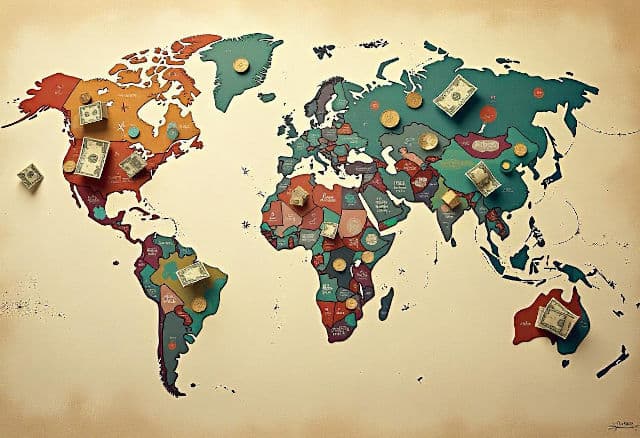
Since the dawn of human civilization, people have engaged in trade through barter. However, around 5,000 years ago, humans gradually abandoned the barter system and began using metallic coins. These coins were made from copper, silver, and gold. Around 1260 AD, the first paper currency was introduced in China and eventually spread throughout the world. In the 1930s, the first credit cards were issued by commercial establishments, and by the 1950s, banks began issuing them as well.