(Part 1) Malaysia's Economic Reforms: From Agrarian Roots to Industrial Powerhouse
G
GeoRenus Editorial Team
671 views
Summary
Malaysia's transformation from an agrarian economy dependent on rubber and tin to a modern industrial powerhouse is one of Southeast Asia's most remarkable success stories. Beginning with the landmark New Economic Policy in 1971 — designed to reduce poverty and address ethnic economic disparities after the 1969 racial riots — Malaysia systematically built its manufacturing sector, attracted massive foreign investment, became the world's second-largest palm oil producer, and weathered the 1997 Asian financial crisis through unconventional policies. This first part traces that extraordinary journey from rural beginnings to the threshold of the new millennium.
Key Takeaways
- Malaysia's economy transformed from agriculture-dependent (rubber, tin, palm oil) to an industry-based powerhouse, with manufacturing and electronics becoming key export sectors.
- The New Economic Policy (NEP, 1971-1990) was a landmark policy aimed at poverty reduction and restructuring society to reduce ethnic economic disparities between Bumiputera and non-Bumiputera communities.
- Foreign investment was attracted through free trade zones and tax reforms, making Malaysia a global hub for electronics and semiconductor manufacturing by the 1990s.
- During the 1997 Asian financial crisis, Malaysia rejected IMF assistance and instead pegged the ringgit at 3.80 to the dollar and imposed capital controls — an unconventional strategy that proved remarkably effective.
- By 2000, Malaysia had reduced its poverty rate from over 49% in 1970 to just 6.1%, while GDP grew at an average of 8% annually throughout the 1990s.
Part 1: Building the Foundation
This is Part 1 of our series on Malaysia's economy. In this installment, we trace Malaysia's journey from an agrarian economy to an industrial power — covering the pre-reform economy, the New Economic Policy, the palm oil industry's rise, the National Development Policy era, and the 1997 Asian financial crisis.
From Rubber Plantations to Nation-Building
Malaysia's economic story is one of the most instructive examples of how a developing country can transform itself through deliberate, sustained policy action. The country started as a resource-dependent agricultural economy — rubber, tin, and later palm oil were virtually its entire economic identity. Today, it is a diversified middle-income nation with advanced manufacturing, a thriving services sector, and ambitions to join the high-income club.
How did Malaysia get here? The answer lies in a series of bold policy decisions, massive infrastructure investments, and a willingness to learn from both successes and failures. As former Prime Minister Mahathir Mohamad once said: "We were told we couldn't industrialize, that we should stick to rubber and tin. We proved them wrong."
The government invested heavily in roads, schools, and industrial facilities. These investments laid the groundwork for Malaysia to become a strong manufacturing hub — and eventually, a globally competitive economy in electronics, automotive, and technology sectors.
Malaysia's Pre-Reform Economy
Before the 1980s, Malaysia's economy was predominantly agricultural. Rubber, tin, and palm oil were the main export commodities, serving as the primary engine of economic activity. While these resources generated substantial export revenue, the economy was dangerously vulnerable to global commodity price fluctuations.
A key concept to understand here is the Bumiputera community. The term literally means "sons of the soil" and refers to Malaysia's indigenous Malay and other native populations. At independence and in the decades that followed, the Bumiputera community was significantly poorer than the ethnic Chinese and Indian communities, who dominated commerce and urban professions. This economic inequality along ethnic lines was not just a statistical fact — it was a source of deep social tension.
The government recognized that long-term growth could not depend solely on agriculture. This commodity dependence made Malaysia vulnerable to global market swings — when rubber or tin prices dropped internationally, the entire economy suffered. Something fundamental had to change.
The New Economic Policy (1971-1990)
The New Economic Policy (NEP) was arguably the most important economic policy in Malaysian history. Launched in 1971 by the government, it was a landmark social and economic restructuring programme designed to address the deep ethnic economic disparities that had contributed to the 1969 racial riots — violent clashes between ethnic communities that shocked the nation and threatened its very survival as a multiethnic state.
The NEP had two core objectives:
1. Poverty eradication: Reduce poverty across all ethnic groups by improving living standards, creating employment opportunities, and expanding access to education and healthcare. In 1970, approximately 49% of Malaysian households lived below the poverty line — a staggering figure for a country with such natural resource wealth.
2. Social restructuring: Eliminate the identification of ethnicity with economic function. In practical terms, this meant increasing Bumiputera participation and ownership in the corporate sector, which in 1970 stood at a mere 1.5% of total corporate equity. The target was to raise this to 30%.
Poverty Reduction and Wealth Redistribution
One of the NEP's primary goals was ensuring more equitable distribution of wealth. In 1970, the Bumiputera community owned just 1.5% of corporate assets, while non-Bumiputera Malaysians (primarily ethnic Chinese) and foreigners held the rest. The NEP aimed to restructure this balance through affirmative action policies, preferential business licensing, and government-linked investment companies.
Rural development programmes were launched to directly reduce poverty. These included agricultural modernization, infrastructure construction in rural areas, new land development schemes through agencies like FELDA (Federal Land Development Authority), and job creation programmes. FELDA, in particular, resettled hundreds of thousands of rural families onto productive agricultural land, transforming subsistence farmers into commercial palm oil and rubber producers.
Investing in Human Capital
The NEP placed strong emphasis on education. The government understood that sustainably lifting disadvantaged communities required investing in the next generation. Scholarships, university quotas, and vocational training programmes were established to increase Bumiputera participation in professional fields.
By 1990, literacy rates among Bumiputera communities had risen significantly, and many had entered professions like law, engineering, medicine, and business — fields that had been almost exclusively dominated by other ethnic groups a generation earlier. This human capital investment proved to be one of the NEP's most enduring contributions.
Building an Industrial Base
Another critical focus of the NEP was industrialization. The government actively worked to move Malaysia away from agricultural dependence by building a manufacturing sector. Investment was channeled into construction, heavy industry, and especially electronics manufacturing.
To attract foreign investment, the government established multiple Free Trade Zones (FTZs) offering tax incentives, streamlined regulations, and modern infrastructure. These zones proved enormously successful in attracting multinational electronics companies. By the late 1980s, Malaysia had become a major global player in semiconductor and electronics manufacturing — a position it strengthened further in the 1990s.
Results of the New Economic Policy
By 1990, the NEP had fundamentally transformed Malaysia's economic landscape. Bumiputera corporate ownership rose from 1.5% to 19.3% — short of the 30% target, but still a dramatic improvement. More importantly, the poverty rate had plummeted from nearly 49% in 1970 to approximately 17% by 1990.
However, the NEP was not without criticism. Some argued that the affirmative action policies created a culture of dependency among beneficiaries and led to economic inefficiency. Others pointed out that the benefits of Bumiputera-targeted policies were not evenly distributed — well-connected elites captured a disproportionate share, while many rural Bumiputera communities saw more modest improvements.
Despite these criticisms, few dispute that the NEP laid the essential foundation for modern Malaysia's economy. It reduced dangerous ethnic tensions, built a manufacturing base, expanded the educated middle class, and created the institutional infrastructure needed for the country's next phase of development.
The Palm Oil Industry: A Global Force
Malaysia is the world's second-largest palm oil producer and exporter, behind only Indonesia. Since the 1960s, the palm oil industry has been one of the most important pillars of Malaysia's economy, contributing significantly to export revenue, employment, and rural development.
The industry's rise was not accidental. Government policies actively encouraged the conversion of rubber plantations to palm oil, recognizing that palm oil offered higher yields and stronger global demand. Agencies like FELDA played a central role in developing palm oil plantations, settling rural families on productive land, and building the supply chain infrastructure needed for large-scale production.
By 2020, the palm oil industry contributed approximately 3.5% of Malaysia's GDP and employed hundreds of thousands of workers — both Malaysian nationals and foreign migrant laborers. Malaysia accounted for roughly 25-28% of global palm oil production and was the industry's technology leader, with Malaysian research institutions developing high-yield varieties and sustainable production methods.
However, the palm oil industry also faces growing challenges, particularly around environmental sustainability. Deforestation, biodiversity loss, and carbon emissions associated with palm oil expansion have drawn international criticism and trade restrictions, forcing Malaysia to invest in sustainable certification programmes and more environmentally responsible production practices.
Post-NEP Malaysia: The National Development Policy (1991-2000)
When the NEP expired in 1990, Malaysia replaced it with the National Development Policy (NDP) in 1991. The NDP retained some core NEP principles — particularly Bumiputera development — while shifting emphasis toward broader economic growth, industrialization, and global competitiveness.
Industrialization and Growth
Throughout the 1990s, Malaysia aggressively expanded its manufacturing sector, with electronics and semiconductors at the center of the strategy. The country attracted major multinational companies like Intel, AMD, and Western Digital to set up manufacturing facilities, leveraging its competitive labor costs, strategic location, and improving infrastructure.
The results were impressive. From 1991 to 1997, Malaysia's GDP grew at an average annual rate of 8% — one of the highest growth rates in the world during that period. The manufacturing sector's share of GDP grew substantially, and Malaysia became one of the world's leading exporters of electronic components.
The 1997 Asian Financial Crisis
The 1997 Asian financial crisis hit Malaysia hard, along with most of Southeast Asia. The crisis began with currency collapses in Thailand and spread rapidly through the region. The Malaysian ringgit fell sharply, stock markets plunged, and investor confidence evaporated.
But Malaysia's response was dramatically different from its neighbors. While countries like Thailand, Indonesia, and South Korea accepted International Monetary Fund (IMF) bailouts with their stringent conditions — including austerity measures, privatization, and market liberalization — Prime Minister Mahathir Mohamad chose a completely different path.
In September 1998, Malaysia imposed capital controls and pegged the ringgit at 3.80 to the US dollar. At the time, this was widely criticized by international economists and the financial press, who predicted it would deepen the crisis. The IMF and Western governments urged Malaysia to follow the conventional playbook.
Instead, something unexpected happened. The capital controls gave Malaysia's economy breathing room. Without the constant threat of currency speculation, the government could focus on restructuring ailing banks, recapitalizing financial institutions, and stimulating domestic demand. By 1999, Malaysia's economy was recovering faster than several IMF-assisted neighbors.
As one economist later admitted: "Malaysia proved that there is more than one way to handle a financial crisis. The textbook answer is not always the right answer." Malaysia's unconventional approach became a case study in economics departments worldwide.
Infrastructure and Vision 2020
Throughout the 1990s, Malaysia invested heavily in infrastructure under the ambitious Vision 2020 programme announced by Mahathir in 1991. The vision aimed to transform Malaysia into a fully developed nation by the year 2020.
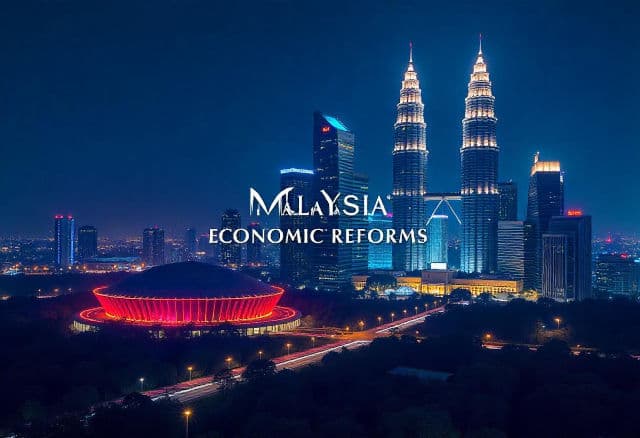
The flagship projects were spectacular. The Petronas Twin Towers in Kuala Lumpur — the world's tallest buildings when completed in 1998 — became Malaysia's global symbol. The new administrative capital at Putrajaya, the Kuala Lumpur International Airport (KLIA), and the North-South Expressway all demonstrated Malaysia's infrastructure ambitions. The Multimedia Super Corridor (MSC) was created to attract technology companies and position Malaysia as a regional tech hub.
Critics argued that some of these mega-projects were vanity exercises that diverted resources from more practical needs. But supporters countered that they put Malaysia on the global map, attracted foreign investment, and built the physical infrastructure needed for a modern economy.
Results of the National Development Policy
By 2000, Malaysia had achieved remarkable progress. The poverty rate had fallen to just 6.1%, down from 17% in 1990 and nearly 49% in 1970. Education and employment opportunities had expanded substantially for all communities. Malaysia had successfully transitioned from a commodity-dependent economy to a diversified one with strong manufacturing, services, and technology sectors.
The country entered the new millennium with confidence and ambition — but also with new challenges ahead. Global competition was intensifying, China's rise was reshaping Asian supply chains, and the dream of becoming a truly high-income nation would require another round of reforms and adaptation.
Looking Ahead to Part 2
In Part 2 of this series, we cover Malaysia's modern economic reforms from 2000 to the present — including the Economic Transformation Programme (ETP), the controversial GST experiment, the devastating 1MDB scandal, COVID-19 pandemic recovery efforts, and the country's strategies for achieving high-income status. The story continues with more ambition, more challenges, and more lessons for developing economies worldwide.
Recommended for you
Banking: What It Is, How Banks Work, and Everything You Need to Know
Most people use banks every single day — depositing salaries, withdrawing cash, transferring money, paying bills — without ever really thinking about how the whole system actually works. A bank is a licensed financial institution that accepts deposits from the public and uses those deposits to provide loans to individuals and businesses. Everything a bank does — from accepting your savings to issuing credit cards to printing cheques — falls under the broad category of banking. But banks are not just convenient places to store your money. They are the central nervous system of any economy — the institutions that keep money flowing productively through the system, connecting people who have surplus funds with people and businesses that need capital. And in Bangladesh, where Bangladesh Bank serves as the central authority overseeing the entire financial system, understanding how banking works is genuinely useful knowledge for anyone managing their personal finances, running a business, or simply trying to make smarter decisions with their money.
Business Models
Sharing Economy Model: How Businesses Make Money Without Owning Anything
E-Commerce
E-Commerce: The Complete Guide to Online Business

Investment
Investment: What It Is, Types, and Real Life Examples
Sales
What Is Sales and How Does It Work?

Accounting
Gross Profit: Definition, Formula, and Why It Matters
Accounting
Accounting for Startups: A Complete Guide to Getting It Right

Accounting
Financial Recording and Transactions: The Complete Guide

Agreement
General Agreement on Tariffs and Trade (GATT)

Agreement
Teesta Water Sharing Treaty