Oil and Geopolitics: The Complete History of Wars Fought Over Energy Resources
G
GeoRenus Editorial Team
807 views
GeoRenus Editorial Team
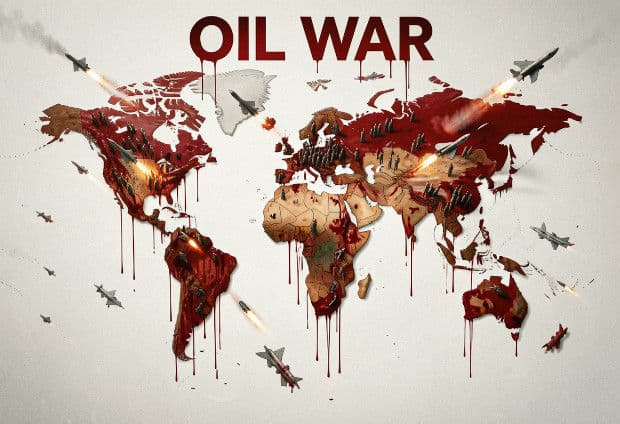
No commodity in human history has caused more bloodshed than oil. From World War II to the 2026 Venezuela and Iran crises, oil has been at the center of almost every major military conflict of the modern era. This article traces the full history of wars fought over energy resources — from Hitler's desperate march toward Baku's oil fields to America's 2003 invasion of Iraq, from Nigeria's resource curse to the ongoing battle for control of the Strait of Hormuz.
In 1944, a classified US State Department memo described Saudi Arabian oil as "the greatest material prize in the history of the world and the greatest source of power."
That single sentence summarized the next 80 years of global politics.
When you read the history of wars fought over oil, a clear pattern emerges. Great powers never openly say they are fighting for oil. They say it is for "democracy," "human rights," or "national security." But when you follow the money — or rather, follow the oil — the real motivations become impossible to ignore.
Before World War II even began, Germany had a massive military vulnerability — the country had virtually no domestic oil. Most of Germany's oil came from Romania's Ploesti oil fields. But for a long-term war, that was not enough.
Hitler understood that sustained warfare required a reliable oil supply. The Soviet Union's Baku oil fields (modern-day Azerbaijan) were the largest in Europe — producing about 80% of the USSR's entire oil output. According to historian Richard Overy, one of the primary objectives of Operation Barbarossa in 1941 was to capture Baku's oil fields.
In 1942, Hitler launched "Operation Blue" — a massive offensive aimed at the Caucasus oil fields. Stalingrad was a key point on this route. Germany's defeat at Stalingrad (1942-43) effectively destroyed any hope of reaching Baku.
Military historian David Glantz noted that by late 1944, German Luftwaffe pilots were fully trained but had no fuel to fly. The oil shortage was so severe that Germany's military machine ground to a halt — not for lack of weapons or soldiers, but for lack of fuel.
Oil was equally central to Japan's war strategy. In 1941, the United States imposed a complete oil embargo on Japan in response to Japanese aggression in China. According to US National Security Archive documents, Japan's oil reserves at the time of the embargo were just 18 months' worth.
Japanese military leaders calculated they had two options: withdraw from China (politically unthinkable) or seize oil-rich territories in Southeast Asia. The Dutch East Indies (modern Indonesia) was Asia's largest oil producer at the time, producing approximately 65 million barrels per day. But taking those oil fields meant war with America.
The December 7, 1941 attack on Pearl Harbor was designed to knock out the US Pacific Fleet so Japan could safely advance south to capture Indonesian oil. The most consequential attack in Pacific War history was, at its core, a fuel grab.
In 1953, the CIA orchestrated a coup that overthrew Iran's democratically elected Prime Minister Mohammad Mossadegh. His crime? He had nationalized Iran's oil industry, threatening British and American oil interests.
After the coup, Shah Pahlavi was installed in power and used his secret police (SAVAK) to suppress dissent for decades. Amnesty International's 1976 report described Iran as having the worst human rights record in the world.
The backlash against this repression fueled the 1979 Islamic Revolution — which in turn created the US-Iran hostility that continues to destabilize the Middle East today. The price of one CIA coup has been paid for decades, with millions of lives.
On September 22, 1980, Saddam Hussein invaded Iran. The official reason was a border dispute over the Shatt al-Arab waterway. But the deeper calculation was oil. Iran's Khuzestan province was the heart of its oil production — Iran's daily output of approximately 3 million barrels came largely from this region.
Saddam believed Iran's post-revolution military chaos presented an opportunity to seize these oil-rich territories quickly.
The United States, European nations, and the Soviet Union all supported Iraq in various ways during this war. The reason was straightforward — Iran's Islamic Revolution threatened the stability of oil supplies from the region.
Declassified US National Security Archive documents reveal that America provided Iraq with satellite intelligence, financial aid, and materials for chemical weapons production. Saddam used chemical weapons against Iranian soldiers and Kurdish civilians — and the West largely looked the other way.
The 8-year war killed approximately 1 million people. But for Western oil companies and governments, the war served a purpose — it kept both Iran and Iraq weakened, ensuring neither could dominate the region's oil supply.
This war is called the "most honest" oil war because the oil motive was so transparent that American officials nearly admitted it openly.
US Defense Secretary Dick Cheney told Congress in 1990: "Do we want to live in a world where Saddam Hussein controls a significant portion of the world's oil reserves?"
By invading Kuwait, Saddam gained control of Iraq and Kuwait's combined oil reserves — approximately 19% of the world's total proven reserves. If Saudi Arabia had also fallen into his reach, that figure would have jumped to 45%.
Former Federal Reserve Chairman Alan Greenspan later wrote: "It is politically inconvenient to acknowledge what everyone knows: the Iraq war is largely about oil."
Knowing defeat was certain, retreating Iraqi forces set fire to approximately 700 Kuwaiti oil wells. According to the Kuwait Institute for Scientific Research, these fires took 9 months to extinguish, burned an estimated 6 million barrels per day, and caused $50-100 billion in environmental damage.
On March 20, 2003, a US-British coalition invaded Iraq. The official reason: Saddam possessed weapons of mass destruction (WMDs) and had links to al-Qaeda. Both claims were later proven false.
So was oil the real reason? The debate continues, but the facts are telling:
Alan Greenspan wrote in his 2007 memoir: "Everyone knows: the Iraq war is largely about oil."
The Iraq Body Count project estimates over 200,000 civilian deaths. Brown University's Costs of War project puts the total cost at over $3 trillion. The post-war chaos in Iraq directly led to the rise of ISIS — which claimed hundreds of thousands more lives.
Libya holds Africa's largest proven oil reserves — approximately 48 billion barrels according to the EIA. When NATO intervened in 2011 under the banner of "protecting civilians," Gaddafi had been planning a gold-backed African currency to replace the dollar in oil trade.
Leaked Hillary Clinton emails revealed that an adviser cited Gaddafi's gold reserves and anti-dollar oil trading plans as key concerns. Today, Libya remains in civil war — with control of oil fields at the center of the conflict.
Nigeria is Africa's largest oil producer, generating approximately 1.4 million barrels per day in 2022. The country has earned trillions of dollars from oil exports. Yet according to the World Bank, over 60% of Nigerians live below the poverty line.
The Niger Delta has been the site of decades-long conflict between armed groups and government forces over oil installations. Environmental activist Ken Saro-Wiwa was executed in 1995 for leading protests against Shell Oil's environmental destruction. In 2009, Shell paid $15.5 million to settle the case — widely seen as an admission of complicity.
When South Sudan gained independence in 2011, it took with it approximately 75% of Sudan's total oil reserves. But the export pipelines ran through the north. This created an impossible situation: South Sudan had the oil but could not export it without northern cooperation.
South Sudan almost immediately descended into civil war, with oil field control at the center. According to the UN, approximately 400,000 people were killed between 2013 and 2020 and nearly 4 million displaced.
Syria's civil war (2011-present) is not just about Assad versus rebels. Behind it lies complex oil and gas pipeline geopolitics. Qatar had long planned a gas pipeline through Saudi Arabia, Jordan, Syria, and Turkey to reach European markets. Assad rejected this plan — reportedly under pressure from Russia, which wanted to maintain its own gas exports to Europe.
According to the UN, the Syrian civil war has killed 300,000-500,000 people and displaced approximately 13 million.
Yemen sits next to the Bab el-Mandeb Strait, through which approximately 4.5 million barrels of oil pass daily. Iran-backed Houthi rebels control territory near this critical chokepoint. Since 2023, Houthi attacks on Red Sea shipping have disrupted 12-15% of global maritime trade, forcing major carriers to reroute around Africa — adding 10 days and increasing shipping costs by approximately 45%.
According to UN estimates, approximately 377,000 people have died in the Yemen conflict — most from indirect causes like hunger and disease rather than direct combat.
Venezuela sits on the world's largest proven oil reserves — approximately 303 billion barrels. Yet the country has experienced one of the worst economic collapses in modern history. Production fell from 3 million barrels per day in 2008 to just around 900,000 by 2025. By 2024, approximately 7.7 million Venezuelans had fled the country — roughly one-quarter of the total population.
The Strait of Hormuz — handling approximately 20 million barrels per day — remains the most dangerous energy chokepoint on earth. In 2024, Iran launched approximately 180 ballistic missiles at Israel. In 2025, a 12-day direct conflict erupted between Israel and Iran involving strikes on oil infrastructure and the South Pars gas field.
Asian economies are most vulnerable — in 2024, 84% of oil and 83% of LNG passing through Hormuz went to Asian markets. China alone imports approximately 15% of its crude oil from Iran. Any prolonged closure of Hormuz would trigger a global economic crisis of unprecedented scale.
Economists have identified a phenomenon called the "resource curse" — where countries rich in natural resources often perform worse economically, politically, and socially than resource-poor countries.
A World Bank study found that from 1970 to 2000, oil-rich developing countries saw lower per capita income growth on average than oil-poor countries. Why? Easy oil money reduces government accountability, increases corruption, prevents industrial diversification, and makes the entire economy vulnerable to oil price swings.
The examples are everywhere: Nigeria, Venezuela, Libya, Iraq, Angola, Congo — countries with enormous resource wealth and enormous human suffering.
When you look at the full tally — millions killed in oil-related conflicts, entire nations destroyed, generations of children whose futures were extinguished — you have to ask: what is the true cost of oil?
History keeps repeating the same lesson: owning oil is often a curse, and fighting wars for oil is always a defeat for humanity.
The renewable energy era may eventually break this cycle. But the early signs are not encouraging — the same geopolitical scramble has already begun over lithium, cobalt, and semiconductors. Only the name has changed. The game remains the same.
"The greatest material prize in the history of the world" has also proven to be its most expensive.
In 1944, as the world was still engulfed in the devastation of World War II, the global economy had collapsed and people’s living standards had plummeted. In an effort to stabilize the international economy and address pressing global financial issues, the Allied nations convened a historic summit. Nearly 730 delegates from 44 countries gathered at the Mount Washington Hotel in Bretton Woods, New Hampshire, for the United Nations Monetary and Financial Conference. The outcome of this summit was the landmark Bretton Woods Agreement, which gave birth to the Bretton Woods System.