Business Model vs Business Plan: Are They the Same Thing? — Differences, Relationship, and Which Comes First
G
GeoRenus Editorial Team
623 views
Summary
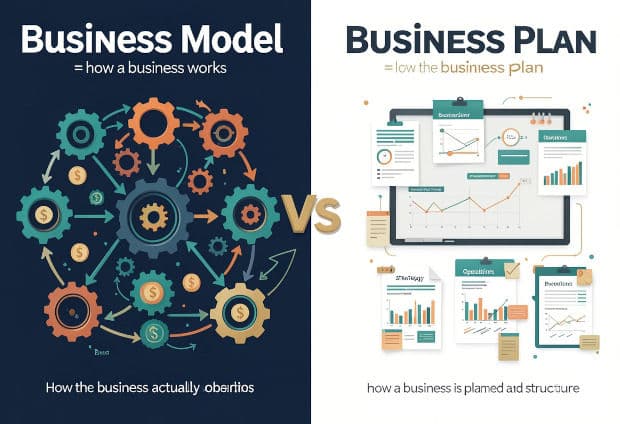
Most entrepreneurs use 'business model' and 'business plan' interchangeably — that is a costly mistake. When an investor asks for your business plan, they often really want to understand your business model. These are two completely different tools built for different purposes. A Business Model is the logic of how you make money — the WHY and HOW of value creation and capture. A Business Plan is a detailed execution roadmap — numbers, timelines, strategies, projections. Model = the GPS destination. Plan = turn-by-turn navigation. This comprehensive guide explains the differences, their relationship, when you need each one, and what this means for entrepreneurs in the Bangladesh context.
Key Takeaways
- 1. Business Model ≠ Business Plan. A Model is the revenue logic or framework (WHY/HOW you make money) — it fits on one page. A Plan is a detailed execution document — a 20-40 page written roadmap with numbers, timelines, and financial projections.
- 2. Sequence matters: Model first, Plan second. The Model is a hypothesis — 'I believe customers will pay this price for this value.' Test the model with an MVP, validate it with real customers, then write the Plan. A great Plan built on a wrong Model is wasted time and money.
- 3. Key audience difference: A Business Model's audience is the founding team (internal strategic tool). A Business Plan's audience is investors, banks, and partners (external formal document). Model = visual canvas, constantly updated. Plan = written doc, updated annually or quarterly.
- 4. When you need each: Only Model — very early stage, idea testing, pivoting. Only Plan — bank loan, government grant, established business expansion. Both — VC/angel pitch, significant scale-up, new market entry.
- 5. Bangladesh context: Most BD entrepreneurs skip both tools and jump straight into execution. Banks require a 'project proposal' (plan) but rarely evaluate the underlying model. Successful startups like Pathao, Chaldal, and ShopUp followed the Silicon Valley approach — canvas first, plan later.
- 6. Steve Blank's warning: 'No business plan survives first contact with customers.' Follow the Lean Startup approach: Build (model/MVP) → Measure (test assumptions) → Learn (pivot or persevere) → then write the detailed plan. SBA research shows businesses with plans grow 30% faster — but only when the plan is built on a validated model.
Introduction: The Most Common Confusion in Business
Picture this: a first-time founder walks into a meeting with an investor. The investor says, 'Show me your business plan.' The founder spends the next three weeks writing a 35-page document full of market research, org charts, and five-year financial projections. The investor skims it for five minutes and asks, 'But how do you actually make money?' That is the moment the founder realizes they answered the wrong question.
The investor wanted to understand the business model — the logic behind revenue. The founder delivered a business plan — a detailed execution document. Two completely different things.
Think of it this way: a Business Model is your GPS destination — you are going from Dhaka to Chittagong. A Business Plan is the turn-by-turn navigation — which road, where to stop for fuel, how long it takes, what to do if there is traffic.
Business Model = the WHY and HOW you make money. It is a logic or framework — visual, strategic, fits on one page.
Business Plan = the detailed execution roadmap — numbers, timelines, budgets, marketing strategy. Typically 20-40 pages.
If the Model is wrong, the Plan is worthless — no matter how beautifully written. This guide will clearly separate the two concepts, explain how they relate, and tell you exactly when you need each one.
Read more about Business Models in depth: https://georenus.com/edu/en/business-models/business-model-what-is-english
Chapter 1: Business Model — Quick Recap
We have a full guide on Business Models. Here is the quick recap you need before the comparison.
Definition: A Business Model is the logic or structure that describes how a business creates value for customers (value creation) and captures some of that value as revenue (value capture).
Core question: HOW do you make money — and why will customers choose you over everyone else?
Alexander Osterwalder's Business Model Canvas (2010) broke this concept into 9 building blocks: Customer Segments, Value Propositions, Channels, Customer Relationships, Revenue Streams, Key Resources, Key Activities, Key Partnerships, and Cost Structure.
Famous real-world examples:
Netflix = subscription model — unlimited content for a flat monthly fee. No ads, no per-title charges.
Google = advertising model — search is free for users, advertisers pay per click. You are the product; advertisers are the real customer.
Uber = commission/platform model — takes 20-25% of every ride without owning a single vehicle.
Four defining characteristics of a Business Model:
Visual: Can be drawn as a one-page canvas that the whole team can see and discuss.
Strategic: Shows the big picture — direction, not detail.
Flexible: Can pivot when market reality changes.
Hypothesis-based: Start with an educated assumption, test it, iterate.
Chapter 2: What Is a Business Plan?
Definition
A Business Plan is a formal, written document that describes in detail how a business intends to achieve its goals. It is a comprehensive roadmap — complete with numbers, timelines, strategies, and execution specifics.
Typically 20-40 pages long and covers a specific time horizon — usually 3-5 years.
Components of a Business Plan
A complete Business Plan contains:
1. Executive Summary: A 1-2 page overview of the entire plan. It is read first but written last.
2. Company Description: Business overview, mission, vision, and legal structure.
3. Market Analysis: Target market size, growth rate, competitive landscape, and industry trends.
4. Competitive Analysis: Who your competitors are, their strengths and weaknesses, and your competitive advantage.
5. Organization & Management: Team structure, founders' backgrounds, and key hire plans.
6. Products/Services: What you sell, why it is unique, and any IP or patents.
7. Marketing & Sales Strategy: Customer acquisition plan, pricing strategy, and distribution channels.
8. Financial Projections: 3-5 year revenue forecast, profit & loss statement, cash flow projection, and balance sheet.
9. Funding Requirements: How much capital you need, how it will be used, and your repayment or equity plan.
10. Appendix: Supporting documents — market research data, legal agreements, team CVs.
Why You Need a Business Plan
Bank loans: Every bank and NBFI in Bangladesh requires a 'project profile' or Business Plan for a business loan application.
Investors: VCs and angel investors want a formal plan — especially at Series A and beyond.
Government grants: SME Foundation, BIDA, and ICT Division grants all require a detailed plan.
Partners: Potential joint venture or strategic partners will ask to review your plan.
SBA (U.S. Small Business Administration) research: Businesses that write plans grow 30% faster than those that do not — and have higher overall success rates.
Weaknesses of a Business Plan
Too much detail, too soon: Startup reality changes daily. Half your assumptions are wrong before the ink dries on a 40-page plan.
False confidence: A beautifully formatted plan does not mean the business will work in practice.
'Plans are useless but planning is indispensable.' — Dwight D. Eisenhower
The Lean Startup movement (Eric Ries, 2011): Instead of a 40-page plan, start with a Business Model Canvas. Test your assumptions, learn from real customers, then build the plan.
This is why Silicon Valley investors respond better to a crisp one-page Business Model Canvas than a polished 40-page Business Plan.
Chapter 3: Head-to-Head Comparison
Let us put them side by side. Study this table carefully:
| Aspect | Business Model | Business Plan |
| Purpose | Define revenue logic and framework | Create an execution roadmap |
| Length | 1-page canvas | 20-40 page written document |
| Focus | Why customers will pay (WHY) | How you will execute (HOW) |
| Audience | Founders and team (internal) | Investors, banks, partners (external) |
| Timeframe | Ongoing / living document | Fixed horizon (typically 3-5 years) |
| Flexibility | Highly flexible, pivot-friendly | Relatively rigid once written |
| Numbers | Conceptual — no detailed figures | Detailed P&L, cash flow, projections |
| When needed | First — before anything else | After the model is validated |
| Format | Visual canvas (diagram/chart) | Formal written document |
| Updated | Continuously | Annually or quarterly |
| Risk approach | Identify assumptions and test them | Plan for known risks |
| Example | 'We earn via subscription revenue' | 'Year 1: 10,000 subscribers x BDT 500/month = BDT 6 crore/year' |
Note: The comparison above is a general guide. In practice, both tools are complementary and are used together.
Chapter 4: How They Work Together
Model First, Plan Second
A Business Model is a hypothesis: 'I believe this type of customer will pay this price for my product or service.' It is an educated guess.
That hypothesis must be tested — through customer interviews, an MVP (Minimum Viable Product), or a pilot project. If the test validates the model, you now have real numbers to work with. Build your Business Plan on that real data.
Key insight: Writing a 40-page plan at the idea stage is like shooting arrows in the dark.
Model Is the Heart of the Plan
Every section of your Business Plan ultimately depends on your Business Model:
Financial Projections: How much revenue will you generate? — That depends entirely on your revenue model (subscription? commission? one-time sale?).
Marketing Strategy: How will you acquire customers? — That depends on your customer segment and channel choices.
Cost Structure: Where will most of your money go? — That depends on your key resources and key activities.
Bottom line: Wrong Business Model → wrong assumptions → wrong Business Plan → wasted time and money.
Six-Step Workflow
Here is how to use both tools together, step by step:
Step 1: Build a Business Model Canvas — fill in all 9 blocks.
Step 2: Test your core assumptions — customer interviews, MVP, pilot project.
Step 3: Validate the revenue model — find out if real people will actually pay.
Step 4: Write the Business Plan using real data — now the numbers are grounded.
Step 5: Present to investors or banks.
Step 6: Execute and keep both documents updated as you learn.
Analogy: Business Model = the recipe (what you are cooking). Business Plan = the kitchen schedule for serving 200 guests (when, how, who does what).
Chapter 5: Real Examples to See the Difference
Example 1: Tea Stall (Simple BD Business)
Business Model: Sell tea and snacks at a busy location. Revenue from direct retail sales. Low cost per unit, high daily volume.
Business Plan:
Location analysis: Monthly rent BDT 15,000.
Initial investment: Equipment and setup BDT 50,000.
Daily sales target: 200 cups x BDT 15 = BDT 3,000/day → BDT 90,000/month.
Break-even: Within 3 months.
Expansion plan: Second location at 6 months, third at 12 months.
The model here is simple (direct retail), but the plan contains specific numbers, timelines, and milestones. You need both.
Example 2: E-commerce Startup
Business Model: Marketplace for handmade crafts — niche platform. Revenue: 10-15% commission per sale. Sellers list for free.
Business Plan:
Platform development: BDT 20 lakh (3 months).
Target: Onboard 500 sellers within 6 months.
Monthly GMV target: BDT 50 lakh within 6 months.
Marketing budget: BDT 5 lakh for the first 6 months.
Break-even: 18 months.
Funding plan: Series A at 12 months — BDT 5 crore.
Example 3: bKash (Real Case)
Business Model: Mobile money — revenue from transaction fees: cash-in, cash-out, P2P transfer, merchant payment. Network effect: more users → more useful → even more users.
Business Plan (early stage): Partnership with BRAC Bank, build an agent network of 100,000 in year one, technology infrastructure investment, Bangladesh Bank regulatory compliance, profitability target at 5 years.
Result: Today bKash has over 60 million registered accounts and dominates Bangladesh's mobile financial services market.
bKash's success was rooted in the right Business Model — transaction fees plus network effects. The Plan was built on top of that validated model. Get the model right first.
Chapter 6: Which Do YOU Need?
Only Model Needed
Very early stage: You only have an idea — no validation yet.
Testing an idea: Before writing 40 pages, check if the concept actually works.
Pivoting: The old model failed and you are exploring a new direction.
Co-founder alignment: Everyone needs to agree on the same strategy before writing anything formal.
At this stage, a 40-page plan is a waste of time. Just build the canvas.
Only Plan Needed
Bank loan application: Banks do not understand a model canvas — they want a formal 'project profile.'
Established business expansion: The model is already validated; you now need expansion specifics.
Government grant application: SME Foundation, BIDA — these bodies require formal plans.
Franchise agreement: The franchisor will want to see your detailed operational plan.
You Need Both
VC/Angel pitch: Investors use the model to understand the logic, the plan to check the numbers.
Significant scale-up: Large expansions require both tools working together.
New market entry: Adapt the model for the new market, then build a fresh plan to execute.
Use the table below to decide which tool fits your situation:
| Situation | Business Model | Business Plan | Both | Priority |
| New idea, not yet tested | Yes | No | — | Model first |
| Bank loan application | Optional | Yes | — | Plan required |
| Angel investor pitch (seed) | Yes | Optional | — | Model first |
| VC pitch (Series A+) | Yes | Yes | Yes | Both equally |
| Pivot / new direction | Yes | No | — | Update model first |
| Government grant | Optional | Yes | — | Plan required |
| Established business expansion | Review | Yes | — | Plan priority |
| Co-founder alignment | Yes | No | — | Start with canvas |
| New market entry | Yes | Yes | Yes | Adapt model, new plan |
Note: The recommendations above are general guidelines. Your specific situation may require a different approach.
Chapter 7: Do's and Don'ts
Do:
Model before Plan: Always build your Business Model Canvas first — then write the Business Plan.
Validate assumptions: Run customer interviews, build an MVP, collect real feedback — before writing numbers into any plan.
Keep the model visual: Draw it on one page as a canvas — everyone can see it, discuss it, and challenge it.
Update the Plan with real data: Every new insight and lesson should be reflected in your Business Plan.
Use Lean Canvas for startups: Ash Maurya's Lean Canvas is a simplified version of Osterwalder's canvas — it is more practical for early-stage startups.
Keep both documents separate: Model = internal strategic tool. Plan = external formal document.
Don't:
Do not write a 40-page plan until you have tested whether anyone actually wants what you are selling.
Do not confuse the two in investor meetings: Say 'Our business model is...' and 'Our business plan shows...' — keep them clearly separate.
Do not build a model and then forget it: When market reality shifts, update the model.
Do not rely on the Plan alone: The best plan in the world will fail if the underlying model is broken.
Do not skip market validation: No matter how elegant the model or plan — without real customers, it is all fiction.
Chapter 8: The Bangladesh Context
Most Bangladeshi entrepreneurs fall into one of two traps:
Trap 1: Jump straight into execution — no model, no plan.
Trap 2: Write a 'project profile' for the bank — but never think seriously about the underlying model.
Banks in Bangladesh typically ask for a project proposal or Business Plan when evaluating a loan. But in many cases, they do not rigorously evaluate the underlying Business Model. The result: loans are approved for businesses with faulty models, the businesses fail, and both sides lose.
The good news: Successful Bangladeshi startups have embraced the Silicon Valley approach.
Pathao: Tested the ride-sharing model first, then scaled.
Chaldal: Validated online grocery delivery in Dhaka before expanding.
ShopUp: Iterated its SME financing model multiple times before finding product-market fit.
SME Foundation, BIDA, and banks should consider introducing Business Model Canvas-based evaluation alongside traditional plan review. It would produce better loan decisions and stronger businesses.
Here is how the Bangladesh context looks across common situations:
| Situation | What Most BD Entrepreneurs Do | What They Should Do | Tool Needed |
| Starting a new business | Jump into execution immediately | Build Model Canvas, test assumptions first | Business Model Canvas |
| Applying for a bank loan | Write only a project profile | Validate model first, then write the plan | Validated Model + Business Plan |
| Launching a startup | Build the app and launch it | Customer interviews, MVP, then full build | Lean Canvas + MVP |
| SME expansion | Decide on gut feeling | Review current model, update plan | Updated Model + Expansion Plan |
| Investor pitch | Show only a product demo | Show model + plan + traction data | Canvas + Deck + Plan |
| Entering a foreign market | Hire a local agent | Adapt the model for the new market first | New Market Model Canvas |
Note: The table above reflects general trends. Individual experiences may differ.
Final Thoughts
Business Model and Business Plan — two different tools, but completely complementary. Not competitors. Partners.
Business Model = the logic of your business. WHY and HOW you create value and earn revenue.
Business Plan = the execution roadmap that turns that logic into reality.
Correct sequence: Start with the Model → Validate it → Then write the Plan.
Remember: Both are 'living documents' — they need to evolve as you learn from the real world.
Knowing which tool to use, and when, is the mark of a smart entrepreneur. Very early stage? Start with the canvas. Need a bank loan? Write the plan. Pitching investors? You need both.
'No business plan survives first contact with customers.' — Steve Blank, Lean Startup pioneer
Steve Blank is not saying do not plan. He is saying: validate your Business Model first with real customers, then build your Business Plan on that solid foundation — and update both as you learn.
Read the full Business Model guide: https://georenus.com/edu/en/business-models/business-model-what-is-english
Recommended for you

The Bretton Woods Agreement: A Turning Point in Global Economic History
In 1944, as the world was still engulfed in the devastation of World War II, the global economy had collapsed and people’s living standards had plummeted. In an effort to stabilize the international economy and address pressing global financial issues, the Allied nations convened a historic summit. Nearly 730 delegates from 44 countries gathered at the Mount Washington Hotel in Bretton Woods, New Hampshire, for the United Nations Monetary and Financial Conference. The outcome of this summit was the landmark Bretton Woods Agreement, which gave birth to the Bretton Woods System.
Business
Needs, Wants, and Demands

Branding
Branding: How to Make Your Business Stand Out
Business Models
Sharing Economy Model: How Businesses Make Money Without Owning Anything
Economics
Economics: What It Is, Why It Matters, and How It Shapes Our Lives
Finance
Finance: What It Is, Why You Need It, and How It Works in Real Life
Accounting
Corporate Taxation and International Tax Challenges Explained
Accounting
Taxation for Individuals and Businesses: A Complete Overview

Agreement
World Trade Organization (WTO) Agreements

Agreement
North American Free Trade Agreement (NAFTA)