What Is a Business Model? How Businesses Actually Make Money — The Complete Guide
G
GeoRenus Editorial Team
664 views
Summary
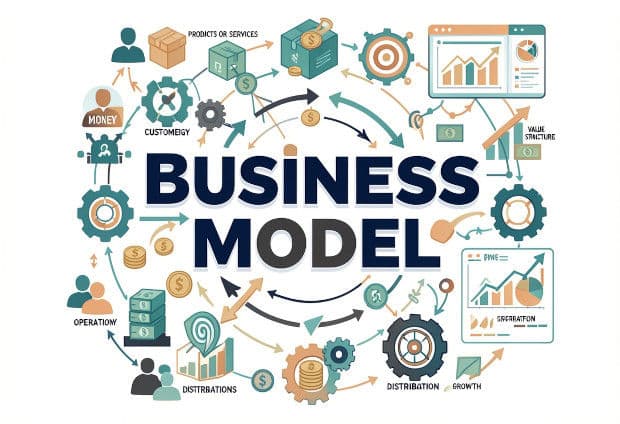
You have a great product — but how exactly do you make money from it? That is the heart of a business model. Google gives away search for free yet earns $307 billion a year. Uber owns zero cars yet commands a valuation of over $130 billion. Amazon started as a bookstore and now runs a cloud empire, a subscription program, an ad platform, and a marketplace — all at once. A business model is not just what you sell — it is the full logic of how a company creates value, delivers it to customers, and captures revenue in return. From Subscription to Freemium, Advertising to Marketplace, Razor-and-Blade to SaaS — this guide covers 15 major business model types, Alexander Osterwalder's Business Model Canvas, the world's best case studies, and what it all means for businesses in Bangladesh.
Key Takeaways
- 1. A business model answers three questions: What value are you creating? For whom? How do you earn revenue? CB Insights research shows 42% of startups fail due to 'no market need' — which really means a broken business model. A great product with the wrong model still fails.
- 2. Alexander Osterwalder's Business Model Canvas (2010) breaks any business into 9 building blocks: Customer Segments, Value Propositions, Channels, Customer Relationships, Revenue Streams, Key Resources, Key Activities, Key Partnerships, and Cost Structure. Any business in the world can be mapped onto this framework.
- 3. 15 major business model types: Subscription (Netflix $33B, 260M+ subscribers), Freemium (Spotify 2-5% conversion), Advertising (Google 80% of $307B from ads), Marketplace (Amazon 15-20% commission), E-commerce/DTC, SaaS (Salesforce $34B, 70-80%+ margins), Franchise (McDonald's 93% franchised), Razor-and-Blade, P2P, Aggregator, Manufacturing, Licensing (ARM $3.2B — zero chips manufactured), Affiliate, Crowdfunding, Data Monetization.
- 4. World's best business model case studies: Google (you are the product — advertisers are the real customers), Amazon (AWS generates 60%+ of total profit, Prime has 200M+ members), Apple (Services revenue $85B+ and growing fast), bKash (21 crore+ accounts, estimated BDT 75,000 crore/month in transactions — built on serving the unbanked).
- 5. Business model innovation is how great companies survive: Netflix pivoted three times (DVD mail → streaming → original content), Adobe switched from one-time Photoshop licenses ($999) to Creative Cloud subscriptions ($55/month) — revenue doubled, stock rose 10x. Apple evolved from computers to iPod+iTunes to iPhone to a services ecosystem.
- 6. Bangladesh opportunity: bKash (transaction fees), Grameenphone (subscription + data), Daraz (marketplace), Pathao (aggregator), 10 Minute School (freemium + course fees), Chaldal (e-commerce). With 180M population, 130M+ internet users, and young demographics, Subscription, SaaS, Marketplace, and Fintech models hold enormous potential.
Introduction: How Does Your Business Actually Make Money?
You have a brilliant product. You have a team that believes in it. You have customers who use it. But here is the real question — how do you actually make money from it? That question is what a business model is all about.
Google gives you search, Gmail, Maps, YouTube, and Android — all completely free. Yet Google's parent company Alphabet earned roughly $307 billion in revenue in 2023. Where does all that money come from? One word: advertising.
Uber owns zero cars. Not a single vehicle is on its balance sheet. Yet the company's valuation has surpassed $130 billion. How? Platform plus commission — it connects drivers with riders and takes a cut of every trip.
Netflix started in 1997 by mailing DVDs in red envelopes. Today it has 260 million+ subscribers worldwide. Three pivots, three different business models, one company that refused to stand still.
A business model is the full logic of how a company creates value for its customers, delivers that value, and captures revenue in return. It is not just what you sell — it is how the whole machine works.
'The purpose of business is to create a customer.' — Peter Drucker
Alexander Osterwalder and Yves Pigneur introduced the Business Model Canvas in 2010 — a simple one-page framework that breaks any business into 9 building blocks. Entrepreneurs, CEOs, investors, and MBA students around the world use it every day.
Understanding business models is not just for startup founders. If you work at a company, invest in stocks, or run a small shop, knowing how businesses make money tells you what will survive, what will grow, and what will collapse.
Chapter 1: What Is a Business Model?
A Simple Definition
A business model is the framework that describes how a business creates value for its customers (value creation) and captures a portion of that value as revenue for itself (value capture).
Three questions cut right to the heart of any business model:
1) What value are you creating? What problem are you solving? What need are you meeting? Why should anyone care?
2) For whom? Who is your customer? Where do they live? What can they afford? What do they actually want?
3) How do you earn revenue? Sales? Subscription fees? Advertising? Commission? Licensing? A mix of all of these?
Business Model vs Business Plan
Business Model = the core logic of how your business makes money. The HOW. It can be sketched on a single page or even a napkin.
Business Plan = the detailed execution document. Numbers, timelines, budgets, hiring plans, marketing strategies — all the specifics.
Critical point: Model comes first, plan comes second. The best execution plan in the world cannot save a broken business model. And models are easier to change than plans — a plan is highly specific, a model is a logic.
Here is a fun example: YouTube started as a dating site. Seriously. Founders wanted users to upload videos describing what they were looking for in a partner. The model flopped instantly. They pivoted to general video sharing, then discovered the advertising model — and in 2006, Google acquired YouTube for $1.65 billion.
Why Business Models Matter
CB Insights research found that the number one reason startups fail (42%) is 'no market need' — which is another way of saying the business model was wrong. Great product, wrong model = failure.
The flip side: an average product with the right model can dominate a market for decades. Gillette's blades may not be technically superior to every competitor — but the razor-and-blade model has kept it on bathroom shelves for over a century.
Investors scrutinize business models because the model predicts whether a company will be profitable long-term, whether revenue will grow predictably, and whether margins will improve over time.
Chapter 2: The Business Model Canvas — 9 Building Blocks
Alexander Osterwalder and Yves Pigneur's book 'Business Model Generation' (2010) is one of the most influential business books ever written. Their framework maps any business onto 9 building blocks that together tell the complete story of how an organization creates, delivers, and captures value.
1. Customer Segments
Who are you serving? One big market? Multiple distinct groups? Getting this wrong means your marketing, pricing, and product will all miss the target.
Mass Market: one product for everyone (Coca-Cola, commodity goods).
Niche Market: a specific, specialized group (luxury watches, medical devices).
Multi-sided Platform: two completely different customer groups that need each other. Facebook serves users (free) AND advertisers (paying). The users are the product; advertisers are the paying customers.
2. Value Propositions
What problem are you solving? Why would a customer choose you over every alternative — including doing nothing?
Uber's Value Proposition: convenience (one tap gets you a cab) + price transparency + no cash hassle + driver ratings = reliable, predictable experience.
3. Channels
How do you reach your customers? Online store? Retail partners? Direct sales team? Social media? The right channel depends on who your customer is and how they prefer to buy.
Apple: owns its retail stores, operates apple.com, and partners with mobile carriers and third-party retailers. Multiple channels reinforce each other.
4. Customer Relationships
How do you acquire customers, retain them, and grow them over time? Every relationship type has a different cost and a different lifetime value.
Amazon: automated recommendations (algorithm), community reviews, and the Prime loyalty program work together to make customers feel understood and rewarded — and very hard to leave.
5. Revenue Streams
This is the heartbeat of the business model. How exactly does money flow in?
Asset sale: sell a product once (Toyota selling a car).
Subscription: recurring monthly or annual fee (Netflix).
Licensing: charge others to use your intellectual property (ARM Holdings).
Advertising: give the service free, charge advertisers for access to users (Google, Meta).
Commission: take a percentage of every transaction (Uber, Daraz, Airbnb).
6. Key Resources
What are the most critical assets your business needs to function?
Physical: factories, warehouses, logistics networks (Walton, Toyota).
Intellectual: patents, brand reputation, proprietary algorithms (Google's search algorithm, Coca-Cola's formula).
Human: exceptional talent (McKinsey, Goldman Sachs — the people ARE the product).
Financial: capital, credit facilities, investor backing.
Uber's insight: its key resource is software and brand — not vehicles. It disrupted the entire taxi industry without owning a single car.
7. Key Activities
What must you do, every single day, for the business to work?
Production: manufacturing the product (Nike, Walton).
Problem-solving: crafting solutions for clients (consulting firms, hospitals).
Platform management: Google must continuously improve its search algorithm and advertising platform. That is the activity — not making physical goods.
8. Key Partnerships
No business is an island. Who do you rely on to make the model work?
Apple + Foxconn: Apple designs, Foxconn manufactures. Apple stays asset-light; Foxconn handles the factory complexity.
Spotify + record labels: Spotify provides the platform; labels provide the content. Neither works without the other.
Pathao + restaurants: Pathao handles delivery logistics; restaurants handle cooking. Classic aggregator partnership.
9. Cost Structure
What are your biggest costs? Understanding cost structure determines whether you can be profitable at your chosen price point.
Fixed costs: rent, salaries, equipment — stay the same regardless of output (think of an airline's aircraft purchase).
Variable costs: raw materials, shipping, commissions — rise and fall with volume.
Cost-driven: obsessively minimize costs to compete on price (Walmart, budget airlines).
Value-driven: spend more to deliver a premium experience; customers pay accordingly (Apple, Ritz-Carlton).
Chapter 3: 15 Major Business Model Types
1. Subscription Model
How it works: customers pay a recurring fee — monthly or annual — in exchange for ongoing access to a product or service.
Netflix: roughly $33 billion in revenue in 2023, with 260 million+ subscribers. Spotify, Microsoft 365, Adobe Creative Cloud all run on the same logic.
Bangladesh: Chorki, bKash premium services, and various SaaS tools.
Why investors love it: Predictable, recurring revenue. Once a subscriber is hooked, you earn from them again and again. Valuation multiples are much higher than one-time sales businesses.
2. Freemium Model
How it works: give the basic product away for free; charge for premium features, storage, or capabilities.
Spotify: free tier (with ads and limited features) vs Premium (ad-free, offline listening, higher quality).
Dropbox: 2GB free; pay for more storage. LinkedIn: basic profile free; Sales Navigator and premium features cost money.
Conversion reality: typically only 2-5% of free users convert to paid. But with tens of millions of free users, even 2% is a massive paying customer base.
3. Advertising Model
How it works: give the service away free to attract massive user scale; earn revenue by selling access to those users to advertisers.
Google: roughly $307 billion in revenue in 2023, with approximately 80% coming from advertising.
Meta/Facebook: roughly $135 billion in revenue, approximately 97% from ads.
The uncomfortable truth: on Google and Facebook, you are not the customer. You are the product. Advertisers are the real customers — they pay to reach you.
4. Marketplace / Platform Model
How it works: bring buyers and sellers together on a platform; take a commission on every transaction.
Amazon Marketplace: third-party sellers list products; Amazon takes 15-20% commission.
Uber: takes roughly 25-30% of every ride fare. Airbnb: 3-15% depending on the booking.
Bangladesh: Daraz, Bikroy, Pathao, and various vertical marketplaces.
5. E-commerce / Direct-to-Consumer (DTC)
How it works: cut out the middleman and sell directly to consumers online — keeping higher margins and owning the customer relationship.
Global: Warby Parker (eyewear), Dollar Shave Club (razors, acquired by Unilever for $1B).
Bangladesh: Chaldal (grocery delivery), Shajgoj (beauty products).
6. SaaS (Software as a Service)
How it works: deliver software over the cloud on a subscription basis — no installation, no one-time license, continuous updates.
Salesforce: roughly $34 billion in revenue in 2023. Zoom, Slack, HubSpot, Notion.
Why it is attractive: gross margins of 70-80%+. Recurring revenue. Low distribution costs. Once a company is integrated into a SaaS tool, switching is painful.
7. Franchise Model
How it works: license your brand, system, and know-how to a franchisee; they invest the capital and run the location; you earn franchise fees and royalties.
McDonald's: over 39,000 locations worldwide, 93% of which are franchised. KFC, Subway, Domino's follow the same model.
The franchisor's advantage: expand globally without deploying your own capital. The franchisee bears the operational risk.
Bangladesh: Pizza Hut, KFC, Chillox, and international cafe chains entering the market.
8. Razor-and-Blade Model
How it works: sell the base product cheaply (or give it away); make the real money on expensive, recurring consumables.
Gillette: cheap razor handle, expensive replacement blades. Once the razor is in your hand, you are locked into buying Gillette blades for years.
HP printers: inexpensive printer, very expensive ink cartridges. Nespresso: affordable machine, premium coffee capsules.
Also called the 'Bait and Hook' model. The hook is the recurring revenue — not the upfront sale.
9. Peer-to-Peer (P2P)
How it works: ordinary people transact directly with each other; the platform facilitates and earns a cut.
Airbnb: hosts list spare rooms or entire homes; guests book directly. Airbnb is the trusted middleman taking a service fee from both sides.
Uber: private car owners become drivers. No company-owned vehicles needed.
10. Aggregator Model
How it works: aggregate supply from many providers without owning anything yourself; present it to customers under a unified brand.
Zomato / Foodpanda: does not own a single restaurant, yet handles orders from thousands of them.
Google: does not create content — it aggregates and organizes the entire internet, then sells ads against it.
Bangladesh: Foodpanda, Pathao Food, Shohoz.
11. Manufacturing / Traditional
How it works: design and make a product, then sell it. The oldest model in existence.
Global: Toyota, Samsung, Apple (hardware division).
Bangladesh: Walton, Pran, Square Pharmaceuticals.
The catch: capital-intensive, thinner margins compared to asset-light models. But full control over quality and supply chain.
12. Licensing / Royalty
How it works: create intellectual property — patents, designs, characters, software — and charge others to use it.
Disney: licenses Mickey Mouse, Marvel, and Star Wars characters for toys, clothing, video games, and theme parks worldwide.
ARM Holdings: designs chip architectures and licenses them to Apple, Qualcomm, Samsung, and nearly every mobile processor maker. Revenue: roughly $3.2 billion — and ARM does not manufacture a single chip.
Pharmaceutical patents: a new drug patent grants 20 years of exclusive selling rights — pure pricing power.
13. Affiliate Model
How it works: refer customers to another company's product; earn a commission on each sale that results from your referral.
Amazon Associates: bloggers and website owners embed Amazon links; when a reader buys, the blogger earns 3-10% commission.
Bangladesh: YouTubers, bloggers, and social media influencers increasingly monetize through affiliate partnerships with local and global brands.
14. Crowdfunding
How it works: raise small contributions from many people — either to fund a product before it is built, or to back a cause.
Kickstarter: collect pre-orders before a product is manufactured — validating demand and funding production simultaneously. GoFundMe: cause-based fundraising from the crowd.
Wikipedia: entirely crowdsourced content, run on donations. Proof that a community-powered model can beat corporate alternatives.
15. Data Monetization
How it works: collect user behavior data at scale; sell insights, targeting capabilities, or anonymized data sets to third parties.
Credit bureaus: sell individual credit histories to banks and lenders.
Social media platforms: use anonymized behavioral data to enable hyper-targeted advertising campaigns.
Loyalty card programs: track purchase patterns across millions of shoppers; sell those insights to consumer goods companies.
| Model | Revenue Source | Global Example | BD Example | Key Advantage | Key Risk |
| Subscription | Monthly/annual fee | Netflix, Spotify | Chorki | Predictable recurring revenue | Churn (subscribers leaving) |
| Freemium | Premium upgrades | Dropbox, LinkedIn | 10 Minute School | Low barrier to entry | Low conversion rate (2-5%) |
| Advertising | Advertiser payments | Google, Meta | Prothom Alo online | Free service = massive scale | Ad blockers, privacy regulations |
| Marketplace | Commission per transaction | Amazon, Airbnb | Daraz, Bikroy | No inventory risk | Chicken-and-egg problem |
| E-commerce/DTC | Product sales | Warby Parker | Chaldal | High margin (no middleman) | High logistics cost |
| SaaS | Software subscription | Salesforce, Zoom | Local SaaS tools | 70-80%+ gross margin | High initial development cost |
| Franchise | Franchise fee + royalty | McDonald's, KFC | Pizza Hut BD | Scale without own capital | Quality control across locations |
| Razor-and-Blade | Repeat consumable sales | Gillette, HP | Nespresso | Lock-in loyal customers | Counterfeit consumables |
| P2P | Commission/transaction fee | Airbnb, Uber | Pathao | Asset-light, fast scale | Regulatory and trust risk |
| Aggregator | Commission/listing fee | Foodpanda, Google | Foodpanda BD | No inventory needed | Supplier/partner dependency |
| Manufacturing | Product sales | Toyota, Samsung | Walton, Pran | Full control over quality | Capital intensive |
| Licensing/Royalty | License fee per use | ARM, Disney | Patent holders | Passive income from IP | Requires strong IP protection |
| Affiliate | Referral commission | Amazon Associates | BD bloggers/YouTubers | Zero inventory needed | Dependent on third-party products |
| Crowdfunding | Pre-sales / donations | Kickstarter | GoFundMe BD | Validate before you build | Funding not guaranteed |
| Data Monetization | Data/insight sales | Credit bureaus | Loyalty programs | Highly scalable revenue | Privacy laws and regulation risk |
Disclaimer: The revenue figures and percentages in this article are approximate, sourced from publicly available reports. Actual figures may differ. Always verify with the latest official filings before making investment decisions.
Chapter 4: World's Most Successful Business Models — Case Studies
Google/Alphabet — The Advertising Empire
Google's most popular products — Search, Gmail, Google Maps, YouTube, and Android — are all completely free to use.
So where does the money come from? Roughly $307 billion in revenue in 2023 (approximate), with about 80%+ coming from advertising.
The genius of the model: you are not Google's customer. You are Google's product. Your search behavior, location history, and browsing patterns are packaged into hyper-targeted advertising inventory sold to businesses.
The network effect is relentless: more users generate more data, which enables better ad targeting, which attracts more advertisers, which generates more revenue to improve the product, which attracts more users. It is a self-reinforcing loop.
Amazon — Everything, All at Once
Amazon is not one business. It is many business models running simultaneously under one roof:
E-commerce (direct retail): buys inventory wholesale and sells it directly to consumers.
Marketplace: hosts third-party sellers and takes 15-20% commission.
AWS (Amazon Web Services): cloud computing that generates over 60%+ of Amazon's total operating profit — from a fraction of total revenue.
Prime subscription: 200 million+ members paying $139/year for free shipping, streaming, and exclusive deals.
Advertising: now the third-largest digital advertising platform in the world.
Estimated total revenue 2023: approximately $575 billion.
Amazon's strength: when one arm of the business earns thin margins, another compensates with fat ones. Once a customer is inside the ecosystem, leaving feels like a downgrade.
Apple — The Ecosystem Lock-In
Apple began as a hardware company. Today its model is far more sophisticated — and far more sticky.
iPhone (hardware): premium pricing, high margins, iconic status.
App Store: Apple takes a 30% commission from developers on every purchase.
iCloud, Apple Music, Apple TV+, Apple Arcade: subscription services stacking recurring revenue on top of hardware sales.
Services revenue: roughly $85 billion+ in 2023 (approximate) — and growing faster than hardware.
The lock-in effect: once you own an iPhone, you rely on iMessage, AirDrop, iCloud, and the Apple Watch. Switching to Android means leaving all of that behind. Apple makes that migration painful by design.
Apple's masterstroke: hardware is sold once, services are billed forever. Every iPhone sold seeds a new lifetime services customer.
bKash — Bangladesh's Business Model Innovation
bKash launched in 2011 to solve a deceptively simple problem: hundreds of millions of people in Bangladesh had no access to formal banking. The solution was a mobile wallet that required only a phone number.
Revenue model: small transaction fees on cash-in, cash-out, send money, and merchant payments.
Scale: 21 crore+ registered accounts (approximate). Estimated monthly transaction volume: over BDT 75,000 crore (approximate).
The innovation: bKash did not disrupt an existing bank — it created an entirely new category. Mobile Financial Services for the previously unbanked population.
bKash shows that a globally proven model (mobile money, pioneered by M-Pesa in Kenya) adapted brilliantly for local context can unlock an enormous untapped market.
| Company | Primary Model | Revenue 2023 (approx) | Main Revenue Source | Key Insight |
| Google/Alphabet | Advertising | ~$307 billion | ~80% from advertising | Free product = mass data = ad targeting power |
| Amazon | Multiple (e-commerce + cloud + marketplace) | ~$575 billion | AWS = 60%+ of operating profit | Multiple revenue arms = resilience and dominance |
| Apple | Hardware + Ecosystem services | ~$383 billion | Services growing rapidly past hardware | Lock-in creates recurring revenue from every device sold |
| Meta/Facebook | Advertising | ~$135 billion | ~97% from advertising | Social graph = unmatched audience targeting |
| Netflix | Subscription | ~$33 billion | 100% subscription revenue | Original content is the moat against competitors |
| bKash | Transaction fees | Growing (private company) | Transaction fees on every transfer/payment | Serving the unbanked = blue ocean with no incumbent |
Disclaimer: All revenue figures above are approximate and compiled from publicly available reports. Actual figures may differ. Always verify against the latest official annual reports before making any investment decisions.
Chapter 5: How to Build a Business Model — Step by Step
Building a business model is not a one-time exercise done in a boardroom. It is an iterative process of hypothesis, testing, and refinement. Here are 8 steps to guide you:
Step 1: Identify the real problem. Who has this problem? How painful is it? Is it painful enough that they would pay to solve it? The sharper your problem definition, the better your model will be. 'A solution for everyone' is a solution for no one.
Step 2: Define your target customer. Age, income, habits, frustrations, aspirations — the more precisely you know your customer, the easier every subsequent decision becomes.
Step 3: Craft your Value Proposition. Why would your customer choose you over every alternative? Price? Speed? Convenience? Quality? Trust? Be specific. Vague value propositions produce vague businesses.
Step 4: Choose your Revenue Model. Subscription? Advertising? Commission? Direct sale? Licensing? Match the model to your customer's willingness to pay and your market's norms.
Step 5: Map your Cost Structure. What are your biggest costs? Fixed vs variable? What does it cost to acquire one customer (CAC)? At what point do you break even?
Step 6: Identify Key Resources and Partnerships. What assets do you already have? What do you need? Who can provide what you cannot build yourself?
Step 7: Launch an MVP. Minimum Viable Product — the simplest version that tests your core hypothesis with real customers. Do not wait for perfection. Ship it and learn.
Step 8: Iterate based on data. What is working? What is not? Be ruthless. YouTube began as a dating site — it failed immediately, pivoted to video sharing, and discovered the advertising model. Instagram launched as a location check-in app and pivoted to photo sharing. Pivoting is not failure; staying married to a broken model is.
No business model is permanent. Markets shift, technology disrupts, and customers evolve. The companies that endure are the ones that know when to change — and change fast enough to matter.
Chapter 6: Business Model Innovation — When Models Transform
The most successful companies in the world did not just build great products — they also reinvented their business models at the right moments. Here are three of the clearest examples.
Netflix: DVD Mail → Streaming → Original Content
1997: DVD rental by mail. A smart alternative to Blockbuster — order online, receive by post, no late fees.
2007: Streaming launched. The model transformed — from physical delivery to unlimited digital access for a flat monthly fee.
2013: 'House of Cards' — Netflix began producing original content. It became a studio, not just a distribution platform.
The result: from near-bankruptcy in 2011 to a $250 billion+ market cap and 260 million+ subscribers.
Blockbuster had the chance to buy Netflix for $50 million in 2000. It passed. It could not change its model — it died. Netflix changed its model three times and thrived.
Adobe: License → Subscription
Before 2013: Photoshop was sold as a one-time purchase for $999. You paid once and owned it forever.
2013: Creative Cloud launched — $55/month subscription. Customers and journalists complained loudly.
The result: within five years, revenue roughly doubled. The stock price rose approximately 10x.
One-time software sales are lumpy and unpredictable. Subscriptions are smooth and compounding. Adobe's shareholders and investors were delighted even if some customers were grumpy.
Apple: Computer → Ecosystem
1976-2000: computer company. Brilliant hardware, loyal niche following, perpetually fighting Microsoft.
2001: iPod + iTunes. Suddenly Apple was hardware + software + a content marketplace. A new revenue stream entirely.
2007: iPhone. Phone + internet + music + apps + camera in one device. The entire industry changed.
2019 onwards: Services push. App Store, iCloud, Apple Music, Apple TV+, Apple Pay, Apple Fitness+. Recurring revenue stacked on every device sold.
Apple never abandoned a successful model — it layered new ones on top. Each pivot added revenue streams without destroying the existing ones.
Chapter 7: Do's and Don'ts
Do's:
Start with the customer's problem, not your product idea. Validate first — is the problem real? Will people actually pay to solve it? Talk to 50 customers before writing a single line of code.
Test your model before scaling. Launch an MVP, collect real data, and prove the model works at small scale before investing heavily.
Study your competitors' business models deeply. How do they earn revenue? Where are their margins? What are their weaknesses? Where can you differentiate?
Build multiple revenue streams over time. Single-source revenue is fragile. Amazon's e-commerce and AWS together make the company nearly unbreakable.
Stay willing to pivot. If the data says the model is not working, change it. Entrepreneurs who pivot early lose a little. Those who wait too long lose everything.
Don'ts:
Do not blindly copy a foreign model. What works in the US or China may not work in Bangladesh or Indonesia. Local context — payment infrastructure, digital literacy, trust levels, income levels — changes everything.
Do not ignore unit economics. How much does it cost to acquire one customer (CAC)? How much revenue does that customer generate over their lifetime (LTV)? If LTV is not meaningfully greater than CAC, the model is mathematically broken.
Do not scale an unproven model. Proven model + scale = growth. Unproven model + scale = expensive failure. Fix the model first, then pour fuel on the fire.
Do not rely on a single revenue source. A company that earns 97% of revenue from one channel is fragile. One regulation change, one algorithm update, one competitor entry — and the whole thing wobbles.
Do not forget customer retention. Acquiring a new customer costs 5-7x more than retaining an existing one. Reducing churn by just a few percentage points can dramatically improve profitability.
Chapter 8: Business Models in Bangladesh
Success Stories
bKash (Transaction fees): Mobile Financial Services for the unbanked. 21 crore+ accounts. The textbook example of a locally adapted global model creating a new market from scratch.
Grameenphone (Subscription + data): 80 million+ subscribers. Telecom subscription is Bangladesh's most proven and scalable model.
Daraz (Marketplace commission): Alibaba-backed. Bangladesh's largest e-commerce marketplace, connecting thousands of sellers with millions of buyers.
Pathao (Aggregator commission): ride-sharing, food delivery, and courier — multiple services, one platform, zero owned vehicles. Asset-light aggregation at its best.
10 Minute School (Freemium + course fees): free YouTube content builds massive trust and audience; paid courses and books monetize that audience. Bangladesh's most successful ed-tech model.
Chaldal (E-commerce + delivery): grocery e-commerce with same-day and two-hour delivery windows.
Challenges
Most SMEs do not think in models: the majority of small businesses in Bangladesh operate purely on 'sell product, make margin' thinking — with no strategy around scale, retention, or multiple revenue streams.
Low digital adoption: many traditional businesses remain offline-dependent, missing the cost efficiencies and reach of digital channels.
Payment infrastructure gaps: card penetration remains low. Digital payments are growing fast, but cash still dominates many transactions.
Online trust deficit: counterfeit products and failed deliveries have eroded consumer confidence in online shopping, slowing e-commerce adoption.
Opportunities
180 million people, 130 million+ internet users, young and increasingly connected demographics.
Growing middle class: rising purchasing power is creating demand for premium products and services — a new willingness to pay for quality.
Subscription models across sectors: streaming, SaaS, fintech, health — every sector is ripe for subscription-based disruption.
B2B SaaS: Bangladesh's businesses still run on outdated software. A local SaaS company that solves real operational pain points has an enormous captive market.
Fintech and inclusive finance: bKash proved the market exists. The next wave — micro-insurance, nano-loans, investment products for the mass market — is largely untapped.
| Company | Model Type | Revenue Source | Key Success Factor |
| bKash | Transaction fees | Fees on every cash-in/out, send money, and payment | First mover advantage, distribution network, public trust |
| Grameenphone | Subscription + data | Monthly SIM subscription, data packages | Network coverage, brand strength, 80M+ subscriber base |
| Daraz | Marketplace commission | Commission from sellers (approximately 10-20%) | Alibaba backing, wide and growing seller network |
| Pathao | Aggregator commission | Ride and delivery commission (approximately 15-25%) | Seamless app UX, multi-service convenience |
| 10 Minute School | Freemium + course fees | Free YouTube content + paid courses and books | Deep trust from free content, youth-focused positioning |
| Chaldal | E-commerce + delivery fee | Product margin + delivery charge | Speed (2-hour delivery), fresh produce reliability |
| ShajGoj | E-commerce + content marketing | Beauty product sales + content-driven traffic | Niche focus, strong female audience trust |
Disclaimer: The above information is compiled from publicly available sources and is approximate. Actual business figures may differ significantly.
Final Thoughts
A business model is not about what you make — it is about how you make money from what you make. That distinction sounds simple. But most businesses that fail get it wrong.
Google's search algorithm is impressive engineering. But it was the advertising model that turned it into a $300 billion empire. Amazon's logistics operation is a marvel. But AWS, Prime, and a marketplace running in parallel is what makes Amazon truly untouchable. Netflix has great content. But the subscription model — charging millions of people a small, predictable fee every month — is what makes Wall Street love it.
The world's best companies did not just build great products. They built great business models and then had the courage to evolve those models when the world changed. Netflix pivoted three times. Adobe switched from one-time sales to subscriptions against fierce customer resistance. Apple grew from a computer company into a services ecosystem spanning music, payments, health, and entertainment.
In Bangladesh, the opportunity is enormous. bKash showed that the right model applied to the right problem can reach 21 crore people in a decade. The next wave of Bangladeshi business innovation will belong to those who think clearly about their model — not just their product.
'A business model describes the rationale of how an organization creates, delivers, and captures value.' — Alexander Osterwalder
Recommended for you

The Bretton Woods Agreement: A Turning Point in Global Economic History
In 1944, as the world was still engulfed in the devastation of World War II, the global economy had collapsed and people’s living standards had plummeted. In an effort to stabilize the international economy and address pressing global financial issues, the Allied nations convened a historic summit. Nearly 730 delegates from 44 countries gathered at the Mount Washington Hotel in Bretton Woods, New Hampshire, for the United Nations Monetary and Financial Conference. The outcome of this summit was the landmark Bretton Woods Agreement, which gave birth to the Bretton Woods System.
Organization
What Is the International Monetary Fund (IMF)?

Accounting
Gross Profit: Definition, Formula, and Why It Matters
Accounting
Business Accounting: What It Is and How It Works
Accounting
Accounting for Startups: A Complete Guide to Getting It Right

Accounting
Taxation, Types and Importance
Banking
What Is a Central Bank? Role, Functions, and How It Works

Books
Zero to One: Building the Future Through Innovation, Not Competition

Branding
Brand Architecture: Definition, Models, and Examples

Branding
10 Characteristics of a Good Brand Name