Business Calculations Part 1 -- Rafiq's Biryani: From Street Cart to First Shop
G
GeoRenus Editorial Team
923 views
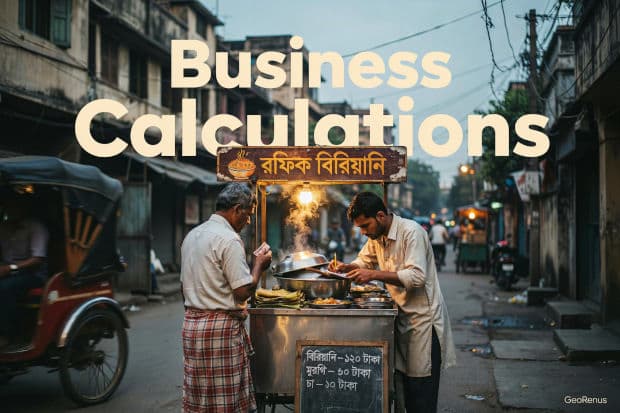
Summary
Rafiq has $500 and a dream: his own biryani business. This is Part 1 of a series that follows Rafiq's journey from street cart to multinational company, teaching every business calculation you need at exactly the moment you need it. In Part 1 (Basic Level), Rafiq starts selling from a cart and learns Revenue, Fixed vs Variable Costs, Gross and Net Profit, Profit Margin, ROI, Break-even Point, and Margin of Safety — all through his real numbers, not textbook formulas.
Key Takeaways
- Revenue is total sales income — not profit. Revenue = Units Sold x Price. It's the starting point, not the finish line.
- Fixed Costs stay constant regardless of sales volume; Variable Costs rise and fall with every unit you produce.
- Gross Profit = Revenue - Variable Cost; Net Profit = Gross Profit - Fixed Cost. Rafiq's net profit is $325/month on $500 invested.
- Profit Margin shows how much you keep per dollar sold. Rafiq's Net Margin of 45.1% crushes the restaurant industry average of 3-9%.
- ROI = (Net Profit / Investment) x 100. Rafiq's monthly ROI is 65% — he recovers his entire $500 investment in less than 2 months.
- Break-even Point = Fixed Cost / Contribution Margin. Opening a shop raises Rafiq's break-even to 845 plates/month — just 55 plates above current sales.
- Margin of Safety = ((Actual - Breakeven) / Actual) x 100. At 6.1% for the shop, Rafiq decides to grow sales to 50/day first — then open. Smart, data-driven thinking.
Intro -- Rafiq's Dream
Rafiq is 24 years old. His father runs a small grocery shop in the neighborhood — rice, lentils, cooking oil, salt. Rafiq has been stacking shelves there since he was a kid, watching customers haggle over cents and his dad scribble numbers into a worn ledger. The work is honest, but it was never Rafiq's dream.
Rafiq's dream smells like cardamom and saffron. His grandmother was the best biryani cook in the whole block — slow-cooked, bone-in, the kind that makes you close your eyes after the first bite. She passed away three years ago, but her recipe lives on in a faded notebook with handwriting so careful it looks like calligraphy. Rafiq has been guarding that notebook like a treasure map.
He has $500 saved up. Five years of working at his dad's shop, skipping luxuries, stashing a little every month. His friend Mike keeps telling him: 'Rafiq, just get a street cart, park it by the office district, watch the lunch crowd go crazy.' His dad says something wiser: 'Before you sell a single plate, you need to know how much it costs to make, how much you'll earn, and how many plates you need to sell before you break even.'
Rafiq thinks his dad is right. Great biryani alone won't keep a business alive. Great biryani plus great math — that's the real recipe. But what kind of math? Where do you even start? That question is what launches Rafiq's journey, and it's the same question this series is designed to answer.
"Numbers are the language of business. If you can't read the numbers, you can't read the business." — Harold Geneen, ITT Corporation
This series follows Rafiq from a street cart all the way to a company with multiple locations. At every stage, he runs into a new problem — and that problem forces him to learn a new calculation. No theory for theory's sake. Just real business, real numbers, real decisions.
The series is divided into four parts. Part 1 (this one): Street Cart to First Shop — Revenue, Cost, Profit, ROI, Break-even. Part 2: First Shop to Second Branch — Working Capital, Cash Flow, Contribution Margin. Part 3: Branch to Chain Business — Valuation, EBITDA, Unit Economics. Part 4: Building a Company — Financial Statements, Ratios, Investor Metrics.
But today we focus on Part 1 alone. Rafiq's first day. His first sale. His first real profit. And his first big decision — is now the right time to open a shop?
Rafiq decided to start with a cart. Low investment, low risk. If business picks up, he'll upgrade. If it flops — it's only $500 and a valuable lesson, not a lifetime of debt. Smart thinking for someone who has never run a business before.
He bought a notebook — his dad's suggestion. Every day he'd write down what he sold, what he spent, and what he kept. That notebook became the foundation of everything. January 2024. Rafiq rolled his biryani cart to the busiest corner near the downtown office park. Grandmother's recipe, his own two hands, and a $500 dream. The journey begins.
Revenue -- Rafiq's First Sale
4:00 PM on the first day. Rafiq lit the burner, lifted the lid, and let the aroma do the marketing. Within minutes, a construction worker stopped and sniffed the air. 'How much?' — '$0.80 a plate.' The man handed over a dollar and Rafiq made his first sale. Change was 20 cents. The look on the man's face after the first bite? Priceless.
By 7:00 PM, Rafiq had sold 30 plates. 30 multiplied by $0.80 equals $24. He stared at the number in his notebook and grinned. Then he thought — wait, is this my profit? He texted his dad the number. His dad replied with one word: 'Costs?'
Right. $24 is not profit. $24 is Revenue — the total money coming in before any expenses are subtracted. Revenue is the starting line of every business story, not the finish line. You need to know your revenue first, but you can never stop there.
Revenue Formula: Revenue = Units Sold x Price Per Unit
For Rafiq: Revenue = 30 plates x $0.80 = $24 per day. That's his daily revenue. But businesses think in monthly terms. If Rafiq sells 30 plates every day for 30 days, what does his monthly revenue look like?
Monthly Revenue = Daily Revenue x Working Days
Rafiq planned to work all 30 days in a month. Monthly Revenue = $24 x 30 = $720. Annual Revenue = $720 x 12 = $8,640 per year. That's a solid number for a one-person street cart operation running on $500 of startup capital.
"Many first-time entrepreneurs make a critical mistake — they see revenue and think it's profit. Revenue is just the opening chapter. The real story starts when you subtract costs."
Rafiq's friend Mike called and shouted: 'Eight thousand dollars a year, bro! You're rich!' Rafiq laughed. But he remembered his dad's question. Revenue means nothing until you know what it costs to generate it. Let's look at that next.
| Time Period | Plates Sold | Price Per Plate | Revenue |
| Day 1 | 30 | $0.80 | $24.00 |
| 1 Week | 210 | $0.80 | $168.00 |
| 1 Month | 900 | $0.80 | $720.00 |
| 6 Months | 5,400 | $0.80 | $4,320.00 |
| 1 Year | 10,800 | $0.80 | $8,640.00 |
Note: These projections assume a steady 30 plates/day and a fixed price. In reality, rainy days, local events, competition, and seasons can push sales up or down significantly. Always treat projections as estimates, not guarantees.
Revenue is the foundation. But a foundation by itself doesn't tell you if a building is profitable. To understand the true picture, we need to split Rafiq's costs into two very different categories. That's the next step.
Fixed vs Variable Cost -- Two Types of Expenses
After his first week, Rafiq opened his notebook and frowned. Money was flying out in every direction. He bought rice, bought meat, bought spices. He paid cart rental. He refilled gas. Some expenses showed up once. Some came back every few days. He couldn't figure out how to organize it all. His dad sat down with him on Sunday afternoon and said three words that changed everything: 'Split them up.'
'There are two kinds of costs,' his dad explained. 'One kind you pay no matter what — even if you sell zero plates. The other kind only shows up when you actually make something.' That's the entire concept of Fixed Cost and Variable Cost. Simple when you see it. Transformative when you use it.
Fixed Cost: Expenses that don't change regardless of how many plates you sell.
Rafiq's fixed costs: Cart rental is $30 per month — he pays it whether he sells 10 plates or 1,000. Two gas cylinders per month cost $15. Business permit fees averaged out to about $5/month. Phone and communications: $2/month. Tools, repairs, and miscellaneous: $5/month. Total Fixed Cost = $57 per month. Wait — in practice, small surprises add up, so Rafiq rounds it to $80/month to account for unexpected expenses.
Variable Cost: Expenses that increase or decrease directly with production volume.
Rafiq spent an afternoon calculating what goes into every single plate. Rice and spices: $0.15. Bone-in meat: $0.15. Packaging and disposable plates: $0.03. Cooking gas (variable portion): $0.02. Total Variable Cost = $0.35 per plate. Sell 30 plates? Pay $10.50. Sell 300 plates? Pay $105. The math scales perfectly.
Two numbers now anchor Rafiq's entire business model: $0.35 per plate in variable costs and $80/month in fixed costs. Everything that comes after — profit, break-even, margin — is built on these two numbers. Get them wrong and all the downstream calculations are wrong too.
| Cost Type | Item | Monthly Amount | Relationship to Sales |
| Fixed Cost | Cart Rental | $30.00 | No relationship |
| Fixed Cost | Gas Cylinders | $15.00 | No relationship |
| Fixed Cost | Permits & Fees | $5.00 | No relationship |
| Fixed Cost | Phone & Communications | $2.00 | No relationship |
| Fixed Cost | Tools & Repairs | $5.00 | No relationship |
| Fixed Cost | Total Fixed Cost (rounded) | $80.00 | -- |
| Variable Cost | Rice & Spices | $0.15/plate | Rises with sales |
| Variable Cost | Meat | $0.15/plate | Rises with sales |
| Variable Cost | Packaging | $0.03/plate | Rises with sales |
| Variable Cost | Gas (variable portion) | $0.02/plate | Rises with sales |
| Variable Cost | Total Variable Cost | $0.35/plate | -- |
Note: In the real world, some costs are semi-variable — gas and electricity often fall into this category. For simplicity, the base portion of gas is counted as fixed and the cooking-specific portion as variable. Always customize these categories to match your actual business.
Fixed and Variable costs are now sorted. This is one of the most powerful organizational moves any entrepreneur can make. Now let's use these numbers to figure out Rafiq's actual profit — which is very different from his revenue.
Gross Profit & Net Profit -- What Does Rafiq Actually Keep?
Month one complete. Rafiq flipped open his notebook. He'd averaged 30 plates per day across all 30 days. Total plates sold: 900. Revenue: 900 x $0.80 = $720. His friend Mike heard that number and started celebrating. Rafiq smiled patiently. He'd learned from his dad: revenue is just the headline. The real story is in the math that follows.
First deduction: Variable Cost. 900 plates at $0.35 each = $315 in variable costs. Subtract that from revenue and you get Gross Profit — the money left after you cover the direct cost of making your product.
Gross Profit = Revenue - Variable Cost (COGS)
Rafiq's Gross Profit = $720 - $315 = $405
But the work isn't done. Fixed costs still need to be paid — cart rental, gas cylinders, permits, all of it. Total Fixed Cost = $80. Subtract that from Gross Profit and you arrive at Net Profit. This is the number that actually matters most to Rafiq.
Net Profit = Gross Profit - Fixed Cost
Rafiq's Net Profit = $405 - $80 = $325
Out of $720 in revenue, Rafiq keeps $325. That's his real take-home from one month of work. This is why the distinction between Gross Profit and Net Profit matters — Gross shows you how efficiently you produce, Net shows you how much you actually earn after running the whole operation.
"Rafiq thought he made $720. He actually made $325. That gap — revenue versus net profit — is the number-one thing that surprises new entrepreneurs. Understand it early and you'll never be caught off guard."
Gross Profit tells you: after paying for ingredients and packaging, how much is left? It reflects the core efficiency of making and selling your product. Net Profit tells you: after running the entire operation — rent, utilities, everything — how much is left? That's the true health check of your business.
| Line Item | Calculation | Amount |
| Revenue (Total Sales) | 900 x $0.80 | $720.00 |
| Variable Cost (COGS) | 900 x $0.35 | $315.00 |
| Gross Profit | $720 - $315 | $405.00 |
| Fixed Cost | Cart + Gas + Permits + Other | $80.00 |
| Net Profit | $405 - $80 | $325.00 |
Note: Rafiq's own labor is not counted here. He works 8-10 hours a day, and that time has real value. If you assign a wage to your own work — say $200/month for a lean operation — Net Profit drops to $125. Part 2 will explore this in more depth under the concept of owner's compensation.
Profit is understood. But is $325 on $720 in revenue good or bad? How does it compare to other food businesses? That's where Profit Margin comes in — turning raw profit into a percentage that tells a much clearer story.
Profit Margin -- How Much Do You Keep Per Dollar Sold?
Rafiq's cousin James runs a sandwich shop. Over coffee one evening, James bragged: 'I made $500 profit last month!' Rafiq asked, 'How much did you sell?' James said, '$5,000.' Rafiq did the math quietly in his head: James keeps 10 cents on every dollar. Rafiq keeps 45 cents. Rafiq earns less in absolute dollars, but his business is dramatically more efficient. That's what Profit Margin reveals.
Profit Margin converts your profit into a percentage of revenue. It strips away the size difference between businesses and lets you compare apples to apples. A $1M business with 2% margin is actually worse at converting sales to profit than a $10K business with 40% margin.
Gross Margin = (Gross Profit / Revenue) x 100
Rafiq's Gross Margin = ($405 / $720) x 100 = 56.3%
Net Margin = (Net Profit / Revenue) x 100
Rafiq's Net Margin = ($325 / $720) x 100 = 45.1%
45.1% net margin. That means for every dollar Rafiq earns, he keeps 45 cents as profit. Let that sink in. The question now is: is that actually good? Context is everything in margin analysis. A number only means something when you compare it to industry benchmarks.
Industry Benchmark: According to Investopedia and the Corporate Finance Institute, the average restaurant net margin is 3-9%. Fine dining reaches 10-15% in good conditions. Street food carts in small-operator models can reach 30-50% because overhead is minimal. Rafiq's 45.1% is extraordinary.
Why is Rafiq's margin so high? Three reasons: no storefront rent (just a $30/month cart fee), no employees (he does everything himself), and extremely low overhead. This combination is rare and fragile. It won't last when he expands. But for now, it's a powerful position to be in.
"Warning: Rafiq's 45% margin is not permanent. The moment he opens a shop, hires staff, and takes on a lease, margins will compress dramatically. High early margins are a gift — use that runway to build volume before scaling costs."
| Business Type | Gross Margin (Avg) | Net Margin (Avg) | Source |
| Standard Restaurant | 60-70% | 3-9% | Investopedia |
| Fast Food Chain | 50-65% | 6-10% | Corporate Finance Institute |
| Street Food / Cart | 50-70% | 30-50% | SBA Small Business Data |
| Rafiq's Current Cart | 56.3% | 45.1% | Rafiq's own calculations |
| Rafiq's Projected Shop | 56.3% | 15-25% (estimated) | To be detailed in Part 2 |
Note: Industry averages vary significantly based on location, business size, and product quality. These figures represent published benchmarks from reputable sources. Always calculate your own margins — do not rely on averages to make decisions for your specific business.
Great margins are wonderful. But margins tell you how efficiently you operate — they don't tell you whether your initial investment was a smart one. That's the job of ROI, and it's where Rafiq's story gets even more interesting.
ROI -- Did Rafiq's $500 Work Hard Enough?
One evening after closing, Rafiq's dad sat beside him and asked a question that every investor asks: 'If you had put that $500 in a savings account instead, you'd earn maybe 5% a year — that's $25. What did your business earn with the same $500?' Rafiq grabbed his notebook. This is the question that Return on Investment (ROI) was built to answer.
ROI measures the efficiency of an investment. It answers: for every dollar I put in, how many dollars did I get back? It doesn't care whether you're investing in a savings account, a stock, or a biryani cart. The formula is universal.
ROI = (Net Profit / Investment) x 100
Rafiq's investment breakdown: Cart purchase/deposit $150, cookware and equipment $100, first month raw materials $200, emergency reserve $50. Total investment = $500.
Rafiq's Monthly ROI = ($325 / $500) x 100 = 65%!
65% ROI in a single month. That means Rafiq recovers his entire $500 investment in less than two months of operation. Compare that to a savings account returning 5% annually or the stock market averaging 10-12% annually. On paper, Rafiq's biryani cart crushes every traditional investment vehicle.
"But here's the critical caveat: ROI only measures money in versus money out. It does not count Rafiq's time, energy, or risk. If Rafiq values his time at $10/hour and works 8 hours a day, that's $2,400 in monthly labor — which would flip his profit to a loss. ROI tells part of the story, not all of it."
Annual ROI calculation: Annual Net Profit = $325 x 12 = $3,900. Annual ROI = ($3,900 / $500) x 100 = 780%. That number looks insane — and it is, because Rafiq's business has almost no capital but a huge amount of personal labor. Capital-light businesses always show inflated ROI when labor is excluded.
| Investment Type | Initial Investment | Monthly Return | Monthly ROI |
| Rafiq's Biryani Cart | $500 | $325 | 65.0% |
| Bank Savings Account (5% annual) | $500 | $2.08 | 0.4% |
| US Treasury Bond (4% annual) | $500 | $1.67 | 0.3% |
| Stock Market Average (12% annual) | $500 | $5.00 | 1.0% |
Note: ROI comparisons above exclude labor cost for Rafiq's cart, which makes it look artificially high. Financial investments also carry different risk profiles. A full comparison should account for risk, liquidity, and the value of your own time when running a business.
ROI confirmed what Rafiq hoped: his investment is working hard. Now his dad asked the toughest question yet: 'What happens when you open a shop? How many plates do you need to sell just to cover the new costs?' That question has one precise answer — and it's called the Break-even Point.
Break-even Point -- How Many Plates to Cover the Bills?
The cart was doing well. Rafiq started scouting locations for a proper shop. He found a small unit near the office district — monthly lease: $150. He did quick math on the new fixed costs: shop lease $150, one part-time assistant $100, utility bills $30, miscellaneous $20. New additional fixed costs = $300/month. Total new fixed costs = $80 (current) + $300 = $380 per month.
Rafiq stared at that $380 figure. It's nearly five times what he pays now. The question that hit him immediately: how many plates do I need to sell every month just to zero out — not make a profit, not take a loss, just survive? That exact number is the Break-even Point.
To find Break-even Point, first calculate Contribution Margin:
Contribution Margin = Selling Price - Variable Cost per unit
Rafiq's Contribution Margin = $0.80 - $0.35 = $0.45 per plate
Each plate of biryani contributes $0.45 toward covering fixed costs and eventually generating profit. Sell the first plate — $0.45 goes toward fixed costs. Sell the second — another $0.45. You keep doing this until fixed costs are fully covered. The plate that tips the balance from 'covering costs' to 'generating profit' is the break-even plate.
Break-even (units) = Fixed Cost / Contribution Margin per unit
Rafiq's Break-even = $380 / $0.45 = 845 plates per month
Daily break-even = 845 / 30 = 28.2 plates per day. Rafiq currently sells 30 plates per day on his cart. Opening a shop with these costs means he only has a buffer of less than 2 plates per day. One slow afternoon, one rainy week, one bad review — and he's in the red.
"A 2-plate daily buffer is terrifyingly thin. If a thunderstorm rolls in on a Tuesday and Rafiq sells 20 plates instead of 30, he's losing money that day. Break-even analysis doesn't just tell you where safety begins — it tells you exactly how exposed you are."
Break-even Point is one of the most practically useful calculations in all of small business finance. It turns the abstract question of 'do I have enough sales?' into a precise daily number you can track in real time. Rafiq now knows: below 28 plates/day at the shop = loss. Above 28 = profit begins.
| Scenario | Fixed Costs/Month | Contribution Margin/Plate | Break-even (Plates/Month) | Break-even (Plates/Day) |
| Current Cart | $80 | $0.45 | 178 | 6 |
| Shop (same sales) | $380 | $0.45 | 845 | 28 |
| Current actual sales | -- | -- | 900/month | 30/day |
| Buffer above break-even | -- | -- | 55 plates | ~2 plates |
Note: Break-even calculation assumes selling price and variable cost per unit remain constant. In reality, ingredient costs rise, and Rafiq may eventually raise his price. Any change to either variable requires a fresh break-even calculation. Review it at least quarterly.
Rafiq now knows his break-even. But knowing you're above break-even isn't enough — you need to know how far above it you are. A tiny gap above break-even is almost as dangerous as being below it. That's where Margin of Safety comes in.
Margin of Safety -- How Much Room Do You Have to Breathe?
Rafiq understood break-even. 845 plates per month to survive. He's currently selling 900 on the cart. But opening a shop means he's projecting the same 900 plates into a higher-cost environment. The question that kept him up at night was: how much can sales drop before I'm in trouble? That's exactly what Margin of Safety measures.
Margin of Safety = ((Actual Sales - Break-even Sales) / Actual Sales) x 100
For the shop scenario, Rafiq's projected actual sales = 900 plates/month, break-even = 845 plates/month.
Margin of Safety = ((900 - 845) / 900) x 100 = (55 / 900) x 100 = 6.1%
Just 6.1%. That means if Rafiq's sales dip by even 6%, he starts losing money. Think about what can cause a 6% drop in sales: one week of bad weather, a new food cart opening nearby, a slow news week that keeps office workers at their desks, or simply a few bad reviews online. 6.1% is not a margin of safety — it's a margin of anxiety.
"According to McKinsey research on small business resilience, successful small businesses typically maintain a 20-30% Margin of Safety before making expansion moves. Rafiq's 6.1% is dangerous territory. It means his shop would be one bad month away from a cash crisis."
Compare that to his current cart situation: Actual sales = 900, Break-even = 178. MoS = ((900 - 178) / 900) x 100 = 80.2%. On the cart, Rafiq could lose 80% of his sales before going underwater. That's not a safety margin — that's a fortress. The shop takes him from a fortress to a tightrope.
| Scenario | Actual Sales (Plates/Mo) | Break-even (Plates/Mo) | Margin of Safety | Risk Level |
| Current Cart | 900 | 178 | 80.2% | Very Low Risk |
| Shop at 30 plates/day | 900 | 845 | 6.1% | High Risk |
| Shop at 50 plates/day | 1,500 | 845 | 43.7% | Acceptable Risk |
| Shop at 60 plates/day | 1,800 | 845 | 53.1% | Low Risk |
Note: There is no universal 'safe' margin number — it depends on your industry's volatility, your personal risk tolerance, and how stable your customer base is. However, below 20% should trigger caution, and below 10% should trigger a serious rethink of your expansion timing.
The numbers are clear. The shop is not the problem — the timing is. Rafiq needs more sales volume before he can safely absorb the higher fixed costs. He can see the path now. The question is: what does he decide?
Rafiq's Decision -- Numbers Over Feelings
Rafiq spread his notebook across the kitchen table. He had run every calculation. The cart was performing beautifully: 45.1% net margin, 65% monthly ROI, 80.2% margin of safety. By every measure, the cart was a success. But the shop told a different story: margin of safety at 6.1%, just 2 plates of daily buffer. Open the shop now and one bad week wipes out the entire month's profit.
He mapped out three paths. Option 1: Open the shop now. High risk, tight margins, one slow week from a loss. Option 2: Stay on the cart forever. Safe but no growth, no scale, no future. Option 3: Grow cart sales to 50 plates/day first, then open the shop. Build the volume before building the cost base.
Rafiq chose Option 3. His 3-month plan: join a food delivery app to capture online orders, pitch two nearby office buildings for weekly catering contracts, aim for 50 plates per day. At 50 plates, the shop's margin of safety jumps to 43.7% — well above the 20% threshold that separates calculated risk from recklessness.
"This is the power of calculations — you stop making decisions based on excitement or fear, and start making them based on evidence. Rafiq wanted to open that shop. His gut said yes. His numbers said 'not yet.' He listened to the numbers. That decision might be the one that saves his business."
Real-world data backs this up. According to research published by the McKinsey Global Institute, 82% of small business failures are linked to cash flow problems. And the leading cause of those cash flow problems is premature expansion — scaling costs before scaling revenue. Rafiq is deliberately avoiding that trap.
Three months later, Rafiq had cracked 52 plates per day. He'd landed a catering contract with a 40-person office team, delivering twice a week. His margin of safety on the cart was still above 75%. Now — and only now — was the right time to look at the shop lease again.
The numbers told him when. Not the excitement, not the fear, not the pressure from friends wondering why he was still pushing a cart. The numbers. That's the lesson that never gets old: in business, data beats drama every time.
Do's and Don'ts
What You Should Do
Track every sale and every expense daily — a simple notebook is enough to start. You don't need software. You need discipline. Build the habit of separating revenue from profit in your thinking — revenue is what comes in, profit is what stays.
Always split your costs into Fixed and Variable categories — this is the foundation of every other calculation in this article. Build a simple monthly income statement: Revenue, Gross Profit, Net Profit. Three lines. Update it every month without fail.
Know your Break-even Point before you commit to any new fixed cost. If you're considering a new lease, a new hire, or a new piece of equipment, calculate your break-even first. Use ROI to compare different investment options — whether it's new equipment, a second cart, or a savings account, compare them on equal terms.
Track Profit Margin over time and compare it to industry averages. A falling margin is a warning sign. A rising margin is confirmation that your efficiency is improving. Always calculate Margin of Safety before expanding — the question is never 'can I afford the new cost?' but 'can I survive if sales dip 20%?'
What You Should Avoid
Never confuse revenue with profit — this is the most common mistake that kills otherwise viable businesses. Don't start a business without accounting for your fixed costs — surprises in fixed costs are what turn profitable ventures into disasters.
Do not expand until your Margin of Safety is above 20% in the new cost scenario. The excitement of growth is real, but premature scaling is the number-one cause of small business failure. Don't treat your own labor as free — if you stopped working and hired someone to replace you, what would that cost? That's the real cost of your time.
Don't rely on monthly ROI projections to plan a full year — seasonal slowdowns, market changes, and unexpected competition will disrupt any straight-line projection. Never operate in a data vacuum. Know what your industry's average margins look like and benchmark yourself against them regularly.
Don't make big decisions based on gut feeling alone — use data to validate or challenge your instincts. And never stop keeping records, no matter how big your business gets. The habit of tracking numbers is the habit that keeps businesses alive.
Part 1 Summary -- What Rafiq Learned
In one month on a street cart, Rafiq learned seven foundational business calculations. Each one answered a different question. Together, they painted a complete picture of his business — and gave him the confidence to make a data-driven decision about expansion. Here's the full summary.
| Metric | Formula | Rafiq's Number | Why It Matters |
| Revenue | Units Sold x Price | $720/month | Tells you the size of your business |
| Fixed Cost | Costs that don't vary with sales | $80/month | Your minimum monthly burden |
| Variable Cost | Cost per unit produced | $0.35/plate | Shows the cost of scaling |
| Gross Profit | Revenue - Variable Cost | $405/month | Core production efficiency |
| Net Profit | Gross Profit - Fixed Cost | $325/month | Your actual take-home earnings |
| Profit Margin | (Net Profit / Revenue) x 100 | 45.1% (Net) | Efficiency per dollar of sales |
| ROI | (Net Profit / Investment) x 100 | 65% monthly | Return on your capital |
| Break-even Point | Fixed Cost / Contribution Margin | 845 plates/mo (shop) | Minimum sales to survive |
| Margin of Safety | ((Actual - Breakeven) / Actual) x 100 | 6.1% (shop scenario) | How much buffer you have |
Note: Rafiq's numbers reflect his specific situation. Your numbers will be different — but the framework is identical. Work through each metric with your own actual numbers and the picture of your business will become dramatically clearer.
These seven metrics don't require an accounting degree or expensive software. They require a notebook, a pen, and the discipline to do the math before you make the leap. Rafiq did that math. And it saved him from opening a shop too early, burning through his cash, and becoming another small business failure statistic.
Coming up in Part 2: Rafiq finally opens the shop. He hires a helper. Sales grow to 1,500 plates a month. Revenue looks amazing. But at the end of the month, there's almost no cash in his account. Where did the money go? The answer will surprise you — and teach you one of the most important concepts in all of business finance.
Coming in Part 2 -- The Shop Opens, and a Mystery Appears
Three months later, Rafiq's cart was selling 52 plates a day. He'd secured a catering contract with a nearby tech company — 50 lunches every Tuesday and Thursday. His margin of safety was above 45%. The numbers gave him the green light. He signed the lease on the shop, hired a part-time assistant named Carlos, and put his grandmother's biryani on a proper menu.
Month one in the shop: 1,500 plates sold. Revenue = $1,200. Net Profit should be around $350 based on his calculations. Rafiq was excited. Month-end arrived. He checked his bank account: $70. He checked it again. Still $70. Where had the other $280 gone?
He hadn't been robbed. Nothing was stolen. The numbers all added up on paper. But somehow, the cash wasn't there. Rafiq stared at his notebook, completely confused. This is one of the most common — and most shocking — moments in every entrepreneur's journey.
"Profit and cash are not the same thing. You can be profitable and still run out of cash. This surprises almost every first-time business owner. Understanding why is the single most important lesson in Part 2."
In Part 2, we follow Rafiq as he solves the mystery of the missing cash. We'll cover: Working Capital — what it is and why it keeps disappearing. Cash Flow Statement — how to track money coming in and going out on a timeline, not just totals. Contribution Margin Analysis — which products and services should Rafiq focus on to maximize profit? Operating Leverage — is having high fixed costs good or bad, and when does it work in your favor?
Rafiq's story is just getting started. The calculations get more powerful with every chapter — because the problems get more complex. But the core skill stays the same: trust the numbers. Read the numbers. Let the numbers guide the decisions. That's how a street cart becomes a real business.
Because in the end — business is not just about a great product. It's about the ability to translate a dream into numbers, and let those numbers show you the way forward.
Recommended for you

From Barter to Bitcoin: The Evolution of Money
Since the dawn of human civilization, people have engaged in trade through barter. However, around 5,000 years ago, humans gradually abandoned the barter system and began using metallic coins. These coins were made from copper, silver, and gold. Around 1260 AD, the first paper currency was introduced in China and eventually spread throughout the world. In the 1930s, the first credit cards were issued by commercial establishments, and by the 1950s, banks began issuing them as well.
Money
How Money Works?
Business
Needs, Wants, and Demands

Business
Understanding Gross Profit: The Foundation of Business Profitability
Books
The $100 Startup

Canvas & Methods
Minimum Viable Product (MVP): The Smart Way to Launch Your Business With Less Risk
GeoPolitics
The U.S.-China Rivalry: What It Means for the World's Economy, Technology, and Military Balance

Accounting
Financial Accounting: Principles, Purpose, and How It Works

Accounting
Taxation, Types and Importance

Agreement
Teesta Water Sharing Treaty

Related Tools
Financial Analysis
EssentialBusiness Financial Health Checker
Market Analysis
ComprehensiveMarket Readiness 360 Analyzer
Financial Planning
PopularTax Calculator (BD)
Financial Management
MVPMoney Management System
Business Analysis
ProBusiness Valuation Calculator
Digital Marketing
New