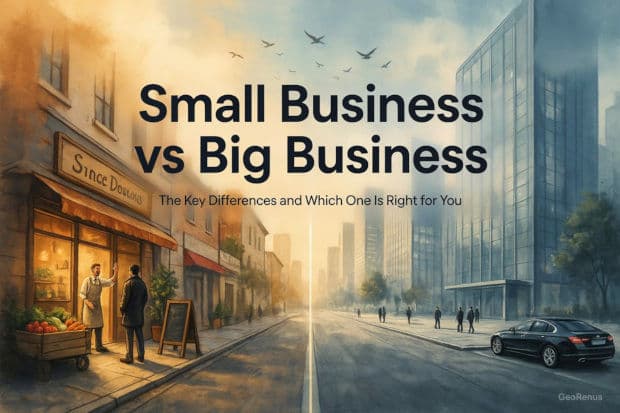
Small Business vs Big Business -- The Key Differences and Which One Is Right for You
G
GeoRenus Editorial Team
855 views
Summary
A small business typically has fewer than 500 employees (SBA definition), limited capital, and operates in a local or niche market. A large business or corporation has hundreds to thousands of employees, massive capital, and operates nationally or internationally. According to the SBA (2025), 99.9% of all US businesses are small businesses, providing 46% of total employment. Meanwhile, Fortune 500 companies generate approximately two-thirds of US GDP. This guide examines the definitions, 10 key differences across capital, decision-making, risk, innovation, customer relationships, and more, along with advantages and disadvantages of each, real-world examples from Apple's garage to Amazon's empire, data-driven comparisons, and a practical roadmap for growing from small to big.
Key Takeaways
- 99.9% of US businesses are small businesses (SBA 2025), employing 46% of the private workforce -- the backbone of the economy.
- Small businesses score higher on customer satisfaction (avg 80/100) than large corporations (avg 73/100) per ACSI 2025.
- 50% of small businesses fail within 5 years (SBA 2025); top causes are cash flow problems, no market need, and wrong team.
- Fortune 500 companies generated over $18 trillion in combined revenue in 2025 with $450B+ in combined R&D investment.
- The 10 key differences between small and big business span capital, decision speed, risk, customer relationships, innovation, HR, market reach, compliance, technology, and brand.
- Small business advantages: speed, low entry cost, full control, personal touch, full profit ownership -- but constrained by capital limits and high failure rates.
- Big business advantages: economies of scale, cheap capital, brand credibility, diversification, global reach -- but hampered by bureaucracy and innovation drag.
- Apple ($3.5T), Amazon ($2T), Shopify ($235B GMV), and Stripe ($1T payment volume) all started as small businesses solving a founder's personal problem.
- The growth roadmap has 4 stages: Validation (0-6mo), Product-Market Fit (6-18mo), Scaling (1-3yr), and Institutionalization (3-5yr+) -- non-optional and sequential.
- Neither small nor big is inherently better. Choose based on your capital, goals, industry, risk tolerance, and personality -- not convention or pressure.
Introduction -- Apple Started in a Garage
It was 1976. A garage in Los Altos, California. Two young men named Steve Jobs and Steve Wozniak pooled together $1,300 -- money scraped together by selling Jobs's old Volkswagen van -- and built the first Apple computer on a workbench surrounded by circuit boards and soda cans. No office. No HR department. No legal team. Just two people, one big idea, and a garage.
Fast-forward to 2025. Apple is the most valuable company on earth with a market capitalization exceeding $3.5 trillion. It employs over 160,000 people and sells products in more than 190 countries. The iPhone alone generates more annual revenue than most countries produce in GDP. That garage has become one of the most mythologized spaces in business history -- a pilgrimage site for entrepreneurs around the world.
But here is the uncomfortable truth: not every garage story becomes Apple. According to the SBA's 2025 report, 20% of small businesses fail within their first year. By year five, 50% have closed their doors. Of every ten businesses launched today, only five will survive past 2030.
And big business is no permanent guarantee either. McKinsey research published in 2025 found that 88% of the companies that appeared on the Fortune 500 list in 1955 are gone today -- bankrupt, acquired, or so dramatically restructured they are unrecognizable. Sears, once the largest retailer in America, filed for bankruptcy in 2018. Kodak invented the digital camera in 1975 and still went bankrupt in 2012. Blockbuster had 9,000 stores worldwide and chose not to buy Netflix for $50 million in 2000.
Neither small nor big is permanent. Neither is inherently better. What matters is understanding the real differences between them -- not just headcount and revenue, but decision-making speed, risk tolerance, customer relationships, access to capital, and the culture that drives every daily choice inside the business.
According to the World Bank (2025), there are over 333 million small and medium businesses worldwide, employing more than 60% of the global private-sector workforce. Meanwhile, Fortune 500 companies alone generated over $18 trillion in combined revenue in 2025.
This guide is for anyone who has ever stood at a crossroads and wondered: should I stay small and stay nimble, or should I push to grow into something bigger? Should I join a large corporation for stability, or build my own business for freedom? We will examine both sides with data, real stories, and a practical framework so you can make the right call for your situation.
Every big business was once a small business that refused to stay small. -- Unknown
Definitions -- What Counts as Small, Medium, or Large?
Before comparing small and big businesses, we need to establish what those labels actually mean. Surprisingly, the definition varies significantly by country, industry, and the purpose of the classification. A business considered 'small' in one country might qualify as 'medium' in another. Getting the definitions right matters -- especially if you are applying for government grants, small business loans, or tax benefits that have strict eligibility criteria.
Small Business -- The Official Definitions
In the United States, the Small Business Administration (SBA) defines a small business as one with fewer than 500 employees. However, the SBA's size standards are actually industry-specific and get quite nuanced. A manufacturing firm can have up to 500 employees and still qualify. A retail business typically must have fewer than 100. Certain professional service firms qualify with annual receipts under $8 million. The SBA updates these thresholds periodically, with the most recent revision in 2024 adjusting revenue caps across dozens of industries.
In the European Union, the definition is more structured. Businesses with fewer than 10 employees and annual turnover below 2 million euros are classified as Micro Enterprises. Fewer than 50 employees with turnover under 10 million euros is a Small Enterprise. Fewer than 250 employees with turnover under 50 million euros is a Medium Enterprise. Together, these are called SMEs (Small and Medium Enterprises) -- and the EU counts over 24 million SMEs operating within its borders as of 2025.
Key stat: According to the SBA's 2025 Small Business Profile, there are 33.2 million small businesses in the United States, representing 99.9% of all US businesses. They employ 46.4% of the private-sector workforce -- roughly 61.6 million American workers.
Large Business -- What Makes a Corporation
A large business, or corporation, typically has 500 or more employees in the US, 250 or more in the EU, and operates at a scale that commands national or international reach. Most large businesses are either publicly traded on stock exchanges or privately held by institutional investors. They have formal governance structures: a board of directors, a C-suite of executives, legal departments, investor relations teams, and compliance officers. Their capital base runs into hundreds of millions or billions of dollars.
Fortune 500 companies represent the 500 largest US corporations by revenue. In 2025, the Fortune 500 list includes companies like Walmart ($648B revenue), Amazon ($590B), Apple ($391B), and ExxonMobil ($398B). These organizations operate in dozens of countries, employ hundreds of thousands of people, and have supply chains that span the entire globe. A single purchasing decision by Walmart can shift global commodity prices.
The Middle Ground -- Mid-Size Is the Hardest Stage
Between small and large sits the mid-market -- businesses with roughly 100 to 499 employees. Business growth experts often call this 'the valley of death for scaling companies.' You have grown large enough that informal startup culture breaks down, but you are not yet big enough to access the cheap capital, talent pipelines, and brand power that large corporations enjoy. Decisions are slower than a small business but faster than a Fortune 500. HR becomes an issue. Systems need to be built. This is where many businesses stall, plateau, or get acquired.
| Classification | US (SBA) | EU | Employees (Approx.) | Examples |
| Micro / Sole Trader | 1-4 employees | Under 10 | 1-9 | Freelancer, food cart, home bakery |
| Small Business | Under 100-500 (varies by industry) | 10-49 | 10-99 | Local restaurant, e-commerce store, agency |
| Medium Business | 100-499 | 50-249 | 100-249 | Regional retailer, mid-size manufacturer |
| Large / Corporate | 500+ | 250+ | 500+ | Apple, Walmart, Unilever, Toyota |
Note: Size thresholds vary by country and industry. Always verify against your local regulatory body's most current guidelines before applying for size-based programs or benefits.
Understanding where your business sits in this classification system is not just an academic exercise. It determines your access to SBA loans, government contracts, tax incentives, and regulatory requirements. It also shapes how investors, partners, and customers perceive you. A 'small business' carries a different psychological weight than a 'corporation' -- and sometimes that difference is your most powerful marketing tool.
The 10 Key Differences -- A Deep Dive
Size is just the surface. The real differences between small and big businesses run through every part of how they operate, compete, and survive. Here are the 10 dimensions that matter most -- each with real examples and data to make the contrast concrete.
1. Capital and Funding
Small businesses typically start with personal savings, loans from family and friends, microloans, or small bank lines of credit. The average US small business launches with less than $10,000 in startup capital, according to the Federal Reserve's 2025 Small Business Credit Survey. This tight capital environment creates discipline -- you cannot afford to waste money -- but it also creates a ceiling. Growth requires money, and money is the constant constraint.
Large businesses access capital at a completely different scale. Apple issued $5 billion in corporate bonds in early 2025 at interest rates far below what any small business could access. Amazon raised billions through its 1997 IPO and has since used equity markets, debt markets, and retained earnings to fund everything from warehouses to satellites. The cost of capital for a large corporation is dramatically lower than for a small business -- which creates a compounding advantage over time.
The funding gap is stark: CB Insights 2025 data shows that small businesses are rejected for bank loans at a rate of roughly 50%, while investment-grade corporations can access credit markets almost on demand. This asymmetry is one of the most significant structural advantages large businesses hold.
2. Decision-Making Speed
In a small business, the owner makes decisions -- often in minutes. A competitor just dropped their prices? You can cut yours by 3 PM today. A supplier just offered a better deal? You sign by end of day. This speed is a genuine competitive weapon. It lets small businesses respond to market changes, customer feedback, and competitive moves with an agility that large organizations simply cannot match.
Large businesses move through layers. A new product idea might require sign-off from a product manager, a VP of Product, the CFO, the legal department, and the board before a single line of code is written. Jeff Bezos famously tried to combat this at Amazon with his 'two-pizza rule' -- no team should be larger than can be fed by two pizzas -- and his 'Day 1' philosophy, which demanded that Amazon maintain the urgency and customer obsession of a startup despite its enormous size. Most large organizations are less disciplined about this.
3. Risk and Reward
In a small business, the founder carries the full weight of risk -- and captures the full upside of reward. If the business fails, it may mean personal financial ruin: drained savings, maxed credit cards, loans called in. But if it succeeds, the owner keeps everything. That is the deal. The risk-reward ratio is asymmetric in both directions, and it is intensely personal.
In a large corporation, risk is distributed across thousands of shareholders and managed by professional risk officers. A bad quarter in one division gets absorbed by strong performance in another. But reward is also distributed -- executives earn salaries and bonuses, while shareholders split the remaining profits. No individual employee builds personal wealth at the same rate a successful founder does. The trade-off is stability versus upside.
4. Customer Relationships
Small businesses build relationships, not transactions. Your neighborhood coffee shop owner knows your name, your order, and probably your Monday mood. That intimacy creates loyalty that no marketing budget can replicate. Word-of-mouth referrals, repeat business, and community trust are the lifeblood of small businesses -- and they are earned one interaction at a time.
Large businesses manage customer relationships at scale through CRM software, AI-driven personalization engines, and data analytics. Amazon's recommendation algorithm knows your buying patterns better than you do. Netflix's suggestion engine drives 80% of what subscribers watch. This is powerful and efficient, but it is also impersonal. When something goes wrong, you deal with a chatbot first, a script-reading agent second, and a human empowered to actually help you last. The relationship is transactional by design.
5. Innovation and Agility
The COVID-19 pandemic of 2020-2021 was the ultimate real-world test of business agility. Small restaurants that survived pivoted to delivery within days. Boutique fitness studios launched virtual classes overnight. Independent bookstores launched online shops in a weekend. The businesses that moved fastest were almost universally small. Their decision cycles were measured in hours, not quarters.
Kodak's story remains the most cautionary tale in business: A Kodak engineer invented the digital camera in 1975. The technology was shelved because it threatened the film business. By 2012, Kodak had filed for bankruptcy, killed by the very disruption it had pioneered. Nokia's story is nearly identical -- the Finnish giant held the world's top mobile phone position until it simply refused to adapt fast enough.
6. Human Resources and Team Structure
In a small business, everyone does a bit of everything. The founder is the CEO, the sales rep, the customer service agent, and sometimes the janitor. This creates versatility and a deep understanding of every part of the business -- but it also creates dangerous dependency on key individuals. If the owner gets sick, the business often stops. If the one good salesperson quits, revenue drops immediately.
Large businesses have formal HR structures: job descriptions, performance review cycles, career development programs, and succession planning. Microsoft has over 228,000 employees as of 2025, each with defined roles, management layers, and development paths. This creates redundancy and resilience -- one departure does not sink the ship -- but it can also create bureaucracy, political maneuvering, and a disconnect between frontline employees and strategic leadership.
7. Market Reach
Small businesses typically serve a local or niche market. This is not a weakness -- it is a strategic choice. A boutique specializing in left-handed kitchen tools does not compete with Williams Sonoma; it dominates a segment Williams Sonoma cannot be bothered with. Niche focus allows small businesses to develop deep expertise, super-loyal customers, and premium pricing that a generalist big business cannot match.
Large businesses have the resources to pursue mass markets at global scale. McDonald's serves 69 million customers daily across 100 countries. Coca-Cola's products are available in every country on earth except North Korea and Cuba. This reach creates brand recognition and volume that small businesses cannot approach -- but it also forces a lowest-common-denominator approach that alienates customers who want something more personal.
8. Legal and Compliance
For a small business, regulatory compliance is a real burden. A sole proprietor in the US must navigate federal, state, and local tax requirements, employment law if they hire staff, health and safety regulations, licensing requirements, and -- depending on the industry -- a web of sector-specific rules. Many small business owners spend 80+ hours per year on compliance tasks alone, time that could be spent on serving customers.
Large corporations deal with far more complex regulation -- antitrust oversight, securities law, international trade compliance, environmental regulation, labor law in multiple jurisdictions -- but they have entire legal and compliance departments to handle it. The compliance cost per unit of revenue is actually lower for large businesses than small ones. Scale creates efficiency even in regulatory burden.
9. Technology
The technology gap between small and large businesses has narrowed dramatically since 2020. Cloud computing, SaaS tools, AI assistants, and no-code platforms have put enterprise-grade capabilities within reach of any small business with a credit card. A one-person operation can now use Shopify for e-commerce, Salesforce for CRM, QuickBooks for accounting, and Slack for communication -- all at a fraction of what these tools cost a decade ago.
However, the gap at the cutting edge remains enormous. Amazon spent over $85 billion on technology and infrastructure in 2024. Google's annual R&D budget exceeds $45 billion. These investments allow large businesses to build proprietary AI models, custom logistics systems, and global data infrastructure that no small business can replicate. Technology is both the great equalizer and the ultimate differentiator.
10. Brand and Credibility
Trust is expensive to build and priceless once you have it. Large corporations invest billions in brand building over decades. Apple's brand is valued at over $500 billion according to Interbrand's 2025 rankings. When Apple announces a new product, billions of people pay attention. When Walmart advertises a sale, millions of shoppers respond immediately. Brand equity is a compounding asset that becomes one of a large business's most durable competitive advantages.
Small businesses build credibility through different channels: customer reviews, local reputation, personal relationships, and community involvement. A restaurant with 500 five-star Google reviews and a chef known in the neighborhood can command loyalty that no amount of corporate advertising can manufacture. The key is that small business credibility is personal and authentic -- and in an era of growing consumer skepticism toward big brands, that authenticity is increasingly valuable.
| Dimension | Small Business | Large Business |
| Capital Access | Personal savings, microloans, limited credit | Bond markets, equity, institutional lending |
| Decision Speed | Hours to days | Weeks to months (multi-layer approval) |
| Risk Profile | High personal risk, full upside | Distributed risk, limited individual upside |
| Customer Relationships | Personal, high-trust, community-based | Scaled, data-driven, often transactional |
| Innovation Agility | Fast pivot, low bureaucracy | Slower but higher R&D budget |
| HR Structure | Multi-role, informal, owner-dependent | Specialized, formal, redundant |
| Market Reach | Local or niche | National or global |
| Compliance Burden | High per-revenue cost, often manual | High absolute cost, but dedicated teams |
| Technology | SaaS/cloud tools, low cost | Proprietary systems, massive investment |
| Brand / Credibility | Personal, authentic, community-built | Mass-reach, high investment, institutional trust |
Note: The differences above represent general patterns. Exceptions exist in every category -- there are agile large companies and slow-moving small ones. Use this as a starting framework, not a fixed rule.
Advantages and Disadvantages of Small Business
Running a small business is one of the most exhilarating and terrifying things a person can do. The freedom is real. So is the risk. Before you decide whether small is right for you, it pays to understand both sides with clear eyes -- not the romanticized version, and not the doom-and-gloom narrative either.
Advantages of Small Business
Speed is the most underrated advantage of a small business. When the market changes -- a trend emerges, a competitor stumbles, a customer need shifts -- a small business can respond in hours. No committee meetings, no budget approvals, no executive sign-off chains. The owner decides and it happens. In fast-moving industries like food, fashion, digital services, and local retail, this speed is worth more than any brand budget.
Low cost of entry is another powerful advantage. Many of today's most successful businesses started with under $5,000. Canva was built from a laptop. Instagram launched with two developers and less than $500,000 in seed money before growing to a billion-dollar acquisition. The democratization of software tools, cloud infrastructure, and global supply chains means that a person with a good idea, a laptop, and $1,000 can build something with genuine market potential.
The SBA's 2025 Small Business Profile reports that the US has 33.2 million small businesses employing 61.6 million workers -- 46% of all private-sector employment. These are not marginal players; they are the backbone of the American economy.
Full control and ownership means every decision is yours. You set the culture, the values, the product direction, the customer experience. You are not navigating office politics or waiting for a manager to approve your idea. If you want to close at 3 PM on Fridays, you close at 3 PM. The business reflects your personality, priorities, and passion in a way no corporate job can.
Personal customer relationships create loyalty that money cannot buy. The small gym where the trainer knows your name, your injury history, and your goals will retain clients that a faceless fitness chain loses constantly. Personal touch is a genuine competitive advantage -- especially as large companies automate more and more of their customer interactions.
Disadvantages of Small Business
Capital constraints are the most persistent challenge. You cannot hire the best talent, invest in the best technology, or expand as fast as you want if you are perpetually cash-strapped. Many small businesses operate in a constant cycle of just-in-time cash flow -- just enough to make payroll, just enough to pay suppliers, just enough to survive but not enough to grow aggressively.
The failure rate is sobering. According to SBA 2025 data, 20% of small businesses fail in year one and 50% are gone within five years. CB Insights research identifies the top causes: no market need (35%), ran out of cash (38%), wrong team (23%), got outcompeted (19%), and pricing or cost issues (18%). These are not abstract risks -- they are the reality for hundreds of thousands of businesses every year.
Owner dependency is a silent killer. In most small businesses, the owner IS the business. Their relationships, their expertise, their energy. If they burn out -- and burnout rates among small business owners exceed 42% according to 2025 Gallup data -- the business goes with them.
Limited bargaining power affects every part of the business. A small retailer buying from Procter & Gamble pays list price. Walmart negotiates discounts that no small competitor can match. The same asymmetry applies to commercial leases, shipping rates, advertising rates, and supplier terms. Being small means you are always the price-taker, never the price-maker.
| | Detail |
| ADVANTAGE -- Speed | Pivot in hours, no committee approval required |
| ADVANTAGE -- Low Entry Cost | Start with $1,000-$10,000 in many industries |
| ADVANTAGE -- Full Control | Your culture, values, and direction completely |
| ADVANTAGE -- Personal Touch | Customer loyalty built on real relationships |
| ADVANTAGE -- Full Profit | No shareholders diluting your financial upside |
| ADVANTAGE -- Passion-Driven | Build something that reflects your values |
| DISADVANTAGE -- Capital Limits | Growth ceiling imposed by funding constraints |
| DISADVANTAGE -- High Failure Rate | 50% fail within 5 years (SBA 2025) |
| DISADVANTAGE -- Owner Dependency | Business stops if the owner stops |
| DISADVANTAGE -- No Scale Discounts | Always pay more per unit than large competitors |
| DISADVANTAGE -- Limited Talent Pool | Cannot compete on salary with large employers |
Note: The advantages and disadvantages of small business are two sides of the same coin. The same freedom that makes you agile also makes you vulnerable. Knowing this lets you plan for the vulnerabilities instead of being surprised by them.
Advantages and Disadvantages of Big Business
Large corporations inspire awe and cynicism in roughly equal measure. They fund groundbreaking research, employ millions of people, and build products that reshape civilization. They also produce bureaucratic nightmares, tone-deaf customer service, and high-profile failures that make the front page. Here is the honest picture.
Advantages of Big Business
Economies of scale are the foundational advantage of large businesses. When you buy in bulk, manufacture at volume, and distribute at scale, your cost per unit falls dramatically. Walmart's purchasing power allows it to source products cheaper than any competitor. McDonald's buys potatoes and beef in quantities that give it pricing leverage no independent restaurant could dream of. This cost advantage flows directly to margin or to competitive pricing.
Access to capital at low cost is a structural advantage that compounds over time. Investment-grade corporations can borrow money at interest rates close to the government's borrowing rate. In 2025, Apple was issuing bonds at rates below 4% while small businesses were paying 7-12% on bank loans. This difference in cost of capital means large businesses can fund growth, acquisitions, and R&D at a fraction of the effective cost a small business pays.
Fortune 500 companies generated over $18 trillion in combined revenue in 2025, according to Fortune's annual report. Their combined R&D investment exceeded $450 billion -- more than the GDP of most countries. This level of investment creates technological moats that are extraordinarily difficult for small competitors to breach.
Brand recognition and institutional credibility open doors that small businesses simply cannot knock on. A Fortune 500 company signing a contract with a government agency or a major supplier carries an implicit guarantee of financial stability and operational capability. The brand does the selling before the sales team walks in the room. New customers trust a known brand faster than an unknown startup.
Diversification reduces existential risk. Amazon's retail business operates on razor-thin margins, but Amazon Web Services (AWS) generates the majority of Amazon's operating profit. If one division struggles, others sustain the whole. Apple's services revenue, which includes the App Store, Apple Music, and iCloud, now generates over $100 billion annually -- a massive cushion against hardware sales fluctuations.
Disadvantages of Big Business
Bureaucracy is the price of scale. As organizations grow, they add layers of management, process, approval cycles, and coordination overhead. A simple decision that would take a small business owner five minutes can take a large corporation five months. By the time the committee approves, the market has moved. This slowness kills innovation and frustrates talented employees who leave for more agile environments.
Kodak did not fail because it lacked resources. It failed because its bureaucracy and institutional inertia prevented it from acting on knowledge it already had. Its own engineers had invented the digital camera. Its own strategists knew film was dying. But the organization could not overcome the political and structural barriers to change fast enough. Nokia's collapse tells exactly the same story -- a massive organization paralyzed by its own success.
The innovation trap is real: Harvard Business Review research shows that large companies file more patents but launch fewer successful new products per dollar of R&D spend than small companies. Size creates resources but can also create conservative, risk-averse cultures that kill the creative experiments that drive breakthrough innovation.
Customer disconnect grows with size. As companies scale, customer feedback travels through layers of intermediaries before reaching decision-makers. Executives stop talking to customers and start reading dashboards. Products drift away from real user needs. The result is a growing gap between what the company builds and what customers actually want -- a gap that agile competitors exploit relentlessly.
| | Detail |
| ADVANTAGE -- Economies of Scale | Lower cost per unit at volume; price leverage with suppliers |
| ADVANTAGE -- Cheap Capital | Bond markets, institutional lending at low rates |
| ADVANTAGE -- Brand Trust | Credibility opens doors before the sales pitch begins |
| ADVANTAGE -- Diversification | Multiple revenue streams absorb individual failures |
| ADVANTAGE -- Global Reach | Serve customers in dozens or hundreds of countries |
| ADVANTAGE -- R&D Power | $450B+ Fortune 500 R&D spend in 2025 |
| ADVANTAGE -- Talent Pipelines | Employer brand attracts top graduates and specialists |
| DISADVANTAGE -- Bureaucracy | Multi-layer approvals slow every decision |
| DISADVANTAGE -- Innovation Drag | Risk aversion kills creative experiments |
| DISADVANTAGE -- Customer Disconnect | Executives lose touch with real customer needs |
| DISADVANTAGE -- Regulatory Scrutiny | Antitrust, securities, and compliance overhead |
| DISADVANTAGE -- Political Complexity | Internal politics can override good strategic decisions |
Note: Every listed disadvantage has been the root cause of at least one major corporate collapse in the last 30 years. Kodak (bureaucracy), Nokia (innovation drag), Wells Fargo (customer disconnect), and Enron (political complexity) are all cautionary case studies worth reading.
Real-World Examples -- From Garages to Empires
Data tells one part of the story. But the stories of real companies -- how they started, what decisions they made, and what they became -- teach lessons that no spreadsheet can. Here are five companies whose journeys reveal the full spectrum from small to world-changing.
Apple -- $1,300 to $3.5 Trillion
In 1976, Steve Jobs sold his Volkswagen van and Steve Wozniak sold his HP calculator to raise $1,300 in startup capital. They built the Apple I computer by hand in a garage in Los Altos, California. The first customer was a local computer store that ordered 50 units at $500 each. They had to scramble to build them in time. There was no brand, no marketing budget, no office. Just two people, one product, and a market they believed existed.
What turned Apple from a garage operation into the world's most valuable company was not just great products -- it was a series of bold strategic decisions. The Mac in 1984. The return of Jobs in 1997. The iPod in 2001. The iPhone in 2007, which reimagined what a phone could be and created an entirely new market in the process. By 2025, Apple's market cap exceeds $3.5 trillion. Key lesson: the product that makes you famous is rarely the product you started with.
Amazon -- Books in a Garage to Everything Everywhere
In 1994, Jeff Bezos quit his Wall Street job, drove a U-Haul from New York to Seattle, and set up Amazon in his garage. The original business was simple: sell books online. The pitch was equally simple: the internet means you can offer a selection of books no physical store could match. Amazon went public in 1997 at $18 per share. At the time, most analysts thought it was wildly overvalued.
By 2025, Amazon's market capitalization exceeds $2 trillion. It is the world's largest e-commerce platform, the dominant cloud computing provider through AWS, and a major player in advertising, logistics, healthcare, and entertainment. The company that started selling books now has annual revenue of approximately $590 billion. Key lesson: start focused, then systematically expand into adjacent markets once you have built the infrastructure.
Shopify -- A Failed Snowboard Shop That Built the Internet's Commerce Layer
In 2004, Tobias Lutke was trying to sell snowboards online and could not find e-commerce software that worked well enough. So he built his own. What started as a solution to his personal problem became one of the most important pieces of infrastructure the internet has ever produced. Shopify launched as a product in 2006 and went public in 2015.
By 2025, Shopify powers over 5.6 million merchants in 175 countries and processed $235 billion in gross merchandise volume (GMV). It is the platform behind businesses ranging from a single person selling handmade jewelry to major global brands like Heinz and Kylie Cosmetics. Key lesson: the best businesses often start as a founder solving their own problem, then discovering that millions of other people have the exact same problem.
Stripe -- Two Irish Brothers Who Processed $1 Trillion
In 2010, brothers Patrick and John Collison were frustrated by how difficult it was for small businesses to accept payments online. The existing solutions required lengthy bank agreements, technical complexity, and weeks of setup. They built Stripe to solve this with seven lines of code. Their value proposition was radical simplicity: any developer could integrate Stripe in an afternoon.
By 2025, Stripe processes over $1 trillion in payment volume annually, serving millions of businesses from solo freelancers to Amazon and Google. The company is valued at approximately $65 billion. Key lesson: in a market where the incumbent solution is painful, the business that makes it easy wins -- even if the incumbents have resources you cannot match.
Patagonia -- The Company That Chose Not to Grow
Yvon Chouinard founded Patagonia in 1973 selling climbing gear from the back of his car. By the 2020s, Patagonia had become a billion-dollar outdoor apparel brand -- but Chouinard made a series of deliberate choices that kept the company operating with small-business values at scale. Patagonia famously ran ads telling customers 'Don't Buy This Jacket.' They repair products for free. They donate 1% of sales to environmental causes.
In 2022, Chouinard transferred ownership of the entire company to a nonprofit and charitable trust rather than take it public or sell it. The decision forfeited an estimated $3 billion in personal wealth. Key lesson: growth is a choice, not an obligation. The most important business decision is deciding what kind of business you actually want to build -- and being willing to stay true to that even when conventional wisdom says to do otherwise.
The Data -- Small vs Big Business by the Numbers
Let us move from stories to statistics. The numbers paint a clear picture of where small and large businesses each dominate, where they struggle, and what the data actually says about performance, survival, and impact. The following data draws from SBA 2025, World Bank SME Report 2025, Fortune 500 2025, ILO Global Employment Report, Statista, and CB Insights.
| Metric | Small Business (Under 500) | Large Business (500+) |
| Number of Businesses (US) | 33.2 million (99.9% of all businesses) | ~20,000 large firms |
| Employment Share (US) | 46% of private sector (61.6M workers) | 54% of private sector |
| GDP Contribution (US) | ~44% of GDP | ~56% of GDP (Fortune 500 alone: ~2/3) |
| 5-Year Survival Rate | ~50% survive to year 5 (SBA 2025) | ~75% of Fortune 500 companies from 2010 still exist |
| Average Annual Revenue | $500K - $5M (varies widely by industry) | $5B+ for Fortune 500 |
| Profit Margin (Median) | 6-8% (varies by sector) | 8-12% (economies of scale advantage) |
| R&D Investment | Limited; often zero | Fortune 500 combined $450B+ (2025) |
| Customer Satisfaction (ACSI) | Small biz avg 80/100 | Large corp avg 73/100 (2025 ACSI report) |
Note: GDP contribution percentages are approximate and vary by measurement methodology. The 'Fortune 500 alone generates two-thirds of US GDP' figure is a common approximation based on combined revenues as a share of GDP, not a direct value-added calculation.
One data point stands out as genuinely surprising: small businesses consistently score higher on customer satisfaction than large businesses. The American Customer Satisfaction Index (ACSI) 2025 report shows small businesses averaging 80 out of 100, while large corporations average 73. Customers prefer the personal experience that small businesses provide -- and that preference is a durable competitive advantage that money cannot easily buy.
| Industry Segment | Small Business Market Share | Large Business Market Share | Key Dynamic |
| Technology (Software SaaS) | ~35% | ~65% | Cloud tools democratizing entry; big tech dominates infrastructure |
| Retail (US) | ~45% | ~55% | E-commerce opened niche retail; Walmart/Amazon dominate volume |
| Food Service / Restaurant | ~60% | ~40% | Independents still dominate; chains growing but limited by format |
| Professional Services | ~70% | ~30% | Lawyers, accountants, consultants: relationship-driven market |
| Manufacturing | ~25% | ~75% | Capital intensity favors large; specialized small manufacturers survive |
| Healthcare | ~30% | ~70% | Consolidation accelerating; large hospital systems growing |
Note: Market share figures are estimated from Statista, IBISWorld, and US Census Bureau 2025 data. They reflect revenue share, not number of businesses.
The food service data is particularly instructive. Despite McDonald's, Domino's, and Starbucks dominating cultural mindshare, independent restaurants still capture roughly 60% of industry revenue. Customers value variety, local flavor, and the experience of a place that could not exist anywhere else. This is the most powerful data point for anyone considering a small business in a market dominated by large chains: domination at the top does not mean domination everywhere.
When Should You Choose Small? -- The Case for Staying Lean
Bigger is not always better. For millions of entrepreneurs and career professionals, staying small is not a failure of ambition -- it is a deliberate strategic choice that leads to a better business and a better life. Here is how to know when small is the right answer.
Choose small when you are working with limited startup capital. The beauty of starting small is that it forces discipline, creativity, and genuine customer focus. You cannot afford to build features nobody asked for. You cannot hire people before you need them. Constraints breed ingenuity. Most of Silicon Valley's great businesses were built on next to nothing in their first year -- not because founders wanted to stay broke, but because scarcity forces you to validate your ideas before you scale them.
Choose small when independence is a core value. If you need to own your decisions, set your own hours, build something that reflects your personality, and wake up every morning accountable only to yourself and your customers -- a small business is the right structure. Studies consistently show that small business owners report higher job satisfaction than corporate employees, even when their income is lower.
Choose small when you are targeting a niche market. Large companies pursue large markets because small margins demand large volume. But niche markets -- left-handed tools, vegan pet food, acoustic guitars under $500, custom motorcycles for women -- are too small for corporations to profitably serve. A small business can dominate a niche that a Fortune 500 company would not even notice.
Choose small when you are testing an idea. The worst thing you can do with an unvalidated idea is raise a lot of money, build a lot of product, and spend a lot of time before discovering whether anyone actually wants what you built. Start small, launch fast, talk to customers, and iterate. This is not just startup wisdom -- it is how the best innovations across every industry have always worked.
Choose small when you value lifestyle over growth. Not every business needs to become a unicorn. A business that pays you $150,000 a year, gives you full control of your schedule, lets you work from anywhere, and provides meaningful work -- that is an extraordinary outcome. The venture capital industry has spent twenty years convincing founders that growth is the only measure of success. It is not. Design the business around the life you want.
The personality fit for small business: You are a natural risk-taker, comfortable with uncertainty, self-driven without external structure, capable of wearing many hats simultaneously, and energized by direct customer contact. If this describes you, a small business will bring out your best. If it does not -- if you need structure, stability, and defined career paths -- that is not a weakness. It is important self-knowledge.
When Should You Choose Big? -- The Case for Corporate Scale
Just as small has a powerful case, so does large. Working for or within a large organization -- or deliberately building your small business toward large-scale growth -- makes sense in specific circumstances. Here is when big is the right answer.
Choose big when you are in a capital-intensive industry. Building a semiconductor fabrication plant, launching a pharmaceutical drug through FDA trials, developing a commercial aircraft, or constructing an oil refinery requires billions of dollars of upfront capital. No small business can access this. If your business model requires massive capital investment before generating any revenue, you need the resources and risk distribution that only a large organization can provide.
Choose big when scale is the product. Google's search engine is better because billions of people use it, generating data that trains its algorithms. Facebook's social network is more valuable because everyone is already on it. These are network-effect businesses where the value is the scale itself. You cannot build a useful version of these products at small scale -- you either grow big or you are irrelevant.
Choose big when you are in a heavily regulated industry. Banks, insurance companies, healthcare systems, and utilities operate in regulatory environments so complex that full-time legal and compliance teams are not a luxury -- they are a survival requirement. Large organizations have the resources to navigate these environments. Small businesses in heavily regulated industries often struggle to keep up with compliance costs that consume a disproportionate share of revenue.
Choose big when you want stability and career structure. If you have specialized expertise, want defined career advancement, need predictable income, and value the safety net of an established organization -- a large corporation offers things a small business genuinely cannot. Health benefits, retirement matching, mentorship from experienced professionals, a built-in professional network, and the brand credibility on your resume that opens future doors.
The personality fit for large business: You thrive with clear role definition, enjoy specialization and deep expertise in one domain, value collaboration across large teams, and find security in structure. You want to learn from experienced professionals around you and advance through a defined system. If you are energized by being part of something large and significant -- even if your individual role is one piece of a very large puzzle -- big business is where you will do your best work.
The honest truth is that most careers involve both. Many of the best entrepreneurs spent years inside large corporations learning systems, building networks, and developing skills before launching their own companies. And many corporate executives started as small business owners before joining larger organizations. The question is not 'which is better' -- it is 'which is right for me, at this stage, given what I am trying to accomplish.'
The Do's and Don'ts -- Lessons From the Trenches
Whether you are running a small business, building toward big, or navigating life inside a large corporation, the same fundamental mistakes keep showing up. Here are the seven most important things to do and the seven most dangerous things to avoid -- drawn from business research, founder interviews, and hard data.
The 7 Do's
DO validate before you invest. Before spending significant time or money, confirm that real customers will pay real money for what you are building. Talk to 20 potential customers. Run a landing page test. Sell the product before you build the product. Every dollar you spend before validation is a dollar at risk of discovering that nobody wants what you built.
DO understand your unit economics. Know your customer acquisition cost (CAC), your customer lifetime value (LTV), your gross margin, and your break-even point. If you do not know these numbers, you do not know if your business model actually works. According to CB Insights, 38% of startup failures are due to cash running out -- and most of those failures were preventable with better financial awareness.
DO build systems, not dependencies. Document your processes. Train people to replace you in any role. Build the business so that it could operate without you for a week. A business that depends entirely on one person is not a business -- it is a job with extra steps. The goal is to eventually own a business that works, not to be the person who does all the work.
DO invest in relationships. In small business, your network is your net worth. Suppliers who trust you extend better terms. Customers who love you refer their friends. Mentors who believe in you make introductions that money cannot buy. Attend industry events. Follow up after meetings. Be genuinely helpful to people before you need anything from them.
DO specialize your positioning. 'We are the best restaurant in town' is not a position. 'We are the only place in the city that serves authentic Oaxacan cuisine' is a position. The narrower and more specific your positioning, the easier it is to find the right customers, build word-of-mouth, and charge premium prices. Trying to be everything to everyone is the fastest route to being nothing to nobody.
DO reinvest profits intentionally. Early profits are not income -- they are fuel for growth. The businesses that compound fastest are the ones that discipline themselves to reinvest margin into the highest-return opportunities: better talent, proven marketing channels, product improvements, or market expansion. Spend on lifestyle upgrades after you have built the machine, not before.
DO know your exit from day one. What does success look like for this business? Are you building to sell, to pass on to family, to sustain your lifestyle indefinitely, or to grow into a public company? The answer to this question changes every major decision you make about funding, hiring, and growth strategy. You do not need to have the answer on day one, but you need to be asking the question.
The 7 Don'ts
DON'T scale before you have product-market fit. Hiring aggressively, spending on marketing, and expanding to new locations before you have confirmed repeatable, profitable customer demand is one of the most common and most expensive mistakes in business. Scale amplifies what you have -- if what you have does not work, scale just helps you fail faster.
DON'T ignore cash flow for profit. A business can be profitable on paper and dead in practice. If customers pay you in 90 days but you must pay suppliers in 30 days, you have a cash flow problem regardless of your profit margins. More businesses die from cash flow problems than from unprofitability. Watch your cash position daily, not monthly.
DON'T hire people you cannot afford to lose. If a single employee leaving would cripple your business, that is a structural risk you need to address immediately. Build systems, document processes, cross-train staff, and create an environment where talent wants to stay -- not because they have to, but because they choose to.
DON'T compete on price alone. Price competition with a larger business is a war you will lose. Large businesses have cost structures you cannot match. Instead, compete on speed, service, personalization, expertise, or a niche you own completely. The moment you reduce your value proposition to 'we are cheaper,' you have surrendered your strategic position.
DON'T neglect marketing until you need customers. Marketing is not a tap you turn on when sales slow down -- it is a relationship you build continuously. The businesses that grow steadily are the ones building awareness, credibility, and audience before they need a sale. When the day comes that you need revenue, your marketing should already be working.
DON'T confuse activity with progress. Being busy is not the same as moving forward. A small business owner can spend 80 hours a week in the business -- answering emails, managing inventory, serving customers -- and make zero strategic progress. Regularly step back and ask: which activities are actually growing the business? Which are just keeping it alive? Invest your best energy in the former.
DON'T wait for perfect conditions to start. Perfect conditions do not exist. There will always be a better time to launch, a better version of the product to build, a more stable economy to launch into. The businesses that win are the ones that start imperfectly and improve relentlessly. Done and learning beats perfect and paralyzed every single time.
The Growth Roadmap -- From Small to Big
Growing from a small business to a large one is not a linear journey. It is a series of distinct stages, each with its own challenges, priorities, and success metrics. Most businesses that fail to grow do not lack ambition -- they try to jump stages. Understanding what each phase demands is the difference between scaling successfully and burning out in the attempt.
Stage 1 -- Idea Validation (0 to 6 Months)
The only goal in Stage 1 is to confirm that someone will pay for what you are offering. Not your family, who will always be supportive. Not your friends, who do not want to hurt your feelings. Real strangers, with real money, making a real purchase decision. This stage is not about building the perfect product -- it is about finding the minimum viable version of your idea that generates a real customer transaction.
Key activities: talk to 20+ potential customers before building anything. Launch a landing page to test demand. Sell manually before automating. Track every dollar spent and every dollar received. The target metric for Stage 1 is simple: at least one paying customer who did not know you personally before the transaction. If you cannot achieve that, the idea needs revision before you invest more.
Stage 2 -- Product-Market Fit (6 to 18 Months)
Product-market fit is the moment when a significant segment of customers not only buys your product but actively wants more of it, recommends it to others, and would be genuinely upset if it disappeared. It is not a binary event -- it is a gradual realization that you have found the right product for the right people. The signal is organic growth: people start coming to you without you pushing.
Marc Andreessen, who coined the term, describes product-market fit bluntly: 'You can always feel when product/market fit is not happening. The customers are not quite getting value out of the product, word of mouth is not spreading, usage is not growing fast enough. And you can always feel product/market fit when it is happening. Customers are buying the product just as fast as you can make it.'
Stage 3 -- Scaling (1 to 3 Years)
Once you have confirmed product-market fit, the goal shifts to scaling the model efficiently. This means building repeatable systems for customer acquisition, fulfillment, and retention. It means hiring your first team and transitioning from doing everything yourself to managing people who do things. It means investing in technology that automates manual processes and frees up your time for strategic work.
This is the stage where most businesses make their most expensive mistakes. Hiring too fast, spending on brand before performance marketing is profitable, expanding to new markets before the core market is fully captured, or losing the product quality and customer experience that drove early growth. The discipline of Stage 3 is: systematize what works, stop doing what does not, and hire people who are better than you at specific functions.
Stage 4 -- Institutionalization (3 to 5 Years and Beyond)
By Stage 4, the business should be able to operate without you in every day-to-day function. Your role shifts from operator to strategist. You are setting direction, making senior hiring decisions, managing capital allocation, and building the culture that will sustain the business through its next decade of growth. This is where you go from being a business owner to being a CEO.
The key transition in Stage 4 is building organizational capability: documented processes, performance management systems, leadership pipelines, and governance structures. This is the stage where many founder-CEOs struggle -- the skills that made them great at Stage 1 (hustle, intuition, personal selling) are not the skills Stage 4 demands (systems thinking, delegation, strategic clarity).
| Stage | Timeframe | Primary Goal | Key Activity | Success Metric |
| Stage 1: Validation | 0-6 months | Prove someone pays | Talk to customers, sell manually | First non-personal paying customer |
| Stage 2: Product-Market Fit | 6-18 months | Find repeatable demand | Iterate product based on real feedback | Organic referrals and word-of-mouth growth |
| Stage 3: Scaling | 1-3 years | Build repeatable systems | Hire, automate, expand marketing | Revenue growth rate over 30% annually |
| Stage 4: Institutionalization | 3-5+ years | Build organization, not just business | Systems, leadership, governance | Business runs without founder in daily ops |
Note: These timeframes are approximate and vary widely by industry, capital, and market conditions. Some businesses reach Stage 4 in 18 months; others take a decade. The stages are sequential and non-optional -- you cannot skip validation and scale successfully.
The roadmap from small to big is not about luck. It is about doing the right things in the right order. Validate before building. Build before scaling. Scale before institutionalizing. Every shortcut in this sequence creates a debt that comes due later -- usually at the worst possible moment.
Conclusion -- The Size of Your Impact Is What Matters
After examining definitions, data, differences, advantages, disadvantages, real stories, and growth frameworks, we arrive at the honest answer: neither small nor big is inherently better. They are different tools for different goals, different personalities, and different moments in a business journey.
Small business gives you freedom, agility, personal connection, and the electric feeling of building something entirely your own. It also gives you risk, constraint, and a weight that never fully leaves your shoulders. Big business gives you resources, stability, scale, and the ability to impact millions of lives. It also gives you bureaucracy, politics, and the persistent danger of losing the customer focus that made you valuable in the first place.
What the data tells us is that size is not destiny. The 88% of 1955 Fortune 500 companies that no longer exist were all, at some point, considered unassailable giants. And every one of the 33.2 million small businesses in America today is, in some sense, the beginning of something that could become anything.
Apple began in a garage with $1,300. Amazon began in a garage with a dream of selling books. Shopify began as a failed snowboard shop. Stripe began as two brothers frustrated by a broken payments process. None of these founders knew how far they would go. What they knew was that there was a real problem worth solving and a customer who needed the solution. That is all a business ever needs to begin.
The question that actually matters is not 'how big should I be?' It is: 'Am I solving a real problem for real people in a way that is sustainable and meaningful?' Get that right, and size will follow from the market's response to your answer. Get that wrong, and no amount of capital, scale, or brand will save you.
If you are a small business owner reading this, understand that your size is not your limitation -- it is your advantage. You can move fast, serve personally, and pivot when the market shifts in ways that large organizations cannot. Use that. If you are inside a large organization, understand that your scale is not your protection -- it is your responsibility. The moment you stop serving customers better than a small competitor could, your advantage is gone.
The size of your business does not matter. The size of your impact does. Start.
Every Apple started small. Every empire started with one person, one idea, and one customer. The journey from garage to global is not guaranteed -- but it is always available. The first step is deciding to begin.
Recommended for you
Accounting: The Language of Business
Accounting is like a notebook for a business where all the money-related activities are recorded and tracked. Just like students track their exam scores to understand how they are doing, businesses use accounting to see if they are making a profit or loss. It acts like the financial backbone of a company. Accountants organize these records into different sections to make things easier to understand. To show their performance to shareholders, companies prepare documents called financial statements.
Money
Money: What It Is, How It Works, and Its Complete History
Business
Red Ocean and Blue Ocean Strategy: Fight the Competition or Make It Irrelevant — The Complete Guide

Business
What is Equity? A Comprehensive Guide to Ownership, Value, and ROE

Branding
Branding: How to Make Your Business Stand Out
Business Models
Sharing Economy Model: How Businesses Make Money Without Owning Anything
GeoPolitics
The U.S.-China Rivalry: What It Means for the World's Economy, Technology, and Military Balance
Startup
How to Calculate Startup Valuation: Methods, Tools, and Examples
Accounting
Auditing: Definition, Types, Principles, and How It Works
Accounting
Income Statement, Balance Sheet and Cash Flow