Customer Acquisition Cost (CAC) -- The Complete Guide to Measuring and Reducing Your Cost Per Customer
G
GeoRenus Editorial Team
786 views
GeoRenus Editorial Team
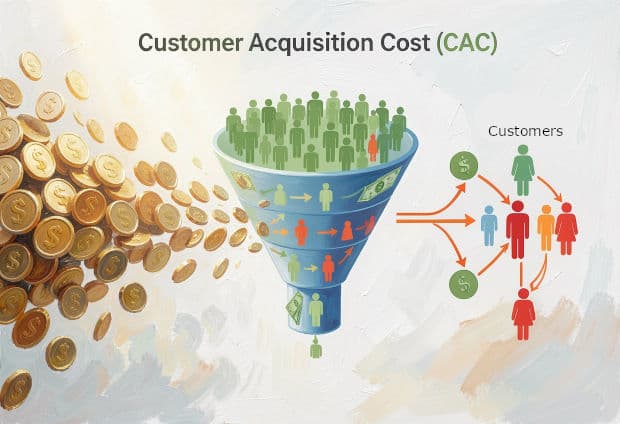
Customer Acquisition Cost (CAC) is the measure of how much a business spends on average to acquire one new customer, calculated by dividing total sales and marketing expenses by the number of new customers gained in that period — for example, spending $10,000 in a month to acquire 100 customers gives a CAC of $100 per customer. This cost includes everything that goes into bringing in new customers: advertising, sales team salaries and commissions, marketing tools and software, content creation, and agency fees. CAC matters because it tells you whether your business is actually profitable; if the total value a customer brings over their lifetime (Customer Lifetime Value or LTV) is lower than the CAC, you're losing money on every customer, and the general rule of thumb is that a healthy business should maintain an LTV:CAC ratio of at least 3:1. From Casper's $308 CAC disaster to Dropbox's near-zero referral-driven acquisition -- understanding CAC can make or break your business. This complete guide covers formulas, three real-world case studies, industry benchmarks, LTV:CAC ratios, 10 proven reduction strategies, and essential tracking tools.
Customer Acquisition Cost (CAC) is the total cost your business spends to convince one potential customer to make a purchase. It is a simple idea with surprisingly deep implications. CAC is not just your Facebook ad spend -- it is every dollar that goes into the process of winning a new customer.
A fully loaded CAC includes: advertising and paid media spend, marketing team salaries, sales team salaries and commissions, creative production (design, video, copywriting), software and tools (CRM platforms, analytics software, email marketing tools), content creation costs, event and trade show expenses, free trial and sample costs, and a proportional share of overhead allocated to the acquisition function.
What CAC does NOT include: product development costs, post-sale customer support, general administration, or costs associated with serving existing customers. CAC is specifically about the acquisition phase.
"The number one killer of startups is that their cost of acquiring customers exceeds their ability to monetize those customers." -- David Skok, General Partner at Matrix Partners
It's important to understand that CAC is not just a tech startup metric. Every business in every industry has a CAC, even if they don't call it that. A local restaurant has a CAC -- it includes flyer distribution, food blogger outreach, and the cost of introductory discount offers. A retail store has a CAC embedded in location rent premiums, window signage, and promotional events. Even a freelancer has a CAC: the time spent networking, the cost of a portfolio website, and the hours invested in pitching prospects.
The businesses that thrive are not necessarily the ones with the lowest CAC -- they are the ones who understand their CAC deeply and manage it intentionally.
In 2019, Casper -- the buzzy direct-to-consumer mattress startup -- filed for its IPO. Inside the filing was a number that made investors nervous: their Customer Acquisition Cost (CAC) was approximately $308 per customer. The average mattress sold for $850. That sounds okay -- until you realize people buy mattresses once every 7 to 10 years. The math simply did not work. Casper's stock crashed 76% from its IPO price within two years.
Blue Apron, the meal-kit delivery service, had a similar problem from the opposite angle. Their CAC was $94 -- not terrible. But 72% of their customers churned within 6 months of signing up. They were spending nearly $100 to acquire customers who left almost immediately. You can't grow a business by pouring water into a leaking bucket.
Then there's Dropbox. In its early days, Dropbox was spending over $300 per signup through Google Ads -- completely unsustainable for a product that started at $9.99/month. So they tried something different: a referral program. Refer a friend, get 250MB of free storage. Refer more, get more. The result? Signups grew by 60% and effective CAC dropped to near zero. The same concept -- acquire users -- was executed at a fraction of the cost.
ProfitWell data shows that SaaS CAC has increased approximately 60% over the past 5 years due to rising ad costs, platform saturation, and intensifying competition.
These stories all point to one fundamental truth: if it costs you more to acquire a customer than that customer is worth to your business, you will eventually go bankrupt -- no matter how fast you grow, how great your product is, or how much funding you raise.
"But what exactly goes into CAC? It is far more than just your ad spend -- and understanding the full picture could be the difference between scaling and shutting down."
There is no single 'right' way to calculate CAC. The method you use depends on the level of detail you need and the decisions you're trying to make. Here are the four most important approaches.
CAC = Total Sales & Marketing Costs / Number of New Customers Acquired
This is the starting point. Add up everything you spent on sales and marketing in a given period, then divide by the number of new customers you acquired in that same period.
Example: You spent $10,000 on sales and marketing in January and acquired 50 new customers. Your simple CAC = $10,000 / 50 = $200 per customer.
Calculating CAC by individual acquisition channel is far more useful than a blended average. It tells you which channels are efficient and which are wasting your budget.
Example: Facebook Ads: spent $4,000, acquired 30 customers = CAC of $133. Google Ads: spent $3,000, acquired 10 customers = CAC of $300. Organic SEO: no incremental spend, acquired 10 customers = marginal CAC of $0.
With channel-specific CAC, you can make smart decisions: double down on Facebook, investigate whether Google is worth it at $300 per customer, and invest more in SEO since it's delivering free customers.
The most accurate -- and the one sophisticated investors will ask for -- is fully loaded CAC. This means including ALL costs associated with acquisition: salaries of the entire marketing and sales team (proportional to their acquisition-focused time), software subscriptions, creative and design costs, a share of office overhead, and any other resources consumed by the acquisition process.
Fully loaded CAC is harder to calculate, requires more accounting discipline, and is often 2-3x higher than simple CAC. But it reflects the true economic cost of growth and is the right number to use for strategic decision-making.
CAC Payback Period = CAC / (Monthly Revenue per Customer x Gross Margin %)
This metric tells you how many months it takes to recover the cost of acquiring a customer. It is especially important for subscription and SaaS businesses where revenue comes in over time, not all at once.
Industry benchmark: Healthy SaaS businesses target a payback period under 12 months. Best-in-class companies achieve 6-9 months.
| Cost Component | Monthly Amount (USD) | Notes |
| Paid Ads (Google + Social) | $5,000 | All paid media |
| Content Marketing | $1,500 | Writers, editors, tools |
| Sales Team (2 reps) | $8,000 | Salaries + commissions |
| Marketing Tools (CRM, email) | $500 | Software subscriptions |
| Creative / Design | $1,000 | Freelancer fees |
| Events / Sponsorships | $500 | Trade shows, meetups |
| Total S&M Spend | $16,500 | Fully loaded |
| New Customers Acquired | 55 | -- |
| Simple CAC | $300 | $16,500 / 55 |
Note: This is a simplified illustrative example. Actual CAC will vary based on your specific business model, industry, and cost structure.
The key takeaway: when you do the full accounting, CAC is almost always higher than businesses initially assume. That is not a bad thing -- it just means you are working with accurate data.
One of the most common questions about CAC is: 'Is mine too high?' The honest answer is -- it depends entirely on your industry, business model, and the lifetime value of your customers. A $500 CAC is catastrophic for a $20/month subscription. It is perfectly fine for a $50,000 enterprise software deal.
| Industry | Average CAC (USD) | CAC Range | Typical LTV:CAC | Notes |
| SaaS B2B | $350 | $200-$500 | 3:1 to 5:1 | Long sales cycle, high LTV |
| SaaS B2C | $100 | $50-$150 | 3:1 to 4:1 | Shorter cycle, more volume |
| E-Commerce | $55 | $30-$80 | 2:1 to 4:1 | Impulse buys, repeat orders |
| Fintech | $350 | $200-$500 | 3:1 to 6:1 | High trust required |
| Real Estate | $1,150 | $800-$1,500 | 10:1+ | High ticket, infrequent purchase |
| Travel / Hospitality | $100 | $50-$150 | 2:1 to 4:1 | Seasonal variation |
| EdTech | $200 | $100-$300 | 2:1 to 5:1 | Long consideration period |
| Insurance | $500 | $300-$700 | 3:1 to 7:1 | Regulated, compliance costs |
| Healthcare | $700 | $500-$900 | 4:1 to 8:1 | Compliance and trust |
| Retail (Physical) | $30 | $10-$50 | 3:1 to 5:1 | Location-driven |
| Food Delivery | $22 | $15-$30 | 1:1 to 2:1 | Low switching cost |
| Media / Publishing | $12 | $5-$20 | 2:1 to 4:1 | Ad-supported model |
Note: Approximate figures sourced from First Page Sage, ProfitWell, and various industry reports. These are US-based averages and will differ by geography, company stage, and specific product.
An important geographic note: these benchmarks reflect US market conditions. In developing markets like India, Bangladesh, and Southeast Asia, digital ad inventory is significantly cheaper. CAC figures in these markets can be 3 to 10 times lower than US equivalents -- which is a major competitive advantage for startups in those regions.
Consider Spotify as an illustration of within-company CAC variation. Spotify's CAC for a free user is approximately $4 to $6 (mostly through word of mouth and app store visibility). But for a paid premium subscriber, CAC jumps to $30 to $50 (through targeted ads, trials, and family plan promotions). Same company, same product ecosystem -- but dramatically different acquisition economics depending on what you're actually selling.
The bottom line on benchmarks: use them as a reference point, not a target. Your specific LTV, margin structure, and growth stage matter far more than matching an industry average.
If CAC is the cost of winning a customer, LTV (Customer Lifetime Value) is what that customer is actually worth to you over the entire relationship. Understanding the relationship between these two numbers is arguably the most important skill in modern business.
LTV Formula: Average Revenue per Customer per Period x Customer Lifespan x Gross Margin %
Investors, analysts, and experienced operators universally agree: the LTV:CAC ratio is the single most important efficiency metric in business. It tells you, for every dollar you spend to acquire a customer, how many dollars you get back over that customer's lifetime.
LTV:CAC < 1:1 -- You are literally paying customers to buy from you. Every new customer destroys value. This business will go bankrupt.
LTV:CAC = 1:1 to 2:1 -- You are barely recovering acquisition costs. After overhead, R&D, and infrastructure, there is no profit. Not viable long-term.
LTV:CAC = 3:1 -- The widely accepted 'sweet spot.' You earn $3 for every $1 spent on acquisition. Covers overhead, funds growth, leaves room for profit.
LTV:CAC > 5:1 -- Very healthy unit economics. But if consistently above 5:1, you may be UNDER-investing in growth -- leaving customers (and revenue) on the table.
| LTV:CAC Ratio | Health Status | What It Means | Recommended Action |
| Below 1:1 | Critical | Losing money on every customer | Halt spending, redesign model |
| 1:1 to 2:1 | Poor | Breaking even or slight loss after costs | Reduce CAC or increase LTV urgently |
| 2:1 to 3:1 | Acceptable | Marginally profitable unit economics | Optimize channels, improve retention |
| 3:1 to 5:1 | Healthy | Strong unit economics | Scale growth investment |
| 5:1 to 10:1 | Very Strong | Excellent efficiency | Consider increasing acquisition spend |
| Above 10:1 | Exceptional | Extraordinary efficiency | Aggressive growth investment justified |
Note: LTV:CAC ratios are guidelines, not absolute rules. Context matters: a pre-revenue startup may tolerate worse ratios during growth phases, while a mature business should consistently hit 3:1 or better.
Even a business with an excellent 4:1 LTV:CAC ratio can run out of cash if the payback period is too long. If you spend $1,000 to acquire a customer today but don't recover that $1,000 until 36 months from now, you need a lot of capital to keep funding new acquisitions in the meantime.
Best-in-class SaaS businesses target a CAC payback period of under 12 months. E-commerce businesses should ideally recover CAC within the first 1 to 3 purchases.
Let's look at three real-world examples to make this concrete:
Netflix: Estimated LTV of approximately $600, CAC of approximately $100 = 6:1 ratio. Strong, sustainable, and backed by massive content investment to retain subscribers.
Dollar Shave Club: Their now-famous viral video cost just $4,500 to produce. Within 48 hours of launch, they had 12,000 new subscribers. Effective CAC was under $5. With an LTV over $200, that's a 40:1 ratio -- one of the most efficient customer acquisition stories in modern business history.
Slack: Grew to over $1 billion in annual revenue with remarkably low CAC by using a product-led growth model. Teams discovered Slack organically, started a free workspace, invited colleagues, and converted to paid plans -- all without a traditional sales team in the early days.
The pattern is clear: the most successful businesses are not the ones that simply spend on acquisition. They are the ones that engineer their acquisition model to deliver maximum LTV per dollar spent.
Theory is useful, but numbers come to life when you see them applied. Here are three detailed case studies across very different business types -- all using real-world cost structures and realistic assumptions.
Monthly marketing spend breakdown: Facebook and Instagram Ads $5,000, Google Shopping $2,000, Influencer collaborations $1,500, Email marketing tool $200, Content creation $800, Part-time marketing hire $2,000. Total: $11,500 per month.
New customers acquired: 150. CAC = $11,500 / 150 = $76.67
LTV calculation: Average order value $65, orders per year 3, average customer lifespan 2.5 years, gross margin 55%.
LTV = $65 x 3 x 2.5 x 0.55 = $268.13
LTV:CAC = $268.13 / $76.67 = 3.5:1 (Healthy) -- Payback achieved within the first 2 purchases.
Monthly marketing spend: Google Ads $3,000, LinkedIn Ads $2,500, Content and SEO $2,000, Sales team (2 reps) $10,000, Free trial hosting costs $1,000, CRM and tools $500. Total: $19,000 per month.
New paying customers: 12. CAC = $19,000 / 12 = $1,583
LTV calculation: Monthly subscription $199, average customer lifespan 28 months, gross margin 80%.
LTV = $199 x 28 x 0.80 = $4,457.60
LTV:CAC = $4,457.60 / $1,583 = 2.8:1 (Acceptable, but room to improve) -- Payback period approximately 10 months.
The SaaS team should focus on either improving customer retention (extending average lifespan beyond 28 months) or reducing CAC by improving their free-trial to paid conversion rate. Even moving from 2.8:1 to 3.5:1 would dramatically change the business's financial health.
Monthly marketing spend: Social media advertising $800, Food blogger outreach and reviews $400, Loyalty card program $200, Neighborhood flyers $100. Total: $1,500 per month.
New customers: 120. CAC = $1,500 / 120 = $12.50
LTV calculation: Average spend per visit $18, visits per year 8, customer lifespan 3 years, gross margin 65%.
LTV = $18 x 8 x 3 x 0.65 = $280.80
LTV:CAC = $280.80 / $12.50 = 22.5:1 (Excellent) -- Payback on first visit.
| Metric | E-Commerce | B2B SaaS | Restaurant |
| Total Monthly S&M Cost | $11,500 | $19,000 | $1,500 |
| New Customers / Month | 150 | 12 | 120 |
| CAC | $76.67 | $1,583 | $12.50 |
| Avg Revenue / Customer | $65/order | $199/month | $18/visit |
| Customer Lifespan | 2.5 years | 28 months | 3 years |
| LTV | $268.13 | $4,457.60 | $280.80 |
| LTV:CAC Ratio | 3.5:1 | 2.8:1 | 22.5:1 |
| Payback Period | 2 purchases | ~10 months | 1st visit |
| Key Insight | Efficient, scale ads | Improve retention | Word-of-mouth amplify |
Note: These are illustrative examples based on realistic industry cost structures. Your actual figures will vary based on market, product pricing, and customer behavior.
Notice that the restaurant has the most 'impressive' LTV:CAC ratio, but also the lowest absolute LTV. The SaaS business has the worst ratio but the highest absolute LTV per customer. Context is everything -- ratios must always be interpreted alongside the absolute dollar values and the capital requirements of the business.
Reducing CAC is not about spending less on marketing. It is about spending smarter. Here are 10 proven strategies, each backed by data and real-world examples.
The biggest waste in digital advertising is showing ads to people who will never buy from you. Facebook's lookalike audience feature, for example, lets you upload a list of your existing customers and find people with similar demographic and behavioral profiles. Businesses that use lookalike audiences consistently report 30 to 50% lower CPAs (cost per acquisition) compared to broad demographic targeting.
Start by identifying your top 10-20% of customers (highest LTV, longest retention). Build lookalike audiences from that segment, not from your full customer list.
Studies consistently show that approximately 97% of first-time website visitors leave without converting. Retargeting campaigns re-engage these warm prospects with targeted ads -- often at 5 to 10x better conversion rates than cold traffic ads.
Retargeting works because the prospect already knows your brand. You are not introducing yourself -- you are reminding them of something they were already interested in. This dramatically improves conversion rates and lowers effective CAC.
Referral programs leverage your existing customers to acquire new ones -- often at near-zero cost. Dropbox's referral program grew signups by 60%. PayPal famously paid $10 to each new user AND the person who referred them in its early days, which grew their user base by 7-10% per day. The key insight: a referred customer often has a 16% higher LTV than a non-referred customer (Wharton School research), making the economics even more compelling.
HubSpot data consistently shows that organic inbound leads cost approximately 61% less than outbound leads. Content marketing -- blog posts, videos, guides, podcasts -- builds a compounding asset that generates leads long after the initial investment.
The CAC from organic search is often near zero in marginal terms once the content is created. A single well-ranked article can acquire customers for years at no additional cost.
You can reduce CAC without changing your ad spend at all -- just by converting more of your existing traffic. If your current landing page converts at 2% and you improve it to 3%, you've just reduced your effective CAC by 33% with the same ad budget.
Industry data suggests that a 1 percentage point improvement in conversion rate can reduce CAC by 10 to 20%. Test headlines, CTAs, social proof, pricing presentation, and form length.
The Data & Marketing Association (DMA) reports that email marketing delivers an average ROI of $36 for every $1 spent -- the highest of any marketing channel. Once you have an email list, the marginal cost of reaching those subscribers is nearly zero.
Email nurture sequences that guide prospects from awareness to purchase consistently show lower CAC than cold paid acquisition. The key is building the list with high-intent prospects from the start.
Glossier, the beauty brand, built a $1.2 billion valuation primarily through community -- not advertising. They created a loyal following through their blog, Into the Gloss, and a highly engaged Instagram community before they had a single product. When they launched, customers were already waiting.
Communities create word-of-mouth acquisition at scale. Members recruit other members. The CAC approaches zero as the community grows.
Partner with complementary (non-competing) businesses to share audiences and split acquisition costs. A fitness app partnering with a healthy meal delivery service, for example, can run joint campaigns where both parties share the cost but each acquires customers in their target demographic.
Co-marketing campaigns, joint webinars, bundled promotions, and affiliate programs all effectively lower CAC by sharing costs across multiple businesses.
Bain & Company research found that a 5% increase in customer retention rates increases profits by 25 to 95%. Separately, it costs 5 to 25 times more to acquire a new customer than to retain an existing one.
When retention improves, LTV increases -- which means you can afford a higher CAC and still maintain healthy unit economics. Retention is not a separate metric from CAC; it directly affects the economics of acquisition.
Slack, Zoom, Calendly, Notion -- these companies made the product itself the primary acquisition channel. Users discover the product organically, use it for free, and eventually convert to paid. More importantly, users share the product with colleagues and friends, creating viral acquisition.
PLG is not right for every business, but when it works, CAC can drop to a small fraction of traditional sales-led acquisition costs. The key design principle: make it effortless for users to invite others as part of the core product experience.
| Strategy | Expected CAC Reduction % | Difficulty | Time to Impact | Best Example |
| Precision Targeting | 30-50% | Medium | 1-4 weeks | Facebook Lookalike Audiences |
| Retargeting | 20-40% | Low | 1-2 weeks | Google/Facebook retargeting |
| Referral Programs | 40-80% | Medium | 1-3 months | Dropbox, PayPal |
| Content / SEO | 50-70% (long term) | High | 6-18 months | HubSpot |
| CRO | 15-35% | Medium | 2-8 weeks | Landing page testing |
| Email Marketing | 30-60% | Low-Medium | 1-3 months | DMA benchmark studies |
| Community Building | 60-90% (long term) | Very High | 12-24 months | Glossier |
| Co-Marketing | 20-40% | Medium | 2-4 months | Joint webinars |
| Retention Focus | Indirect: 25-95% profit lift | Medium | 3-12 months | Bain & Company data |
| Product-Led Growth | 50-90% | Very High | 6-24 months | Slack, Zoom, Calendly |
Note: CAC reduction percentages are approximate ranges based on industry case studies and marketing research. Results will vary significantly by business type, market, and execution quality.
The most effective CAC reduction programs combine multiple strategies simultaneously. Precision targeting brings quality traffic in; CRO converts more of it; retargeting captures who was lost; and referral programs turn converted customers into acquisition engines.
You cannot manage what you cannot measure. Tracking CAC accurately requires the right combination of analytics, attribution, and CRM tools. Here is a comprehensive overview of the most widely used options.
| Tool | Starting Price | Best For | Key Feature | Company Size |
| Google Analytics 4 | Free | Web & app analytics | Multi-touch attribution | All sizes |
| HubSpot CRM | Free to $800/mo | Full-funnel tracking | Lead source attribution | SMB to Enterprise |
| Mixpanel | $0 to $25+/mo | Product analytics | User behavior cohorts | Startups & growth |
| ProfitWell | Free | SaaS metrics | Automated CAC & LTV calculation | SaaS businesses |
| Kissmetrics | $299/mo | E-commerce analytics | Revenue attribution by user | E-commerce brands |
| Salesforce CRM | $25+/user/mo | Sales pipeline management | Full CRM + custom analytics | Mid-market to Enterprise |
| Facebook Ads Manager | Free | Paid social tracking | Pixel-based conversion attribution | All sizes |
| Triple Whale | $100+/mo | E-commerce multi-channel | Blended ROAS and CAC dashboard | DTC E-commerce |
Note: Pricing is approximate and subject to change. Free tiers often have usage limits or feature restrictions. Evaluate tools based on your specific tracking needs and team capabilities.
For most small to mid-size businesses, Google Analytics 4 combined with a free CRM (HubSpot or similar) is sufficient to calculate channel-specific CAC. As you scale, dedicated tools like ProfitWell (for SaaS) or Triple Whale (for e-commerce) provide automation and dashboards that save significant time.
The most important discipline is not the tool you use -- it is the consistency with which you track. Set up UTM parameters on all marketing links, define your customer acquisition events clearly, and review CAC by channel at least monthly.
Managing CAC effectively is as much about avoiding common mistakes as it is about applying best practices. Here is a practical guide to both.
Do track CAC by channel, not just as a blended average. A $200 blended CAC could be hiding a $500 CAC on Google Ads and a $50 CAC from referrals. You cannot optimize what you cannot see.
Do calculate fully loaded CAC. Include salaries, tools, and overhead. VCs and experienced operators will see through CAC figures that exclude staff costs.
Do always pair CAC with LTV. A CAC of $1,000 is excellent if LTV is $10,000. It is disastrous if LTV is $800. CAC alone is meaningless without context.
Do benchmark against your specific industry. A $300 CAC is normal for B2B SaaS and alarming for food delivery.
Do recalculate CAC monthly. CAC drifts over time as markets saturate, ad prices rise, and competitive dynamics shift.
Do prioritize channels with the lowest CAC first. Maximize efficiency before scaling volume.
Do track CAC payback period alongside the LTV:CAC ratio. A great ratio with a 36-month payback can still cause a cash flow crisis.
Do set CAC targets before launching campaigns. Know in advance what maximum CAC is acceptable given your LTV and margin structure.
Don't count only ad spend as your CAC. This is the most common mistake. It makes your acquisition look cheap when it is not.
Don't compare your CAC to averages from a different industry. A retail store should not benchmark against SaaS CAC figures.
Don't ignore time lag. A customer acquired in January from a December campaign should be attributed to December's spend, not January's. Time lag in attribution skews calculations significantly.
Don't optimize purely for the lowest CAC at the expense of customer quality. Cheap acquisitions are worthless if they churn immediately or have low LTV.
Don't panic about high CAC if LTV is proportionally high. Enterprise sales with $5,000 CAC and $50,000 LTV is a 10:1 ratio -- excellent.
Don't forget seasonal variations. CAC in Q4 is typically higher for e-commerce due to increased competition for ad inventory. Plan for this.
Don't assume CAC stays constant as you scale. It almost always rises. Early customers are easiest and cheapest to acquire. As you exhaust your core audience, you must reach progressively harder and more expensive prospects.
Don't scale a channel before proving its CAC is sustainable at target volume. What works at $1,000/month may not work at $100,000/month.
CAC is a powerful metric, but like all metrics it has both strengths and blind spots. Understanding both helps you use it more effectively.
Financial clarity: CAC quantifies exactly what it costs to grow your customer base. This turns vague marketing budgets into accountable investments.
Channel optimization: Channel-specific CAC reveals which acquisition investments are efficient and which are wasteful, enabling smarter budget allocation.
Investor communication: LTV:CAC ratios are a universal language for investors and analysts. A strong ratio immediately signals a healthy business model.
Growth planning: If you know your CAC and LTV, you can model exactly how much capital you need to acquire a target number of customers and what revenue that will generate.
Team alignment: CAC creates shared accountability between marketing and sales teams around a common efficiency metric.
Competitive intelligence: Tracking CAC over time reveals changes in market competition -- rising CAC often signals increased competitive pressure in your market.
Attribution is imperfect: Most customers touch multiple channels before converting (social ad, then Google search, then email, then direct visit). Attributing the acquisition to a single channel always oversimplifies the journey.
Time lag complications: Acquisition spend and customer conversion often happen in different accounting periods, making month-to-month CAC calculations noisy.
Doesn't capture viral or organic: Customers acquired through word-of-mouth, press coverage, or organic discovery have near-zero measured CAC, but this can mask the true cost of the brand-building activities that enabled those acquisitions.
Quality vs. quantity tradeoff: Optimizing purely for low CAC can lead to acquiring low-value customers (high churn, low spend). CAC must always be considered alongside retention and LTV metrics.
Segment variation ignored: A blended CAC hides the fact that different customer segments have different acquisition costs and different lifetime values. Enterprise customers may have 10x the CAC but 20x the LTV of SMB customers.
| Dimension | Advantage | Limitation |
| Financial clarity | Quantifies growth cost precisely | Fully loaded CAC is complex to compute |
| Channel analysis | Reveals efficiency by channel | Multi-touch attribution is imperfect |
| Investor relations | Universal efficiency benchmark | Can be manipulated by excluding costs |
| Growth modeling | Enables capital planning | CAC rises unpredictably at scale |
| Team accountability | Aligns marketing and sales goals | May incentivize cheap but low-quality acquisition |
| Market intelligence | Signals competitive pressure | Seasonal variation creates noise |
Note: Use CAC as one input in a broader set of metrics including LTV, churn rate, NPS, and gross margin. No single metric should drive all business decisions.
The data on CAC trends paints a consistent picture: customer acquisition is getting more expensive across almost every industry and channel. Here are the key statistics every marketer and entrepreneur should know.
| Statistic | Finding | Source |
| CAC growth over 5 years | SaaS CAC increased approximately 60% over the past 5 years | ProfitWell |
| LTV:CAC and growth rate | Companies with LTV:CAC above 3:1 grow approximately 2x faster than competitors | Various VC studies |
| Email marketing CAC | Email acquisition costs $7-10 per new customer on average -- lowest of all channels | DMA (Data & Marketing Association) |
| Referral customer value | Referred customers have 16% higher LTV than non-referred customers | Wharton School of Business |
| Organic vs paid CAC | Organic search CAC is approximately 61% lower than outbound/paid leads | HubSpot State of Marketing |
| Retention vs acquisition cost | Acquiring a new customer costs 5 to 25x more than retaining an existing one | Bain & Company |
| E-commerce conversion rate | Average e-commerce conversion rate is 2.5-3%, directly affecting CAC | Shopify / IRP Commerce |
| Facebook Ads CPC increase | Facebook Ads CPC increased 89% year-over-year in some industry categories | Revealbot Benchmark Report |
| Content marketing efficiency | Content marketing generates 3x more leads at 62% less cost than outbound marketing | DemandMetric |
| Retargeting conversion lift | Retargeted visitors are 70% more likely to convert than cold traffic | Criteo |
Note: Statistics reflect data available at time of publication. Digital advertising benchmarks change rapidly -- always verify current figures with up-to-date platform reports and industry research.
The trend is clear and consistent: paid acquisition is becoming more expensive while organic and referral channels maintain their efficiency advantage. This is driving a structural shift in how successful companies think about growth.
The businesses that will win over the next decade are the ones building acquisition models that are less dependent on paid media and more reliant on compounding assets: content libraries, community networks, referral programs, and product-led growth loops. These channels take longer to build but become increasingly efficient over time -- the opposite of paid channels, which become less efficient as you scale.
"If you cannot measure it, you cannot improve it." -- Adapted from Lord Kelvin, and true for every marketing budget ever spent.
We started with the story of Casper -- a brand with exciting growth metrics that masked a fundamentally broken acquisition economics model. We've covered the formula, the benchmarks, the real-world case studies, the strategies to improve, and the tools to track. Now it comes down to three numbers you must know for your business:
1. Your CAC -- fully loaded, by channel, recalculated monthly.
2. Your LTV -- factoring in real retention rates and actual gross margins.
3. Your LTV:CAC ratio -- the single number that tells you whether your growth is creating value or destroying it.
If you don't know these numbers today, the most valuable thing you can do for your business this week is calculate them. Pull your sales and marketing costs from the past 3 months. Count your new customers. Do the math. Then break it down by channel.
You will almost certainly be surprised. Some channels will be far more efficient than you assumed. Others will be quietly destroying capital. That knowledge is worth more than any individual marketing campaign.
The businesses that win are not the ones that spend the most on marketing. They are the ones that spend the most EFFICIENTLY.
CAC is not just an accounting exercise. It is a strategic lens that reveals the true health of your growth engine. Master it, and you master your ability to grow profitably and sustainably.

Accounting is like a notebook for a business where all the money-related activities are recorded and tracked. Just like students track their exam scores to understand how they are doing, businesses use accounting to see if they are making a profit or loss. It acts like the financial backbone of a company. Accountants organize these records into different sections to make things easier to understand. To show their performance to shareholders, companies prepare documents called financial statements.