Barriers to Entry: What They Are, Why They Matter, and How They Shape Markets
G
GeoRenus Editorial Team
856 views
Summary
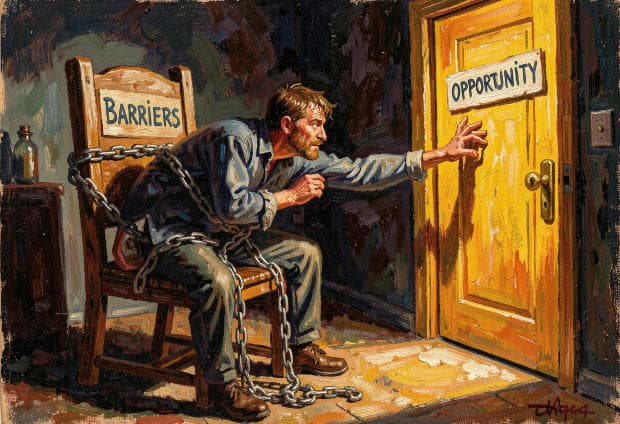
Barriers to entry are the obstacles that make it difficult for new companies to enter a market and compete with established players. These barriers include high capital requirements, government regulations, technological advantages held by incumbents, supply chain control, strong brand loyalty, and control over raw materials. While barriers protect existing businesses, they also reduce market competition, stifle innovation, and can negatively impact overall economic growth. Understanding these barriers is the first step for any entrepreneur looking to break into a competitive industry.
Key Takeaways
- Barriers to entry are obstacles — like high capital costs, government regulations, and technological gaps — that prevent new businesses from easily entering and competing in a market.
- Control over raw materials or resources, established brand recognition, and strong supply chains give incumbent companies significant advantages over newcomers.
- These barriers reduce market competition, discourage innovation, and can ultimately have a negative impact on a country's overall economic growth.
- Identifying and understanding specific barriers in your target industry is the essential first step before attempting to enter any competitive market.
What Are Barriers to Entry?
Breaking into the business world is never as simple as having a good idea and some enthusiasm. When a new company tries to enter a specific market, it almost always runs into obstacles — some visible, some hidden — that make competition with established players extremely difficult.
These obstacles are called barriers to entry. In economics, the term refers to the costs, regulations, structural advantages, or other factors that prevent or discourage new competitors from easily entering an industry. Think of it like trying to join a poker game where the other players already have most of the chips — you can sit down, but the odds are stacked against you from the start.
Barriers to entry exist in virtually every industry, though their nature and intensity vary enormously. A neighborhood tea stall has very low barriers — almost anyone can start one. But trying to launch a new airline, a pharmaceutical company, or a telecom network? Those barriers are massive.
As legendary investor Warren Buffett has often said: "The most important thing in evaluating a business is figuring out how big the moat is." In Buffett's analogy, the "moat" around a business is essentially its barriers to entry — the wider the moat, the harder it is for competitors to get in.
Understanding these barriers is crucial whether you are an entrepreneur planning to start a business, an investor evaluating a company, or a policymaker trying to promote competition. Let us break down the six major types.
The Six Major Types of Barriers to Entry
Barriers to entry come in many forms, and each has its own characteristics and impact on market dynamics. Here are the most significant ones.
1. Capital Requirements
Starting a new business often requires significant upfront investment. For a manufacturing operation, you need land, machinery, raw materials, and labor costs — all before you sell your first product. For capital-intensive industries like steel production, automobile manufacturing, or semiconductor fabrication, the initial investment can run into hundreds of millions or even billions of dollars.
Consider this example: if you wanted to start a new cement factory in Bangladesh, you would need to invest approximately $50-100 million just for the plant, equipment, and initial operations. Most aspiring entrepreneurs simply cannot access that kind of capital — which is exactly why the cement industry is dominated by a handful of large players.
High capital requirements do not just keep small players out. They also create risk — even if you raise the money, there is no guarantee the business will succeed, and the cost of failure is enormous. This risk-reward imbalance is itself a powerful deterrent.
2. Government Policies and Regulations
Governments impose licenses, permits, and regulatory requirements on many industries — and for good reason. You would not want an unqualified person manufacturing medicines or running a bank. But these regulations, while protecting consumers, also create significant barriers for new entrants.
Take the pharmaceutical industry as an example. Before a new drug can be sold, it must go through years of clinical trials, regulatory review, and approval processes. In most countries, this process takes 8-12 years and costs over $1 billion on average. A small startup simply cannot compete with established pharmaceutical giants who have the resources to navigate this regulatory maze.
Similarly, in banking and telecommunications, obtaining the necessary licenses and meeting regulatory capital requirements can take years and cost millions — effectively limiting these industries to well-capitalized players.
3. Technological Advantages and Know-How
Established companies often possess advanced technology, proprietary processes, and deep institutional knowledge that give them significant cost and quality advantages. Replicating these advantages is not just expensive — it can take years of research, development, and accumulated experience.
Think about companies like Intel or TSMC in semiconductor manufacturing. Their chip fabrication processes are the result of decades of R&D investment totaling hundreds of billions of dollars. A new competitor cannot simply replicate that technology overnight — even with unlimited funding, the expertise gap would take years to close.
Patents and intellectual property protections make this barrier even stronger. If a company holds patents on key technologies, competitors may be legally prevented from using similar approaches — forcing them to either develop entirely different solutions or wait until the patents expire.
4. Supply Chain Control
In many industries, established companies maintain tight control over supply chains and distribution networks, making it extremely difficult for newcomers to get their products to customers.
Consider the soft drink industry. Companies like Coca-Cola and PepsiCo have spent decades building distribution networks that reach virtually every corner store, restaurant, and vending machine. A new beverage company might make an excellent product, but getting it onto those same shelves — when Coca-Cola's distributors have exclusive or preferential agreements — is a monumental challenge.
Large retailers often have long-term supply agreements with existing manufacturers, and breaking into these networks requires either significantly better pricing (which is hard when you lack economies of scale) or a genuinely differentiated product that retailers believe will attract customers.
5. Brand Recognition and Customer Loyalty
Established brands enjoy something that money alone cannot buy quickly: customer trust and loyalty. When consumers already trust a brand, convincing them to switch to an unknown alternative is one of the hardest challenges in business.
For example, try launching a new cola brand to compete with Coca-Cola or Pepsi. Your product might taste just as good — or even better. But consumers have decades of brand association, emotional connection, and habitual purchasing behavior that makes switching incredibly unlikely without massive marketing investment.
According to marketing research, acquiring a new customer costs 5-7 times more than retaining an existing one. For a new market entrant, every single customer is a "new" customer — while incumbents enjoy the compounding benefit of existing relationships. This asymmetry makes brand loyalty one of the most powerful and enduring barriers to entry.
6. Control Over Raw Materials and Resources
In some industries, large incumbents control access to essential raw materials or natural resources, creating a barrier that is nearly impossible to overcome.
Consider the natural gas sector. In many countries, exploration and extraction rights are controlled by state-owned companies or a small number of licensed operators. A new company cannot simply decide to enter the natural gas business — the resource itself is locked behind government concessions and existing contracts.
De Beers, the diamond company, historically controlled approximately 80-85% of the global rough diamond supply — making it nearly impossible for competitors to source diamonds at competitive prices. While De Beers' market share has declined in recent decades, the example illustrates how resource control can create an almost impenetrable barrier.
Even in less extreme cases, established companies often have long-term contracts with key suppliers, securing better prices and priority access — leaving newcomers to pay higher prices or face supply shortages.
The Bottom Line
Barriers to entry are a fundamental reality of any market economy. On one hand, they protect established companies and can ensure quality standards (particularly in regulated industries like healthcare and finance). On the other hand, they reduce competition, stifle innovation, and can lead to monopolistic or oligopolistic market structures where consumers have fewer choices and pay higher prices.
For aspiring entrepreneurs, understanding the specific barriers in your target industry is not optional — it is essential survival knowledge. You cannot overcome an obstacle you do not understand. Whether it is capital, regulation, technology, supply chains, brand loyalty, or resource control, each barrier requires a different strategy to address.
For policymakers, the challenge is finding the right balance — maintaining necessary regulations and standards while ensuring that barriers do not become so high that they permanently lock out new competitors and the innovation they bring.
As economist Joseph Schumpeter argued, economic progress depends on "creative destruction" — the process by which new businesses and innovations replace old ones. Barriers to entry are the friction that slows this process. Understanding them is the first step toward overcoming them.
Recommended for you

Banking: What It Is, How Banks Work, and Everything You Need to Know
Most people use banks every single day — depositing salaries, withdrawing cash, transferring money, paying bills — without ever really thinking about how the whole system actually works. A bank is a licensed financial institution that accepts deposits from the public and uses those deposits to provide loans to individuals and businesses. Everything a bank does — from accepting your savings to issuing credit cards to printing cheques — falls under the broad category of banking. But banks are not just convenient places to store your money. They are the central nervous system of any economy — the institutions that keep money flowing productively through the system, connecting people who have surplus funds with people and businesses that need capital. And in Bangladesh, where Bangladesh Bank serves as the central authority overseeing the entire financial system, understanding how banking works is genuinely useful knowledge for anyone managing their personal finances, running a business, or simply trying to make smarter decisions with their money.
Business Models
Sharing Economy Model: How Businesses Make Money Without Owning Anything
E-Commerce
E-Commerce: The Complete Guide to Online Business
Investment
Investment: What It Is, Types, and Real Life Examples
Sales
What Is Sales and How Does It Work?

Accounting
Gross Profit: Definition, Formula, and Why It Matters
Accounting
Accounting for Startups: A Complete Guide to Getting It Right

Accounting
Financial Recording and Transactions: The Complete Guide

Agreement
General Agreement on Tariffs and Trade (GATT)

Agreement
Teesta Water Sharing Treaty