Return on Investment (ROI) — The Complete Guide to Measuring How Hard Your Money Works
G
GeoRenus Editorial Team
684 views
Summary
Return on Investment (ROI) measures net profit as a percentage of investment cost and is the most universally used financial metric for evaluating any investment. This guide covers the ROI formula, three calculation methods, real-world examples, industry benchmarks, key limitations, better alternatives like IRR and CAGR, and practical strategies to improve your returns in Bangladesh and globally.
Key Takeaways
- ROI (Return on Investment) measures net profit as a percentage of total investment cost, making it possible to compare any two investments regardless of size or type.
- Basic formula: ROI = (Net Profit / Cost of Investment) x 100. For multi-year comparisons, always annualise: Annualised ROI = [(1 + ROI)^(1/n) - 1] x 100.
- A 'good' ROI is entirely context-dependent -- always compare against a relevant benchmark such as the current FD rate, inflation, or the return from the next best alternative.
- ROI has five critical limitations: it ignores time value of money, risk, cash flow timing, intangible benefits, and can be manipulated through selective cost accounting.
- For complex investments, use IRR (accounts for cash flow timing), NPV (discounts future values), CAGR (smooths multi-year performance), or the Sharpe Ratio (adjusts for risk).
- In Bangladesh with inflation around 9-10% in 2024-2025, any investment earning less than 10% per year is delivering a negative real return in purchasing power terms.
- The compounding effect of small ROI improvements is enormous: a 2% higher annual return (10% vs 12%) more than doubles your final wealth over 30 years.
- Always include ALL costs in ROI calculations: purchase price, fees, taxes, maintenance, management charges, and opportunity cost. Missing hidden costs is the most common ROI mistake.
Two Friends. One Decision. Very Different Results.
In 2022, two old university friends -- Rakib and Sakib -- both received a 5,00,000 taka bonus from their jobs. They were both 32, both ambitious, and both decided to invest every taka.
Rakib heard a stock tip at a wedding and put it all into a single company. Sakib spent a weekend crunching numbers, comparing three options, and chose a diversified mutual fund portfolio. Two years later, they met at another wedding.
Rakib had 4,10,000 taka left. Sakib had 7,20,000 taka.
The difference was not luck. It was not timing. It was not even the market. The difference was that Sakib knew exactly how to measure whether an investment was worth making -- before he put in a single taka, and after. He used a deceptively simple formula called Return on Investment, or ROI.
"ROI is the universal language of investing. Whether you are buying stocks, opening a shop, or spending money on marketing -- ROI tells you if it was worth it."
This guide will show you what ROI is, how to calculate it (three different ways), what good ROI looks like across different asset classes, its real limitations, and -- most importantly -- how to use it the way Sakib did to make smarter, calmer investment decisions.
By the end of this guide, you will have the same mental framework Sakib uses -- and you will never look at an investment the same way again.
What Is Return on Investment (ROI)?
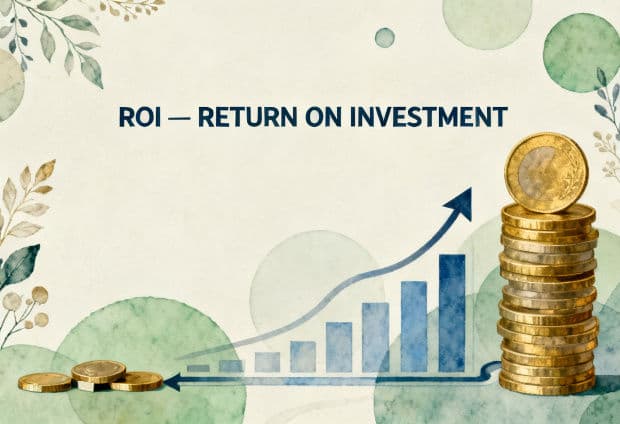
Return on Investment (ROI) is a financial ratio that measures the net profit or loss from an investment relative to the amount of money invested. It is expressed as a percentage, which makes it easy to compare investments of completely different sizes, types, and time horizons.
In plain English: ROI answers the question -- for every taka I spent, how many taka did I get back?
ROI is one of the oldest and most widely used performance metrics in finance, business strategy, marketing, and even personal budgeting. It does not care about the type of investment -- stocks, real estate, a small business, a marketing campaign, or an education degree. The formula works for all of them.
That universality is ROI's greatest strength. It gives you a single, clean number that strips away all the complexity and asks: did this investment create value, or did it destroy it?
Why ROI Matters
Before ROI, comparing investments was messy. A 10,000 taka profit sounds great -- but not if you had to invest 10,00,000 taka to get it. ROI normalises the profit against the cost, giving you a fair, apples-to-apples comparison number.
Feature | Without ROI | With ROI |
Comparison | Hard -- different sizes and types | Easy -- all expressed as percentages |
Decision making | Based on gut feeling or raw profit | Data-driven and standardised |
Cross-asset comparison | Not possible (stocks vs real estate) | Fully possible |
Communication | Vague ("we made a good profit") | Precise ("we earned a 22% return") |
Goal setting | Arbitrary targets | Clear percentage benchmarks |
ROI originated in corporate accounting in the early 20th century but has long since escaped into everyday usage. Marketing teams use it to justify ad spend. Entrepreneurs use it to pitch investors. Governments use it to evaluate public infrastructure projects. You can use it to decide whether to take a weekend course or buy a second-hand car.
Historical note: The concept behind ROI gained mainstream corporate use in the 1920s when the DuPont Corporation developed its famous DuPont Analysis framework, using return-on-equity to evaluate business unit performance.
Today, ROI is used by everyone from hedge fund managers making billion-dollar allocation decisions to small business owners deciding whether to open a second branch. The formula is the same for all of them.
How to Calculate ROI -- Three Methods
There is more than one way to calculate ROI, depending on what you are measuring and how much precision you need. Here are the three most important methods every investor should know.
Method 1 -- Basic ROI Formula
Formula: ROI = (Net Profit / Cost of Investment) x 100
Equivalently: ROI = ((Current Value - Cost) / Cost) x 100
This is the go-to formula for most everyday situations. It is fast, universal, and works even when you are doing a rough back-of-envelope estimate. You only need two numbers: what you put in, and what you got out.
Variable | Meaning | Example Value |
Net Profit | Final value minus initial cost of investment | 70,000 taka |
Cost of Investment | Total money invested, including all fees | 5,00,000 taka |
ROI Result | Profit as a percentage of the cost | 14% |
Interpretation | For every 100 taka invested, you earned 14 taka profit | -- |
One important thing to get right: the cost of investment should include ALL costs -- the purchase price, transaction fees, brokerage charges, taxes paid upfront, maintenance or management fees, and any other money you spent to make the investment happen. Forgetting hidden costs is the number one way investors overstate their ROI.
Method 2 -- Annualised ROI
Formula: Annualised ROI = [(1 + ROI)^(1/n) - 1] x 100
Where n = number of years the investment was held. Basic ROI ignores time entirely -- a 30% return over 10 years is very different from a 30% return over 1 year. Annualised ROI fixes that by converting any holding period into an equivalent annual return, making comparisons across different timeframes honest and fair.
Scenario | Total ROI | Years Held | Annualised ROI |
Sakib's mutual fund | 44% | 2 | 20.0% per year |
Rakib's losing stock | -18% | 2 | -9.5% per year |
Dhaka real estate | 80% | 5 | 12.5% per year |
Bank fixed deposit | 30% | 3 | 9.1% per year |
Startup investment | 200% | 4 | 31.6% per year |
Notice how Sakib's 44% total ROI translates to a very impressive 20% per year. The annualised figure is what you should use whenever you compare investments held for different time periods -- which is almost always.
Method 3 -- Social ROI (SROI)
SROI is used for non-profit projects, government programmes, and social enterprises where the 'return' includes social, environmental, or community outcomes rather than just financial profit. It assigns a monetary value to these outcomes and runs the same calculation as basic ROI.
Formula: SROI = (Social Value Created / Investment Cost) x 100
Example: A government spends 1 crore taka on a vocational training programme. The programme helps 500 people secure employment, each earning an additional 50,000 taka per year. Over 5 years, the total social value generated is 25 crore taka. SROI = (25 crore / 1 crore) x 100 = 2500%.
That 2500% SROI means every 1 taka of government investment generated 25 taka of social value -- a compelling case for the programme's continuation.
SROI is intentionally broad and involves qualitative judgement in valuing social outcomes. Critics argue valuations can be subjective and manipulated. SROI works best as a directional signal and communication tool, not a precise financial metric.
ROI in Action -- Three Real-World Examples
Theory is useful, but examples make ROI stick. Here are three detailed worked examples covering the most common investment types -- stocks, a small business, and a digital marketing campaign.
Example 1: Stock Market Investment
Sakib bought 3,00,000 taka worth of shares in a Bangladeshi telecom company in January 2023. By December 2024, those shares were worth 4,20,000 taka. He also received 18,000 taka in dividends during that period.
Total return = (4,20,000 + 18,000) - 3,00,000 = 1,38,000 taka profit
Basic ROI = (1,38,000 / 3,00,000) x 100 = 46% over 2 years
Annualised ROI = [(1.46)^(1/2) - 1] x 100 = approximately 20.8% per year
That 20.8% annualised return is nearly double the average fixed deposit rate in Bangladesh and comfortably ahead of inflation -- a genuinely excellent result.
Example 2: Small Business Investment
Rakib, undeterred by his stock loss, used his remaining 4,10,000 taka to open a small stationery shop. After 1 full year of operation:
- Total revenue: 9,50,000 taka
- Total operating costs (rent, stock purchase, one employee salary, utilities): 7,20,000 taka
- Net profit: 2,30,000 taka
ROI = (2,30,000 / 4,10,000) x 100 = 56.1% in 1 year -- significantly better than his earlier stock investment!
This example shows why ROI is so powerful for business decisions. It lets you compare completely different types of investments -- listed stocks versus a physical retail business -- on completely equal footing. The formula does not care what you invested in. It only cares about profit versus cost.
Example 3: Digital Marketing Campaign
A Dhaka-based e-commerce startup spent 1,00,000 taka on Facebook and Google advertising over one month. The campaign generated 4,50,000 taka in new sales revenue. The cost of goods sold for those new sales was 2,80,000 taka.
Net profit from campaign = 4,50,000 - 2,80,000 - 1,00,000 ad spend = 70,000 taka
Marketing ROI = (70,000 / 1,00,000) x 100 = 70%
A 70% ROI from a single month-long campaign is exceptional by any standard. Marketing ROI (also called ROMI -- Return on Marketing Investment) is one of the most practical applications of the ROI formula, helping teams rapidly identify which channels to scale and which to cut.
Investment Type | Amount Invested | Net Profit | ROI | Annualised ROI |
Sakib's stocks (2 years) | 3,00,000 taka | 1,38,000 taka | 46% | 20.8% |
Rakib's shop (1 year) | 4,10,000 taka | 2,30,000 taka | 56.1% | 56.1% |
Marketing campaign (1 month) | 1,00,000 taka | 70,000 taka | 70% | ~125%* |
Vocational training (SROI, 5 yr) | 1 crore taka | 25 crore social value | 2500% | ~89% |
* The annualised marketing ROI assumes the same monthly performance would repeat for 12 months, which rarely happens in practice. Monthly campaign ROI should not be annualised without careful analysis of sustainability.
What Is a Good ROI? Industry Benchmarks
This is the question every investor asks first. The honest answer is: it depends. A 5% ROI from a government savings bond is outstanding. A 5% ROI from a high-risk startup venture is disastrous. Context matters more than the number itself.
The golden rule: always compare ROI to the opportunity cost -- what you would have earned in the next best alternative of similar risk.
For most Bangladeshi investors, the baseline benchmark is the current fixed deposit rate (around 8-10% in 2025). Any investment that cannot consistently beat FD rates after accounting for its extra risk is not worth making.
Asset Class | Typical Annual ROI (Bangladesh/Global) | Risk Level | Liquidity |
Bank savings account (BD) | 3% - 6% | Very Low | Very High |
Fixed Deposit (BD) | 8% - 10% | Low | Low (locked term) |
Government bonds (BD) | 8% - 11% | Low | Medium |
Mutual funds (BD) | 10% - 18% | Medium | Medium-High |
DSEX stock market (BD avg) | 10% - 15% | Medium-High | High |
Real estate -- Dhaka prime | 12% - 20% | Medium | Very Low |
Small business ownership | 20% - 60%+ | High | Very Low |
Angel/startup investment | Negative to 100x+ | Very High | Very Low |
Global S&P 500 (10-yr avg) | ~10.7% nominal | Medium-High | High |
Notice the pattern: higher expected ROI comes with higher risk and lower liquidity. This is the fundamental risk-return trade-off in all of finance. ROI alone cannot capture this trade-off -- which is one of its biggest limitations.
"If your investment is not beating inflation, you are not earning -- you are slowly losing. A 7% return in a 10% inflation environment is actually a -3% real return." -- Common wisdom among experienced Dhaka-based fund managers
ROI Benchmarks by Business Function
For businesses, ROI benchmarks vary dramatically by function. Here are the industry standards that marketing, HR, and strategy teams use:
Business Function | Average ROI Benchmark | Notes |
Email marketing | 3,600% - 4,200% | $36-42 return per $1 spent (global avg) |
SEO (organic search) | 300% - 1,500% | Builds slowly but compounds over time |
Paid social media ads | 100% - 400% | Highly variable by industry and targeting |
Employee training | 200% - 400% | Based on productivity and retention gains |
New product development | 20% - 80% | Highly variable; many products fail |
Customer retention | 300% - 700% | Retaining is 5-7x cheaper than acquiring |
IT infrastructure upgrades | 50% - 200% | Through efficiency and reduced downtime |
The Dark Side of ROI -- Key Limitations You Must Know
ROI is powerful, but it is not perfect. Experienced investors know its blind spots and compensate for them. Beginners who rely on ROI alone have made -- and continue to make -- expensive mistakes. Here is what ROI cannot tell you.
Limitation 1 -- ROI Ignores Time Value of Money
A 50% ROI sounds incredible. But if it took 20 years to achieve, that is approximately 2% per year -- worse than a savings account. Without annualising, raw ROI percentages from different holding periods are completely incomparable.
Worse, basic ROI treats 1,00,000 taka received today the same as 1,00,000 taka received in 10 years -- even though the future payment is worth much less in today's purchasing power due to inflation. Net Present Value (NPV) solves this by discounting future cash flows back to their present value.
Limitation 2 -- ROI Ignores Risk
Two investments both showing 15% ROI could have wildly different risk profiles. One might be a government bond (near-certain return), the other a volatile crypto token (could go to zero overnight). ROI treats them identically. The Sharpe Ratio is the industry standard fix -- it divides return by volatility to give a risk-adjusted performance score.
Limitation 3 -- ROI Ignores Cash Flow Timing
Two investments with identical ROI might have completely different cash flow profiles. Investment A might pay all returns in year 1, while Investment B pays them in year 10. For businesses with working capital needs, that timing difference is critical. IRR (Internal Rate of Return) accounts for when cash flows occur, making it superior for capital budgeting decisions.
Limitation 4 -- ROI Can Be Manipulated
The ROI formula looks objective, but both the numerator (profit) and denominator (cost) can be defined in self-serving ways. A marketer might exclude overhead costs from the campaign cost to inflate the ROI number. A business might exclude depreciation or founder salary. Always ask: exactly what costs are included in this ROI calculation?
Limitation 5 -- ROI Cannot Measure Intangibles
Brand awareness, employee morale, customer trust, community goodwill, and long-term strategic positioning do not show up in ROI. Some of the most valuable business investments -- sponsoring a community event, investing in employee wellbeing, building a premium brand -- look terrible on short-term ROI. Using ROI alone to evaluate these investments leads to chronic underinvestment in the things that make businesses great.
Limitation | The Problem It Creates | Better Alternative Metric |
Ignores time value of money | Misleading raw % without annualising | Annualised ROI, CAGR |
Ignores risk | High ROI may hide catastrophic downside | Sharpe Ratio, standard deviation |
Ignores cash flow timing | Cannot compare sequential vs lump-sum | NPV, IRR |
Can be manipulated | Selective cost inclusion inflates figures | Standardised full-cost accounting |
Misses intangibles | Under-values brand, culture, loyalty | Balanced Scorecard, SROI |
Short-termism bias | Kills long-term value creation | 3-5 year strategic ROI targets |
Better Alternatives -- When to Use Something Other Than ROI
Smart investors and finance professionals use ROI as a starting point, then reach for more specialised tools depending on the situation. Here are the main alternatives and exactly when each one is the better choice.
Metric | Full Name | Best Used For | Key Advantage Over ROI |
IRR | Internal Rate of Return | Long-term projects, PE/VC | Accounts for exact cash flow timing |
NPV | Net Present Value | Capital budgeting decisions | Discounts future cash flows to present |
CAGR | Compound Annual Growth Rate | Multi-year investment comparison | Smooths year-to-year volatility |
Payback Period | N/A | Working capital decisions | Shows exactly when you break even |
Sharpe Ratio | N/A | Portfolio management | Adjusts return for risk/volatility |
ROCE | Return on Capital Employed | Comparing companies | Captures efficiency of all capital |
SROI | Social Return on Investment | Non-profits, CSR, government | Values social/environmental outcomes |
IRR -- The Institutional Favourite
Private equity firms, infrastructure funds, and project finance teams almost always quote IRR rather than ROI. IRR tells you the effective annual interest rate that makes the net present value of all cash flows equal to zero. In plain English: it is the annualised return that fully accounts for when money goes in and when money comes out.
Example: A factory investment requires 1 crore taka today and generates 30 lakh taka per year for 5 years. The IRR is approximately 15.2%. This IRR fully accounts for the fact that money arrives gradually over 5 years, not as a lump sum on day 1.
CAGR -- The Investor's Best Friend
If Sakib invested 1,00,000 taka and it grew to 2,20,000 taka over 8 years, his CAGR = [(2,20,000/1,00,000)^(1/8) - 1] x 100 = 10.3% per year. CAGR is ideal for comparing long-term investment performance because it presents a smooth annual growth rate that eliminates the noise of volatile individual years.
The practical rule: Use ROI for quick snapshots and simple comparisons. Use IRR or NPV when the timing of cash flows matters. Use CAGR to communicate and compare long-term growth trajectories.
How to Improve Your ROI -- Proven Strategies
Knowing your ROI is step one. Actively improving it is step two. Here are proven strategies for both individual investors and business owners.
For Individual Investors
- Diversify across asset classes -- different assets perform best in different economic cycles.
- Minimise fees and taxes -- a 2% annual fund management fee destroys approximately 40% of your cumulative wealth over 30 years.
- Reinvest dividends and interest automatically -- compounding is the most reliable ROI booster over any long time horizon.
- Hold quality investments longer -- transaction costs, bid-ask spreads, and short-term capital gains tax all erode net ROI.
- Invest in education and skills -- the ROI on human capital is often 200-400% and compounds for decades.
- Avoid emotional decisions -- panic selling and excitement buying are the two greatest destroyers of individual investor ROI.
For Business Owners
- Track ROI per product line, per marketing channel, and per business unit -- not just overall company profit.
- Cut underperforming investments quickly rather than doubling down due to sunk cost fallacy.
- Improve operational efficiency -- the same revenue with lower costs directly translates to higher ROI.
- Negotiate better supplier terms -- every taka saved on input costs is a taka added to net profit and ROI.
- Focus marketing spend on proven high-ROI channels (email, SEO, referrals) before scaling expensive paid channels.
- Measure employee training ROI -- well-trained staff produce more with lower error rates and turnover.
Strategy | Who It Helps | Estimated ROI Impact |
Reinvesting dividends automatically | Individual investors | +1% to 3% annualised return |
Reducing fund fees from 2% to 0.5% | Individual investors | +1.5% annualised over time |
Cutting low-ROI advertising channels | Businesses | +10% to 40% on marketing ROI |
Process automation and workflow | Businesses | +15% to 50% on operational ROI |
Employee upskilling programmes | Businesses | +200% to 400% SROI |
Tax-efficient investment structuring | Individual and Business | +1% to 5% after-tax return |
Supplier renegotiation | Businesses | +5% to 20% gross margin improvement |
ROI Do's and Don'ts -- The Investor's Checklist
After years of watching investors both succeed and fail with ROI, a clear pattern emerges. The winners follow these rules. The losers ignore them.
Do's -- Best Practices
- Always annualise ROI when comparing investments held for different time periods -- never compare raw percentages from different holding periods.
- Include ALL costs in your denominator: purchase price, transaction fees, taxes, maintenance, management fees, and opportunity cost.
- Compare ROI against a meaningful benchmark -- at minimum, compare against the current FD rate plus inflation.
- Use ROI alongside other metrics (IRR, CAGR, Sharpe Ratio) -- never make major investment decisions on ROI alone.
- Calculate projected ROI before investing, not just actual ROI after -- prospective analysis is more valuable than retrospective.
- Use ROI to actively kill underperforming investments -- not just to celebrate winners and justify holding losers.
- Be consistent in your ROI calculation methodology so comparisons across time and investments are valid.
Don'ts -- Common Mistakes
- Don't compare raw ROI percentages from investments held for different time periods -- always annualise first.
- Don't cherry-pick which costs to include in the denominator to artificially inflate the ROI figure.
- Don't ignore risk -- a higher ROI that comes with catastrophic downside risk is not a better investment.
- Don't use ROI as the sole metric for evaluating intangible or strategic investments -- supplement with qualitative analysis.
- Don't confuse gross ROI (before costs) with net ROI (after all costs) -- always specify which you are using.
- Don't let short-term ROI thinking sacrifice genuine long-term value creation -- some great investments look terrible in year 1.
- Don't trust ROI figures without asking who calculated them and what costs were included.
Common Mistake | Why It Is Harmful | How to Fix It |
Not annualising for time periods | Overestimates short-hold returns | Use [(1+ROI)^(1/n)-1] x 100 |
Excluding hidden costs | Artificially inflates ROI | Full-cost accounting before calculating |
Ignoring investment risk | High ROI hides potential total loss | Add Sharpe Ratio or risk premium analysis |
Short-term ROI focus | Destroys compound value creation | Set 3-5 year ROI targets minimum |
No benchmark comparison | No context for whether ROI is good | Compare to FD rate + inflation always |
Pros and Cons of ROI -- A Balanced Assessment
ROI is brilliant when used correctly and genuinely dangerous when misapplied. Here is a balanced, honest look at both sides.
Advantages of ROI
- Simplicity: easy to calculate with no advanced mathematics or specialised software required.
- Universality: works across every investment type -- financial assets, physical assets, human capital, marketing spend.
- Comparability: expressing everything as a percentage puts investments of any size on equal footing.
- Immediate clarity: a positive ROI means value was created; a negative ROI means value was destroyed.
- Wide acceptance: universally understood by investors, executives, board members, and lenders worldwide.
- Flexibility: can be adapted to measure any time period and any definition of costs and returns.
Disadvantages of ROI
- Time blind: ignores the time value of money without explicit annualisation.
- Risk blind: treats a safe 15% return and a high-risk 15% return as identical.
- Gameable: both the profit numerator and cost denominator can be manipulated through selective accounting.
- Not suited for complex cash flows: multiple cash flows over many years need IRR or NPV instead.
- Misses intangibles: brand value, culture, customer loyalty, and ESG outcomes are invisible in ROI.
- Encourages short-termism: organisations that over-optimise near-term ROI systematically underinvest in their future.
Dimension | Advantage | Disadvantage |
Complexity | Simple enough for anyone to compute | May oversimplify genuinely complex situations |
Scope | Works for any investment type | Blind to risk differences between investments |
Communication | Instantly understood globally | Context still required for accurate interpretation |
Time | Quick snapshot of past performance | Misleading without annualisation |
Value capture | Excellent for financial returns | Blind to intangible and social value |
Decision quality | Beats gut-feeling decisions | Can still lead to bad decisions if used alone |
ROI Statistics and Benchmarks -- 2025 Global Data
Data brings ROI to life. Here are the most important investment return statistics for Bangladesh and global markets in 2024-2025.
Benchmark / Statistic | 2024-2025 Data Point |
US S&P 500 average annual return (10-year) | ~10.7% nominal, ~7.5% inflation-adjusted |
Bangladesh DSEX index 2024 | Approximately -5% to +8% (highly volatile year) |
Bangladesh fixed deposit rate 2025 | 8% - 10% average across major banks |
Dhaka prime residential real estate | 8% - 15% annual appreciation in prime areas |
Bangladesh inflation rate 2024-2025 | ~9% - 10% CPI estimate |
Global private equity average IRR | 14% - 18% (top quartile funds) |
Email marketing ROI (global average) | $36 - $42 return per $1 spent (~3,600%) |
Employee training ROI (ATD research) | ~353% average across industries |
Venture capital average IRR (top decile) | ~25% IRR for best-performing funds |
Real estate vs stocks (Bangladesh 5-yr avg) | Real estate: ~13%, Stocks: ~9% |
Critical Bangladesh context: With inflation running at 9-10% in 2024-2025, any investment returning less than 10% per year is delivering a negative real return -- your money is losing purchasing power.
The global shift toward digital investing has transformed what individual investors can realistically achieve. Retail investors now have access to index funds, robo-advisors, and fractional shares -- tools that historically produce consistent 9-12% annual ROI with minimal active management.
"Compounding at 10% for 30 years turns 1,00,000 taka into 17,44,940 taka. Compounding at 12% for 30 years turns the same 1,00,000 taka into 29,95,992 taka. That 2% annual difference equals an extra 12,51,052 taka -- earned by doing nothing differently except choosing a slightly better investment."
The Power of Compounding -- ROI Over Time
The most important ROI table you will ever study is the compounding table. It shows what 1,00,000 taka becomes at different annual ROI levels over time. The differences are staggering.
Annual ROI | After 10 Years | After 20 Years | After 30 Years |
6% | 1,79,085 taka | 3,20,714 taka | 5,74,349 taka |
8% | 2,15,892 taka | 4,66,096 taka | 10,06,266 taka |
10% | 2,59,374 taka | 6,72,750 taka | 17,44,940 taka |
12% | 3,10,585 taka | 9,64,629 taka | 29,95,992 taka |
15% | 4,04,556 taka | 16,36,654 taka | 66,21,177 taka |
20% | 6,19,174 taka | 38,33,760 taka | 2,37,37,631 taka |
This table makes one thing brutally clear: the difference between a 10% and 12% annual ROI after 30 years is not 2% -- it is 12,51,052 taka on a single 1,00,000 taka investment. Small ROI improvements, sustained over time, compound into life-changing wealth differences.
This is why Sakib's obsession with measuring ROI before and after every investment was not nerdy number-crunching. It was the single most valuable financial habit he had.
The Bottom Line -- Back to Rakib and Sakib
Three years after that first wedding, both Rakib and Sakib are doing well -- but they got there very differently.
Sakib's mutual fund portfolio has quietly grown from 5,00,000 to 9,40,000 taka. He has made no dramatic moves. He rebalances once a year, reinvests all dividends, and ignores the noise. His annualised ROI across the portfolio sits at approximately 23%. He spends about 2 hours a year actively thinking about his investments.
Rakib's stationery shop is now generating over 3,00,000 taka in annual net profit on the original 4,10,000 taka investment. He is considering opening a second branch. More importantly, he tracks ROI religiously now -- per product category, per supplier, per marketing channel. When a product line is not pulling its weight, he cuts it without emotion.
What changed for Rakib was not the market or the industry. It was discipline and measurement. He stopped making decisions based on tips, excitement, and gut feeling. He started asking one clean question before every decision: what is the ROI?
ROI will not tell you everything. It cannot capture the joy of building something you believe in, the strategic value of a 10-year brand investment, or the community impact of a social enterprise. Use it alongside NPV, CAGR, qualitative judgement, and your own understanding of risk.
But for a fast, universal, honest signal about whether your money is working hard enough -- whether a decision created value or destroyed it -- there is nothing better than a well-calculated, carefully interpreted Return on Investment.
Start measuring. Start comparing. Make every taka earn its place.
"ROI is not the destination. It is the compass." -- Sakib, probably, at the next wedding.
And next time you hear a hot investment tip at a wedding? Pull out a napkin, write down the projected ROI, and compare it to your FD rate. Sakib would be proud.
Recommended for you

From Barter to Bitcoin: The Evolution of Money
Since the dawn of human civilization, people have engaged in trade through barter. However, around 5,000 years ago, humans gradually abandoned the barter system and began using metallic coins. These coins were made from copper, silver, and gold. Around 1260 AD, the first paper currency was introduced in China and eventually spread throughout the world. In the 1930s, the first credit cards were issued by commercial establishments, and by the 1950s, banks began issuing them as well.
Money
How Money Works?
Business
Needs, Wants, and Demands

Marketing
Digital Marketing: What It Is, Why It Matters, and How It Works

E-Commerce
E-Commerce: The Complete Guide to Online Business

Organization
What Is the International Monetary Fund (IMF)?

Startup
What Is a Startup? The Ultimate Guide You Need to Read

Accounting
Income Tax, Concept and Calculation

Analysis
PESTLE Analysis in depth

Analysis
Six Thinking Hats