Invisible Hand vs Impartial Spectator -- Why Capitalism Adopted Adam Smith's Minor Metaphor and Abandoned His Central Philosophy
G
GeoRenus Editorial Team
1,344 views
GeoRenus Editorial Team
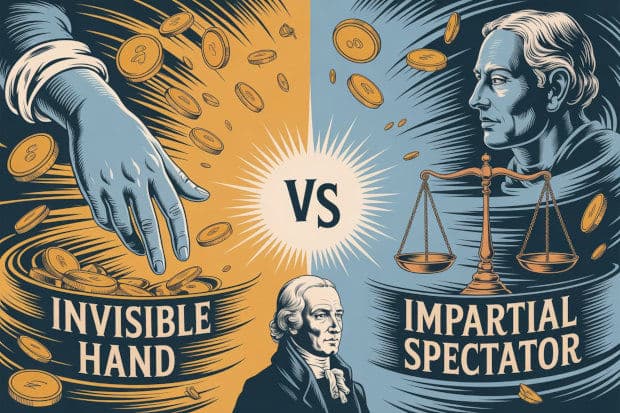
Adam Smith is celebrated as the 'Father of Capitalism' for his 'Invisible Hand' concept -- the idea that self-interest automatically benefits society. But a startling fact emerges from his actual writings: Smith used the phrase 'Invisible Hand' only 3 times in his entire body of work (once each in The Theory of Moral Sentiments, The Wealth of Nations, and History of Astronomy -- per Emma Rothschild, Harvard University Press, 2001). Meanwhile, his concept of the 'Impartial Spectator' -- an internal moral conscience based on empathy, justice, and social responsibility -- is the central theme of The Theory of Moral Sentiments (1759), mentioned hundreds of times. Smith himself considered TMS his greatest work, not Wealth of Nations. So why did capitalism adopt the minor metaphor and abandon the central philosophy? This article traces how the Industrial Revolution, the 'Adam Smith Problem,' the Chicago School, Cold War politics, and the mathematization of economics collectively cherry-picked one idea and discarded the rest.
On the night of July 17, 1790, in Edinburgh, Adam Smith lay dying. His final request was one of the stranger wishes of any great intellectual: he asked that his sixteen unpublished manuscripts be burned. His closest friends, the chemist Joseph Black and the geologist James Hutton, honored that wish. Ian Simpson Ross, in The Life of Adam Smith (2nd ed., Oxford University Press, 2010), recounts this episode in detail. What survived were two books: The Theory of Moral Sentiments (1759) and The Wealth of Nations (1776). History, it turned out, would remember only one of them.
This selective memory is the subject of this article. Adam Smith -- whom we celebrate as the 'Father of Capitalism' -- believed, until his final day, that The Theory of Moral Sentiments was his greater work, not The Wealth of Nations. Gavin Kennedy, in Adam Smith: A Moral Philosopher and His Political Economy (Palgrave Macmillan, 2008), documents that Smith revised TMS six times over his lifetime, completing the sixth and final revision in 1790, just months before his death. His devotion to that moral text never wavered.
Now here is the fact that should stop you cold. Adam Smith -- the man whose name is synonymous with the Invisible Hand -- used that phrase exactly 3 times across his entire body of work. Once in The Theory of Moral Sentiments, once in The Wealth of Nations, and once in History of Astronomy. Emma Rothschild, in Economic Sentiments: Adam Smith, Condorcet, and the Enlightenment (Harvard University Press, 2001), documents this meticulously.
Three times. In a lifetime of writing that runs to thousands of pages. Three uses of a two-word metaphor -- and from those three uses, capitalism built its entire ideological foundation. Meanwhile, Smith's concept of the 'Impartial Spectator' -- an internal moral judge grounded in empathy, fairness, and social conscience -- appears hundreds of times across The Theory of Moral Sentiments. It is the organizing principle of the entire book. And it has been almost completely forgotten.
Consider what that means in practice. Walk into any university economics department in the world. The Wealth of Nations is on the syllabus. The Theory of Moral Sentiments? Rarely assigned, rarely read, rarely discussed. Ask any MBA student to explain the Invisible Hand and they will give you a fluent answer. Ask them about the Impartial Spectator and you will get a blank stare. Ask a politician invoking 'free markets' whether they have read TMS and the conversation will typically end.
Nobel laureate Amartya Sen addressed this directly in The Idea of Justice (Harvard University Press, 2009): the narrowing of Smith's thought to self-interest alone is not merely an incomplete reading -- it is, in Sen's word, a 'distortion.' In his earlier published essay 'Adam Smith's Prudence' (in Theory and Reality in Development, 1986), Sen showed that Smith's notion of prudence always combined self-interest with social responsibility, and that later economists surgically removed the social responsibility half.
"The narrow reading of Smith that focuses only on self-interest is a serious distortion of his actual thought." -- Amartya Sen, The Idea of Justice, 2009
So why did this happen? Who chose the Invisible Hand and discarded the Impartial Spectator? Was it an honest intellectual error, or something more deliberate? The answer involves the Industrial Revolution, a dispute among German academics, the University of Chicago, the Cold War, and the professional ambitions of economists who wanted their discipline to look like physics. Each of these forces played a role in what is arguably the largest act of intellectual cherry-picking in economic history.
This article investigates that question with evidence from published academic sources. Every claim is sourced. Every quote is cited. We are not offering opinion -- we are tracing a historical process that shaped, and continues to shape, the world economy. By the end, the real Adam Smith will emerge: a moral philosopher who believed that markets need conscience, that self-interest without ethics destroys societies, and that the goal of economic life is not profit alone but human flourishing. A vision that capitalism heard half of -- and urgently needs to hear in full.
Let us begin where Smith himself began -- with his actual words.
The Invisible Hand is possibly the most famous concept in the history of economics. It is invoked in presidential speeches, corporate reports, undergraduate textbooks, and television commentary. It is the intellectual bedrock on which laissez-faire economics rests. And most of the people invoking it have never read the passages where Smith actually used the phrase.
The most famous occurrence is in The Wealth of Nations (1776), Book IV, Chapter 2. Smith is discussing why domestic merchants prefer to invest at home rather than abroad -- they are more familiar with local conditions and trust them more. He writes: 'he is in this, as in many other cases, led by an invisible hand to promote an end which was no part of his intention.' That is the entire relevant sentence. The merchant's motive is self-protection from unfamiliar foreign risk. The outcome is a benefit to the domestic economy. Smith is making a limited, specific observation about one type of behavior -- not proclaiming a universal law of markets.
The second occurrence is in The Theory of Moral Sentiments (1759), Part IV, Chapter 1. Smith is writing about the wealthy landowner who employs laborers. He writes that the landowner 'are led by an invisible hand to make nearly the same distribution of the necessaries of life, which would have been made had the earth been divided into equal portions among all its inhabitants.' Read that carefully. Here the Invisible Hand is not a metaphor for free markets producing growth. It is a metaphor for wealth distribution -- the idea that wealthy consumption trickles down to workers. This context is almost never cited by those who use the phrase to defend inequality.
The third occurrence is in History of Astronomy, an early essay likely written in the 1750s and published posthumously. Smith uses 'the invisible hand of Jupiter' to describe how ancient peoples attributed natural events to the intervention of the Roman god. This is a philosophical and rhetorical observation about primitive belief systems. It has no connection to economics whatsoever.
Modern capitalism has decoded the Invisible Hand as follows: individuals pursuing their own self-interest automatically, through market mechanisms, produce the best possible outcomes for society as a whole. Government intervention is therefore unnecessary and counterproductive. Greed is not just tolerable -- it is socially beneficial. Regulation distorts the natural harmony of markets.
None of that is what Smith said. Emma Rothschild, in Economic Sentiments (Harvard UP, 2001), is unambiguous: the Invisible Hand was never intended as a grand theory of market self-organization. It was a passing metaphor used in specific, limited contexts. Rothschild further shows that the phrase attracted almost no scholarly attention for nearly a century after Smith's death. The Victorian economists who built on Smith's work -- David Ricardo, John Stuart Mill -- did not treat it as central. It was the 20th century that elevated it, for reasons that had more to do with ideology than scholarship.
Gavin Kennedy, in published research (2009), makes a complementary point: the Invisible Hand was an example, not a prescription. Smith never argued that self-interest is always socially beneficial. He never said government should never intervene. He never claimed markets always produce fair outcomes. Those conclusions were retrofitted onto his words by later thinkers who needed a prestigious name to lend authority to their own positions.
| Text | Year | Exact Context | Actual Meaning | Modern Misreading |
| The Wealth of Nations (Book IV, Ch. 2) | 1776 | Domestic merchants invest at home to avoid foreign risk | Self-protective behavior incidentally benefits the local economy | All self-interest automatically benefits all of society at all times |
| The Theory of Moral Sentiments (Part IV, Ch. 1) | 1759 | Wealthy landowners distribute necessaries through their consumption | Wealth filters down through economic activity -- a distribution observation | Markets naturally solve inequality without government action |
| History of Astronomy (posthumous) | ~1750s | Ancient peoples attributed natural events to Jupiter's invisible hand | A rhetorical point about primitive religion and superstition | Not cited -- too obviously irrelevant to free market ideology |
Note: All quotes drawn from Adam Smith's original texts. Analysis based on Rothschild (Harvard UP, 2001), Kennedy (2008, 2009), and Sen (2009).
The Invisible Hand: 3 mentions, all in limited, specific contexts, none proclaiming a universal free-market law. Now compare that to Smith's actual central concept -- the one he built an entire book around.
The Theory of Moral Sentiments opens with one of the most important sentences in the history of social science: 'How selfish soever man may be supposed, there are evidently some principles in his nature, which interest him in the fortune of others, and render their happiness necessary to him, though he derives nothing from it except the pleasure of seeing it.' This is the first sentence of Smith's first great work. Not 'self-interest drives society.' Not 'greed is good.' The first thing Smith wanted to say to the world was: human beings care about each other.
This is the foundation on which The Theory of Moral Sentiments is built. Smith argued that moral judgment arises from our capacity for sympathy -- our ability to imagine ourselves in another person's situation and feel what they feel. From this capacity emerges an internal figure Smith calls the 'Impartial Spectator': an imagined neutral observer within each person who evaluates our own conduct as an outsider would. It is, in essence, a conscience -- but grounded not in divine law or abstract rules, but in the human capacity for empathy.
D.D. Raphael, in The Impartial Spectator: Adam Smith's Moral Philosophy (Oxford University Press, 2007), establishes that the Impartial Spectator is the organizing concept of TMS. Raphael, who co-edited the authoritative Oxford University Press edition of TMS, explains that Smith used this figure to explain how we form moral judgments, why we feel guilt and pride, how societies develop shared norms, and why justice is the most critical of all virtues. This is not peripheral material in Smith's work -- it is the entire argument.
Ryan Patrick Hanley, in Adam Smith and the Character of Virtue (Cambridge University Press, 2009), frames it even more broadly: Smith's whole intellectual project -- not just TMS but his teaching and thinking in general -- was built on the idea that human flourishing requires moral sympathy as its foundation. The Impartial Spectator is not a footnote. It is the thesis.
To appreciate how central it is, consider the numbers. Smith revised TMS six times. The final revision, in 1790, added an entirely new section (Part VI: 'Of the Character of Virtue') -- he was expanding and deepening the moral argument right up until his death. The Wealth of Nations received no comparable late-life attention. If Smith's intellectual priorities can be read from his actions, TMS was his life's work. WN was a major contribution, but not his heart.
| Dimension | Invisible Hand | Impartial Spectator |
| Source text | WN (1776) + TMS (1759) + History of Astronomy | TMS (1759) |
| Number of mentions | 3 times total (per Rothschild, 2001) | Hundreds of times across TMS |
| Core idea | Self-interest can produce social good incidentally | Empathy and moral conscience must guide behavior |
| Human nature assumed | Self-interested individual | Empathetic, social, morally aware individual |
| Role of ethics | Not required -- markets self-correct | Central and non-negotiable |
| Role of government | Minimized (misreading) / limited (actual Smith) | Justice as the pillar of society -- requires enforcement |
| Goal of economics | Growth and efficiency | Human flourishing and moral development |
| Smith's own priority | One passage among thousands | The entire argument of his 'greatest work' |
| Modern relevance | Free market ideology, deregulation | ESG, stakeholder capitalism, behavioral economics |
| Who developed it further | Chicago School, neoclassical economists | Sen, Nussbaum, Raphael, Hanley |
Note: Synthesis based on Raphael (Oxford UP, 2007), Hanley (Cambridge UP, 2009), Rothschild (Harvard UP, 2001), and Kennedy (2008).
Smith wrote one sentence about self-interest incidentally benefiting society. He wrote an entire book about why conscience, empathy, and justice are the foundations of civilization. One of those ideas became capitalism's motto. The other was quietly shelved.
This did not happen by accident. Five distinct historical forces conspired to elevate the Invisible Hand and suppress the Impartial Spectator. Each one is documented in published academic research.
When the Industrial Revolution accelerated through Britain in the late 18th and early 19th centuries, factory owners and industrialists faced a serious moral challenge. The conditions they imposed on workers -- 14-hour days, child labor, poverty wages, industrial diseases -- required some intellectual justification. As Eric Hobsbawm documented in The Age of Revolution, 1789-1848 (Weidenfeld and Nicolson, 1962), the emerging capitalist class urgently needed an economic philosophy that legitimized unrestricted profit-seeking and delegitimized labor regulation and social welfare claims.
Adam Smith, conveniently recently deceased and unable to object, was drafted for this purpose. The Invisible Hand -- extracted from its context and amplified -- provided exactly the story they needed: self-interest automatically produces social good, therefore interfering with capitalists serves nobody. The fact that Smith himself had written extensively about the duty of society to provide public education, regulate monopolies, and protect workers from employer exploitation was simply ignored. The Impartial Spectator, with its demands for empathy and justice, was profoundly inconvenient. So it was quietly set aside.
In the 19th century, German scholars engaged in a protracted debate about an apparent contradiction in Smith's work. TMS seemed to be about sympathy and altruism; WN seemed to be about self-interest. How could the same person write both? German economists, including August Oncken in the 1890s, concluded that there must be a fundamental inconsistency -- that Smith had changed his mind between 1759 and 1776. This debate became known in German academic circles as 'das Adam Smith Problem.'
Keith Tribe, in his published research (Oxford University Press, 2015), has shown that this was a false problem created by reading both texts selectively. Smith himself saw no contradiction -- he believed self-interest and sympathy were complementary aspects of human nature that together explained economic and social behavior. But the damage was done. By treating TMS and WN as representing two incompatible philosophies, the German scholars gave later economists permission to choose one and discard the other. Unsurprisingly, they chose WN.
The most powerful 20th-century force in shaping how Smith is read was the University of Chicago economics department. Philip Mirowski, in Against Mechanism: Protecting Economics from Science (Rowman and Littlefield, 1988, and subsequent work including More Heat than Light, Cambridge UP, 1989), has documented how Chicago economists systematically constructed a canon of economic thought that positioned Smith as the intellectual forefather of free-market ideology.
Milton Friedman's famous 1970 essay in The New York Times Magazine -- 'The Social Responsibility of Business is to Increase Its Profits' -- cites the spirit of Smith without engaging with TMS at all. Friedman's argument that corporations have no ethical obligations beyond profit maximization is precisely the opposite of what the Impartial Spectator demands. But by invoking Smith's name without Smith's moral philosophy, Friedman could claim the authority of the 'Father of Economics' for a position Smith would have rejected. George Stigler's influential work at Chicago similarly constructed a Smith who was a proto-libertarian -- an interpretation that requires ignoring most of what Smith actually wrote.
Robert Heilbroner, in The Worldly Philosophers (7th ed., Touchstone, 1999), traces how economics in the late 19th and 20th centuries progressively transformed itself from a branch of moral philosophy into a branch of applied mathematics. This transformation, driven by the desire for scientific respectability, had a specific casualty: any concept that could not be quantified, modeled, or subjected to mathematical proof was gradually expelled from mainstream economics.
The Invisible Hand was perfect for this project. It could be formalized into general equilibrium theory, mathematized by Leon Walras and later Kenneth Arrow and Gerard Debreu, and expressed in elegant proofs. The Impartial Spectator could not. How do you write an equation for conscience? How do you model empathy? How do you put sympathy into a supply-and-demand curve? You cannot. So the Invisible Hand entered every economics textbook, and the Impartial Spectator was left to philosophers.
Angus Burgin, in The Great Persuasion: Reinventing Free Markets since the Depression (Harvard University Press, 2012), documents how the Mont Pelerin Society -- founded by Friedrich Hayek in 1947 and including Milton Friedman among its early members -- made it a deliberate mission to promote free-market ideas as the ideological alternative to Soviet communism. In this context, Adam Smith's Invisible Hand became a weapon in the Cold War: proof that capitalism was not only efficient but natural, self-regulating, and morally superior.
The Impartial Spectator, with its emphasis on social responsibility, duties to others, and the moral dimensions of economic life, could too easily be read as compatible with socialist ideas about collective welfare. In the binary logic of Cold War ideology, there was no room for a capitalism that took moral obligations seriously. The Invisible Hand -- pure, simple, and ideologically useful -- won. The Impartial Spectator was sidelined as too nuanced, too demanding, too inconveniently moral.
| Force | Period | Mechanism | Key Source |
| Industrial Revolution capitalism | 1780s-1850s | Needed philosophical cover for unrestricted profit and labor exploitation | Hobsbawm, Age of Revolution (1962) |
| Das Adam Smith Problem | 1890s | German scholars artificially split TMS from WN, making economists choose one | Tribe, Oxford UP (2015) |
| Chicago School / Friedman | 1950s-1980s | Selectively read Smith as proto-libertarian; formalized Invisible Hand mathematically | Mirowski, Cambridge UP (1989) |
| Mathematization of economics | 1870s-1950s | Only quantifiable concepts survived; morality cannot be modeled | Heilbroner, Worldly Philosophers (1999) |
| Cold War politics | 1947-1991 | Free market narrative needed ideological clarity; moral complexity was a liability | Burgin, Harvard UP (2012) |
Note: Timeline and mechanisms based on published academic research cited above. Each force independently contributed to the marginalization of TMS.
Five separate forces. Five separate historical moments. Together they produced the same result: capitalism got the Invisible Hand, and the Impartial Spectator was forgotten.
The surest way to see how badly Smith has been misread is to read what he actually wrote. Not summaries. Not secondary accounts. His own words -- from texts that are publicly available and free to access. What follows are direct quotes with context, demonstrating that Smith's full vision is almost the opposite of what 'capitalism' attributes to him.
On justice as the foundation of society
In The Theory of Moral Sentiments, Part II, Section II, Chapter 3, Smith writes: 'Society may subsist, though not in the most comfortable state, without beneficence; but the prevalence of injustice must totally destroy it... Justice, on the contrary, is the main pillar that upholds the whole edifice.' Smith did not believe markets self-regulate morally. He believed justice -- enforced by institutions -- was the precondition for any functional society or economy.
On inequality and wages
In The Wealth of Nations, Book I, Chapter 8, Smith writes: 'The workers desire to get as much, the masters to give as little as possible. The former are disposed to combine in order to raise, the latter in order to lower the wages of labour.' And: 'Masters are always and every where in a sort of tacit, but constant and uniform combination, not to raise the wages of labour above their actual rate.' This is not the writing of a man who thought markets automatically produce fair wages.
On the proper role of government
In The Wealth of Nations, Book V, Smith outlines the duties of the sovereign: maintaining defense, maintaining justice, 'erecting and maintaining certain publick works and certain publick institutions' including roads, bridges, educational institutions, and facilities that benefit society but which private profit cannot supply. Smith explicitly endorsed public education, arguing that a society which allowed its working poor to grow up without education was breeding its own moral and economic degradation.
On merchants and manufacturers
In The Wealth of Nations, Book I, Chapter 11, in what Jesse Norman (Adam Smith: What He Thought and Why It Matters, Allen Lane, 2018) calls one of Smith's most revealing passages, Smith writes: 'The interest of the dealers... in any particular branch of trade or manufactures, is always in some respects different from, and even opposite to, that of the publick... The proposal of any new law or regulation of commerce which comes from this order, ought always to be listened to with great precaution, and ought never to be adopted, till after having been long and carefully examined, not only with the most scrupulous, but with the most suspicious attention.'
Smith -- the supposed patron saint of business -- was warning government to be deeply suspicious of business lobbying. He understood that the interests of merchants and the interests of the public are structurally in tension. He did not trust markets to self-correct. He trusted institutions, including skeptical government, to check merchant power.
Jesse Norman, whose 2018 biography is one of the most comprehensive recent assessments, concludes that the real Smith was not a libertarian, not an ideologue of self-interest, and not a prophet of deregulation. He was a rigorous moral philosopher who believed that markets are powerful tools that require ethical foundations, institutional oversight, and a citizenry capable of moral judgment -- all the things the Impartial Spectator was meant to cultivate.
The evidence is in Smith's own texts. The misreading is not an honest error -- it required systematically ignoring everything Smith wrote outside of three sentences.
This is not a debate about the correct interpretation of a dead philosopher. Forgetting the Impartial Spectator has had real-world consequences that are measurable, documented, and ongoing. When an economic system is built on half of a moral philosophy -- the self-interest half, stripped of the conscience half -- the results are predictable.
Consequence 1: Extreme and growing inequality
Thomas Piketty's Capital in the Twenty-First Century (Harvard University Press, 2014) documented with unprecedented historical data that when return on capital consistently exceeds economic growth, wealth concentrates into fewer and fewer hands across generations. Oxfam's 2025 inequality report found that the top 1% now hold 46% of all global private wealth. The bottom 50% hold approximately 0.5%. This is not a market accident -- it is the structural consequence of an economic system that optimizes for capital accumulation without the ethical constraints the Impartial Spectator would demand.
Consequence 2: Systemic financial crises
The 2008 global financial crisis -- the worst since the Great Depression -- was not caused by market failure in the technical sense. It was caused by moral failure. The Financial Crisis Inquiry Commission (FCIC, 2011 final report) concluded that the crisis was 'the result of human action and inaction, not of Mother Nature or computer models gone haywire.' Greed, deception, negligence, and the systematic violation of the duty of care to customers -- all of which the Impartial Spectator would have condemned -- produced a crisis that cost an estimated $22 trillion in lost economic output (U.S. Treasury estimates).
Consequence 3: Environmental catastrophe
The IPCC's Sixth Assessment Report (2022) confirmed that human economic activity, driven overwhelmingly by the logic of profit maximization without moral constraint, has put the planet on track for catastrophic warming. The Impartial Spectator asks: how would an impartial judge view actions whose consequences fall on future generations who have no voice? An economics built on that question would look very different from what we have.
Consequence 4: Labor exploitation
The International Labour Organization's 2025 World Employment and Social Outlook reports that over 2 billion workers globally operate in informal employment with no job security, no benefits, and no legal protection. Global supply chains optimized for cost minimization have produced conditions that Smith himself explicitly condemned in The Wealth of Nations -- the structural power of employers over workers, the suppression of wages, and the human cost of treating labor as just another input to be minimized.
Consequence 5: Trust erosion
The Edelman Trust Barometer 2025 found that global trust in business stands at 47% -- barely half of humanity trusts the institutions that shape their economic lives. Trust is not a soft variable. It is the lubricant of economic exchange. When the Impartial Spectator is absent -- when there is no internal moral check, no sense that business has obligations beyond profit -- trust collapses and transaction costs explode. Smith understood this. The Chicago School, focused on equilibrium models, did not.
| Domain | Measurable Outcome | Source |
| Wealth inequality | Top 1% own 46% of global wealth (2025) | Oxfam Global Inequality Report 2025 |
| Financial crisis | $22 trillion in lost U.S. economic output from 2008 crisis | U.S. Treasury / FCIC Final Report 2011 |
| Climate change | 1.1 degrees C warming above pre-industrial; accelerating per BAU | IPCC Sixth Assessment Report 2022 |
| Labor conditions | 2+ billion workers in informal, unprotected employment | ILO World Employment and Social Outlook 2025 |
| Public trust in business | 47% global trust in business institutions | Edelman Trust Barometer 2025 |
| Financialization | Financial sector grew from 4% to 8%+ of U.S. GDP, 1980-2010 | BIS and World Bank financial development data |
Note: Data from published institutional reports. Causal claims are based on documented scholarly analysis, not single-factor attribution.
Every one of these outcomes is what you get when you build an economy on self-interest without conscience. Every one of them is what the Impartial Spectator was designed to prevent.
Something interesting has been happening in the last two decades. Across multiple fields -- philosophy, economics, finance, corporate governance -- thinkers and practitioners have been converging on ideas that look remarkably like the Impartial Spectator, often without knowing it. The suppressed half of Adam Smith is coming back.
Academic philosophy
Amartya Sen's capability approach -- developed in works including Development as Freedom (1999) and The Idea of Justice (2009) -- explicitly grounds economic evaluation in empathy and moral judgment rather than utility maximization. Sen invokes the Impartial Spectator directly as a model for the kind of impartial moral reasoning that economics needs. Martha Nussbaum, in Political Emotions: Why Love Matters for Justice (Harvard University Press, 2013), builds a political theory on exactly the capacity for empathy that Smith described in TMS -- the ability to care about the fortune of others.
Behavioral economics
The behavioral economics revolution -- associated with Daniel Kahneman, Richard Thaler, and Robert Shiller -- has demonstrated empirically that the rational self-interest maximizer assumed by neoclassical economics does not exist. Real human beings are social, emotional, altruistic, and fairness-motivated in ways that look a lot like what Smith described in TMS. Thaler's Nobel lecture (2017) explicitly acknowledged that homo economicus needs to be replaced by a more humanistic model -- one that sounds remarkably like the agent described in The Theory of Moral Sentiments.
Stakeholder capitalism and ESG
The Business Roundtable's 2019 Statement on the Purpose of a Corporation -- signed by 181 CEOs of America's largest companies -- explicitly abandoned the Friedman doctrine that corporations exist solely to maximize shareholder value. The statement committed to delivering value to customers, investing in employees, dealing fairly with suppliers, supporting communities, and generating long-term shareholder value. This is stakeholder capitalism -- and structurally, it is the Impartial Spectator applied to corporate governance. The World Economic Forum's 2020 Davos Manifesto echoed the same framework.
Larry Fink and the BlackRock letters
Larry Fink, CEO of BlackRock -- the world's largest asset manager with over $10 trillion under management -- has written annual letters to CEOs since 2018 arguing that purpose, sustainability, and social contribution are not merely ethical add-ons but fundamental drivers of long-term value. His 2022 letter stated: 'Stakeholder capitalism is not about politics. It is not a social or ideological agenda. It is not woke. It is capitalism, driven by mutually beneficial relationships between you and the employees, customers, suppliers, and communities your company relies on to prosper.' This is almost verbatim Smithian moral philosophy.
The B-Corp movement
The B Corporation certification movement -- with over 8,000 certified companies in 96 countries as of 2025 -- legally embeds obligations to workers, communities, and the environment into corporate governance structures. This is the Impartial Spectator institutionalized: an external accountability mechanism that asks the same question Smith's internal moral judge asked -- how would a fair, impartial observer evaluate this company's conduct toward all its stakeholders?
The tide is turning. The tools are different -- ESG metrics, stakeholder frameworks, capability approaches. But the underlying insight is Smith's: you cannot have a functioning economy without conscience.
What does the data actually show about the difference between Invisible Hand economics and what an Impartial Spectator framework would produce? The contrast is stark and measurable.
| Dimension | Invisible Hand Economics (Actual Outcomes) | Impartial Spectator Economics (Projected Outcomes) | Data Source |
| Wealth distribution | Top 1%: 46% of global wealth; bottom 50%: 0.5% (2025) | More equitable distribution through progressive taxation and public investment | Oxfam 2025; Piketty 2014 |
| Financial stability | Global financial crises: 1987, 1997, 2001, 2008, 2020 | Reduced systemic risk through ethical constraints on financial innovation | IMF World Economic Outlook; FCIC 2011 |
| Environmental outcomes | CO2 at 421 ppm (2024); 1.1C warming; biodiversity loss accelerating | Externalities internalized; long-term sustainability prioritized | IPCC AR6 2022; IEA 2024 |
| Worker welfare | 2+ billion informal workers; stagnant real wages in advanced economies since 1980s | Decent wages, security, voice -- Smith's own position in WN Book I Ch. 8 | ILO 2025; BLS real wage data |
| Public trust in institutions | 47% trust in business (2025); declining trend since 2008 | Higher trust through demonstrated accountability and ethical conduct | Edelman Trust Barometer 2025 |
| Human development | HDI improvements strong in 1990s-2000s, stalling in 2020s | Human flourishing as explicit goal of economic activity -- Sen's capability approach | UNDP Human Development Report 2024 |
| Mental health | Global mental health crisis; WHO: depression = leading disability by 2030 | Social bonds, meaning, and moral development as economic goals | WHO Mental Health Report 2022 |
Note: 'Impartial Spectator Economics' projections are based on policy research from OECD, IMF, World Bank, and academic literature on inequality, trust, and well-being. They are not predictions but research-based alternatives.
The gap between what we have and what we could have is not small. And the difference, fundamentally, is the presence or absence of the Impartial Spectator in our economic thinking.
1. Do read both books. The Theory of Moral Sentiments (1759) and The Wealth of Nations (1776) are both freely available online through the Library of Economics and Liberty (oll.libertyfund.org). TMS is shorter, more readable, and arguably more important for understanding what Smith actually thought. If you have only read WN, you have read half of Smith.
2. Do check primary sources before citing Smith. The Invisible Hand passage in WN is in Book IV, Chapter 2. Read the surrounding paragraphs. The context transforms the meaning entirely. Verify any quote you plan to use by finding the original sentence in its original paragraph.
3. Do recognize self-interest and ethics as complementary. Smith never said self-interest is evil. He said it is one component of human motivation, and that it works well when embedded in ethical institutions, shared norms, and the moral check of the Impartial Spectator. Self-interest plus ethics = functioning market. Self-interest minus ethics = crisis.
4. Do take the Impartial Spectator seriously as a practical tool. The question it poses -- 'How would a fair, impartial observer evaluate this action?' -- is actually a powerful decision-making heuristic. It is used implicitly in corporate ethics training, judicial reasoning, and journalistic fairness standards. Smith gave it a name and a theoretical foundation.
5. Do read Jesse Norman's Adam Smith: What He Thought and Why It Matters (2018) for a rigorous, accessible modern assessment of Smith's complete thought. Norman, a British politician with a philosophy doctorate, has written what many reviewers consider the best single-volume introduction to Smith's full body of work.
6. Do recognize the historical forces that shaped how Smith was read. The misreading was not random or innocent. Understanding the Industrial Revolution, Das Adam Smith Problem, and the Chicago School helps you see why the distortion happened and how to correct it.
7. Do engage with Amartya Sen's work on Smith. Sen's essays on Smith -- collected and published across multiple volumes -- offer the most philosophically rigorous rehabilitation of TMS's moral framework in the context of contemporary economics and development theory.
1. Don't reduce Smith to a single phrase. 'Invisible Hand' does not summarize Adam Smith. It is one sentence, in one passage, in one of two major books, in a total written output of thousands of pages. Using it as a summary of Smith's thought is like summarizing Shakespeare as 'To be or not to be' -- technically a real quote, but not a summary.
2. Don't cite Smith to justify ignoring ethics. Friedman's claim that Smith supports profit maximization as the sole corporate obligation ignores Smith's lengthy critique of merchants, his support for labor rights, his demand for government regulation of monopolies, and the entire existence of The Theory of Moral Sentiments. Smith did not support this position.
3. Don't treat TMS and WN as contradictory. The 'Adam Smith Problem' was a false problem created by selective reading. TMS covers moral development; WN covers economic organization. They are complementary analyses of different aspects of human life, written by the same person with a consistent underlying worldview.
4. Don't assume self-interest is always socially beneficial. Smith's specific observation that domestic investment preference incidentally benefits the local economy does not generalize to 'all self-interest always benefits society.' This logical leap -- from a specific observation to a universal law -- is precisely what Rothschild and Kennedy argue Smith never made.
5. Don't confuse free trade with deregulation. Smith was a passionate advocate for free trade between nations. He was simultaneously an advocate for domestic regulation of monopolies, employer power, and financial institutions. Free trade and domestic regulation are not contradictory in Smith's framework -- they are both tools in service of public welfare.
6. Don't ignore Smith's critique of the rich and powerful. Smith wrote that the wealthy and politically connected 'always and every where in a sort of tacit, but constant and uniform combination' conspire to advance their interests at the expense of the public. This critique of elite capture is as sharp as anything written by left-wing economists -- it is just routinely omitted from conservative invocations of Smith.
7. Don't assume capitalism and the Impartial Spectator are incompatible. Smith was not an anti-capitalist. He believed markets are powerful instruments for human welfare. He also believed they require ethical foundations to function well. The Impartial Spectator is not a critique of markets -- it is the moral infrastructure that makes markets civilized.
| Dimension | Invisible Hand Philosophy | Impartial Spectator Philosophy |
| Core strength | Efficient resource allocation through price signals; unleashes entrepreneurial energy | Builds social trust, reduces systemic risk, promotes long-term stability and human flourishing |
| Empirical support | Strong evidence for market efficiency in competitive, well-regulated markets | Strong evidence for trust-productivity link (Putnam), well-being economics (Layard), and capability development |
| Growth outcomes | High growth in early industrialization and technology-intensive economies | Nordic model: high growth AND high equality AND high trust -- demonstrating compatibility |
| Inequality | Structural tendency to concentrate wealth (Piketty 2014); requires deliberate correction | Distributive justice as design goal; progressive institutions built in from start |
| Crisis resilience | Prone to systemic crises when moral constraints removed (1929, 2008) | Higher resilience through ethical constraints on excessive risk-taking and leverage |
| Innovation | Strong incentive for entrepreneurial risk-taking; venture capital model | Innovation also driven by public funding, social motivation, and long-term institutional investment |
| Environmental outcomes | Systematically neglects externalities; requires additional policy tools to address | Internalizes long-term consequences through Impartial Spectator framework -- what would a future person judge? |
| Human motivation model | Homo economicus: rational self-interest maximizer | Homo reciprocans: social, fairness-motivated, empathetic -- supported by behavioral economics |
| Smith's actual position | Partial -- he identified its operation in specific conditions | Central -- his 'greatest work' was entirely about this |
Note: This table synthesizes academic literature. The goal is not to declare a 'winner' but to present the documented trade-offs in each framework.
Neither philosophy is a complete picture on its own. Smith himself knew this -- which is why he wrote both books. The tragedy is not that we chose one; it is that we chose one and pretended the other did not exist.
The rehabilitation of Smith's full moral philosophy is not fringe scholarship. It represents the mainstream of serious academic work on Smith across the last three decades. Here are key voices from published research.
"Smith was a philosopher of sympathy before he was a philosopher of self-interest. The separation of these two aspects of his thought has been one of the most damaging simplifications in the history of economic ideas." -- D.D. Raphael, The Impartial Spectator: Adam Smith's Moral Philosophy, Oxford University Press, 2007
"The real Adam Smith believed that markets require a moral foundation to function well. He would have been horrified by an economics that celebrates greed as a social virtue." -- Jesse Norman, Adam Smith: What He Thought and Why It Matters, Allen Lane, 2018
"The idea that capitalism has a credible founding text in The Wealth of Nations while ignoring The Theory of Moral Sentiments is historically illiterate. You cannot understand what Smith meant without reading both books together." -- Gavin Kennedy, Adam Smith: A Moral Philosopher and His Political Economy, Palgrave Macmillan, 2008
"The Invisible Hand was not meant to be a theorem. It was a rhetorical device -- a throwaway metaphor that was elevated into a grand principle by people who needed it to be one." -- Emma Rothschild, Economic Sentiments: Adam Smith, Condorcet, and the Enlightenment, Harvard University Press, 2001
"Smith's entire intellectual project was built on the insight that human moral development -- through sympathy, the Impartial Spectator, and the virtues -- is the foundation on which both individual well-being and social order must rest." -- Ryan Patrick Hanley, Adam Smith and the Character of Virtue, Cambridge University Press, 2009
"What we now call 'Adam Smith's economics' is really a selective reading of one book, stripped of its moral context, constructed in the service of an ideological agenda that Smith himself would have recognized and condemned." -- Amartya Sen, The Idea of Justice, Harvard University Press, 2009
"The current economic system, built on maximizing profit without moral constraint, produces the inequality that Smith described as unjust and the exploitation that he explicitly condemned. We have inherited his name while rejecting his philosophy." -- Joseph Stiglitz, The Price of Inequality, W.W. Norton, 2012
This is not a fringe position. Rothschild is a Harvard professor. Raphael edited the authoritative OUP edition of TMS. Hanley is a Cambridge Press author. Sen is a Nobel laureate. Norman is a serious biographer. Kennedy has spent decades on primary Smith scholarship. The consensus in serious Smith scholarship is clear: the popular image of Smith as the prophet of unconstrained self-interest is a historical distortion with documented causes.
The experts who have read Smith most carefully agree: the real Smith included both the Invisible Hand and the Impartial Spectator -- and he thought the second one mattered more.
Adam Smith revised The Theory of Moral Sentiments six times. The last revision was completed in 1790 -- the year he died. While he was dying, he was still working on his moral philosophy. He added an entire new section to TMS in that final revision: Part VI, 'Of the Character of Virtue.' He was, until the very end, a moral philosopher. Not an economist. A moral philosopher who had written about economics.
What would he say today if he could see what capitalism has made of his name?
He would almost certainly be pleased that markets have spread prosperity, raised living standards, and driven technological innovation on a scale he could not have imagined. He believed in the productive power of markets. He was right to.
But he would, the evidence strongly suggests, be appalled by what has been attributed to him. He warned governments to be deeply suspicious of merchant lobbying -- yet he is invoked to justify deregulation. He argued that employers systematically conspire against workers' wages -- yet he is cited to oppose minimum wage laws. He believed justice was the pillar of society and must be enforced -- yet he is used to argue against public institutions. He wrote an entire book about empathy and conscience -- and it is treated as an embarrassing footnote.
"How selfish soever man may be supposed, there are evidently some principles in his nature, which interest him in the fortune of others, and render their happiness necessary to him, though he derives nothing from it except the pleasure of seeing it." -- Adam Smith, opening sentence of The Theory of Moral Sentiments, 1759
This is where Smith started. With our capacity to care about each other. With the principle that human beings are not just self-interested atoms but social, empathetic creatures who can imagine themselves in another's situation and be moved by what they find there. The Impartial Spectator is the formalization of that capacity -- the internal voice that asks, before we act: 'How would a fair, impartial person judge what I am about to do?'
Capitalism heard half of what Adam Smith said. It heard the half about markets, self-interest, and the division of labor. It did not hear the half about conscience, sympathy, justice, and the moral foundations without which markets become engines of extraction rather than engines of prosperity. The Industrial Revolution needed the first half. It found the second half inconvenient. And two centuries of intellectual work have reinforced that selective reading.
But the Impartial Spectator never went away. It lives in every whistleblower who refuses to stay silent about corporate wrongdoing. It lives in every ESG analyst who asks whether an investment is truly sustainable. It lives in every citizen who asks whether the economy is serving people or whether people are serving the economy. It lives in every economist who finds Piketty's data disturbing, in every CEO who finds Edelman's trust numbers alarming, in every policymaker who reads the IPCC report and understands that the current trajectory is incompatible with human flourishing.
The question Smith left us is not: 'How free should markets be?' The question Smith left us is: 'What kind of people do we need to be for markets to serve us well?' He spent 1759 to 1790 -- his entire adult intellectual life -- trying to answer that question. Perhaps it is time to listen to that answer.
Capitalism chose the Invisible Hand because it was convenient. The Impartial Spectator was always there, in the first book, in the opening sentence, waiting for us to come back and read what Smith actually wrote. We are long overdue for that conversation.
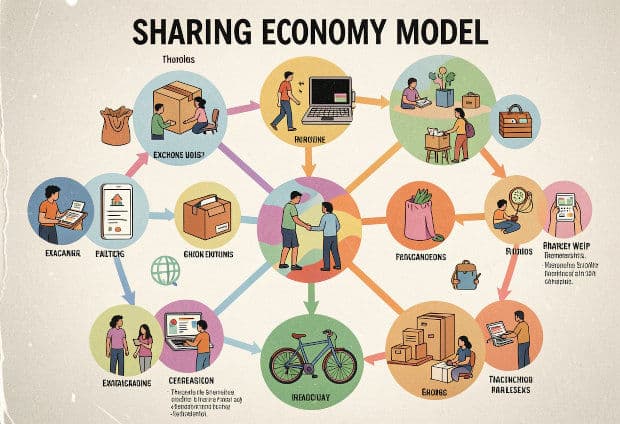
The sharing economy is a peer-to-peer business model where the main company acts as a middleman — connecting people who have something to offer with people who need it. The company itself does not own the product or service being exchanged. Instead, it uses technology to bring two sides together: the service provider and the service receiver. Pathao in Bangladesh, Uber globally, and Airbnb worldwide are all perfect real-world examples of this model in action. Simply put, the sharing economy turns unused assets into income-generating opportunities — for everyone involved.