The Boom-Bust Cycle: Why Economies Rise and Fall — Definition, History, Mechanism, and How to Navigate It
G
GeoRenus Editorial Team
1,162 views
Summary
Economies never move in a straight line — they always go up and down. A boom is a period of rapid growth: employment rises, incomes climb, businesses invest, optimism soars. A bust is the painful reversal: GDP shrinks, layoffs mount, businesses close, despair spreads. According to NBER data going back to 1854, the United States alone has experienced 34 business cycles. In 2006 everyone was buying houses, 2008 brought a global meltdown, 2020 delivered a COVID crash, 2021 sparked an unexpected boom, 2022 hit an inflation bust — and the pattern keeps repeating. Why it happens, how it works, what history's biggest cycles looked like, and how Bangladesh fits into this global rhythm — this in-depth guide covers it all.
Key Takeaways
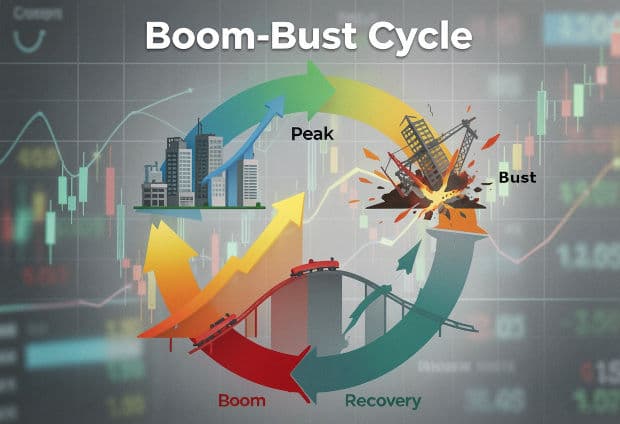
- 1. The Boom-Bust Cycle (also called the Business Cycle or Economic Cycle) is the economy's timeless pattern of expansion and contraction. Four phases: Expansion → Peak → Contraction → Trough. Average expansion ~58 months, average contraction ~11 months (NBER, United States).
- 2. Six major theories explain why cycles happen: Keynesian (demand collapse), Monetarist (money supply errors — Friedman), Austrian (Hayek — malinvestment from cheap credit), Minsky (stability breeds instability — three borrowing stages, Minsky Moment), Real Business Cycle (external shocks), and Behavioral Economics (greed, fear, animal spirits).
- 3. Minsky Moment: During a boom, borrowing evolves through three stages — Hedge borrowing (can repay principal + interest) → Speculative borrowing (can only service interest, needs refinancing) → Ponzi borrowing (relies entirely on asset price gains). When the Ponzi stage collapses, a financial crisis erupts. The 2008 Global Financial Crisis was a textbook Minsky Moment.
- 4. History's great cycles: Tulip Mania 1637, South Sea Bubble 1720 (Newton lost £20,000), Great Depression 1929–39 (US GDP -30%, unemployment 25%), Dotcom Bubble 2000 ($5 trillion destroyed), Housing Bubble 2008 ($10 trillion in household wealth gone), COVID Crash 2020 (S&P 500 -34% in just 23 days), Crypto Bust 2022 ($2 trillion evaporated).
- 5. Signs a bust is coming: Inverted yield curve (has preceded every US recession since 1955), rising defaults, VIX spike, credit tightening, falling CEO confidence. Signs of a boom: rising stock markets, low unemployment, easy credit, IPO boom, FOMO everywhere — even taxi drivers giving stock tips.
- 6. Bangladesh context: The 1996 DSE bubble and the 2010–11 stock market crash (DSEX fell 50%+) were textbook boom-bust episodes. The 2022–24 economic pressure (shrinking reserves, currency depreciation, 9–10% inflation) shows how global cycles transmit directly through RMG exports and remittances. Cycles cannot be eliminated — but preparation limits the damage.
Introduction: Why the Economy Never Moves in a Straight Line
The economy never moves in a straight line. It breathes — expanding, peaking, contracting, bottoming out, then expanding again. Like a heartbeat on a monitor, it goes up and down in a rhythm that has repeated across centuries, cultures, and continents. This rhythm is the Boom-Bust Cycle, and understanding it may be the single most practical piece of financial knowledge you can have.
According to NBER (National Bureau of Economic Research) data going back to 1854, the United States alone has experienced 34 business cycles.
Average expansion (boom): approximately 58 months — about 5 years. Average contraction (bust): just 11 months.
Let's look at a recent replay: In 2006 everyone was buying houses, prices were soaring. By 2008 the financial system had nearly collapsed. By 2010 a slow recovery was underway. By 2019 markets were at record highs. In 2020 COVID triggered the fastest crash in history. By 2021 an unprecedented boom was in full swing. Then 2022 delivered an inflation bust. And the cycle reset — again. Different costumes, same play.
Understanding this cycle is not just about passing an economics exam — it is the most practical financial knowledge you can possess. When to invest, when to be cautious, when to look for opportunity — all of it connects back to where you are in the cycle.
Chapter 1: What Is the Boom-Bust Cycle?
Simple Definition
The Boom-Bust Cycle — also called the Business Cycle or Economic Cycle — is the recurring pattern of economic expansion followed by contraction followed by expansion again. It is as old as market economies themselves.
Boom = a period of rapid growth. Employment is rising, incomes are climbing, businesses are investing, consumers are spending, and optimism is contagious.
Bust = the painful reversal. GDP is shrinking, layoffs are mounting, businesses are closing, spending has dried up, and pessimism has taken hold.
Think of it as a staircase: the economy climbs several steps, then slips back one or two, then climbs again. Sometimes the ascent is fast and exhilarating. Sometimes the fall is sharp and brutal. But the long-run direction has always been upward.
The Four Phases of the Cycle
1. Expansion: GDP is growing, employment is rising, businesses are investing, consumers are spending confidently. Banks are lending freely. Interest rates are generally low. This is the 'good times' phase — but the seeds of the next bust are quietly being planted.
2. Peak: Maximum output, near-full employment. Inflation begins to rise. Overconfidence is rampant. Asset prices seem to only go up. This is the danger zone — the higher you are, the harder the fall.
3. Contraction / Recession: GDP is falling. Layoffs are accelerating. Businesses are closing. Demand is shrinking. Banks are tightening credit. By the standard definition, two consecutive quarters of negative GDP growth constitute a recession.
4. Trough: The lowest point. Maximum despair. Media headlines are at their most frightening. But hidden inside this darkness is the seed of the next recovery — governments and central banks are pouring in stimulus, and smart money is quietly buying.
How Long Does Each Phase Last?
Based on NBER's US data:
Average expansion: 58 months (~5 years). But the expansion from 2009 to 2020 lasted 128 months — the longest in recorded US history.
Average contraction: 11 months. But the 2020 COVID recession lasted just 2 months — the shortest recession ever recorded.
The enormous variation reminds us: averages describe the past but do not predict the future. The length of any given phase depends on the cause, the policy response, and external circumstances.
| Phase | Also Called | What Happens | Avg Length (US) | Key Indicators |
| Expansion | Boom, Recovery | GDP & employment rise, investment grows | ~58 months | GDP growth, low unemployment |
| Peak | Top of the cycle | Maximum output, inflation starts rising | A few months | High consumer confidence, rising inflation |
| Contraction | Recession, Bust | GDP falls, layoffs, demand drops | ~11 months | Negative GDP, rising unemployment |
| Trough | Bottom | Lowest point, recovery begins | Brief | Highest unemployment, lowest consumer confidence |
Note: These figures are approximate. Actual numbers may vary slightly.
Chapter 2: Why Boom-Bust Cycles Happen — Six Theories
Economists have debated for centuries: why do cycles happen? There is no single answer. Six major schools of thought offer different explanations — each capturing a real piece of a complex truth.
1. Keynesian Theory — The Demand Collapse
John Maynard Keynes (1883–1946) argued that booms occur when aggregate demand outstrips supply, and busts happen when demand suddenly collapses.
The 'Paradox of Thrift': saving is rational for an individual, but if everyone saves simultaneously, total spending falls, businesses suffer, layoffs follow — and in trying to save more, everyone ends up earning less.
Keynesian solution: during a recession, government should spend more — build roads, fund hospitals, expand unemployment benefits. Government demand fills the void left by collapsing private demand.
2. Monetarist Theory — The Money Supply Error
Milton Friedman (1912–2006) argued that central bank policy errors are the primary driver of cycles. Print too much money → boom → inflation → raise rates sharply → bust. Friedman showed that poor money supply management lay behind most major recessions, including the Great Depression.
Monetarist solution: the central bank should expand the money supply at a steady, predictable rate — not in response to political pressure or short-term economic mood.
3. Austrian School — Cheap Credit Creates Malinvestment
Friedrich Hayek and Ludwig von Mises argued that artificially low interest rates created by central banks encourage malinvestment — projects that appear profitable at cheap rates but would never survive at natural market rates.
In the Austrian view, the bust is not a failure — it is a correction, clearing away the distortions. Government intervention during a bust, they argued, merely delays and prolongs the necessary adjustment.
4. Minsky's Financial Instability Hypothesis
Hyman Minsky (1919–1996) offered the most vivid and practical theory. His famous insight:
'Stability breeds instability.' — Hyman Minsky
In good times, people take on more risk and borrow more heavily, precisely because things seem stable. Minsky identified three stages of borrowing that evolve during a boom:
Hedge Borrowing: Borrowers can repay both principal and interest from their cash flows. The safest stage.
Speculative Borrowing: Borrowers can only service interest; they need to refinance the principal. Riskier, but still manageable if asset prices hold.
Ponzi Borrowing: Borrowers cannot even cover interest from cash flows — they depend entirely on rising asset prices to stay afloat. When prices stop rising, the whole structure collapses.
When the Ponzi stage breaks down, a 'Minsky Moment' arrives — a sudden credit freeze, a rush to sell assets, a sharp crash. The 2008 Global Financial Crisis was a textbook Minsky Moment.
5. Real Business Cycle (RBC) — External Shocks
Finn Kydland and Edward Prescott (both Nobel laureates) argued that business cycles are driven not by monetary errors but by real external shocks — technological change, oil price spikes, natural disasters, pandemics.
COVID-19 (2020): a near-perfect RBC example. There was no financial bubble — a purely external shock suddenly froze the global economy.
6. Behavioral Economics — Greed, Fear, and Animal Spirits
People are not rational. During a boom: FOMO (Fear of Missing Out), 'this time is different' thinking, herd mentality — everyone is doing it so I will too.
During a bust: panic selling, hoarding cash, 'the economy will never recover' mindset — even when the facts say otherwise.
Keynes called these forces 'Animal Spirits' — the psychological currents that drive economic behavior far more powerfully than any spreadsheet.
| Theory | Key Thinker | Cause of Boom | Cause of Bust | Solution | Criticism |
| Keynesian | J.M. Keynes | Excess demand | Demand collapse | Government spending | Leads to rising debt |
| Monetarist | M. Friedman | Excess money supply | Sudden money tightening | Steady money growth rule | Hard to execute precisely |
| Austrian | Hayek, Mises | Cheap credit, malinvestment | Correction of distortions | Let markets clear | Busts are very painful |
| Minsky | H. Minsky | Stability breeds excess risk-taking | Ponzi collapse, Minsky Moment | Macro-prudential regulation | Hard to see crisis coming |
| RBC | Kydland, Prescott | Technology improvements | External shocks | Fast adaptation | Dismisses policy as ineffective |
| Behavioral | Shiller, Thaler | Greed and FOMO | Fear and panic | Financial literacy | Individual variation is huge |
Note: These figures are approximate. Actual numbers may vary slightly.
Chapter 3: How the Cycle Works — Step by Step Mechanism
Theory is useful, but let's walk through how a boom-bust cycle actually unfolds in real life — seven steps, from the ashes of a bust to the peak of the next boom and back again.
Step 1: Recovery / Early Expansion
The economy is at its lowest. Interest rates are at rock-bottom — the central bank cut them to revive growth. Cheap credit is available. Brave investors begin buying — stocks, real estate, businesses. Employment starts to tick upward. Consumer confidence, while still fragile, starts to improve.
Key characteristic: Deep skepticism still lingers, but the contraction has stopped. 'Smart money' — contrarian investors who study cycles — is quietly buying at bargain prices.
Step 2: Mid-Expansion / Growth
GDP is growing steadily. Businesses are hiring, wages are rising. The stock market is on an upward trend. Real estate prices are climbing. Banks are lending freely again. Optimism is spreading — this is the sweet spot of the cycle.
Key characteristic: This phase offers the best risk-adjusted investment opportunities. Growth is real, but speculative excess has not yet taken over.
Step 3: Late Expansion / Overheating
Danger Zone. Everyone believes the good times will last forever. Debt is piling up. Asset bubbles are forming in real estate, stocks, and sometimes exotic assets like tulip bulbs or crypto tokens.
"This time is different" — the four most dangerous words in investing — are being spoken everywhere. Inflation is rising. The central bank begins hiking interest rates to cool things down.
Step 4: Peak / Euphoria
Maximum overconfidence. Markets are hitting record highs. The taxi driver giving you stock tips is a classic sign — when everyone has become an investor, there is nobody left to buy. Leverage is at its maximum. Asset prices have completely detached from fundamental value.
Alan Greenspan, former Federal Reserve Chairman, captured this phase in one memorable phrase in 1996:
'Irrational exuberance.' — Alan Greenspan, 1996
He was right — but markets kept climbing for another three years before the Dotcom crash arrived in 2000. Timing the peak is nearly impossible. Recognizing the signs of excess is the best you can do.
Step 5: Bust / Contraction
A trigger event occurs — Lehman Brothers files for bankruptcy, COVID lockdowns are announced, the central bank raises rates too fast. Panic spreads. Selling begets more selling. Credit freezes. Layoffs begin. GDP turns negative. Asset prices fall hard.
Key characteristic: Greed turns to fear overnight. Those who used the most leverage suffer the most. The asset that seemed like a sure thing becomes an anchor.
Step 6: Trough / Capitulation
Maximum despair. 'The economy will never recover' is the prevailing sentiment. Media headlines are at their most alarming. But this is precisely when the smartest investors are quietly buying.
Governments and central banks are deploying their biggest stimulus packages. The seeds of the next boom are already being planted, even as the headlines read like the end of the world.
Step 7: Recovery Begins Again
Confidence slowly returns. New investors spot cheap assets and begin buying. Employment starts improving. GDP turns positive. The cycle resets and begins its next ascent.
Peak to peak, the average US cycle has taken around 7–10 years, though actual durations vary enormously. The pattern, however, is remarkably consistent across time and geography.
Chapter 4: History's Most Important Boom-Bust Cycles
History is the boom-bust cycle's living textbook. Every major financial crisis follows the same basic script: excessive optimism, too much debt, a complete detachment from reality — and then a brutal return to earth. The costumes change; the play does not.
Tulip Mania 1637 — History's First Recorded Bubble
In the Netherlands, a single rare tulip bulb reached the price of a house. People were selling their homes to buy tulip contracts. Then, suddenly, prices collapsed. Tulip Mania is the first well-documented speculative bubble in history.
Key lesson: any asset bought purely in the hope of selling it to someone else at a higher price is a bubble. A tulip bulb produces beauty — but no cash flow, no earnings, no fundamental value to anchor a price.
South Sea Bubble 1720
Britain's South Sea Company was granted a monopoly on trade with South America. Its shares rocketed from £100 to £1,000 — then collapsed back to £124. Fortunes made in months were wiped out in weeks.
Even Isaac Newton — perhaps the greatest analytical mind in history — lost approximately £20,000 (equivalent to millions today). He reportedly said:
'I can calculate the motion of heavenly bodies, but not the madness of people.' — Isaac Newton, ~1720
Great Depression 1929–39
The Roaring Twenties delivered one of history's great booms. Then came Black Tuesday — October 29, 1929 — and a decade of misery followed.
US GDP contracted by approximately 30%.
Unemployment peaked at around 25% — one in four workers.
Approximately 9,000 banks failed.
The Great Depression gave birth to Keynesian economics and proved that markets could not always heal themselves. It reshaped government's role in the economy forever — and its scars were still visible in policy decisions made decades later.
Dotcom Bubble 1995–2001
The internet was real. The revolution was real. But the valuations were pure fantasy. Companies with no revenue, no profits, and no viable business model were valued at billions of dollars simply because their names ended in '.com'.
NASDAQ index: 1,000 (1995) → 5,048 (March 2000) → 1,114 (October 2002).
Total wealth destroyed: approximately $5 trillion.
The lesson was not that technology was overrated — Amazon and Google survived and thrived because they had real business models. The lesson was that revolutionary technology does not automatically justify any price.
Housing Bubble 2003–2008
US house prices doubled. Subprime mortgages were handed out to people with no income, no job, and no assets. These loans were packaged into CDOs and MBS and sold to investors worldwide. Then Lehman Brothers collapsed on September 15, 2008.
Total US household wealth destroyed: approximately $10 trillion.
Global GDP: fell for the first time since World War II.
This crisis brought Hyman Minsky from obscurity to the center of economic debate. The term 'Minsky Moment' entered the mainstream vocabulary. It remains the most studied financial crisis of the modern era.
COVID Crash & Recovery 2020–21
Fastest crash in history: the S&P 500 fell 34% in just 23 days (February–March 2020).
Fastest recovery in history: new all-time highs reached in just 5 months.
Why so fast? Over $5 trillion in US fiscal stimulus and unprecedented Federal Reserve quantitative easing flooded the system.
But the story did not end there. All that stimulus money produced 40-year-high inflation by 2022. The Fed raised rates at the fastest pace in decades — and 2022 became one of the worst years for both stocks and bonds simultaneously, a rare double bust.
Crypto Bubble 2021–22
Bitcoin: November 2021 peak of $69,000 → November 2022 low of $16,000.
Total crypto market cap: ~$3 trillion → ~$1 trillion. Approximately $2 trillion evaporated.
The collapse of FTX in November 2022 was crypto's Lehman Brothers moment — a trusted institution that turned out to be built on fraud. The pattern was identical to every bubble before it: euphoria, leverage, collapse, recrimination.
| Event | Boom Period | Peak | Bust | Recovery | Market / GDP Impact (Approx.) |
| Great Depression | 1920–29 | Aug 1929 | 1929–33 | ~1939 | US GDP -30%, unemployment 25% |
| Dotcom Bubble | 1995–2000 | Mar 2000 | 2000–02 | ~2003–04 | NASDAQ -78%, ~$5T destroyed |
| Housing Bubble | 2003–06 | 2006–07 | 2008–09 | ~2012–13 | ~$10T household wealth gone |
| COVID Crash | 2019–20 (pre-crash) | Feb 2020 | Mar 2020 (23 days) | Aug 2020 | S&P -34%, new high in 5 months |
| Crypto Bust | 2020–21 | Nov 2021 | 2022 | ~2023–24 | ~$2T crypto market cap gone |
Note: These figures are approximate. Actual numbers may vary slightly.
Chapter 5: How to Know Where You Are in the Cycle
No single indicator is perfect — markets are famously difficult to time. But when multiple signals point the same way, the weight of evidence becomes hard to ignore. Here is what to watch.
Boom Signals
Stock market: sustained multi-year rally. Price-to-earnings (P/E) ratios well above their historical averages.
Unemployment: very low. Companies struggling to find workers. Wages rising quickly.
Consumer Confidence Index: elevated and climbing.
Credit: freely available. Banks actively encouraging borrowing. 'No documentation' loans reappearing.
Real estate: prices rising fast. Construction cranes everywhere. Flipping becomes a hobby.
IPO boom: companies racing to list. Investors buying anything new. Celebrity-backed SPACs.
FOMO: everyone is saying 'don't miss this.' The taxi driver is giving you stock tips. Your dentist is talking about crypto.
Warning Signs a Bust Is Coming
Inverted Yield Curve: when short-term interest rates rise above long-term rates, the yield curve 'inverts.' This has preceded every single US recession since 1955 — a track record no other indicator can match.
Rising defaults: loan delinquencies climbing, especially in subprime or high-yield bonds.
VIX spike (Volatility Index): the 'fear gauge' of the stock market spiking sharply.
Credit tightening: banks suddenly making it harder to borrow.
Falling CEO confidence: business leaders pulling back on investment and hiring plans.
Leading Economic Indicators (LEI) declining: the Conference Board's LEI index has historically turned down 6–12 months before a recession begins.
Trough Signals
Maximum despair in media: the most alarming headlines. 'This is the end' sentiment everywhere.
Layoffs slowing: unemployment is still high but the pace of new job losses is decelerating.
Central bank at zero: Fed Funds rate at or near zero. Maximum policy accommodation.
Insider buying: CEOs and CFOs buying their own company's stock — they know the business better than anyone.
Maximum government stimulus: budget deficits at peak, central bank running quantitative easing.
| Indicator | Boom | Peak Warning | Bust | Trough / Recovery |
| GDP Growth | 3–6%+ | High but inflation rising | Negative (recession) | Slowly turning positive |
| Unemployment | 3–4% (low) | Low but wages rising fast | 7–10%+ (rising) | High but starting to fall |
| Stock Market | Rising fast | High P/E, IPO flood | Falling hard | At bottom, insider buying |
| Yield Curve | Normal (upward slope) | Flattening | Inverted or in crisis | Normalizing |
| Consumer Confidence | High | At peak, then rolling over | Low | At bottom, then improving |
| Credit Availability | Easy | Too easy, reckless lending | Tight (credit freeze) | Slowly easing again |
Note: These figures are approximate. Actual numbers may vary slightly.
Chapter 6: Who Wins and Who Loses
Every phase of the cycle reshuffles the deck. Winners in a boom can become losers in a bust — and vice versa. The biggest winners across the entire cycle are those who understand where they are and position themselves accordingly.
Winners during a Boom: investors (asset prices rising), borrowers (inflation erodes the real value of debt), entrepreneurs (access to cheap capital and growing demand), real estate developers, banks and lenders.
Losers during a Boom: new employees (wages rise but inflation often rises faster), people on fixed incomes (purchasing power eroded), late buyers who purchase near the peak and face the full decline.
Losers during a Bust: leveraged investors (forced selling, margin calls), ordinary workers (layoffs, wage freezes), small businesses (revenue collapses, credit disappears), pension funds (stock market losses).
Winners during a Bust: cash-holders (can buy assets at bargain prices), short sellers (profit from falling prices), highly skilled workers (still in demand even in downturns), government employees (more job security).
Warren Buffett's timeless advice:
'Be fearful when others are greedy, and greedy when others are fearful.' — Warren Buffett
| Group | During a Boom | During a Bust | Best Strategy |
| Stock investors | Gains (prices rising) | Losses (prices falling) | Sell near peak, buy near trough |
| Ordinary workers | Job security, rising wages | Risk of layoffs | Build emergency fund, upgrade skills |
| Entrepreneurs | Easy growth, cheap loans | Falling revenue, tight credit | Save in boom, prepare for bust |
| Real estate owners | Property values rising | Values may fall | Avoid over-leverage |
| Cash holders | Relatively lower returns | Best opportunity to buy cheap | Deploy cash during busts |
| Pension funds | Portfolio grows | Stock losses hurt retirees | Diversification across asset classes |
Note: These figures are approximate. Actual numbers may vary slightly.
Chapter 7: Do's and Don'ts — Riding the Cycle
Understanding the cycle does not mean predicting it perfectly — it means behaving correctly in each phase. Here is your practical playbook.
During a Boom — Do's:
Save more, not less: Build an emergency fund covering 6 months of expenses. Good times are for building buffers, not for spending every dollar.
Reduce debt: Avoid excessive leverage. Cheap debt in a boom becomes crushing debt in a bust.
Diversify your investments: Do not put all your eggs in the hottest asset class. Diversification is boring — until it saves you.
When you hear 'this time is different,' get cautious: Every single time in history this phrase has been uttered confidently, it has been wrong.
During a Bust — Do's:
Do not panic sell: Selling during a bust locks in losses at the worst possible price. As Buffett says, 'the stock market is a device for transferring money from the impatient to the patient.'
Look for bargains: Great companies on sale during a bust represent generational buying opportunities.
Protect your income: Upgrade your skills, develop alternative income streams, make yourself hard to lay off.
Cut unnecessary expenses: But not health, education, or skills development — those are investments in your resilience.
Always Do's:
Track where you are in the cycle: Monitor the indicators from Chapter 5 regularly.
Maintain liquidity: Keep some cash or easily liquidated assets at all times.
Be counter-cyclical: Defensive in boom, opportunistic in bust.
Think long-term: Every single bust in history has been followed by a boom. Every one.
Always Don'ts:
FOMO buying at the peak: The most destructive financial decision you can make. Buy at the peak and you absorb the full decline.
Maximum leverage at the peak: Borrowed money in a boom becomes a catastrophe in a bust.
Selling everything at the trough: Selling at the bottom locks in the maximum loss — just before the recovery begins.
Believing the boom will last forever: It never has. Not once in 400 years of recorded market history.
Believing the bust will never end: It always ends. Every single time.
Chapter 8: Boom-Bust Cycles in Bangladesh
Bangladesh is not insulated from global boom-bust cycles — and as a developing economy with specific structural dependencies, it experiences the cycle with some distinctive characteristics that every Bangladeshi investor and businessperson should understand.
Bangladesh's Boom-Bust History
1996 DSE Stock Market Bubble: The Dhaka Stock Exchange experienced an abnormal surge in share prices followed by a sharp crash. Thousands of retail investors lost their savings in what became a defining moment for Bangladesh's capital markets.
2010–11 Stock Market Crash: The DSEX index fell more than 50% from its peak. Nationwide protests erupted as ordinary citizens who had borrowed money to invest lost everything. This was a textbook boom-bust: unrealistic returns attracted waves of unsophisticated investors, leverage amplified the crash, and weak regulation allowed the bubble to grow unchecked.
2022–24 Economic Pressure: The Russia-Ukraine war drove energy and food prices sharply higher worldwide. Bangladesh's foreign exchange reserves declined significantly. The taka depreciated by 30%+ against the dollar. Inflation reached 9–10%. Bangladesh had to turn to IMF for a loan program — a clear signal of bust-phase pressure.
Current Situation
As of 2024–25, Bangladesh appears to be transitioning from the tail end of contraction toward the early stages of recovery. Inflation is slowly declining. Reserves have stabilized somewhat. Remittance inflows are improving. But significant challenges remain: dependence on RMG export demand, vulnerabilities in the banking sector, and the ongoing need to diversify the economic base.
What Makes Bangladesh Different
RMG dependence: Garment exports account for approximately 85% of total exports. When the global economy booms and demand rises in Europe and America, Bangladesh booms with it. When the global economy busts and discretionary spending falls, Bangladesh faces direct order cancellations and layoffs.
Remittance dependence: Remittances are a major source of foreign exchange. During global busts — particularly in the Middle East or Malaysia — migrant workers return home, remittances decline, and domestic demand falls under pressure.
Shallow stock market: A relatively small and shallow market means even modest capital flows create large price swings. Manipulation is easier. Retail investors — who are often the last to know — absorb the most damage.
Banking sector weakness: High non-performing loan (NPL) ratios in many banks mean that during a boom, too much credit is extended; during a bust, NPLs spike and banks contract — amplifying the cycle rather than smoothing it.
| Event | Year | Boom Phase | Cause of Bust | Approx. Impact |
| DSE Stock Bubble | 1996 | Abnormal price surge | Manipulation exposed | Thousands of investors wiped out |
| DSEX Crash | 2010–11 | Rapid price run-up | Regulatory failure, margin calls | DSEX fell 50%+, mass protests |
| RMG Slowdown | 2008–09 | Record export growth | Global financial crisis | Order cancellations, layoffs |
| Economic Pressure | 2022–24 | Post-COVID growth | Energy price shock, dollar crisis | Reserves fell, inflation 9–10%, IMF loan |
Note: These figures are approximate. Actual numbers may vary slightly.
Chapter 9: Can Boom-Bust Cycles Be Prevented?
Short answer: No. Long answer: moderation is possible, elimination is not.
What Governments and Central Banks Can Do
Counter-cyclical fiscal policy: Save a surplus during the boom (by raising taxes or cutting spending) and spend that surplus during the bust to support demand. In practice, many governments do the opposite — they spend freely in good times and face a crisis in bad times.
Monetary policy: raise interest rates during a boom to cool excess enthusiasm; cut rates during a bust to encourage investment and borrowing.
Macro-prudential regulation: prevent banks and financial institutions from taking on too much leverage during the boom. Build capital buffers in good times that can be drawn down in bad times.
Early warning systems: institutions like the IMF and the US Financial Stability Oversight Council (FSOC) actively monitor for systemic risk — though their record of actually preventing crises is mixed.
None of these tools can eliminate the cycle. At best, they can reduce its amplitude — the peaks are less extreme, the troughs are less severe.
Why Elimination Is Impossible
Human nature: greed and fear are hardwired into us. You can make people aware of them — you cannot make them disappear.
Innovation and disruption: every genuine technological revolution (railroads, electricity, the internet, AI) generates real excitement — which almost always overshoots into speculation and then crashes.
Unpredictable external shocks: no model predicted COVID-19, the 1973 oil embargo, or the 2011 Fukushima disaster. External shocks will always arrive.
Political incentives: governments facing elections often manufacture artificial booms through tax cuts, spending increases, or pressure on central banks — storing up a worse bust for later.
Moderation Is Possible, Elimination Is Not
The 'Great Moderation' (1985–2007): For 22 years, US business cycles were notably mild. Better monetary policy, reduced oil dependence, flexible labor markets, and improved inventory management all helped moderate the swings.
Then 2008 arrived and shattered the illusion. The Great Moderation had not eliminated the cycle — it had merely compressed the spring. Debt and risk had been accumulating in the shadows. When it all unwound, the severity was the worst in 80 years.
The core lesson: prolonged stability should make you more cautious, not less — exactly what Minsky predicted.
Final Thoughts
The Boom-Bust Cycle is capitalism's heartbeat — painful at times, but essential. Booms create wealth, jobs, and innovation. Busts destroy excesses, reset valuations, and clear the way for the next expansion. Together, they are how a market economy breathes.
From Tulip Mania in 1637 to the Crypto Bust of 2022, the story is always the same: excessive optimism, too much debt, a conviction that 'this time is different' — and then the brutal return to reality. The costumes change. The play never does.
Understanding this cycle is the most valuable economic knowledge a person can carry through life. It will not let you time the market perfectly — nobody can. But it will stop you from buying at the peak in a panic of FOMO, and it will stop you from selling at the trough in a panic of fear. That alone is worth more than any market tip.
'Those who cannot remember the past are condemned to repeat it.' — George Santayana
'The four most dangerous words in investing are: this time is different.' — Sir John Templeton
The practical wisdom is simple: during booms, save more, reduce debt, and stay grounded in reality. During busts, do not panic, look for bargains, and keep your long-term perspective. And always remember: every single bust in history has been followed by a boom. Without exception.
Recommended for you
The Bretton Woods Agreement: A Turning Point in Global Economic History
In 1944, as the world was still engulfed in the devastation of World War II, the global economy had collapsed and people’s living standards had plummeted. In an effort to stabilize the international economy and address pressing global financial issues, the Allied nations convened a historic summit. Nearly 730 delegates from 44 countries gathered at the Mount Washington Hotel in Bretton Woods, New Hampshire, for the United Nations Monetary and Financial Conference. The outcome of this summit was the landmark Bretton Woods Agreement, which gave birth to the Bretton Woods System.
Money
Money: What It Is, How It Works, and Its Complete History
Branding
Branding: How to Make Your Business Stand Out

E-Commerce
E-Commerce: The Complete Guide to Online Business

Marketing
The 7 P's of Marketing: The Complete Framework Every Business Needs
Startup
What Is a Startup? The Ultimate Guide You Need to Read

Accounting
Gross Profit: Definition, Formula, and Why It Matters
Accounting
GAAP: What It Is and Why It Matters in Accounting

Accounting
Business Accounting: What It Is and How It Works
Accounting
Four Flavors of Accounting: Tax, Project, Financial, and Cost Accounting Explained