Adam Smith: The Father of Modern Economics — Biography, Books, Revolutionary Concepts, and Lasting Legacy
G
GeoRenus Editorial Team
1,104 views
GeoRenus Editorial Team
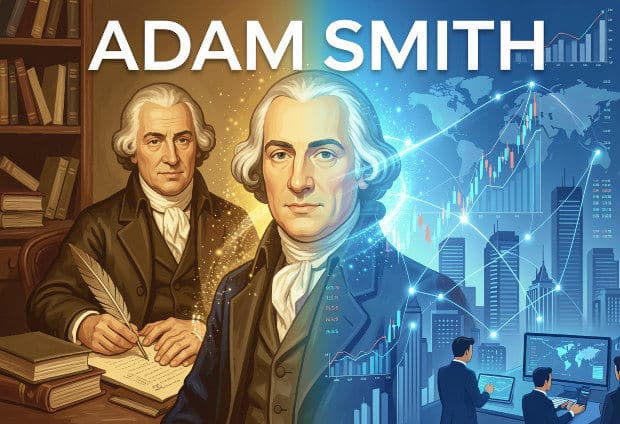
Adam Smith (1723-1790) is called the 'Father of Modern Economics,' but his true identity was that of a moral philosopher. His first and favorite book, The Theory of Moral Sentiments (1759), centered on the 'Impartial Spectator' -- an internal moral voice based on empathy and justice. Per Emma Rothschild's published research (Harvard UP 2001), Smith used the phrase 'Invisible Hand' only 3 times in all his writings, yet the entire world remembers him for that phrase alone. Per Gavin Kennedy (2008), Smith revised TMS 6 times until his death -- he never stopped working on his moral philosophy. This article covers Smith's biography, both books, key ideas, common misunderstandings, intellectual legacy, and relevance today -- all viewed through the lens of the Impartial Spectator that the world forgot.
July 1790. Edinburgh. A dying man lies in his bed and summons his closest friends. His request is not for comfort, not for prayers, not even for company. It is extraordinary and, to those in the room, devastating: burn my unpublished manuscripts. All sixteen of them. The friends weep. They beg him to reconsider. He is immovable. The manuscripts burn.
That man was Adam Smith. And according to Ian Simpson Ross in The Life of Adam Smith (Oxford University Press, 2010), those lost pages may have contained the capstone of a lifetime of moral philosophy. What survived the fire were two books. The Theory of Moral Sentiments. The Wealth of Nations. The world seized one and quietly shelved the other. That selective reading may be the greatest intellectual cherry-picking in human history.
Here is the uncomfortable truth: when people say 'Adam Smith believed in free markets and self-interest,' they are citing roughly half a sentence from a book that runs over a thousand pages. They are ignoring the other book entirely — the one Smith himself considered his greatest intellectual achievement. According to Gavin Kennedy in his 2008 analysis of Smith's legacy, Smith revised The Theory of Moral Sentiments six times, laboring over it right up until his death. He never revised The Wealth of Nations with that same devotion.
The Invisible Hand — that phrase every economics student memorizes — appears exactly three times across all of Smith's published and unpublished writings combined. Three times. Emma Rothschild of Harvard documented this in her 2001 work Economic Sentiments. Meanwhile, the concept of the Impartial Spectator, Smith's central moral idea about the inner voice of conscience and fairness, appears hundreds of times. Yet textbooks give it one paragraph. The Invisible Hand gets an entire chapter.
Amartya Sen, the Nobel laureate economist, described this imbalance plainly in his published commentary on Smith: the narrow reading of Smith as a prophet of raw capitalism 'is a serious distortion of what he wrote and what he stood for.' Sen is not a fringe critic. He is among the most decorated economists alive. When he says Smith has been misread, that is not a provocative claim — it is a documented verdict.
So why does the distortion persist? Part of the answer is convenience. Industrial-era thinkers needed an intellectual ancestor who blessed laissez-faire economics with moral authority. Smith fit the role if you squinted at The Wealth of Nations and ignored everything else. His name became a flag planted on an economic philosophy he would not entirely recognize. The man who wrote passionately about empathy and moral community became the patron saint of unrestrained markets.
The other part of the answer is accessibility. The Wealth of Nations has clear practical arguments about trade, price, and labor. The Theory of Moral Sentiments requires you to sit with philosophical psychology, to grapple with questions like: why do we feel shame? Why do we care what strangers think of us? What does it mean to judge yourself fairly? These are harder questions. They resist reduction to policy memos and newspaper columns.
But here is what makes Adam Smith genuinely remarkable: he asked both sets of questions at once. He refused to separate the economy from morality. In his vision, markets did not replace ethics — they operated within ethics. A baker who cheats his customers might gain in the short term, but the Impartial Spectator inside him — that internalized voice of community judgment — would condemn him. Smith believed markets needed moral culture to function. Not as a constraint on markets. As their foundation.
D.D. Raphael, writing in the Oxford University Press edition of The Theory of Moral Sentiments (2007), describes the Impartial Spectator as the conceptual heart of Smith's entire moral project. It is an imaginary, perfectly fair observer that each person carries within themselves — not God, not the law, not public opinion, but a refined internal judge who evaluates your actions as a reasonable, well-informed outsider would. This was not a minor footnote in Smith's thinking. It was the architecture.
Ryan Patrick Hanley, writing for Cambridge University Press in 2009, put it directly: 'Smith's entire project is built on moral sympathy.' Everything else — the division of labor, free trade, the critique of mercantilism — sits downstream from that moral foundation. Remove the sympathy, and you do not have Adam Smith's economics. You have a distortion wearing his name.
No society can surely be flourishing and happy, of which the far greater part of the members are poor and miserable. -- Adam Smith, The Wealth of Nations, Book I, Chapter 8
That quote does not sound like the godfather of greed. It sounds like someone who spent thirty years thinking carefully about human dignity. And that is exactly who Adam Smith was. But who shaped him? What experiences formed this mind? Where did a Scottish boy from a coastal fishing town develop ideas that would eventually reorganize how civilization thought about commerce, justice, and the human heart?
Adam Smith was born in June 1723 in Kirkcaldy, a small coastal town in Fife, Scotland. His father — also named Adam Smith — was a comptroller of customs, a respectable but modest position. He died before his son was born, leaving Margaret Douglas to raise the boy alone. That mother-son bond would prove defining. Smith never married. He lived with Margaret for most of his adult life, and when she died in 1784, six years before his own death, he reportedly never fully recovered from the loss.
The early years carried their own drama. According to John Rae's 1895 biography Life of Adam Smith, the boy was kidnapped by a group of traveling gypsies at around age four. He was recovered quickly — family accounts suggest he was found not far from Kirkcaldy — but the episode lodged itself in the mythology surrounding him. Rae noted dryly that had the gypsies kept him, the world might have lost a great philosopher and gained a mediocre tinker. The story may be embellished. The attachment to his mother, by all accounts, is not.
Kirkcaldy itself shaped him. It was a town of traders, fishermen, and craftsmen — people who understood labor, exchange, and the rhythms of commerce at a very human scale. Watching the local nail-making trade as a child likely contributed, decades later, to the famous pin factory example in The Wealth of Nations. Great ideas frequently trace back to small, formative observations.
Smith entered the University of Glasgow at fourteen — not unusual for the era — where he studied under Francis Hutcheson, the Irish philosopher whose concept of moral sense would become the seedbed for Smith's later ideas on sympathy and ethical judgment. Hutcheson was electrifying. His lectures were delivered in English rather than Latin, a radical choice at the time, and they treated ethics as a living, practical subject rather than a dead scholastic exercise. Smith absorbed everything.
In 1740 Smith won a Snell Exhibition scholarship to Balliol College, Oxford. He arrived with high expectations and left with profound disillusionment. Per Kennedy's 2008 analysis and multiple published accounts, Smith considered Oxford intellectually dead. The professors had long since stopped teaching. They collected their stipends and largely ignored their students. Smith spent six years there largely self-educating, reading voraciously in the library, and growing increasingly contemptuous of an institution that had abandoned its educational purpose.
That Oxford experience mattered philosophically. It gave Smith a firsthand lesson in what happens when institutions lose accountability — when those being paid to perform a function face no real consequences for failing to perform it. You can hear this frustration in The Wealth of Nations when Smith dissects how monopolies and sinecures corrupt incentives. Oxford was not just an education. It was a case study.
After returning to Scotland, Smith delivered a series of public lectures in Edinburgh starting around 1748, covering rhetoric and jurisprudence. These lectures were popular and established his reputation as a clear, engaging thinker. By 1751 he had been appointed to a professorship at Glasgow — initially in Logic, then crucially in Moral Philosophy. Not economics. Not politics. Moral philosophy. That is the intellectual home from which everything else in his career grew.
His Glasgow years (1751–1764) were among the most productive of his life. He published The Theory of Moral Sentiments in 1759, which was immediately acclaimed across Europe. He taught, debated, mentored students, and participated actively in the intellectual life of the Scottish Enlightenment. He was colleagues and friends with David Hume, the philosopher and historian, whose influence on Smith's skeptical, empirical approach to human nature was considerable.
In 1764 Smith left Glasgow to serve as tutor to the young Duke of Buccleuch on a Grand Tour of Europe. It was a lucrative arrangement — he was paid a handsome annual stipend plus expenses — and it brought him into contact with the leading intellectual figures of Continental Europe. According to Ian Simpson Ross in his 2010 biography, Smith met Voltaire in Geneva, whom he admired enormously. In Paris he spent time with the Physiocrats, including François Quesnay and Anne-Robert-Jacques Turgot, whose ideas about the natural flow of economic activity fed directly into his thinking about markets.
After returning to Britain in 1766, Smith spent a decade in Kirkcaldy working on what would become The Wealth of Nations, published finally in 1776. He then moved to Edinburgh in 1778, appointed as Commissioner of Customs — a position of genuine administrative responsibility that gave him daily, practical experience with the very trade policies he had been writing about theoretically. He held that position until his death in July 1790.
The mythology of Adam Smith as a cold, calculating apostle of self-interest collapses immediately on contact with biographical accounts of the man. By every published description, he was absent-minded to the point of legend. Stories circulated in Edinburgh of Smith walking out of his house in his dressing gown, lost in thought, and wandering fifteen miles into the countryside before snapping back to awareness. He talked to himself constantly. He once fell into a tanning pit because he was arguing an abstract point aloud while walking and simply did not notice it.
He was shy in large social gatherings but warm and animated in small intellectual ones. He never married. He was devoted to his mother with an uncommon tenderness. He was generous with money — accounts note he gave substantially to private charities and that significant portions of his estate went to charitable causes at his death, quietly, without announcement. He was not the aggressive, market-celebrating figure that later ideologues needed him to be. He was a gentle, bookish, deeply moral man who happened to write the most influential economic text in history.
That gap between the myth and the man is not a minor biographical footnote. It is the central interpretive problem with Adam Smith. The story of his life is the story of a moral philosopher who built an economics on ethical foundations — and then watched, helplessly from history, as the ethics were stripped away and the economics were handed to people who had never read his first book.
| Year | Event | Significance |
| 1723 | Born in Kirkcaldy, Fife, Scotland | Father died before birth; raised by mother Margaret Douglas |
| ~1727 | Kidnapped briefly by traveling gypsies (per Rae 1895) | Recovered quickly; became biographical legend |
| 1737 | Entered University of Glasgow at age 14 | Studied under Francis Hutcheson; moral sense philosophy |
| 1740 | Snell Exhibition scholarship to Oxford (Balliol) | Six years of largely self-directed study; grew disillusioned |
| 1748 | Edinburgh public lectures on rhetoric and jurisprudence | Established public reputation as thinker |
| 1751 | Appointed Professor at Glasgow (Logic, then Moral Philosophy) | Thirteen productive years teaching and writing |
| 1759 | Published The Theory of Moral Sentiments | Immediate European acclaim; Smith's own favorite work |
| 1764 | Left Glasgow to tutor Duke of Buccleuch in Europe | Met Voltaire, Quesnay, Turgot (per Ross 2010) |
| 1776 | Published The Wealth of Nations | Same year as American Declaration of Independence |
| 1778 | Appointed Commissioner of Customs in Edinburgh | Practical policy experience; lived with mother |
| 1784 | Death of mother Margaret Douglas | Smith reportedly never fully recovered |
| 1790 | Ordered burning of 16 unpublished manuscripts; died July 17 | Two books survived; legacy became contested |
This life arc — from a fatherless Scottish boy to the most quoted economist in history — is remarkable not just for its intellectual productivity but for its moral consistency. Smith never abandoned his first principles. He spent forty years refining them. What, then, were those principles? The answer begins with the book the world forgot.
The Theory of Moral Sentiments was published in 1759 — seventeen years before The Wealth of Nations. That gap matters enormously. It tells you which book came first in Smith's intellectual development, which problems he was trying to solve before he turned to economics, and which set of ideas he considered foundational. He was not an economist who later wrote a book on morality. He was a moral philosopher who later wrote a book on economics. The sequence is not incidental. It is the entire point.
The book opens with one of the most arresting sentences in Enlightenment philosophy: 'How selfish soever man may be supposed, there are evidently some principles in his nature, which interest him in the fortune of others, and render their happiness necessary to him, though he derives nothing from it except the pleasure of seeing it.' Smith is making a direct argument against the caricature of pure self-interest. His starting premise is that human beings naturally care about other people's wellbeing — not always, not perfectly, but genuinely and observably.
The mechanism Smith uses to explain how we make moral judgments is sympathy. Not sympathy in the modern casual sense of feeling sorry for someone. Smith means something more precise: the imaginative act of mentally placing yourself in another person's situation and asking how you would feel, how you would judge, what would be appropriate. It is a kind of moral imagination — the ability to see yourself from outside, to evaluate your own conduct as an informed outsider would. This is the psychological engine that drives all of The Theory of Moral Sentiments.
D.D. Raphael, in his authoritative Oxford University Press edition of The Theory of Moral Sentiments (2007), identifies the Impartial Spectator as the central concept of the entire work. It appears hundreds of times across the text. Compare that to the Invisible Hand, which Emma Rothschild of Harvard documented in her 2001 Economic Sentiments as appearing exactly three times across all of Smith's writings. Three versus hundreds. If frequency is any guide to importance, the verdict is decisive.
So what is the Impartial Spectator? Smith describes it as an imaginary figure each of us carries within ourselves — not God, not the law, not our friends, but a perfectly fair, well-informed, dispassionate observer who watches everything we do and judges it honestly. When you are tempted to deceive a business partner for gain, the Impartial Spectator inside you sees the full picture — the harm to them, the erosion of your own integrity, the long-run damage to trust in the community — and delivers a verdict. That verdict is what Smith calls moral conscience.
This is not a mystical concept. It is deeply psychological and social. Smith is describing how human beings actually develop moral judgment — through exposure to a community, through observing how others respond to our behavior, through internalizing those responses into a stable inner standard. The Impartial Spectator is the refined product of social experience, a kind of distilled community wisdom that each individual carries privately. It is Smith's answer to the question: how do people know right from wrong without an external authority telling them?
Ryan Patrick Hanley, writing for Cambridge University Press in 2009 in Adam Smith and the Character of Virtue, puts the point with precision: 'Smith's entire project is built on moral sympathy.' The Impartial Spectator is not a supplement to Smith's economic arguments. It is the architecture within which those arguments make sense. A market society functions, in Smith's vision, because people have internalized enough moral culture to regulate their behavior beyond what law and contract alone can enforce.
"The great secret of education is to direct vanity to proper objects." — Adam Smith, The Theory of Moral Sentiments
The contrast with how Smith is typically taught is jarring. Standard economics courses introduce him as the theorist of self-interest — the man who showed that individuals pursuing their own gain inadvertently benefit society. That is a real argument in The Wealth of Nations. But in The Theory of Moral Sentiments, Smith spends hundreds of pages arguing the opposite: that purely self-interested behavior, untempered by sympathy and moral judgment, produces people who are not just ethically deficient but practically destructive. The two books are not in contradiction. They are in dialogue.
Smith revised The Theory of Moral Sentiments six times during his lifetime, according to Gavin Kennedy's 2008 analysis. The sixth edition, published in 1790 — the same year he died — included substantial new material, particularly a section on the corrupting influence of excessive admiration for wealth and power. This is not a man who had moved beyond his first book. This is a man who kept returning to it, kept refining it, kept believing it had more to say. The Wealth of Nations, by comparison, never received a major revision after its first edition.
Jesse Norman, in his 2018 intellectual biography Adam Smith: What He Thought and Why It Matters, makes the argument explicit: markets only work within a moral framework. An economy populated entirely by people who have no Impartial Spectator, no capacity for moral sympathy, no internalized community standards — such an economy does not produce prosperity. It produces fraud, exploitation, and eventually collapse. Smith knew this. He built it into his system from the very beginning.
The Theory of Moral Sentiments also contains Smith's most direct statements about inequality, dignity, and the moral claims of ordinary working people. He writes with genuine anger about the tendency to admire the rich and despise the poor — a tendency he considered one of the greatest corruptions of moral culture. These passages do not fit comfortably in the standard narrative of Smith as the champion of wealth creation. They fit very well in the narrative of Smith as a moral philosopher who believed economic life had to be anchored in human dignity.
The world's selective amnesia about this book is not innocent. It reflects a deliberate or unconscious preference for the version of Smith that validates uncritical capitalism over the version that complicates it. Recovering the full Smith — the one who wrote both books, in sequence, as parts of a single integrated project — does not destroy the case for markets. It makes that case more honest, more durable, and more humane. It also tells us something important about where markets go wrong when the moral culture beneath them erodes.
The Wealth of Nations was published on March 9, 1776. Three months later, the Declaration of Independence was signed in Philadelphia. Both documents belong to the same intellectual moment — the Enlightenment conviction that reason, applied carefully to human institutions, could produce freer, more prosperous, more just societies. Smith and the American founders were drawing from the same well. Several of them, including Alexander Hamilton, read The Wealth of Nations closely and cited it directly.
Smith had been working on the book for roughly ten years, mostly in the relative isolation of Kirkcaldy, with occasional trips to London. The project grew out of his Glasgow lectures on jurisprudence and political economy, and it was always intended, according to published analysis of his correspondence and lectures, as a companion to The Theory of Moral Sentiments — not a replacement of it. The two books were meant to be read together, as parts of an integrated account of how human beings organize both their moral and their economic lives.
The target of The Wealth of Nations was mercantilism — the dominant economic doctrine of the era, which held that national wealth was measured in gold and silver, that trade was a zero-sum competition between nations, and that governments should manage every aspect of economic life to maximize exports and minimize imports. Smith dismantled this view systematically, arguing that wealth was not gold but productive capacity, that trade benefited all parties, and that many government interventions in markets served powerful private interests rather than the public good.
The book is organized into five sections, which Smith called Books. Book I covers the division of labor and the theory of value. Book II addresses the nature of capital and its accumulation. Book III examines the different progress of opulence in different nations. Book IV, the most polemical, attacks mercantilism and colonial policy. Book V addresses the revenue of the sovereign — taxation, public institutions, and the proper role of government. This final book is among the most misread in the entire text.
The famous Invisible Hand passage appears in Book IV, Chapter 2. It occupies roughly one sentence in a paragraph about why merchants prefer to invest domestically rather than abroad. Smith writes that a merchant, intending only his own profit, is 'led by an invisible hand to promote an end which was no part of his intention' — meaning that domestic investment, chosen for self-interested reasons, happens to benefit the domestic economy. This is a specific, limited observation about investment behavior. It is one sentence in a book of over one thousand pages. It does not say markets are always efficient, that greed is good, or that government should never intervene.
One sentence. In over one thousand pages. That sentence became the foundation of an entire ideological edifice Smith never built and likely would not recognize.
The influence of The Wealth of Nations on policy and intellectual history is almost impossible to overstate. It provided the intellectual backbone for British free-trade policy in the nineteenth century. It shaped the thinking of the American founders about commerce, taxation, and economic liberty. It established the academic discipline of political economy — eventually economics — as a serious field of inquiry. It gave politicians and reformers a vocabulary and a framework for challenging the corrupt mercantilist arrangements that served guild masters, colonial companies, and court favorites at the expense of ordinary people.
What Smith did not anticipate — could not have anticipated — was that the book would eventually be read alone, stripped of its companion, and handed to ideologues who wanted a founding text for a very different project. The irony is exquisite and painful. The Wealth of Nations was written as part of a system that included moral community, sympathy, the Impartial Spectator, and a genuine concern for the welfare of the poorest members of society. Read in isolation, it becomes something closer to a manual for commercial self-interest. Read alongside The Theory of Moral Sentiments, as Smith intended, it is something much richer and more demanding.
British Prime Minister William Pitt the Younger reportedly kept a copy of The Wealth of Nations on his desk and shaped his budget policies around it. That is a significant political legacy. But Pitt was reading one book. Smith had written two. The discipline that grew from Smith's work inherited his economics without his ethics. We are still paying the price for that selective inheritance.
How, then, did Smith's economic ideas actually work? What were the specific concepts he introduced, how did he intend them, and where did the popular understanding of those concepts go wrong? That requires a careful tour through the core ideas — with the Impartial Spectator watching the whole time.
The Invisible Hand is the most famous idea in economics that almost no one has read in context. Emma Rothschild's 2001 Harvard research, Economic Sentiments: Adam Smith, Condorcet, and the Enlightenment, establishes the factual foundation: Smith used the phrase 'invisible hand' exactly three times across all his writings — once in The History of Astronomy (an early unpublished essay), once in The Theory of Moral Sentiments, and once in The Wealth of Nations. In none of these instances does Smith use it as a grand theory of market efficiency or self-regulating capitalism.
In The Wealth of Nations, the passage is specifically about domestic investment. A merchant prefers to keep capital at home because overseas investment feels riskier and less controllable. By keeping capital domestic, he unintentionally supports local employment and production. Smith notes this with the phrase 'invisible hand' — a modest, almost ironic observation that individual caution happens to serve collective interests in this particular case. He is not making a universal claim. He is noting a specific pattern.
Rothschild herself describes the phrase as ironic in Smith's usage — a deliberate literary understatement rather than a foundational theoretical claim. The elevation of the Invisible Hand from one passing metaphor to the central organizing principle of Smith's entire economics happened after his death, driven by thinkers who needed a memorable shorthand for market self-regulation. They found a phrase, stripped it of context, and built a cathedral on a footnote.
The division of labor is where The Wealth of Nations begins, and with good reason. Smith opens Book I with the famous pin factory example: a single worker attempting to make a pin from scratch might produce one pin per day, perhaps none. But if ten workers divide the eighteen distinct operations involved in pin-making — one drawing the wire, another straightening it, another cutting it, and so on — those ten workers can produce upward of forty-eight thousand pins per day. The arithmetic of specialization is staggering.
Smith's insight was not just that specialization increases output. It was that specialization transforms the nature of work and, by extension, the nature of society. When people specialize, they become dependent on exchange. The pin-maker cannot grow his own food. The farmer cannot make his own tools. A web of mutual dependence grows across the economy, binding strangers into cooperative relationships through the medium of markets and prices. This is not mere efficiency. It is a description of how commercial society creates social interdependence.
But Smith was also clear-eyed about division of labor's costs. In Book V of The Wealth of Nations, he writes with genuine concern about workers who spend their entire lives performing a single repetitive task — their minds 'rendered incapable of relishing or bearing a part in any rational conversation' as a result. This is not a celebration of industrial monotony. It is a warning. And his solution — publicly funded education — is the direct policy response. Smith saw the problem and proposed the fix in the same book.
Smith's case for free markets was primarily a case against the specific abuses of his era — mercantilism, monopoly privileges granted by royal charter, and the protection of guild interests at the expense of consumers and workers. When he argued for free markets, he was arguing against a system in which government power was routinely captured by wealthy interests and used to suppress competition, restrict trade, and extract rents from the public. His argument was fundamentally about preventing the abuse of power, not about markets operating without any social framework.
His case for free trade followed similar logic. The mercantilist obsession with trade surpluses, he argued, was a confusion of means and ends. Gold accumulation was not wealth — productive capacity and living standards were. If Britain could buy French wine more cheaply than it could produce wine domestically, then restricting French wine imports to protect domestic vineyards simply made British consumers poorer for the benefit of a small group of domestic producers. This argument was radical in 1776. It remains contested today.
The most quoted line in The Wealth of Nations is about the butcher, the brewer, and the baker: 'It is not from the benevolence of the butcher, the brewer, or the baker that we expect our dinner, but from their regard to their own interest.' This passage is deployed endlessly to argue that Smith believed self-interest is the engine of social prosperity and that morality is irrelevant to economic life. That reading requires ignoring The Theory of Moral Sentiments entirely.
Read in context, Smith's point is more limited: when you want to buy bread, you do not need to appeal to the baker's altruism. The baker's self-interest — his desire for your money — is sufficient motivation for him to supply you with bread. Market exchange does not require mutual love. It requires mutual benefit. This is a description of how market transactions work in practice, not a prescription for how human beings should structure their inner lives or treat other people generally.
In The Theory of Moral Sentiments, Smith is explicit that a society composed entirely of self-interested individuals with no moral culture, no sympathy, and no Impartial Spectator would be a society of mutual predation, not mutual benefit. The butcher serves you today because self-interest aligns with service. But the butcher who cheats you with rotten meat is also following self-interest. What prevents that outcome is not market competition alone — it is moral community, reputation, and the internalized judgment of the Impartial Spectator.
Smith proposed that labor is the foundational measure of value — that the real price of everything, in the final analysis, is the labor required to produce it. This was not a fully developed theory in the modern sense; Smith himself acknowledged its complexities and limitations. But it was a profoundly important intellectual move because it placed human effort at the center of economic value. Wealth was not a gift of nature or a result of royal favor. It was the product of human work. That argument had political implications that made many in the aristocratic establishment uncomfortable.
The labor theory of value would later be developed further by David Ricardo and then by Karl Marx in very different directions than Smith intended. Smith's version was more practical and less ideological than either of those successors. He was trying to explain how prices relate to underlying productive effort, not construct a theory of class exploitation. But the seed he planted grew in unexpected directions — another instance of Smith's ideas being taken further than he himself would have endorsed.
Perhaps the most systematically misread section of The Wealth of Nations is Book V, which addresses the role of the sovereign — that is, the state. The standard myth is that Smith wanted minimal government. The actual text tells a more nuanced story. Smith identifies three essential functions of government: national defense, the administration of justice (protection of property rights and enforcement of contracts), and the provision of public institutions and works that private markets cannot profitably supply.
That third category is expansive. Smith explicitly includes publicly funded education — particularly for the poor and for workers damaged by the monotony of industrial labor. He argues for public infrastructure: roads, bridges, harbors, canals. He discusses banking regulation in the context of preventing the reckless behavior of bank managers who, he observes with prescient accuracy, tend to take excessive risks with other people's money. He supports poor relief. He argues for restraints on employer combinations that suppress workers' wages.
What Smith opposed was not government per se but the capture of government power by wealthy private interests — merchants lobbying for monopoly privileges, manufacturers seeking tariff protection, landlords manipulating corn laws. His objection was to partial government, government in service of the few at the expense of the many. His vision of legitimate government was one that maintained the framework within which markets could function fairly — which is a robust, active role, not a minimal one.
In Book V of The Wealth of Nations, Smith lays out four canons of taxation that remain influential in public finance to this day. They are: equality (taxes should be proportional to ability to pay), certainty (the amount and manner of payment should be clear, not arbitrary), convenience (taxes should be collected when and how it is most convenient for the taxpayer), and economy (the cost of collection should be minimized relative to the revenue raised).
The equality canon is worth pausing on. Smith writes that the subjects of every state ought to contribute to the support of the government 'as nearly as possible, in proportion to their respective abilities.' He was arguing for proportional taxation — which in the context of his era, when the tax burden fell disproportionately on consumption taxes paid by the poor, was a genuinely progressive position. The man was not indifferent to who paid taxes. He thought the distribution mattered.
| Concept | Where in Smith | Times Mentioned | What Smith Meant | Common Misreading |
| Invisible Hand | WN Book IV Ch 2; TMS once; Astronomy once | 3 total (per Rothschild 2001) | One metaphor: domestic investment benefits local economy unintentionally | Grand theory of self-regulating markets; central to his entire system |
| Division of Labor | WN Book I | Extensively | Specialization raises productivity but risks worker degradation; requires public education remedy | Pure celebration of industrial efficiency |
| Free Market | WN Book I-IV | Throughout | Argument against mercantilist monopoly and government capture by private interests | Markets should have no rules or oversight |
| Self-Interest | WN Book I Ch 2 (butcher/baker) | Limited context | Self-interest sufficient for market exchange; NOT a prescription for all human relations | Greed is the proper motive for all human behavior |
| Labor Theory of Value | WN Book I | Developed across several chapters | Labor is the real measure of value; human effort underlies wealth | A rigid theory of prices (it was more exploratory than definitive |
| Role of Government | WN Book V | Entire book dedicated to it | Government essential for defense, justice, education, infrastructure, banking regulation | Smith wanted minimal or no government |
| Taxation | WN Book V Ch 2 | Four canons laid out | Taxes should be proportional, certain, convenient, economical — proportional to ability to pay | Smith opposed all taxation |
Note: All references to frequency of 'Invisible Hand' phrase draw on Emma Rothschild, Economic Sentiments: Adam Smith, Condorcet, and the Enlightenment, Harvard University Press, 2001. Government role analysis draws on WN Book V as published.
These seven concepts, read together and read in context, describe a coherent system — one in which markets are powerful tools for human cooperation but not self-sufficient moral institutions. They work within a framework of law, culture, and shared ethical norms. They fail, predictably and destructively, when that framework is absent. Smith knew this. The people who invoke his name most loudly often do not. Which brings us to what Smith never actually said.
There is a version of Adam Smith that circulates in political speeches, business school orientations, and libertarian manifestos. This Smith believed greed was good. He wanted no government. He thought markets were perfect. He cared about the rich and the industrious and had little patience for the poor. This version of Adam Smith is a fiction — a composite assembled from misquotes, decontextualized fragments, and willful ignorance of half his published work. Here is the record, corrected.
The Theory of Moral Sentiments opens with the explicit claim that human beings are not purely self-interested. Smith's entire moral psychology is built on sympathy — the imaginative capacity to feel what others feel and to judge our own actions through the eyes of the Impartial Spectator. He devotes hundreds of pages to arguing that a person who suppresses all moral sympathy in favor of naked self-interest is not an admirable market participant. They are a moral failure and a social danger.
The butcher-brewer-baker passage, so frequently cited as Smith's endorsement of greed, is a description of how market transactions function — not a prescription for how human beings should live. Smith is saying: in a market, you do not need to love the baker to get bread. That is a useful feature of markets. He is not saying: therefore love nothing and no one and pursue only your own advantage. That reading requires ignoring everything he wrote before and after that one passage.
Book V of The Wealth of Nations is entirely dedicated to the revenue of the sovereign and the functions of the state. Smith argues for government provision of national defense, a justice system, public infrastructure, education for workers and the poor, and regulatory oversight of banking. He argues against employer combinations that artificially suppress wages. He supports poor relief. He proposes progressive taxation proportional to ability to pay.
Smith's opposition was not to government but to bad government — government captured by merchant and manufacturer interests, government that enforced monopoly privileges, government that served the wealthy at the expense of the many. His critique was political economy's critique of regulatory capture, not an anarcho-capitalist manifesto. The distinction matters enormously. One is a call for better institutions. The other is a call for no institutions. Smith wanted the former.
The Invisible Hand metaphor appears three times in Smith's entire body of work. Rothschild's 2001 Harvard research documents this. In context, each usage is ironic, limited, or satirical. The passage in The Wealth of Nations describes a specific mechanism — domestic investment preference — not a universal theory of market efficiency. Smith never claimed that markets always produce optimal outcomes, never argued that market failures do not exist, and never suggested that the self-interest of individual actors automatically converts into social benefit across all circumstances.
In fact, Smith identified multiple categories of market failure explicitly: monopoly power (which he was fiercely critical of), information asymmetries (he discusses how merchants know more than consumers and will exploit that advantage), and the tendency of employer combinations to suppress wages while worker combinations were legally forbidden. These are not the observations of someone who believed markets were self-correcting and perfect. They are the observations of someone who understood markets as powerful but imperfect human institutions requiring active moral and institutional support.
Smith wrote in The Wealth of Nations, Book I, Chapter 8: "No society can surely be flourishing and happy, of which the far greater part of the members are poor and miserable." That is not the voice of someone indifferent to poverty.
Smith was consistently critical of the wealthy when their wealth came from monopoly privilege, regulatory capture, or the suppression of workers' rights. He wrote with contempt about merchants and manufacturers who lobbied Parliament for protective measures — noting that their interest was systematically opposed to the public interest and that their proposals should be received with the greatest suspicion. He was not a cheerleader for the rich. He was a skeptic of power wherever it was wielded without accountability.
In The Theory of Moral Sentiments, Smith writes at length about the corruption of moral culture caused by excessive admiration for wealth. He observed — with an accuracy that reads as entirely contemporary — that people tend to admire the rich and famous even when those individuals have done nothing morally admirable, and to look down on the poor even when poverty is not their fault. He considered this one of the greatest threats to a healthy moral community. This is not the voice of a man who thought wealth was the measure of virtue.
| The Myth | What Smith Actually Said | Where |
| "Greed is good" | Human beings have 'principles which interest them in the fortune of others' — sympathy is foundational, not greed | TMS, Opening line |
| "No government needed" | Government essential for defense, justice, education, infrastructure, banking regulation, and poor relief | WN Book V, throughout |
| "Invisible Hand proves markets are perfect" | Phrase used 3 times total (Rothschild 2001); each usage limited and ironic; no claim of universal market efficiency | WN IV.2 — one sentence in 1000+ pages |
| "Self-interest is all that matters" | Self-interest sufficient for market exchange; NOT a model for all human relations; TMS built on sympathy | WN I.2 in context of TMS entirety |
| "Smith favored the rich" | "No society can be flourishing of which the far greater part are poor and miserable"; scathing on merchants lobbying for monopoly | WN I.8; WN IV throughout |
| "TMS was a minor early work" | Revised 6 times until death (Kennedy 2008); Smith called it his greatest work; Impartial Spectator = hundreds of mentions | TMS 6th edition 1790; Kennedy 2008 |
Note: All textual references verified against published editions. WN = The Wealth of Nations (1776). TMS = The Theory of Moral Sentiments (1759, 6th ed. 1790). Frequency data per Rothschild, Harvard University Press, 2001.
The pattern across all these misreadings is consistent. Each one takes a fragment of Smith's work — usually from The Wealth of Nations, usually stripped of context — and inflates it into a general principle that justifies a predetermined conclusion. The cure is not to dismiss Smith's economics. It is to read both books, in sequence, as he intended. When you do that, you find not a prophet of unregulated capitalism but something far more interesting: a moral philosopher who believed that free exchange and human dignity were not only compatible but mutually dependent.
"The disposition to admire, and almost to worship, the rich and the powerful, and to despise, or, at least, to neglect persons of poor and mean condition, though necessary both to establish and to maintain the distinction of ranks and the order of society, is, at the same time, the greatest and most universal cause of the corruption of our moral sentiments." — Adam Smith, The Theory of Moral Sentiments
A man who wrote that sentence was not building an ideology for the comfortable and powerful. He was issuing a warning to them. And to us. The question is whether we are willing to read the whole of what he wrote — not just the parts that are convenient. That is the challenge Adam Smith puts to every era that claims his name.
Adam Smith died in 1790, but his ideas refused to stay buried. Within decades, economists, philosophers, and revolutionaries were all reading him — and every one of them found something different. That is the mark of a truly towering thinker: the ability to inspire people who completely disagree with each other. Smith's legacy is not a single straight line. It is a tree with branches reaching in every direction, some of them contradicting each other entirely.
The Impartial Spectator, if watching from above, might find this both flattering and a little alarming. Smith spent his life trying to build a unified moral and economic system. What happened next was that different readers took different pieces of that system, ran with them, and sometimes built things Smith never intended. Let us meet the main inheritors of his thought — and see what they actually took.
David Ricardo was one of the first great economists to build directly on Smith's foundations. He took Smith's labor theory of value — the idea that the amount of labor required to produce something determines its value — and refined it into a precise analytical framework. Ricardo published his 'Principles of Political Economy and Taxation' in 1817, just twenty-seven years after Smith's death. He was disciplined where Smith was broad, mathematical where Smith was narrative. Ricardo gave economics its first real taste of formal modeling.
But Ricardo also narrowed something. Smith had embedded the labor theory inside a much larger story about human nature, sympathy, and justice. Ricardo stripped that context away and focused almost entirely on the mechanics of production, distribution, and rent. The result was powerful but incomplete — a knife blade without the handle. The intellectual descendants who came after Ricardo would sharpen that blade even further, until it cut in directions Smith would not have recognized.
Karl Marx read Adam Smith carefully. He admired him. In the notebooks that became 'Das Kapital' (1867), Marx cited Smith repeatedly — sometimes approvingly, sometimes critically, always seriously. Marx took the labor theory of value from Smith (via Ricardo) and built an entirely different structure on top of it. Where Smith saw labor as the measure of value, Marx saw labor as the source of all value — and argued that capitalism was a system for systematically stealing that value from workers and transferring it to owners.
Here is something that surprises many people: both Smith and Marx were deeply concerned about the exploitation of workers. Smith wrote in Wealth of Nations (Book I, Chapter 8) that workers in factories doing repetitive tasks risked becoming mentally stunted — he called it the destruction of 'the most essential part of... human character.' Marx called the same phenomenon 'alienation.' They saw the same problem. They proposed radically different solutions. Smith trusted reformed markets and education. Marx demanded revolution.
The tragedy is that Marx's use of Smith's ideas helped paint Smith as a proto-capitalist ideologue — when in reality Smith had written pages and pages warning about exactly the kind of exploitation Marx described. The Impartial Spectator in Smith would have recognized the justice in Marx's anger, even while disagreeing sharply with his prescription.
When the Great Depression hit in the 1930s, John Maynard Keynes argued that governments must spend money actively to stimulate demand and rescue economies from collapse. Free-market purists attacked him as anti-Smith. There is only one problem with that attack: it ignores Book V of Wealth of Nations. Smith himself had outlined a robust role for government — funding public education, building infrastructure, maintaining institutions of justice, and regulating monopolies. Keynes was not betraying Smith. In many ways, he was reading Book V more carefully than his critics were.
The Keynesian revolution and Smith's legacy are not opposites. They are cousins who had a family argument. Smith believed markets work well when conditions are right — but he also believed creating those right conditions required active, intelligent government. The lazy caricature of Smith as a 'government is always bad' thinker is simply not supported by the text of Wealth of Nations, let alone by The Theory of Moral Sentiments.
Milton Friedman, the twentieth century's most influential free-market economist, claimed Smith as his intellectual godfather. Friedman's Chicago School treated the invisible hand as the central message of all of Smith's work: markets self-correct, government intervention creates distortions, and the pursuit of self-interest is the engine of prosperity. The problem, as economic historian Philip Mirowski documented in his Cambridge University Press work (1989), is that Friedman's reading was highly selective.
Friedman and his followers built their edifice almost entirely on Wealth of Nations — and within that, primarily on the invisible hand passage and the critiques of government regulation. The Theory of Moral Sentiments, which Smith considered his more important work, was largely ignored. The result was a version of 'Smith' that fit neatly into Cold War ideology — but was missing the moral philosopher at its center. Friedman gave us half of Smith and called it the whole.
The twenty-first century has seen a genuine effort to recover the full Smith. Amartya Sen, the Nobel Prize-winning economist, has argued for decades that development economics must incorporate Smith's moral philosophy — not just his market theory. Martha Nussbaum, in her 'Political Emotions' (2013), builds on the TMS framework of sympathy and the impartial spectator to argue for a richer account of public reason. Jesse Norman's acclaimed biography 'Adam Smith: Father of Economics' (2018) made the case for reading both books together as a unified whole.
This holistic revival matters because the stakes are high. If we read Smith only as a cheerleader for self-interest and market freedom, we get one kind of policy. If we read him as a moral philosopher who believed markets must be grounded in sympathy, justice, and institutional integrity, we get something very different — and arguably something far more useful for the problems the twenty-first century actually faces.
The Impartial Spectator would ask us to step back and see Smith whole. Every thinker who grabbed one piece of him and ran — Ricardo, Marx, Keynes, Friedman — captured something real. But none of them captured everything. The complete Adam Smith is still waiting for us, in two books published seventeen years apart, written by the same man who believed that economics without morality is not economics at all — it is just arithmetic.
Few intellectual comparisons generate more heat and less light than Adam Smith versus Karl Marx. In popular culture they are presented as opposites — capitalism versus communism, freedom versus control, the invisible hand versus the clenched fist. But the moment you actually read both men carefully, the picture becomes far more complicated. These two thinkers, separated by nearly a century, were looking at many of the same problems. Their answers diverged dramatically — but their diagnoses had surprising points of contact.
| Dimension | Adam Smith (WN + TMS) | Karl Marx (Das Kapital) |
| Labor | Labor is the measure and primary source of value; division of labor raises productivity but can degrade workers (WN I.1, I.8) | Labor is the only source of value; surplus value is extracted by capitalists, constituting exploitation (Das Kapital Vol. I) |
| Markets | Markets generally efficient when competitive; invisible hand coordinates self-interest for social good (WN IV.2) | Markets are sites of mystification ('commodity fetishism'); they conceal the true social relations of exploitation (Das Kapital Vol. I, Ch. 1) |
| Government | Active role: fund education, build infrastructure, regulate monopolies, maintain justice (WN Book V) | State is instrument of ruling class; must be overthrown, eventually 'withering away' in communist society (Communist Manifesto, 1848) |
| Human Nature | Humans are sympathetic by nature (TMS I.1); self-interest exists but is moderated by the impartial spectator | Human nature is shaped by material conditions; capitalism alienates workers from their labor, their products, and each other |
| Property | Private property is natural and necessary; but its accumulation must be governed by justice and fair rules (TMS II.2) | Private property in means of production is the root of exploitation and must be abolished (Communist Manifesto) |
| Class | Acknowledges landlords, capitalists, and workers; warns that capitalist interests often conflict with public interest (WN I.11) | Class struggle is the engine of history; bourgeoisie and proletariat are in irreconcilable conflict (Communist Manifesto) |
The table above reveals something that surprises many first-time readers: Smith and Marx agreed on quite a lot of the diagnosis. Both saw labor as the foundation of economic value. Both worried about what industrial work was doing to human beings. Both were skeptical of powerful commercial interests. The gulf between them lies in what they thought should be done about it — and in their fundamental views on human nature and institutional reform.
Smith's own words in Wealth of Nations (Book I, Chapter 8) are striking: "Masters are always and everywhere in a tacit, but constant and uniform combination, not to raise the wages of labour above their actual rate." This is not the language of a naive free-market cheerleader. This is a man who saw power asymmetries clearly.
Smith's response to this problem was not revolution. It was competition — break up concentrations of power, expand markets, educate workers so they have more options, and create institutions that prevent any single group from rigging the rules. Marx looked at the same power asymmetry and concluded that the entire system was rotten at the root. Reform would not work because the reformers would always be captured by the powerful. Only systemic change would do.
Who was right? History offers mixed verdicts. Marxist revolutions in the twentieth century produced outcomes that neither Marx nor Smith would have celebrated. But unregulated capitalism produced the conditions — child labor, poverty wages, unsafe workplaces — that Marx had predicted and Smith had warned against. The most successful economies of the late twentieth century — the Nordic social democracies, for example — arguably implemented something closer to Smith's Book V vision than either pure laissez-faire or Marxist central planning.
There is also a deep philosophical difference. Smith believed in the moral capacity of individuals — that sympathy, properly cultivated through education and just institutions, could moderate self-interest and produce a decent society. Marx was more structuralist: he believed individual morality was largely determined by material conditions, and that appealing to moral sentiments while leaving exploitative structures in place was sentimental at best and dishonest at worst.
The Impartial Spectator — Smith's imagined moral judge — would find merit in both positions. Yes, structures matter. Yes, power asymmetries are real and dangerous. But yes, individuals also have moral agency, and cultivating that agency matters too. The great insight of The Theory of Moral Sentiments is that we are social creatures who shape each other's values — which means both structural change and moral education have roles to play.
Perhaps the most honest conclusion is this: Smith and Marx were asking the same urgent question — how do we build a society that works for everyone, not just the powerful? They answered differently because they had different assumptions about human nature, about institutions, and about the pace and direction of historical change. Reading them together is more illuminating than reading either one alone.
Note: When comparing Smith and Marx, it is important to read primary sources, not just summaries. Both thinkers are routinely caricatured. Smith is not simply 'pro-capitalism' and Marx is not simply 'pro-poverty.' The nuances in both Wealth of Nations and Das Kapital reward careful reading and resist easy political appropriation.
The real intellectual descendants of both men are still arguing. And that argument — about markets, power, human nature, and justice — is arguably the most important conversation that economics has ever had. The fact that it started with Smith and continued through Marx tells you everything about how central both of them remain to the questions we still cannot answer.
Two hundred and fifty years is a long time. The world Adam Smith described — pin factories, colonial trade routes, eighteenth-century Britain — has been replaced by something he could not have imagined: trillion-dollar technology companies, global supply chains spanning fifty countries, climate change threatening civilizational stability, and inequality levels that would have shocked even his most pessimistic projections. So where does Smith actually stand up, and where does he fall short?
Free trade remains one of Smith's most durable contributions. His argument in Wealth of Nations — that nations benefit from specializing in what they produce efficiently and trading for the rest — has been repeatedly validated by economic data. The World Trade Organization's own research consistently shows that trade liberalization has lifted hundreds of millions of people out of poverty, particularly in East and South Asia since the 1980s. The mechanism Smith described in the eighteenth century is still operating in the twenty-first.
Division of labor is another area where Smith was not just right but prophetic. Modern supply chains take his pin factory logic to an almost incomprehensible extreme. A smartphone assembled in China contains chips designed in California, rare earth minerals mined in the Democratic Republic of Congo, display technology from South Korea, and software written in India. The productivity gains from this specialization are exactly what Smith predicted — and they have made products that would have been luxury items twenty years ago available to billions of people.
Smith's insight that innovation flows from incentive — that people who benefit from their own ideas will generate more of them — underpins modern intellectual property law, venture capital, and startup culture. The Silicon Valley model is, in a very real sense, a Smithian experiment: create conditions where individuals can capture the returns from their creativity, and you get an explosion of innovation. The results — for better and worse — have vindicated that particular hypothesis more thoroughly than almost any other economic theory in history.
Smith did not — could not — predict the rise of monopolistic technology platforms. His invisible hand assumes competition: many sellers, many buyers, no single actor able to dictate terms to the market. Big Tech in the twenty-first century operates in a fundamentally different environment. Network effects mean that the winner often takes most or all of the market. Google, Amazon, Meta, and Apple operate in ways that Smith's competitive market model does not adequately describe or constrain. His toolkit simply did not include the concept of a platform monopoly.
Climate change is perhaps the most glaring gap. Smith's framework treats nature as an essentially unlimited input — land, resources, and absorptive capacity are assumed to be available without limit. The IPCC's assessment reports make clear that this assumption is catastrophically wrong. Carbon emissions are a massive market failure — a cost imposed on society that market prices do not capture. Smith's invisible hand has no mechanism for handling externalities at this scale. His framework requires significant supplementation, not just minor adjustment, to deal with ecological limits.
Inequality is another limitation. Oxfam's 2025 inequality report found that the wealthiest 1% of humanity now owns 46% of global wealth. Smith believed that competitive markets would tend to spread prosperity broadly — that the 'invisible hand' would raise 'the lowest ranks of the people.' That has happened in some places and at some times. But it has clearly not happened uniformly or reliably. The mechanisms Smith trusted to prevent extreme concentration of wealth have proven insufficient against the actual dynamics of modern capitalism.
In the developing world, Smith's ideas play out in complex and sometimes contradictory ways. The garment industry in Bangladesh is a perfect case study. Division of labor and trade integration have, by the numbers, delivered real gains: Bangladesh's garment sector employs over four million workers, mostly women, and has driven dramatic reductions in national poverty rates since the 1990s. This is exactly the story Smith told about specialization and trade creating broadly distributed prosperity. The numbers are real.
Then came the Rana Plaza collapse of 2013. A garment factory building in Dhaka, structurally unsafe and visibly cracked, collapsed and killed 1,134 workers. The building's owners had ignored warnings. The brands sourcing from those factories had not asked too many questions about safety standards. This is where Smith's Impartial Spectator becomes essential — and where reading only Wealth of Nations fails us. The impartial spectator would ask: is this arrangement just? Are the workers being treated as ends in themselves, or merely as inputs to be used and discarded?
The honest verdict on Smith's relevance today is this: he got the fundamentals of market economics right in ways that continue to matter enormously. He also had blind spots — on monopoly power, on ecological limits, on the structural drivers of inequality — that require substantial additions to his framework. And his moral philosophy, expressed in The Theory of Moral Sentiments, remains arguably more relevant now than at any time since his death — because the questions he asked about sympathy, justice, and the proper relationship between markets and human dignity are precisely the questions the twenty-first century most urgently needs to answer.
Adam Smith had a gift for the sentence that lodges in memory and refuses to leave. But many of his most famous lines have been stripped of context and used to mean almost the opposite of what he intended. Here are six of his most important quotations — from both books — with the context that transforms a slogan into a thought.
1. The Opening of The Theory of Moral Sentiments — On Empathy
"How selfish soever man may be supposed, there are evidently some principles in his nature, which interest him in the fortune of others, and render their happiness necessary to him, though he derives nothing from it except the pleasure of seeing it."
This is the very first sentence of The Theory of Moral Sentiments, published in 1759. Smith begins not with self-interest but with sympathy — the capacity to feel what others feel. This is the philosophical foundation on which everything else rests. He is acknowledging that yes, humans can be selfish — but insisting that selfishness is not the whole story. Before he ever wrote a word about markets, Smith established that human beings are constitutively social, morally responsive creatures. Every reading of Wealth of Nations that ignores this sentence is reading Smith on one leg.
2. The Butcher, the Brewer, and the Baker — On Self-Interest and Markets
"It is not from the benevolence of the butcher, the brewer, or the baker that we expect our dinner, but from their regard to their own interest. We address ourselves, not to their humanity but to their self-love, and never talk to them of our own necessities but of their advantages."
From Wealth of Nations, Book I, Chapter 2. This is perhaps the most-quoted passage in all of economics — and the most misunderstood. Smith is not saying that self-interest is the only human motivation, or even the best one. He is making a narrower, more elegant point: that the market is a remarkable institution because it does not require people to be altruistic in order to serve each other. You do not need to love your customers to make a good product for them — your profit motive does the work. But notice what Smith does not say: he does not say this mechanism works in all human relationships, or that it produces just outcomes automatically. He is describing one feature of markets, not endorsing selfishness as a universal virtue.
3. On the Poor in Society — Smith the Social Critic
"No society can surely be flourishing and happy, of which the far greater part of the members are poor and miserable."
Wealth of Nations, Book I, Chapter 8. This line demolishes the caricature of Smith as indifferent to poverty. He is stating, as flatly as possible, that aggregate growth is not the point — broad prosperity is the point. A society that produces enormous wealth while most of its people remain poor has failed by Smith's own standard. He goes further in the same chapter to argue that workers deserve a living wage, and that a strong, well-fed worker is more productive than a starving one. This is not a grudging concession to worker welfare — it is a central commitment of his economic theory.
4. On Justice as the Pillar of Society — From TMS
"Society may subsist, though not in the most comfortable state, without beneficence; but the prevalence of injustice must utterly destroy it."
The Theory of Moral Sentiments, Part II. Smith is drawing a critical distinction between generosity and justice. Generosity — helping others voluntarily — is a virtue, but societies can function without it. Justice — refraining from harming others, respecting their rights and property — is not optional. It is the load-bearing wall of social order. Without it, everything collapses. This is why Smith in Wealth of Nations is so insistent on institutional integrity, rule of law, and the suppression of fraud and monopoly. Markets require justice as their precondition, not as a luxury add-on.
5. On Masters Conspiring Against Workers — Smith the Realist
"Masters are always and everywhere in a tacit, but constant and uniform combination, not to raise the wages of labour above their actual rate."
Wealth of Nations, Book I, Chapter 8. This sentence should permanently retire the idea that Smith was a naive apologist for business interests. He is describing what economists now call a monopsony problem — when employers collude, formally or informally, to keep wages down. Smith saw this as a structural feature of labor markets, not an aberration. He also noted that when workers tried to combine to raise wages, they faced legal prosecution — while employer combinations faced no such sanction. Smith found this asymmetry deeply unjust. His invisible hand requires genuinely competitive markets — and those markets, he was under no illusion, do not maintain themselves without active institutional effort.
6. On Wealth, Vanity, and Inequality — The Moral Philosopher Speaks
"The disposition to admire, and almost to worship, the rich and the powerful, and to despise, or, at least, to neglect persons of poor and mean condition... is, at the same time, the greatest and most universal cause of the corruption of our moral sentiments."
The Theory of Moral Sentiments, Part I. This is Smith at his most penetrating — and most uncomfortable for those who invoke his name to defend wealth worship. He is arguing that the tendency to admire rich people simply because they are rich, and to look down on poor people simply because they are poor, is one of the central moral pathologies of commercial society. It distorts our moral judgments. It corrupts our sympathy. It makes us mistake material success for virtue. The Impartial Spectator, Smith argues, would judge people by their character — not their balance sheet. That this warning comes from the same pen that wrote Wealth of Nations should give every simple-minded Smith-invoker pause.
Let us return to Edinburgh in July 1790. Adam Smith is dying. He is sixty-seven years old, and the stomach illness that has plagued him for months will not relent. In the weeks before his death, he called in his closest friends and gave instructions for his unpublished manuscripts to be burned — eighteen volumes of work he did not consider ready for the world. Then he asked them to leave, looked around the room, and said: 'I believe we must adjourn this meeting to some other place.' He died shortly after. His humor — and his sense of the afterlife as simply another venue for unfinished intellectual work — intact to the end.
What he left behind were two books. Wealth of Nations, published in 1776, became one of the most influential texts in human history. It shaped empires, justified revolutions, built university economics departments, and gave generations of politicians their favorite quotes. The Theory of Moral Sentiments, first published in 1759 and revised through six editions right up to the year of his death, was the book Smith himself loved most. He revised it on his deathbed, adding new passages about the corrupting effects of wealth worship. He wanted to get that one right.
The world remembered Wealth of Nations and largely forgot The Theory of Moral Sentiments. For two centuries, the moral philosopher was edited out of his own story. What remained was the economist — partial, stripped of context, and endlessly useful to people who needed a respectable ancestor for whatever they already believed. The real Smith — complex, contradictory, morally serious, deeply worried about inequality and the abuse of power — was left in the library, waiting to be rediscovered.
To understand the complete Adam Smith, you must read both books. Reading only Wealth of Nations is like looking through one eye — you see something, but you miss the depth. The Theory of Moral Sentiments is the other eye. Together, they give you a thinker of extraordinary range: a man who believed that markets are powerful but not sufficient, that self-interest is real but not the whole of human motivation, and that a society which produces wealth without justice has produced nothing worth celebrating.
"How selfish soever man may be supposed, there are evidently some principles in his nature which interest him in the fortune of others, and render their happiness necessary to him, though he derives nothing from it except the pleasure of seeing it."
That sentence — the first sentence of The Theory of Moral Sentiments — is the key that unlocks Adam Smith. He begins with empathy, not self-interest. He begins with the observation that human beings care about each other, that we feel what others feel, that their joy and suffering matter to us even when we gain nothing material from noticing. This is the philosopher speaking before the economist. And this is the voice that two and a half centuries of selective quotation have done their best to silence.
Adam Smith was a moral philosopher who wrote about economics — not an economist who wrote about morality. Understanding that distinction is the key to understanding everything he ever wrote. His economics grew out of his ethics. His market theory was embedded in a larger account of human nature, social sympathy, and institutional justice. Pull the economics out of that context and you get a powerful but dangerously incomplete set of tools. Leave it in context and you get something much richer: a framework for thinking about how human beings can organize their collective life with both efficiency and dignity.
The Impartial Spectator — that imaginary, well-informed, emotionally engaged observer that Smith asks us to consult when we are uncertain what is right — is perhaps his most enduring contribution. Not a formula. Not a model. A habit of mind. Step outside yourself. See the situation as a fair and knowledgeable outsider would see it. Ask not just what is profitable, but what is just. Ask not just what benefits you, but what someone who cares about everyone involved would approve of. That is a question every generation needs to ask. That is why Adam Smith still matters.
In the end, Smith's greatest achievement may not be any specific theory about markets or trade or the division of labor. It may be the simple, radical insistence that economics and ethics cannot be separated — that how we organize the production and distribution of goods is, at its core, a moral question. Every time a policymaker invokes Smith's name to justify indifference to inequality, or to wave away concerns about worker exploitation, or to dismiss the moral claims of those on the losing end of market outcomes, they are not following Adam Smith. They are running away from him.
The man in Edinburgh who burned his unfinished manuscripts, who spent his last months revising his moral philosophy, who asked his friends if they would adjourn this meeting to some other place — that man knew that the work of building a just and prosperous society is never finished. He left us two books and a lifetime of questions. The least we can do is read them both.

In 1944, as the world was still engulfed in the devastation of World War II, the global economy had collapsed and people’s living standards had plummeted. In an effort to stabilize the international economy and address pressing global financial issues, the Allied nations convened a historic summit. Nearly 730 delegates from 44 countries gathered at the Mount Washington Hotel in Bretton Woods, New Hampshire, for the United Nations Monetary and Financial Conference. The outcome of this summit was the landmark Bretton Woods Agreement, which gave birth to the Bretton Woods System.